

Sean Carroll’s defense of affirmative action rests on two claims: that racial preferences worked, and that opposition to them is largely driven by racism, resentment, or bad faith.
The first claim is incomplete. The second evades the strongest objections.
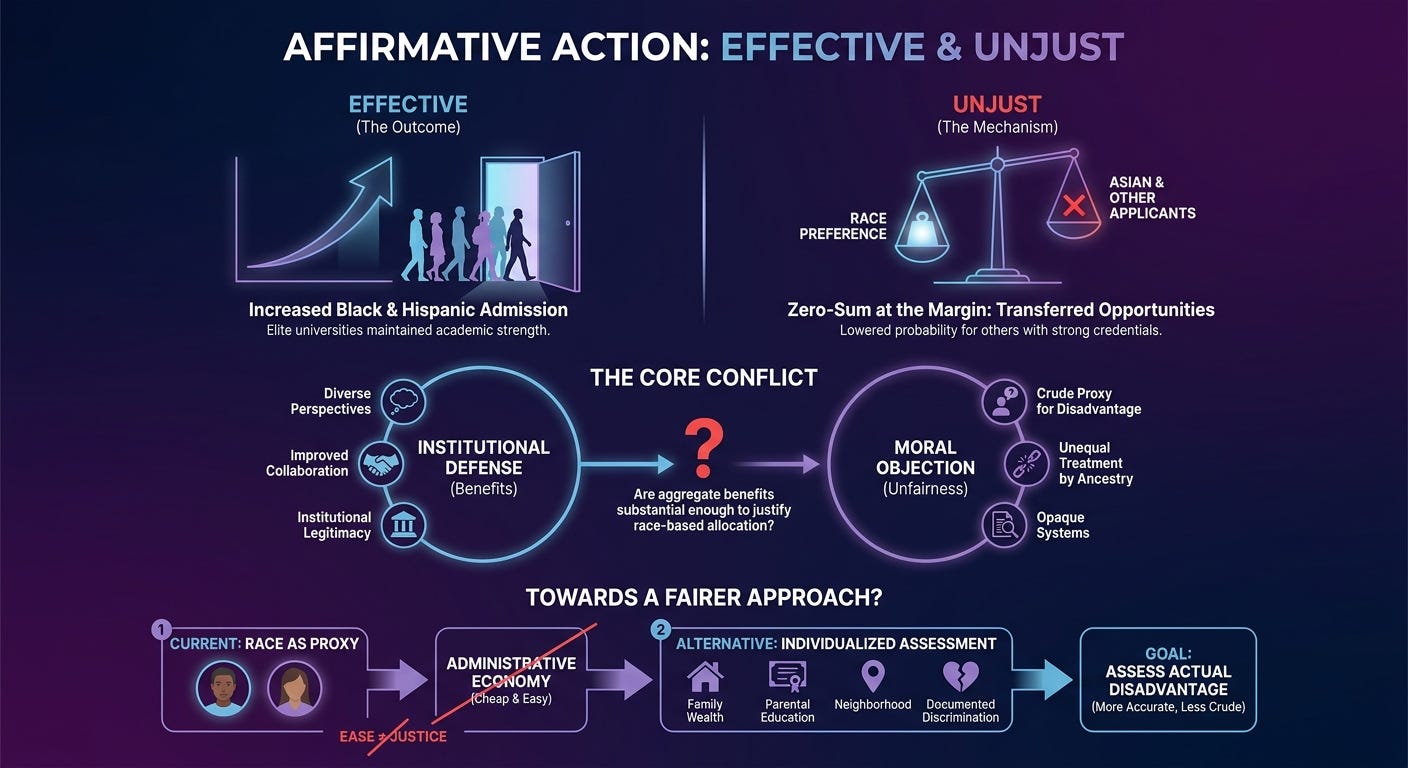
Affirmative action worked in one clear sense: it increased the admission of Black and Hispanic students at selective universities. But selective admissions are zero-sum at the margin. A preference for one applicant lowers the probability of admission for another. The policy transferred opportunities toward favored racial groups and away from others, especially Asian applicants, many of whom had stronger conventional academic credentials.
That does not mean the beneficiaries were incapable of succeeding. Elite universities reject large numbers of applicants who would perform well. A university can lower the effective admissions threshold for one group while still admitting capable students and preserving strong graduation outcomes.
Carroll treats those outcomes as evidence that the policy succeeded. They establish that many beneficiaries gained from admission and that the institutions remained academically strong. They do not establish that the allocation was fair.
The standard institutional defense is that universities are constructing a class rather than rewarding applicants according to a single ranking. Demographic diversity may broaden the range of experiences, intuitions, and hypotheses available to a group facing open-ended problems. It may also improve discussion, collaboration, or institutional legitimacy.
Even granting those benefits, the moral question remains. Aggregate benefits do not automatically justify allocating opportunities by race. Defenders must show that the benefits are substantial enough to justify unequal treatment, that racial categories track the relevant differences with acceptable accuracy, and that less discriminatory alternatives would sacrifice comparable benefits.
Holistic admissions are not inherently objectionable. Universities may reasonably value leadership, adversity, unusual talent, geographic background, or achievement relative to opportunity. The problem begins when race itself changes the effective standard, or when vague holistic criteria provide cover for doing so.
Race is also a crude proxy for disadvantage. It can benefit affluent members of preferred groups while penalizing poor or otherwise disadvantaged Asians and whites. Socioeconomic measures are not perfect substitutes for race, because racial discrimination can persist independently of income. But universities can assess disadvantage more directly through family wealth, parental education, school quality, neighbourhood conditions, disability, family instability, refugee status, and documented experiences of discrimination. Those measures concern what happened to an applicant, not merely which ancestry category the applicant occupies.
Affirmative action could therefore be both effective and unjust.
Carroll acknowledges that race is an imperfect proxy. His defense is partly administrative. Identifying each person’s actual disadvantage is, he says, “completely unfeasible,” whereas group preferences are easy, simple, and bureaucratically undemanding.
Individualized assessment cannot perfectly reconstruct every applicant’s history of advantage and discrimination. Neither can race. The relevant comparison is not between a flawless individual process and an imperfect group proxy, but between two imperfect systems. Race is cheaper, but it is also coarser and assigns benefits and burdens partly by ancestry.
Administrative economy cannot by itself justify racial discrimination. A crude policy may be cheap and effective while remaining unjust.
Carroll’s treatment of dissent is worse. He treats opposition to affirmative action as part of a culture-war campaign ungrounded in science or research, attributes some of it to explicit racism, and characterizes another part as resentment toward “undeserving” people receiving opportunities that properly belong to someone else.
There are obvious non-bigoted objections.
Racial affirmative action judged applicants partly by ancestry. It imposed costs on people who did not cause the injustice being remedied. It used broad racial categories where more individualized evidence was available. It produced different effective admissions standards for different groups. It encouraged opaque admissions systems that concealed the magnitude and distribution of those preferences.
One can defend those choices. One cannot dismiss opposition to them as scientifically uninformed grievance.
Carroll is entitled to believe that the benefits justified the discrimination. He is not entitled to present that judgment as the uncontested conclusion of research.
The central question was never whether affirmative action helped anyone. It plainly did. The question was whether universities should allocate scarce opportunities by race.
Carroll assumes the answer, then assigns suspect motives to much of the opposition. That is political advocacy presented with scientific confidence.
Appendix: Sean Carroll on DEI and Affirmative Action
The following passage is from Sean Carroll’s Mindscape podcast. It is reproduced here because the argument of this article depends partly on how Carroll characterizes both affirmative action and its critics. Paragraph breaks have been added for readability; otherwise the wording is unchanged.
Diversity, equity and inclusion are three words that I’m very much in favor of, either individually or combined. And equity and inclusion we can put to the side. I think those are good things. It’s really diversity that rubs people the wrong way.
And I think that there’s two things going on here that are worth keeping in mind. One is purely at a value-free, how do you solve problems kind of level. Is it useful to have more diversity in either your team or your set of possible strategies for solving problems or is it better to have more or less focus on the most effective kinds of people and kinds of strategies?
And I think that there’s literally been all sorts of studies done that actually address this question, and they always come up, as far as I can tell, with more or less the same answer, which is that diversity is good.
If you have anything that is more complicated than a sort of well-known, perfectly understood problem in front of you, if you have a situation where things are fluid or things are not very well defined or you’re coming up with a new problem that you’ve never faced before, diversity is helpful in solving those problems.
And you might say, “Well, yes, but that’s just intellectual diversity, that’s not like personal diversity.” No, no, no. Actually, personal diversity also really helpful. Turns out that people coming from different backgrounds, having different experiences and things like that, super helpful to coming up with different possible solutions to problems.
[…]
The other point to make is a much more down-to-earth, practical, moral question. Like in a society where there has been discrimination against certain groups, what is the right way to combat that discrimination?
And I absolutely get the attitude that would say, “Look, the right way to combat discrimination is to look at every possible candidate for every possible job opening or acceptance into university or whatever, learn about their individual experiences.” After all, not all Black people experienced the same situation growing up. Some of them might have actually come from otherwise very privileged backgrounds. Some of them might have really struggled. Some non-Black people might have really struggled, for example, and so we should just treat every individual as an individual.
Well, that’s adorable, that kind of attitude, but it’s also completely unfeasible.
John Skrentny, who we had on the podcast a while back, a sociologist at UC San Diego, we talked about the scientific enterprise in the modern world, but some of his early work was on affirmative action. The idea here in the United States that we would just increase the number of underrepresented minorities in universities and in other kinds of jobs to help combat the pre-existing legacy of discrimination.
And he made the point in that work. It’s a lot of the motivation for affirmative action was not just “let’s make the world a more just and fair place,” but it’s easy, it’s simple. It’s bureaucratically undemanding.
Just say, “Look, I don’t know, I don’t have the time to figure out who the people who are really discriminated against are. So let’s just take the groups that were subject to systemic discrimination over the years and give them a boost in terms of letting them in to whatever the positions are.”
And the amazing thing is that even though from that perspective, it was kind of like a cheap strategy for dealing with this problem, it worked.
[…]
And the answers are yes, yes, and yes. It kind of works remarkably well, despite the fact that it’s kind of a silly, cheap mechanism for getting things done. It’s by no means perfect, but it might be the low-resource way of making things better.
So I think that in the real world, the fight against DEI is just sort of a culture war kind of thing. It’s not based on science or knowledge or research. It’s just based on feelings and sometimes those feelings are bad, whether it’s explicit racism, which it is in some cases, or other times just these feelings of “The world is not treating me with the respect that I deserve because all of these undeserving people are getting what really belongs to me.”
And I think that’s also a bad attitude to have. And so there’s a lot of bad-faith actors fighting against DEI, and I think that those of us who believe in it should just stand up for it very explicitly.