

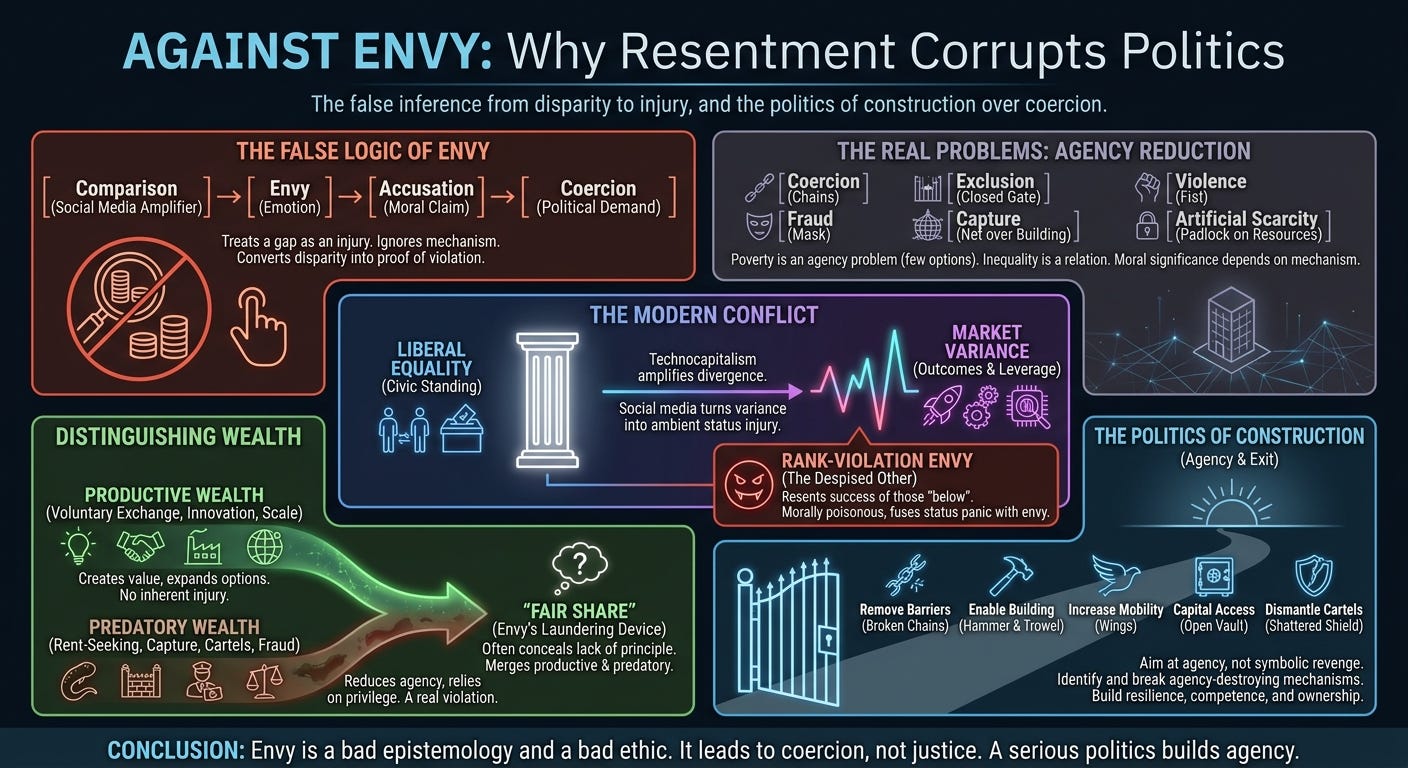
The standard argument about inequality usually smuggles in its conclusion. It treats a gap between two people as if the gap were itself an injury. That move is false. A difference is not yet a harm. To get to harm, you need a mechanism: coercion, fraud, exclusion, capture, violence, or some other reduction in agency.
This is where envy corrupts political reasoning. Envy begins with comparison and converts comparison into accusation. Someone else has more. Someone else rose faster. Someone else escaped the ordinary limits of scale. The envious mind experiences this as injury, then searches for a theory that will authorize punishment. Equality supplies the vocabulary.
Many egalitarian arguments come from Rawlsian theory, utilitarian welfare calculus, democratic stability concerns, religious obligation, or prudential fear of oligarchy. Those arguments deserve evaluation on their actual premises. The target here is narrower: the invalid inference from disparity to injury, and the political psychology that makes that inference feel morally obvious.
Poverty and inequality are routinely collapsed into the same moral category. That collapse does most of the damage. Poverty is an agency problem. A poor person has fewer live options: less ability to exit bad situations, absorb shocks, bargain with employers, relocate, educate children, refuse exploitation, preserve health, start projects, or take meaningful risks. Poverty compresses the future. It turns life into a sequence of narrow contingencies where every mistake compounds and every emergency becomes existential.
Inequality is a relation between quantities. One person has more than another. One group earns more than another. One firm dominates a market. One founder captures a vast return from a scalable product. These facts may matter greatly, but their moral significance depends on mechanism and effect.
If inequality comes from coercion, fraud, monopoly privilege, regulatory capture, cartelization, theft, political favoritism, or state-backed exclusion, then the underlying violation matters. If inequality produces domination, credible threats, political capture, or structural exclusion, then again there is a real issue. Concentrated power can become coercive. Wealth can buy law. Status can become gatekeeping. Platforms can become chokepoints. Institutions can be captured by incumbents who pull the ladder up behind them.
If inequality emerges from voluntary exchange, superior judgment, productive leverage, compounding skill, entrepreneurial risk, aesthetic taste, or the ability to create something millions of people freely choose, then resentment has no ethical force. A founder becoming rich because a billion people voluntarily use his product does not make those users victims. A performer, engineer, investor, or entrepreneur capturing extreme upside from extreme scale has not thereby injured those who captured less.
Envy erases these distinctions. It does not ask how the wealth was created. It asks how the comparison feels.
The Status-Comparison Trap
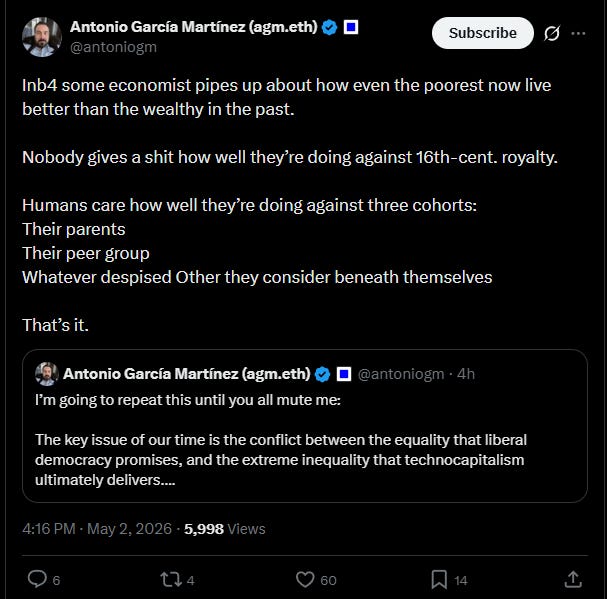
Arguments about historical living standards rarely land with people animated by envy. It may be true that ordinary people today live with conveniences and medical protections that kings could not buy five centuries ago. That observation is useful as economic history. It is almost useless as moral therapy.
Human beings do not evaluate their lives only against extinct monarchs or distant ancestors. They evaluate themselves against parents, peers, rivals, visible elites, and groups they expected to outrank. Status is local. Aspiration is social. Humiliation is comparative.
That descriptive fact matters. It explains why abundance does not automatically produce gratitude and why a society can become materially richer while psychologically angrier. But a descriptive fact about human comparison does not become a moral claim. People envy their neighbors. The neighbor is not therefore guilty.
Modern social media destroys the natural limits of comparison. In a village, a person compared himself with a few hundred people. In a networked society, he compares himself with curated fragments of millions: the founder, the influencer, the athlete, the dropout millionaire, the foreign buyer, the younger competitor, the symbolic enemy, and the despised outgroup member who seems to be rising faster than he is.
The result is continuous relative-status exposure. That matters politically because humiliation wants an explanation. Sometimes the explanation is true: fraud, corruption, capture, credential cartels, asset inflation, zoning restriction, licensing barriers, monetary distortion, corporate welfare. Much of the modern economy is indeed rigged by law and policy in favor of incumbents.
But envy can run on the gap alone. Someone has more, therefore something is wrong. Someone rose, therefore someone else was pushed down. Someone succeeded spectacularly, therefore the system must be unjust. The causal work has been skipped.
Liberal Equality and Market Variance
Modern liberal democracy created a deep ambiguity around equality. At its best, equality means equal civic standing: no hereditary caste, no formal aristocracy, no ownership of persons, no official hierarchy of human worth before the law. That achievement is real. It destroyed old structures of inherited domination and widened the sphere of legitimate agency.
But equality also became a psychological promise. Citizens were encouraged to expect equal legal standing, equal social dignity, equal recognition, equal opportunity, equal voice, and eventually something close to equal outcomes. Each expansion sounds humane in isolation. Together they create an impossible social contract.
People differ in ability, discipline, charisma, intelligence, beauty, health, judgment, energy, risk tolerance, inheritance, imagination, location, timing, and luck. They want different things. They make different tradeoffs. They create different amounts of value for others. They attract different levels of trust. They bear different consequences for error. Any system that permits freedom will generate unequal outcomes because agency itself is differentiating. To choose is to diverge.
Technocapitalism intensifies this divergence because it rewards leverage. Software scales. Capital compounds. Networks amplify. Attention concentrates. A single product can serve billions. A small team can outcompete legacy institutions. AI can multiply the productivity of people who already know how to aim it. The modern economy rewards judgment under leverage, and leverage produces variance.
This creates extraordinary abundance and extreme inequality. The political crisis comes from the collision between democratic egalitarian expectation and technological variance. Liberal democracy tells people they have equal civic status. Technocapitalism shows them, every hour of every day, that outcomes are wildly unequal. Social media then turns the comparison into ambient status injury.
The usual response is to moralize the discomfort. If unequal outcomes feel humiliating, then unequal outcomes must be unjust. That inference is invalid. Humiliation may identify a political danger, but it does not identify a victimizer.
The Despised Other
The ugliest form of envy appears when people compare themselves against groups they believe should remain below them. Ordinary upward envy resents success above one’s station. Rank-violation envy resents success by people assigned, in the resentful imagination, to a lower station. This is politically explosive because it fuses envy with status panic. The complaint becomes: they were supposed to stay beneath us.
This explains a great deal of modern resentment. The immigrant who opens a successful business. The dropout who becomes rich through code. The foreigner who buys the house. The minority group that rises faster than expected. The young person who makes more money through a platform than an older credentialed professional makes through an institution. These cases trigger a specific humiliation: the violation of expected rank.
That emotion is morally poisonous. It reveals that much egalitarian rhetoric is really a demand for a preferred hierarchy with different branding. People who denounce privilege in the abstract often become vicious when the wrong people succeed.
History matters here. Present competition often begins from unequal baselines created by earlier coercion, exclusion, favoritism, and legal asymmetry. A serious analysis must account for inherited distortion and compounding advantage. But inherited distortion still has to be analyzed as mechanism. It does not turn every later success into theft, every disparity into injury, or every resentment into justice.
This is one reason envy so easily allies with nationalism, socialism, populism, and bureaucratic moralism. Each offers a story in which someone else’s success is illegitimate and the state becomes the instrument of correction. The target changes. The structure remains stable. The envious coalition needs a villain whose flourishing can be redescribed as theft.
The despised Other gives private humiliation a public object.
Production, Predation, and “Fair Share” Politics
The phrase “fair share” often functions as a laundering device for envy. It pretends to name a principle while concealing the absence of one.
What exactly is the fair share of a person who creates a product used voluntarily by hundreds of millions of people? What is the fair share of a founder who absorbs years of risk, coordinates talent, raises capital, survives competition, and builds infrastructure that did not previously exist? What is the fair share of an investor who allocates resources correctly under uncertainty? What is the fair share of a surgeon, athlete, novelist, engineer, or musician whose skill produces rare value?
There may be answers in particular cases. Some fortunes are inseparable from state privilege, IP abuse, subsidy, bailout, procurement corruption, zoning restriction, licensing cartel, monetary distortion, or political access. Those should be criticized precisely. “They have too much” is not a principle. It is an emotion with a policy preference.
All wealth is socially embedded. Founders rely on law, infrastructure, inherited knowledge, standards, workers, customers, energy systems, transport networks, and accumulated civilization. That observation matters. It still does not by itself specify a rightful claimant, a legitimate taxing authority, a fair percentage, or a morally valid threat.
A serious theory of justice must distinguish production from predation. Envy has no interest in the distinction because it wants the same remedy either way. The productive rich and the predatory rich become morally interchangeable. The entrepreneur and the rent-seeker are merged into a single hated class. That merger protects actual predators because it destroys the conceptual tools needed to identify them.
Attacking wealth as such weakens the critique of illegitimate wealth. If every large fortune is presumed guilty, then no specific mechanism has to be proved. The analysis becomes theatrical. The guilty can hide among the merely successful.
The right question is: by what mechanism did they get it, and what does that mechanism do to agency?
The Real Threat of Extreme Inequality
There is a hard problem here, and market defenders often evade it. Extreme inequality can destabilize a society even when much of the wealth was created productively. The reason is power.
At sufficient scale, wealth can buy political insulation, shape regulation, control speech infrastructure, influence universities, fund ideological machinery, purchase legal endurance, and convert markets into managed enclosures. Even legitimate wealth can become dangerous when it hardens into durable control over the conditions under which others must act.
The boundary is rarely permanent. A firm can begin by creating enormous consumer value and later become tempted to preserve its position through moats: exclusive distribution, regulatory lobbying, acquisition of potential competitors, standards capture, platform lock-in, privileged access to state power, or legal barriers that make entry harder for everyone else.
This point does not depend on accepting any particular DOJ or FTC theory of antitrust. The state often treats scale, default placement, vertical integration, and aggressive competition as inherently suspect. That is its own pathology. The relevant claim is structural: concentrated power under political incentives creates recurring opportunities for productive scale to harden into coercive entrenchment.
The difference between productive scale and coercive control is essential. Did the concentration arise from voluntary exchange or political privilege? Does it expand the option-space of others or narrow it? Does it create tools or chokepoints? Does it increase competition or suppress it? Does it make exit easier or harder? Does it depend on state violence, artificial scarcity, or legal asymmetry?
These questions can distinguish a builder from a parasite, a founder from a commissar, a platform from a cartel, a market success from a political extraction machine. Envy lacks the resolution to separate productive scale from coercive control.
That is why envy is a bad epistemology as well as a bad ethic. It misidentifies the causal structure of wealth. It treats outcome disparity as proof of moral violation. It then directs political force against the visible symptom rather than the agency-destroying mechanism.
The Politics of Construction
A serious politics should aim at agency.
Make it easier to build, hire, move, save, start firms, learn useful skills, own capital, and escape bad schools, bad cities, bad employers, bad families, and bad institutions. Remove licensing cartels. Break regulatory moats. End subsidies to incumbents. Stop inflating asset prices for the benefit of those who already own assets. Stop using zoning to protect homeowners from newcomers. Stop turning healthcare, education, housing, and finance into captured mazes.
This is the constructive alternative to envy. It does not require pretending that the current order is fair. Much of it is corrupt. The modern economy is saturated with artificial privilege, monetary distortion, credential cartels, land-use restriction, corporate welfare, and bureaucratic sclerosis. But the answer to those failures is specific institutional attack. Identify the agency-destroying mechanism and dismantle it.
The poor do not need symbolic revenge against the rich. They need more ways to become powerful in their own lives: capital access, ownership, competence, mobility, resilience, and exit. That means fewer gates, fewer permissions, and fewer institutions whose business model is standing between agents and their possible futures.
Postscript
Envy begins in comparison and ends in coercion. It tells people that another person’s success is their injury, that disparity is proof of injustice, and that punishment can substitute for construction. It is a false moral theory built from a real human emotion.
Poverty, coercion, fraud, capture, exclusion, and violence all reduce agency. Disparity sometimes reveals those mechanisms and sometimes does not. Serious arguments about redistribution, oligarchy, democratic stability, historical injustice, and institutional legitimacy have to do the causal work. Envy is the impulse to skip that work and proceed directly to punishment.