

The Confession Before the Catering
A land acknowledgment is an extraordinary little performance. An institution begins by announcing that the ground beneath its feet belongs, or once belonged, to people from whom it was taken. The speaker names the people, invokes the territory, sometimes adds that it was “unceded,” and then proceeds with the meeting, lecture, conference, gala, convocation, grant announcement, board session, or strategic planning retreat.
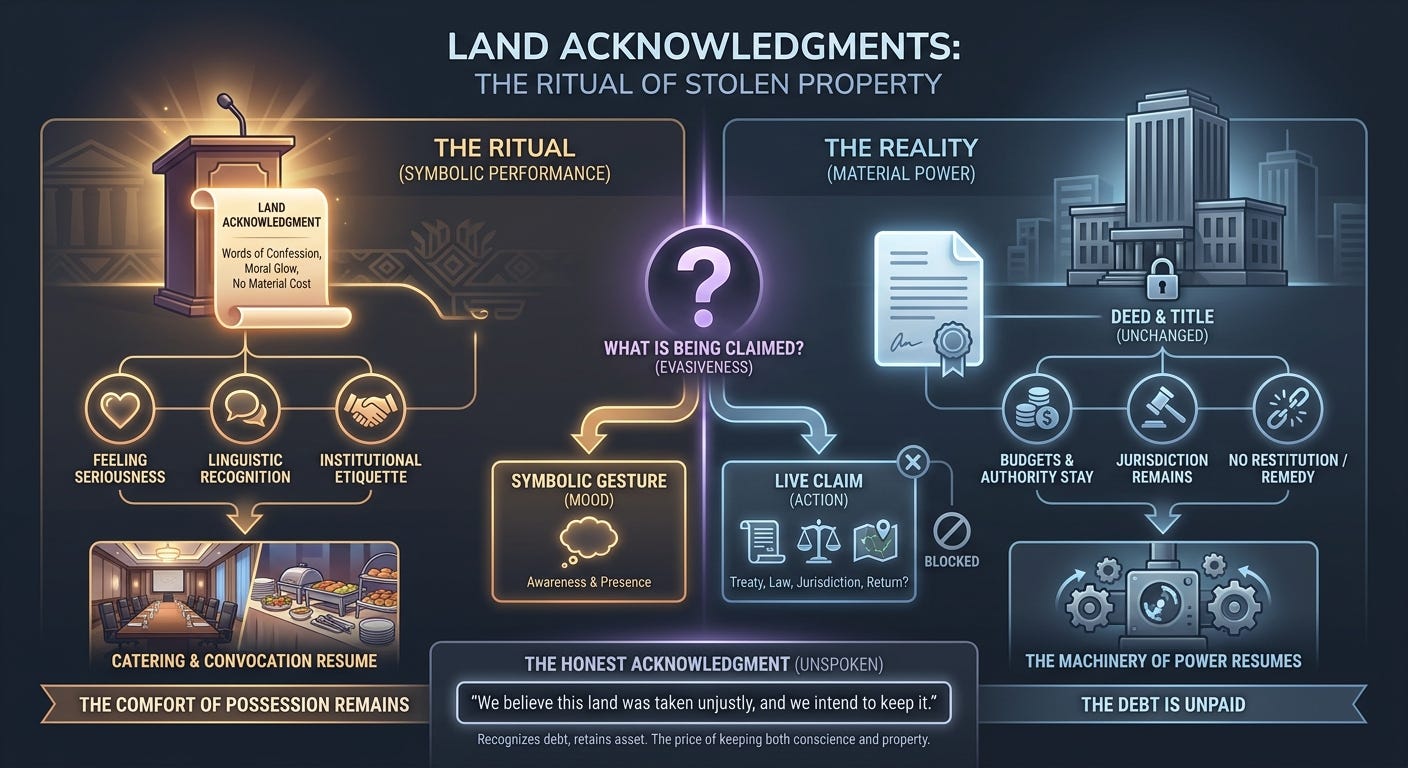
The land stays where it is. The title stays where it is. The budget stays where it is. The institution’s authority remains untouched. Everyone gets the glow of moral awareness without the inconvenience of a remedy.
The sentence has the surface grammar of a confession and the practical consequence of a table decoration. It is treated as morally necessary by the same people who treat its implications as optional. The room is asked to feel the seriousness of the claim while accepting the triviality of the act.
If a man opened a dinner party by saying, “Before we begin, I acknowledge that this house was obtained from Bob by fraud, and I am grateful to live and work here,” we would know what to ask next. Where is Bob? Does Bob get the house back? Does Bob get paid? Is there a legal claim? Was there a settlement? Has the fraud somehow been cured? The statement would make the host look worse, because it would show knowledge without restitution. Ignorance can excuse many things. Publicly announcing the injury while keeping the benefit is a different moral category.
Land acknowledgments operate with the same structure, decorated with institutional incense.
What Exactly Is Being Claimed?
If the land was stolen, who has the claim? Against whom? Under what legal, political, or moral principle? What remedy follows? Return of title? Treaty enforcement? Rent? Compensation? Jurisdictional transfer? Co-management? Resource rights? Public apology plus funding? Something else?
These are ordinary questions when a property claim is meant seriously. They are almost never the questions invited by the ritual. The acknowledgment wants the emotional force of a live claim while avoiding the discipline required to state one.
That evasiveness matters because many Indigenous claims are not vague ancestral poetry. They involve treaties, law, conquest, jurisdiction, public authority, and the violent machinery by which political orders replace one another. A serious acknowledgment would move quickly from reverent language to named obligations. Which treaty? Which violation? Which present authority is defective? Which institution has the power to repair it? Which remedy is being pursued?
The ritualized version usually stops exactly where thought would have to become action.
The Cheap Moral Luxury of Institutional Guilt
The modern progressive institution has developed a remarkable talent for converting material questions into linguistic ones. Ownership becomes “presence.” Sovereignty becomes “relationship.” Restitution becomes “awareness.” A live controversy over title, treaty, and authority is turned into a mood.
This is why the ritual is so attractive. It allows people with power to borrow the posture of dissent while preserving the arrangements from which their power flows. A university can acknowledge stolen land while charging tuition on it. A city can acknowledge unceded territory while collecting property taxes on it. A corporation can acknowledge Indigenous presence while keeping the office tower, the lease, the lobby, the branding, and the quarterly plan.
The performance gives everyone involved a small sacrament of moral seriousness. The speaker demonstrates sensitivity. The audience demonstrates recognition. The institution demonstrates alignment with elite etiquette. Then the machinery resumes.
No title changes. No jurisdiction changes. No coercive relation changes. No budgetary obligation necessarily changes. No agency is restored to anyone. The institution has merely inserted a sentence between its existing power and its public image.
The First-Step Defense
There is a more intelligent defense of land acknowledgments than the one usually implied by the people performing them. A symbolic act can sometimes be a wedge. It can force public recognition of suppressed history, normalize the language of treaty violation and unceded territory, and create pressure for later institutional concessions. Some Indigenous activists understandably treat acknowledgments as one move in a longer strategy.
Fine. Then show the ratchet.
A first step deserves the name only when it is attached to a second step. Is the institution naming a specific obligation? Has it created a budget line? Has it transferred land? Has it entered co-management? Has it paid rent to a relevant Indigenous body? Has it changed procurement rules, governance rights, admissions policy, archival access, sacred-site control, or resource-sharing agreements? Has it accepted any measurable liability?
If the answer is no, “first step” becomes a wonderfully convenient phrase. It allows the institution to stand forever at the threshold of justice, congratulating itself for facing the right direction.
History Without Civic Anesthesia
There is also a bad conservative response to all of this, which is to sneer at the history itself. That misses the target. Land was taken. Treaties were broken. Peoples were displaced. Entire political orders were imposed by force and later moralized as destiny. Acknowledging those facts requires no progressive metaphysics. It requires a minimal willingness to read history without the comforting narcotic of patriotic innocence.
Human political history is full of conquest, and that fact does not dissolve any particular claim. A murder rate above zero does not make a particular murder less real. The ubiquity of conquest tells us something about the species; it does not tell us whether this treaty was violated, whether this title is legitimate, or whether this institution has inherited obligations it prefers to sublimate into ceremony.
The point, then, is not that land acknowledgments are too radical. They are usually much too timid. They invoke the moral vocabulary of theft, dispossession, and illegitimacy, then decline to follow the logic to any costly conclusion.
The Actual Acknowledgment
The honest version would be almost unbearably short:
We believe this land was taken unjustly, and we intend to keep it.
That sentence would at least have the virtue of stripping away the perfume. It would expose the real institutional position: the moral debt is recognized, the asset will be retained, and the acknowledgment is the price of keeping both conscience and property.
Perhaps current possession is legitimate. Perhaps too much time has passed. Perhaps restitution creates more injustice than it repairs. Perhaps the relevant treaties already specify the available remedies. Perhaps public land and private title require different treatment. Perhaps overlapping claims make simple return impossible. All of these arguments can be made. They require propositions, evidence, principles, tradeoffs, and some willingness to disappoint the room.
The land acknowledgment avoids that burden. It offers the thrill of moral indictment without the misery of institutional consequence.
The Moral Ledger Does Not Move
A culture that confuses speech with agency will produce exactly this sort of ritual. It will imagine that the world changes when the right sentence is spoken by the right person in the right tone before the right audience. It will mistake the redistribution of prestige for the redistribution of authority. It will treat symbolic humility as a kind of payment.
Reality is less accommodating. Property does not move because a dean sounds solemn. Jurisdiction does not change because a conference organizer names a people. Historical injury is not repaired by making affluent professionals feel briefly implicated before the keynote begins.
Land acknowledgments reveal the peculiar cowardice of institutions that want to be morally accused on terms they control. They want the language of debt, the comfort of possession, and the social prestige of confession. The result is a ritual of unpaid obligation, repeated by people who have learned to say “stolen land” with one hand resting comfortably on the deed.