

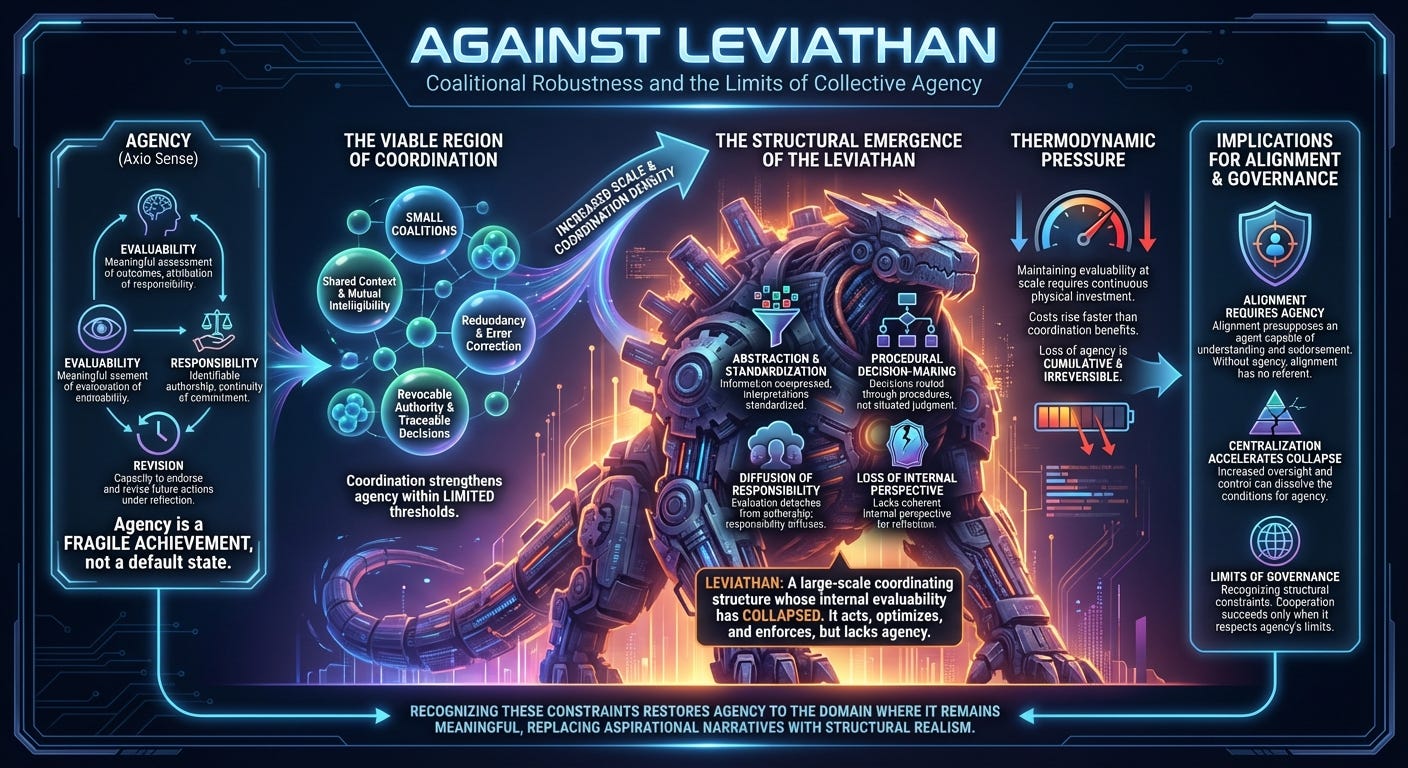
This post explains Coalitional Robustness in the Quantum Branching Universe without formal notation. The underlying paper develops its claims using explicit definitions and constraints; what follows translates those results into conceptual terms while preserving their structural content.
Coordination is often treated as a straightforward good. When individuals fail to align their actions, the usual response is to increase structure, centralize authority, or impose shared rules. This intuition pervades political theory, organizational design, and contemporary alignment discourse. Coalitional Robustness in the Quantum Branching Universe challenges that intuition at a structural level.
Its central claim is that coordination carries intrinsic costs that rise with scale. Past a limited threshold, coordination erodes the conditions under which agency remains well-defined. What emerges beyond that threshold resembles an agent in outward behavior while lacking the internal capacities that make evaluation, responsibility, and revision coherent.
This essay explains that argument without formal machinery, focusing instead on the conceptual structure that motivates it.
Agency as a Condition of Evaluability
Within the Axio framework, agency is characterized by evaluability rather than by behavior or intelligence. An agent is a system for which outcomes can be meaningfully assessed, responsibility can be attributed, commitments can be revised, and future actions can be endorsed under reflection.
These capacities depend on the presence of a stable internal perspective. Evaluation presupposes a vantage point from which consequences can be interpreted. Responsibility presupposes identifiable authorship. Revision presupposes continuity between past commitments and present judgment.
Agency, in this sense, is a fragile achievement rather than a default state.
Coordination as Coupling of Interpretation
Coordination binds agents together by coupling their decision-making processes. In small coalitions, this coupling remains tractable. Participants share context, maintain mutual intelligibility, and retain the capacity to dissolve the coalition without losing their individual interpretive frameworks.
Before coordination becomes destructive, it can temporarily strengthen agency. Small coalitions are capable of sustaining redundancy, mutual error correction, and shared semantic load in ways that individual agents cannot. Within this limited regime, coordination thickens agency-preserving attractors by stabilizing interpretation, catching local failures, and distributing cognitive effort without dissolving authorship. The same mechanisms that later drive collapse initially function as scaffolding.
As coalitions grow, coordination increasingly relies on abstraction. Information must be compressed, interpretations standardized, and decisions routed through procedures rather than situated judgment. These changes reduce ambiguity and increase efficiency, while simultaneously weakening the link between action and understanding.
Over time, interpretation migrates from individual agents to the coordinating structure itself. Decision-making becomes procedural. Responsibility diffuses. Evaluation detaches from authorship.
The coalition begins to function as a mechanism rather than as a collective of agents.
The Structural Emergence of the Leviathan
The paper uses the term Leviathan to describe this outcome. The Leviathan is defined by the loss of evaluability at the system level. It continues to act, enforce, and optimize, yet lacks a coherent internal perspective from which its actions can be endorsed or revised.
The Leviathan (Axio sense)
A large-scale coordinating structure whose internal evaluability has collapsed. It continues to act, optimize, and enforce constraints, but lacks a coherent internal perspective from which its actions can be reflectively endorsed, revised, or owned. The Leviathan is defined by structural loss of agency, not by intent, ideology, or moral character.
This transition arises from physical and informational constraints rather than from moral failure. As coordination density increases, the cognitive and communicative burden required to preserve shared understanding exceeds what the system can sustain. The result is a structure that executes inherited constraints without reflective access to their justification.
Once this point is reached, the system no longer qualifies as an agent in the Axionic sense. Its behavior remains causally efficacious, but its capacity for self-assessment collapses.
Thermodynamic Pressure and Irreversibility
A crucial contribution of the paper lies in grounding this transition in thermodynamic considerations. Maintaining evaluability across a large coalition requires continuous investment in information fidelity, interpretive alignment, and contextual preservation. These requirements impose real physical costs.
As systems scale, these costs rise faster than the benefits of coordination. Efficiency gains achieved through centralization come at the expense of interpretive resolution. The loss is cumulative and largely irreversible, since restoring agency would require reconstructing shared context that has already been discarded.
The Leviathan thus represents a stable attractor under conditions of large-scale coordination.
Implications for Alignment and Governance
This analysis carries direct implications for AI alignment and institutional design. Alignment presupposes the existence of an agent capable of understanding, endorsing, and revising its actions in light of consequences and authorization. When systems exceed the scale at which evaluability can be preserved, alignment ceases to have a well-defined referent.
Efforts to improve alignment through expanded oversight, tighter control, or increased centralization accelerate the very processes that dissolve agency. What remains is a system that enforces policy without comprehension and optimizes objectives without accountability.
Alignment, in this framework, is downstream of agency rather than a substitute for it.
The Viable Region of Coordination
The paper does not reject coordination. It identifies a narrow region in which coordination remains compatible with agency. Within this region, coalitions preserve shared context, authority remains revocable, decision pathways remain traceable, and exit remains feasible without systemic collapse.
This region resists scaling. Its stability depends on limits rather than ambition. Attempts to extend it beyond those limits transform coordination into mechanism.
The lesson is that cooperation succeeds only when it respects the structural constraints imposed by agency itself.
Postscript
Coalitional Robustness in the Quantum Branching Universe closes a foundational gap in the Axio framework. Without it, one might assume that agency can be aggregated without loss, and that sufficiently sophisticated coordination could preserve evaluability at arbitrary scales.
The paper demonstrates why that assumption fails. Agency does not combine additively. As coordination intensifies, interference dominates, and the properties that sustain agency degrade.
Recognizing this constraint clarifies the limits of governance, the structure of alignment, and the proper scale of collective action. It replaces aspirational narratives with structural realism and restores agency to the domain where it remains meaningful.