

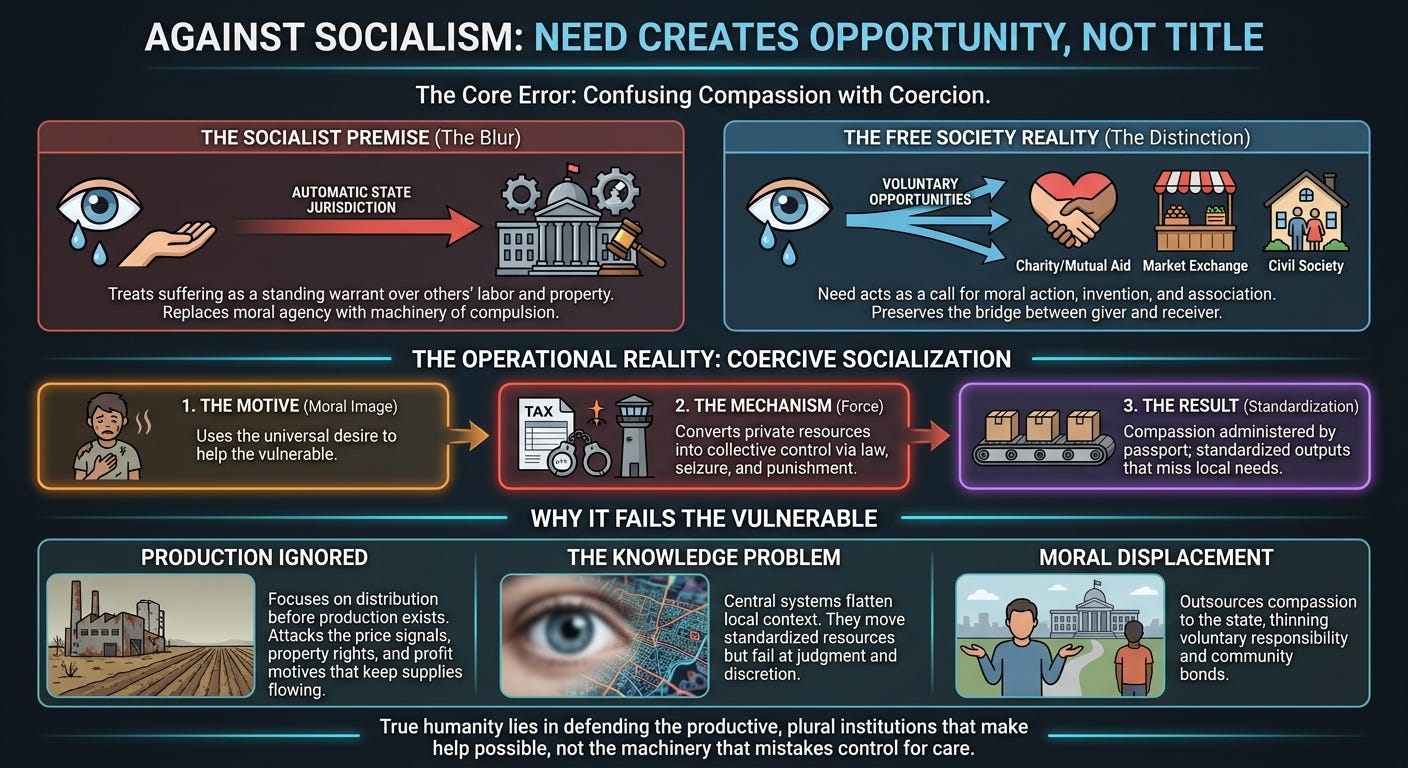
Socialism survives on a moral image almost everyone shares: the hungry person, the sick child, the worker one accident away from ruin. The socialist looks at these and says some needs are too important to leave to charity. That one sentence carries most of the appeal. It sounds humane and adult, and it paints the opponent as having nothing but coldness to offer, generosity when convenient and neglect when not.
The sentence also hides the argument. A person’s need can be urgent, tragic, unbearable to watch. It creates an opportunity: for help, for sacrifice, for invention. It does not create title to another person’s labour, savings, or property. By itself it cannot answer the political question that decides everything else: who may compel whom, by what authority, and at what cost. Socialism opens by talking about need and closes by building machinery of compulsion, and its defenders prefer to keep the join out of focus.
What socialism means here
Socialism has many official definitions, and the ambiguity protects it. Point the word at Soviet command planning and its defenders retreat to libraries and hospitals. Point it at libraries and hospitals and they insist socialism means only collective ownership of the means of production. The word expands to collect moral credit and contracts to escape accountability.
I will use it in its operational sense: the coercive socialization of a function. The domain can be narrow or vast. A public school socializes education, a public pension socializes retirement income, a public hospital socializes medical finance and often delivery, a command economy socializes production as such. The stakes vary by dose, domain, monopoly, exit, and feedback, but the political move is the same. Private resources are converted by law into collective provision or collective control.
Public schools, public hospitals, pensions, roads, and libraries are all socialism under this definition. Familiarity and popularity do not change the structure: tax-funded provision is coercive socialization of a function. A society may choose a little of it or a great deal, competent versions or ruinous ones. Once the state taxes people to provide a service collectively, the socialist principle has been invoked.
Need and title
If a man is starving, his condition matters, and any moral theory that cannot see that is broken. But need alone does not name the debtor. Who owes him food? His parents? His employer? The nearest farmer? Every taxpayer in the country, or every wealthy person on Earth? How much, for how long, and who enforces the answer when several needs compete for the same loaf? Socialism tends to skip these by treating compassion as though it already contained jurisdiction.
Obligation needs a bridge from the need to the person who must meet it. Contract can build one. Parenthood can. Restitution after harm can. A legitimate political compact may. Need by itself leaves the crucial span unbuilt. A drowning stranger gives me a powerful reason to act, and if I can throw a rope at little cost, refusing would be cruelty. It does not follow that every unmet need anywhere generates an enforceable claim against everyone who has resources. Moral opportunity and enforceable title are different things, and socialism blurs them.
Charity, welfare, and coercion
Charity is voluntary aid. It belongs to the moral life of persons and associations, and it stays charity because the giver acts as a moral agent. Socialism uses law to collectivize provision. It taxes, transfers, and commands. It may relieve suffering, it may be popular, it may be defended under some theory of citizenship or social peace, and it is still coercive provision. The taxpayer pays under compulsion, the official distributes what was collected by force, the recipient receives an entitlement created by statute.
Many arguments for socialism borrow the warm light of charity while reaching for the tools of coercion. They begin with “we should help” and arrive at “the state may compel,” and that movement is the whole thing that needs justifying. It cannot be carried across on sentiment. The slogan says compassion; the mechanism says tax authority, asset seizure, courts, and prison at the limit. A serious defense of socialism has to defend that machinery, not just point at the suffering that motivates it.
Voluntary failure does not create state title
Voluntary institutions fail. Families break, charities misjudge, churches turn parochial, mutual-aid societies buckle under a large enough shock. No honest argument pretends voluntary provision has always been enough. Private charity did not abolish industrial poverty; friendly societies did not end old-age insecurity; local aid could be patchy, humiliating, and thin.
Those failures create problems to solve. They do not, by themselves, create state title over other people’s labour and enterprise, and that is the leap socialism keeps making. It points to the shortcomings of voluntary care and then treats political command as the only serious alternative. The inference moves too fast. A failed charity may call for better charity, for mutual aid, for insurance and savings institutions, for lower barriers to work and cheaper housing and freer medicine, and some limited public measure may be defensible inside a given political order. None of it hands the state a standing warrant over the productive life of society. The failure of one voluntary arrangement establishes the failure of that arrangement, nothing larger.
Redistribution needs a jurisdiction
Redistribution only works inside a coercive structure: a defined population, taxable assets, enforcement, borders. Socialist rhetoric tends to shift between two registers without admitting it. Arguing morally, it speaks in universal terms about hunger and dignity. Paying bills, it becomes national. The domestic poor acquire enforceable claims; the global poor receive concern, aid budgets, and conferences. Suddenly the border matters a great deal.
This is a genuine problem for anyone who grounds redistribution in need or inequality, because the poorest person in a rich country is usually far better off than the poor of a developing one. If need plus inequality creates an enforceable claim, the global poor have a stronger claim on a Swedish taxpayer than a Swedish welfare recipient does. The socialist can embrace global redistribution, heavy claims and all, which at least holds together. Or he can say redistribution flows from shared membership in a political order, citizens bound by common laws and a common coercive scheme. That argument might work, but it has changed the ground under itself: need is no longer doing the work, jurisdiction is. What most welfare socialism actually wants is universal moral language with national fiscal boundaries, condemning wealth in the name of humanity while limiting the bill to the tax base it already controls. The result is compassion administered by passport.
Scarcity and coercion
The socialist often answers that markets coerce too. The starving worker is not really free when he takes a bad job; the poor tenant is not free in a bad apartment; the sick man is not free when care is ruinous. There is something real here. Desperation makes choices ugly, and bad law makes them worse, since monopoly, licensing, zoning, and credential barriers narrow people’s options on purpose.
But scarcity and coercion are not the same thing. Poverty constrains; coercion commands. Hunger can be a brute fact about scarcity. A tax collector, a licensing board, a border guard is an agent with the authority to compel and punish. And much scarcity is itself manufactured by law: housing shortages from zoning, medical shortages from licensing, drug prices held up by patents, cartels and import barriers protected by statute. These distortions do not rescue socialism. They sharpen the case against coercive power, because when the state creates the scarcity, the first remedy is to remove the privilege that caused it. Let people build housing. Let more doctors practice. Let patients import medicine. Let competitors in. A state that manufactures a shortage has not thereby earned more authority over the shortage it made.
Socialism blurs this because the blur pays. Once hardship is renamed coercion, every hard condition becomes a license for counter-coercion: the hungry man’s condition licenses authority, the worker’s weak hand licenses the power to tax and prohibit and seize, and the vocabulary slides from suffering to jurisdiction without ever passing through an argument. A free society should attack desperation by widening options, with more housing, more competition, more entry and mobility, cheaper goods, stronger civil society. Socialism usually runs the other way and treats the existence of hardship as proof that choice should give way to command.
Production comes before distribution
The standard objection comes fast: without socialism the hungry starve and the poor go without medicine. It assumes what it has to prove, casting socialism as the only mechanism that feeds people, and it starts the story at distribution, after the food and medicine already exist.
But they have to exist first. Food has to be grown, stored, and moved before anyone can allocate it; medicine has to be discovered, tested, manufactured, and shipped before it reaches a patient. That is the main event, and it depends on land, labour, capital, logistics, risk-taking, and a mountain of local knowledge. A government can pass a law declaring a right to bread or antibiotics. The law plants no wheat, synthesizes no compound, staffs no clinic. A distribution scheme cannot hand out what the productive order failed to make.
Socialism fixes moral attention on allocation and then reaches for control over the systems that make allocation possible. Prices look suspect because they exclude, profit because it offends, private ownership because it concentrates control, independent institutions because they resist direction. But prices, profit, property, and institutional independence are feedback: they reveal scarcity, reward competence, punish waste, attract capital, and expose error. Damage them in the name of distribution and you may earn applause for your intentions while making hunger worse. Socialism asks who gets the bread. It rarely asks who keeps the bread coming, which is the question that decides whether there is any.
State support and the production excuse
States can sometimes help production. Roads, sanitation, basic research, courts, and some infrastructure improve the conditions under which private enterprise works, and the internet, the highway system, and publicly funded medical research are the usual examples. They do not rescue socialism as a general principle. They show that a few bounded socialized functions can coexist with, and sometimes assist, a wider order still run by property, prices, enterprise, and exit.
A grant to a laboratory is not political ownership of medical production. A road network is not state allocation of transport, fuel, and labour. Public sanitation is not state administration of the economy. Of course some state action can help production. The record on whether socialized control scales into a better productive order is long and consistent: overpromising, underproducing, rationing, and blaming the shortage on someone else.
The state and the market order
Markets do not float in a legal vacuum. Property, contract, courts, bankruptcy, corporate forms, and money all require institutions, and production happens inside a legal order. But supplying the grammar of exchange is not owning what people say with it. The state may define and enforce the rules under which production occurs without thereby holding title to the product, let alone authority to direct the whole order of production.
This is where socialists slide from “the state helps constitute the market” to “the state may command the market.” The first is true in any ordinary legal system. The second needs a separate argument, because a court that enforces contracts is not a ministry that allocates labour, prices, and output. The state can run courts without owning commerce, enforce contracts without commanding production, define corporate forms without becoming the moral owner of every firm’s output. Legal infrastructure can support voluntary action without swallowing it.
Dose, domain, and damage
Every modern state is partly socialist, because every modern state forcibly collectivizes selected functions: education, healthcare, pensions, transport, sanitation, roads, libraries. Some of those programs are widely valued, some perform decently, some solve coordination problems that would otherwise be handled badly. The label still applies. Only the dose, the domain, and the reach of the damage change from case to case.
A continuum is not a prophecy. A public library does not mechanically grow into a command economy. Taxonomically they are the same thing, coercive socialization of a function, and the variables that decide the risk are dose, domain, monopoly, exit, and feedback. Some socialized functions stay stable for generations because they are narrow, culturally accepted, disciplined from outside, and surrounded by productive institutions that are not socialized. The danger climbs as the socialized domain grows larger, more essential, more monopolistic, less open to exit, and more tangled up with the production of future surplus.
In this analogy the parasite is the coercive institution, not the person who receives aid. Limited socialism is a parasite load a strong host can carry. It feeds on a productive order it did not create; it can grow while the host stays healthy enough to sustain it; and its defenders mistake that coexistence for vindication. The parasite’s survival is evidence of the host’s strength, not of the parasite’s virtue. Successful welfare states run on non-socialist foundations they lean on without admitting it: private property, market exchange, capital accumulation, enterprise, trade, professional autonomy, and a deep stock of cultural trust. They can redistribute because something was produced first. Socialism turns dangerous at the moment it mistakes access to the surplus for command of the machinery that makes it, and the line is crossed when the state stops taxing particular streams for particular services and starts treating private production and voluntary exchange as concessions it grants.
The knowledge problem of compassion
Socialists usually think scale is their advantage. A national program covers everyone, a central agency standardizes eligibility, a ministry guarantees uniform provision. Scale also manufactures ignorance. Human need is local, varied, and often hidden. One person needs cash, another needs supervision, another needs addiction treatment, another needs a job or a ride to an appointment or protection from a violent house. Some need help once; some need it for years; some need it in ways that will wreck them if it comes in the wrong form.
Central systems flatten all that. They run on categories, thresholds, forms, and measurable outputs, which makes them good at moving standardized resources to standardized cases and bad at judgment, discretion, and context. Markets and charities have their own knowledge problems, and plenty of private institutions are cruel or incompetent or corrupt. The difference is the number of correction points. A bad charity can be abandoned, a bad clinic loses its patients, a failed mutual-aid society gets replaced, a neighbour notices what no form can capture. Socialism concentrates judgment, and concentrated judgment raises the price of being wrong. When the plan is wrong, everyone under the plan is wronged at once.
Moral displacement
When every serious need becomes the state’s department, suffering starts to feel like someone else’s assignment. The moral relation between persons gets displaced upward into administration: the taxpayer has complied, the official has processed, the recipient has claimed, and the neighbours may never meet. Welfare states still hold private charity, families still sacrifice, many public servants still act with real care. The tendency holds anyway. Large systems convert moral problems into budget lines and eligibility rules, and that quietly thins the habit of voluntary responsibility.
Churches, fraternal orders, unions, neighbourhood associations, and philanthropic hospitals once carried much of this weight. They were imperfect, uneven, sometimes parochial and sometimes humiliating, and they were also human-scale places where the obligation stayed visible. A centralized apparatus can relieve suffering while thinning the moral muscles of the society paying for it, until people learn to outsource compassion to systems and keep their own energy for complaining about the system’s failures. A society of clients, taxpayers, and administrators is a poorer thing than a society of neighbours and benefactors who owe each other something they can see.
The false choice
Being against socialism is not indifference to hunger, sickness, poverty, or age. That charge is the oldest shield socialism owns, and it is a false choice between political control and cruelty. A humane society should build institutions that make destitution rare and recovery possible, and it should welcome charity, mutual aid, medical innovation, cheap food, and low barriers to work. Some public assistance can be defended inside a particular political order; the argument here does not require pretending every tax-funded program is tyranny.
It requires refusing the choice itself. Feeding the hungry does not require political ownership of agriculture. Treating the sick does not require political control of medicine. Helping the poor does not require turning need into a standing warrant over other people’s labour and property. The better standard is practical and moral at once: help people while preserving the institutions that make help possible. Keep production, keep feedback, keep exit, keep civil society, and keep the difference between compassion and command.
Against the premise
The premise itself is what to refuse: that human need authorizes political control over the productive and moral life of society. Grant that, and the limiting principle dissolves. Food, medicine, housing, energy, transport, childcare, banking, employment are all necessary, so each becomes a reason for control, each control breeds distortions, and each distortion becomes the reason for the next. Need has no natural stopping point. There is always another emergency, another inequality, another group underserved by the present allocation, and if the answer to need is jurisdiction, jurisdiction never stops growing.
A free society needs the opposite premise. Need creates opportunities, for aid and sacrifice and association and invention and the building of institutions. Socialism converts those opportunities into jurisdiction. People should help one another through families, associations, markets, and charities, and where it is justified, through limited public measures, but no one should get to treat another person’s labour or enterprise as raw material for a moral project he never agreed to join.
Postscript
Socialism is attractive because it begins with real suffering, and its weakness is that it turns that suffering into jurisdiction. It confuses opportunity with title, generosity with entitlement, public concern with political ownership, and redistribution with production, and it treats the state as a moral agent while treating actual persons as resources to be administered. To be against socialism is to refuse that conversion, and to defend the productive, voluntary, plural, self-correcting institutions that make humane action possible. It is to take suffering seriously enough to refuse a machinery that keeps mistaking control for care.