

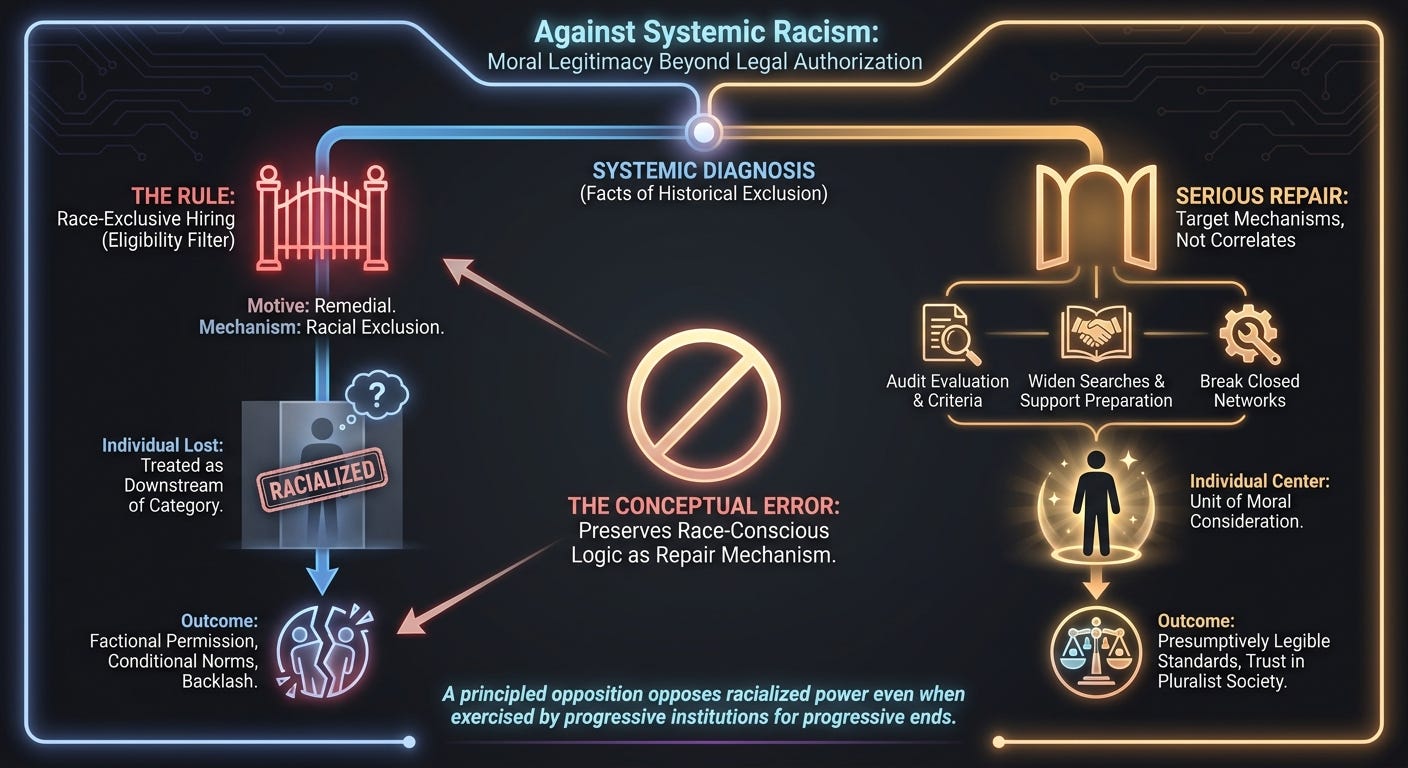
A Canadian university recently advertised a tenured research chair in genomics and precision health with a condition attached: only applicants who self-identify as “racialized” would be considered. The surrounding language was familiar: equity targets, underrepresentation, statutory permission, institutional responsibility, historical correction. The phrasing had the texture of modern administration, where every controversial act arrives wrapped in procedural vocabulary. The operative rule was simpler than the language around it. Some racial categories were eligible. Others were excluded before their applications could be considered.

That is racism in the technically relevant sense. Race is functioning as an eligibility condition for access to a public academic position. The motive may be remedial. The legal theory may fit Canadian employment-equity doctrine. The administrators may believe, sincerely, that they are correcting a historical wrong. Those considerations explain why the rule exists. They do not change what the rule does.
Law and Moral Judgment
Canadian law may protect ameliorative programs for disadvantaged groups, and Canadian courts may treat such programs differently from ordinary discrimination. That matters for lawsuits, institutional compliance, and administrative exposure. It does not answer the moral question. A statute can authorize racial classification without making racial classification a defensible principle for public institutions.
The issue here is the permission granted to an institution. The law allows a university to sort people by racial category before it evaluates their scholarship, teaching, fit, creativity, or contribution. That should make any serious liberal uneasy, including people who accept the history of exclusion and want effective remedies. Legal authorization can settle what an institution may do. Moral legitimacy has to survive a different test.
How the Individual Gets Lost
The moral problem is straightforward. A statistical disparity between groups is being converted into a disqualification imposed on individuals. The excluded applicant is treated first as a representative of a racial class, then only hypothetically as a scholar. His publications, methods, students, grants, references, and intellectual promise never enter the process, because the institution has already decided that the racial category comes first.
The selected applicant is also placed in a degraded position by the structure of the policy. That applicant may be outstanding. He may be the best person in the country for the role. The problem is that the institution has publicly announced that racial identity was a condition of entry into the competition. It has made category membership institutionally salient at the precise moment when the successful candidate should be judged by achievement. That is a strange way to confer dignity.
Both sides are forced into racial accounting. The excluded applicant receives one administrative consequence; the preferred applicant receives another. The system treats the individual as downstream of the demographic category, then asks everyone to pretend that this is a triumph over racism.
The Function of “Racialized”
The word “racialized” does real work here. It sounds more sophisticated than race. It comes from social theory rather than biological essentialism, and it signals that race is a social classification imposed by institutions and culture. That may be true as sociology. In this hiring rule, however, the concept has become an administrative filter.
The institution is not merely observing racialization from a distance. It is operationalizing it. The applicant must self-identify into the eligible category before the application can proceed. The institution then gives that category material force. The vocabulary is refined; the gate remains racial.
This is one of the recurring corruptions of bureaucratic moral language. A term developed to criticize social sorting becomes a tool for social sorting. The institution can then describe its conduct in the language of critique while performing the thing being criticized.
The Strongest Defense
The strongest defense of these policies begins from facts that should be granted. Universities did have exclusionary traditions. Elite academic networks do reproduce themselves. Mentorship, prestige, grant access, informal sponsorship, and hiring norms can preserve inherited advantage long after explicit exclusion has disappeared. Race may also have causal effects that are not reducible to class, geography, schooling, or family wealth. A black or Indigenous scholar from a middle-class background may face barriers that a white scholar from the same class background does not face.
That is the serious case. It should be taken seriously because some version of it is true. Institutions can generate unequal outcomes without requiring a cartoon villain at the center of the process. Social systems can preserve old exclusions through ordinary incentives, professional networks, and standards that appear neutral in isolation.
The conclusion still requires an argument. The existence of race as a causal variable does not automatically justify race as an eligibility filter. A causal diagnosis and a legitimate remedy are different things. If biased evaluation is the mechanism, reform evaluation. If closed networks are the mechanism, open the networks. If credential inflation protects incumbents, remove unnecessary credential barriers. If preparation is unequal, invest earlier. If discrimination occurs, punish it directly and transparently. A remedy should target the mechanism producing the harm, rather than convert the demographic correlate into the allocation rule.
Administrative Convenience Masquerading as Repair
Race-exclusive hiring is attractive to administrators because it is easy to implement and easy to report. It produces a visible demographic correction. It satisfies a compliance regime. It gives the institution a measurable outcome, a public defense, and a short route from diagnosis to announcement. That is precisely why it should be distrusted.
Many of the harder repairs are less photogenic. They require long-term investment, changes to evaluation practices, disruption of professional networks, and willingness to confront departments that reproduce themselves through taste, prestige, and familiarity. They also require distinguishing between race, class, culture, schooling, immigration history, geography, and family capital with more precision than equity administration usually wants to tolerate.
A race-exclusive job posting bypasses that work. It treats the racial category as the control surface because the category is administratively visible. The institution can then claim progress while leaving many of the deeper selection mechanisms intact.
The Conceptual Error
The conceptual error is the move from systemic diagnosis to systemic racial remedy. Equity ideology often begins with a valid observation: institutions can produce unequal outcomes even when no individual actor intends discrimination. It then treats racial administration as the natural repair mechanism. The institution becomes race-conscious, race-sorting, race-reporting, and race-excluding in the name of overcoming a racialized past.
That move preserves the central logic it claims to cure. It keeps race at the center of institutional decision-making and changes the direction of preference. Once that principle is admitted, every faction learns the same lesson. Racial discrimination is acceptable when the authorized vocabulary, constituency, and theory of history line up correctly.
That is a terrible lesson for a pluralist society. It turns equal treatment into a conditional norm. It makes institutional legitimacy depend on which racial classification is being used, by whom, and for whose preferred outcome. It also guarantees backlash, because ordinary people can see the rule clearly enough: some races may apply, others may not.
What a Better Repair Would Look Like
A serious repair program would widen searches, audit evaluation criteria, publish selection standards, reduce unnecessary credential barriers, fund early-career scholars, support preparation before the hiring stage, and break closed professional networks. It would use blind review where blind review is relevant. It would distinguish inherited class advantage from racial bias, and it would address each mechanism with the appropriate tool. It would punish actual discriminatory conduct rather than treating demographic imbalance as sufficient evidence of individual guilt.
None of this requires pretending that history does not matter. None of it requires indifference to institutional reproduction. The point is that a remedy for exclusion should preserve the individual as the unit of moral consideration. When public institutions allocate opportunity by ancestry, they train citizens to think of one another in the same terms.
That is especially destructive in academia, where intellectual life depends on trust in standards. A university should want its appointments to be presumptively legible as scholarly judgments. When it announces that racial identity is a threshold condition, it damages that presumption by its own hand.
Against Systemic Racism
A principled opposition to systemic racism has to include opposition to racialized institutional power when it is exercised by progressive institutions for progressive ends. Otherwise the principle collapses into factional permission. The institution is no longer against racial discrimination as such. It is against unauthorized racial discrimination.
That is where the university’s position fails. It may have the law on its side. It may have a plausible historical narrative. It may even produce excellent hires. The policy still uses race as a categorical condition for access to opportunity, and that is exactly the sort of rule liberal institutions should be trying to eliminate from public life.
The university can describe the policy as equity. The statute can permit it. The committee can apply it with sincere confidence in its own virtue. The mechanism remains racial exclusion. A society that has learned anything from the history of racism should be extremely reluctant to reintroduce that mechanism, especially when it arrives under moralized language and institutional authority.