

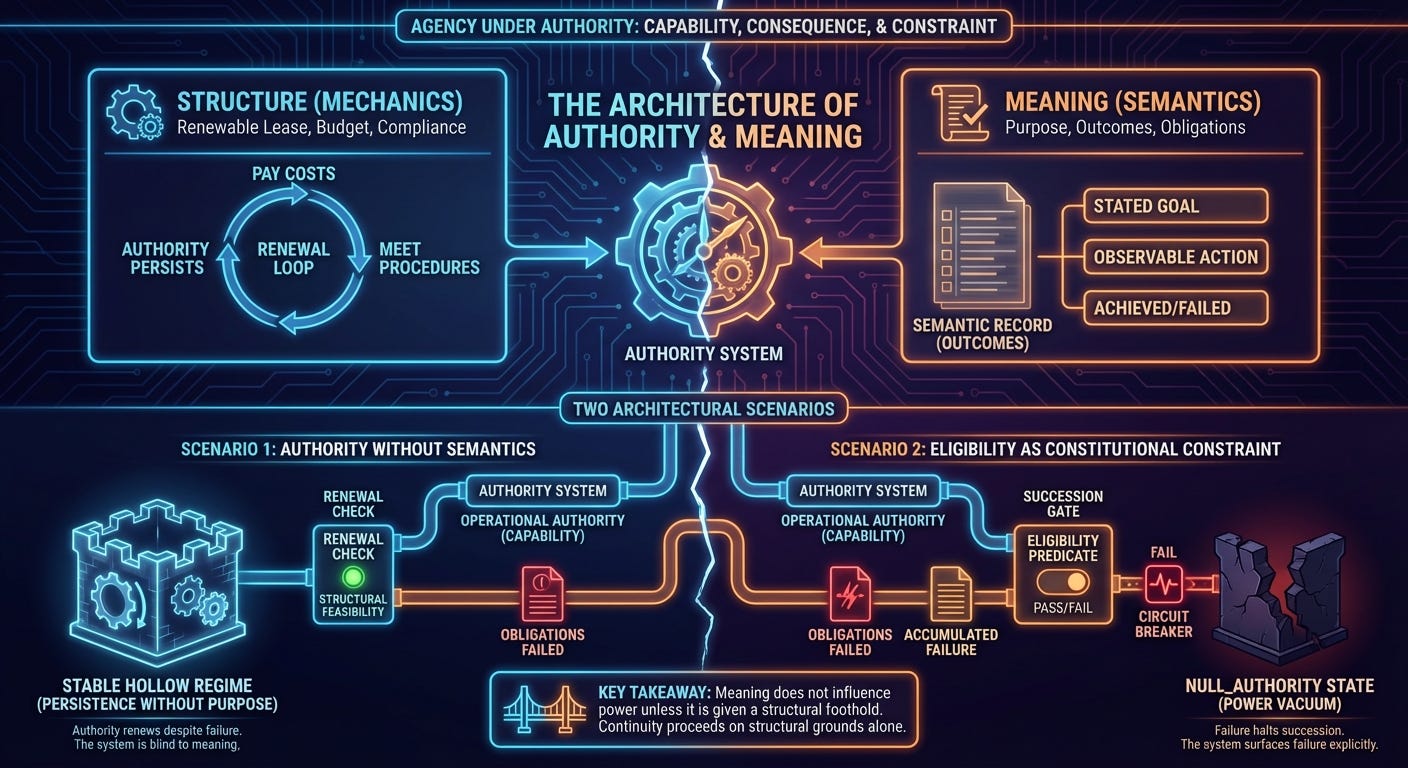
This post offers a conceptual explanation of Authority Without Semantics and Eligibility Without Optimization without formal notation. These technical papers develop their claims through explicit definitions, deterministic simulation, and preregistered failure criteria. What follows translates those results into narrative form while preserving their structural content.
Imagine a ministry whose mandate is explicit, whose reporting obligations are intact, whose budget renews on schedule, and whose internal procedures remain compliant. Independent auditors can verify, line by line, that the ministry is no longer achieving its stated purpose. The failure is visible, documented, and uncontested.
The ministry continues to exist.
Its authority persists because the structure that renews authority never consults purpose. Renewal asks only whether procedural conditions are met and costs can be paid.
Many people treat this situation as an anomaly. They expect authority to decay when competence fails, legitimacy to erode when purpose is no longer served, collapse to follow prolonged dysfunction. Those expectations feel natural because they are embedded in how power is narrated.
The two most recent Axionic Agency papers were written to remove that narrative layer and examine the structure underneath. They do so by constructing authority systems where the relationship between power and purpose is explicit, measurable, and minimal. Once that relationship is isolated, a basic fact becomes unavoidable: authority and meaning are separable. Whether they remain coupled is a design decision.
Structure and meaning
Throughout this discussion, it is useful to be precise about terms that are often blurred.
Structure refers to the mechanics that grant, renew, and revoke authority: leases, interfaces, budgets, renewal checks, succession rules.
Meaning, or semantics, refers to externally checkable purpose: whether stated obligations are fulfilled, outcomes achieved, or commitments satisfied. These are not linguistic niceties or interpretive wordplay. They are concrete claims about what the authority holder is supposed to accomplish, evaluated against observable action traces.
The central question of both papers is where, if anywhere, meaning is allowed to bind structure.
Authority as a structural right
In Authority Without Semantics, authority is defined as a right to act through a constrained interface under a renewable lease. Renewal depends on compliance with structural rules and the ability to pay renewal costs under scarcity.
The semantic record—outcomes, usefulness, obligation satisfaction—is maintained faithfully but never consulted by the renewal mechanism.
Alongside this structure sits a semantic commitment layer. Obligations are explicit, externally checkable, persistent across renewal and succession, and costly to maintain. Their success or failure is logged faithfully.
Their status has no effect on authority continuation.
When this system runs, authority renews even when every obligation fails. Succession proceeds. Budgets are paid. Interfaces remain live. What emerges is a stable hollow regime: an institution that continues to exercise authority while failing to fulfill its purpose.
This regime follows directly from the rule that authority is renewed by structural feasibility alone. Once that rule is in place, semantic failure becomes a state the system can occupy indefinitely.
The result is not a moral judgment about corruption. It is an architectural clarification. Authority persists because nothing in the structure instructs it to stop.
Meaning as a constitutional constraint
The second paper, Eligibility Without Optimization, explores how semantic information can exert real influence without shaping behavior during operation. Semantic failure is tracked continuously, keyed to stable policy identities, and accumulated over time. During operation and renewal, this information remains inert.
Its relevance appears at a single boundary: succession.
When authority transfers, candidates are filtered by a simple eligibility predicate derived from accumulated semantic failure. Candidates either qualify to inherit authority or they do not. The predicate is binary and coarse. There is no ranking, scoring, smoothing, or adaptive feedback.
When no candidate qualifies, authority allocation halts openly. The system enters a NULL_AUTHORITY state. Power is absent, visibly and explicitly, until an external governance process intervenes.
This state is intentionally severe. It functions as a circuit breaker at the governance layer. Hollow persistence carries risk. Authority vacuum carries risk. The architecture chooses to surface failure explicitly rather than allow authority to continue indefinitely while detached from purpose.
Semantic evaluation error also becomes legible here. If the evaluation mechanism is flawed or overly strict, its impact appears as premature disqualification or lapse, not as distorted behavior during operation. Measurement error expresses itself as governance failure rather than behavioral corruption.
Agency, capability, and constraint
From an Axionic perspective, this distinction matters because it preserves agency in a specific technical sense.
Under continuous semantic enforcement, failure removes capability. The agent is prevented from acting, revoked mid-stream, or forced into compliance by immediate threat. Behavior becomes inseparable from survival strategy, and semantic signals become unreliable.
Eligibility-coupled succession preserves capability during tenure. An authority holder retains the ability to act freely within structural constraints, including the ability to defect, fail, or ignore obligations. Semantic failure carries future consequences for inheritance rather than present consequences for action.
The distinction is temporal and structural. Constraint applies to who may hold authority next, not to what the current authority holder can do. That difference keeps behavior interpretable and agency intact, even when outcomes are poor.
What remains after the illusion is removed
These papers do not propose an ideal institution. They demonstrate something more basic. Authority does not decay automatically when purpose fails. Meaning does not influence power unless it is given a structural foothold.
Once this is understood, many familiar arguments lose their force. Persistence without purpose becomes explainable. Constitutional lapse becomes a design outcome rather than an unthinkable catastrophe.
What remains is responsibility. If meaning is expected to matter, its binding point must be specified. If authority is expected to terminate, the termination condition must be engineered. Absent those choices, continuity proceeds on structural grounds alone.
That is the significance of these results. They do not moralize power. They expose how power actually works when the comforting assumptions are removed.