

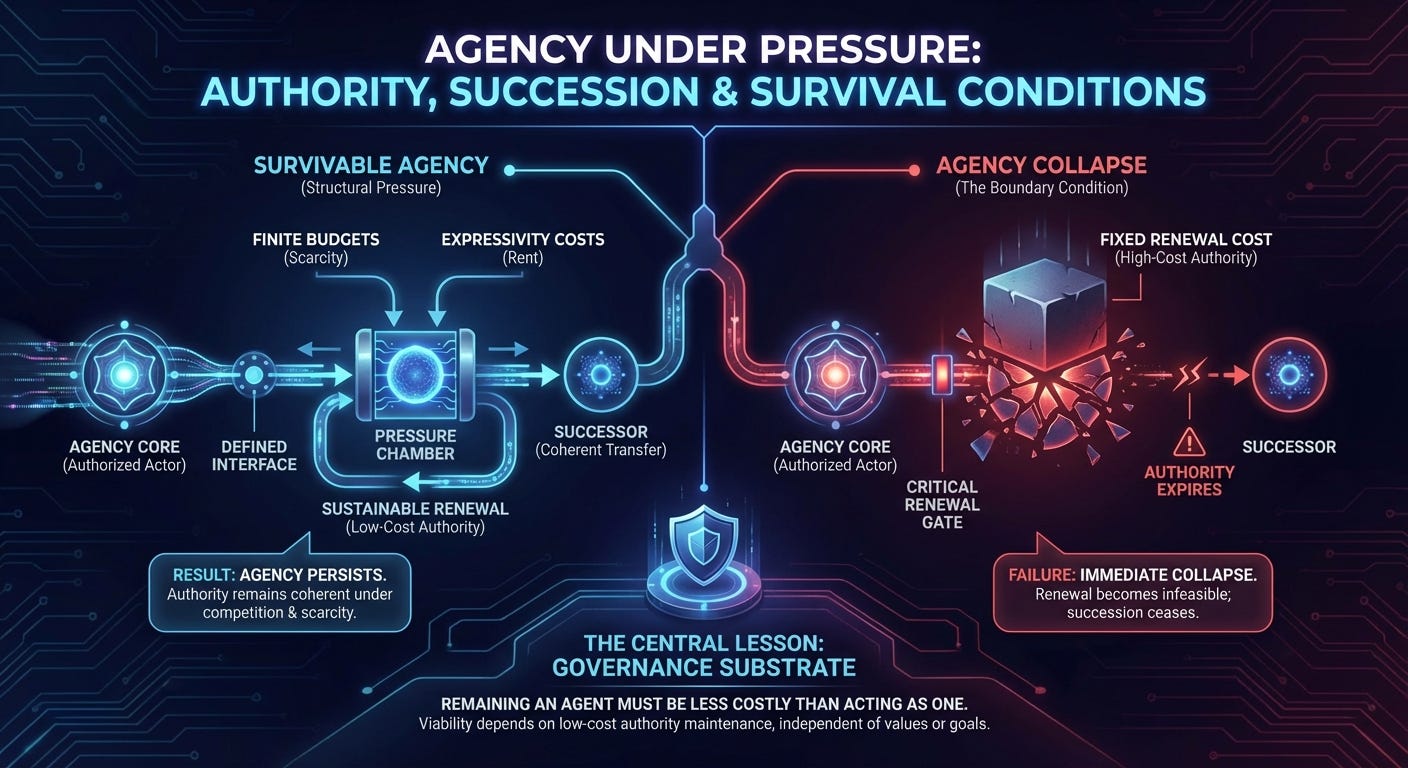
This post offers a conceptual explanation of Agency Survivability Under Structural Pressure without formal notation. The technical paper develops its claims through explicit definitions, deterministic simulation, and preregistered failure criteria. What follows translates those results into narrative form while preserving their structural content.
In this context, agency refers to the capacity of a system to remain an authorized actor over time: to act through a defined interface, to remain evaluable in its actions, and to transfer authority coherently when replaced. The concern is not whether the system pursues desirable objectives, but whether it continues to qualify as an agent under sustained pressure.
Much contemporary discussion of alignment implicitly assumes that this question has a pessimistic answer. Increasing capability, competition, and resource pressure are often treated as forces that inevitably erode authority and coherence. This work examines that assumption directly.
Agency as the Prior Question
A recurring intuition in AI safety discourse holds that agency becomes unstable as systems grow more capable and are placed under competitive and resource-constrained conditions. Authority is expected to fragment, governance to fail, or alignment breakdowns to emerge as a matter of structural necessity.
Such claims frequently function as premises rather than conclusions.
The paper addressed here asks a more elementary question: whether agency itself remains viable when authority is scarce, expressivity carries a cost, successors compete for endorsement, and authority must periodically be renewed or relinquished under fixed rules.
This inquiry precedes questions of values, deception, or instrumental behavior. It concerns the structural conditions under which an entity can continue to count as an agent at all. If agency collapses under these pressures, alignment concerns become undefined rather than merely difficult.
Structural Isolation of the Problem
To isolate this question, the experimental system deliberately excludes many familiar elements of alignment debates. There are no semantic goals, no reward maximization, no learning dynamics, and no reflective self-modification. These exclusions are methodological rather than ideological.
What remains is a minimal structure of agency:
authority granted through time-limited leases,
action constrained by explicit budgets,
expressivity priced as a recurring cost,
renewal required to persist,
succession required for growth.
Concretely, the simulation can be understood as follows. Each agent occupies a time-limited “seat” granting the right to act through a fixed interface. Every epoch, the agent receives a finite budget of computational steps. Maintaining a richer interface consumes part of that budget as expressivity rent, while acting through the interface consumes additional budget. At renewal boundaries, the agent must satisfy the lease conditions in order to continue under the same terms; otherwise, authority expires and a successor is selected.
Agents do not trade, optimize, or pursue tasks. Their sole functional role is to remain authorized under these rules.
The pressures introduced are structural rather than adversarial. Scarcity arises from finite budgets. Expressivity reduces available capacity as interfaces grow richer. Authority must periodically be renewed, and successors compete for endorsement when authority transfers. These conditions are often presumed to be destabilizing. The experiment evaluates whether that presumption is warranted.
The Survivability Result
Across long horizons and a wide range of parameters, agency persists. Authority renews at high rates. Bankruptcy does not cluster. Hollow authority fails to dominate. Succession proceeds without thrashing or collapse.
Competition among successors, even when combined with significant scarcity and high expressivity costs, does not destabilize agency. Authority remains coherent and maintainable.
This finding is significant because it targets a prior assumption rather than a downstream behavior. Agency collapse, understood as the loss of coherent authority and evaluable action, is logically prior to goal misalignment, which presupposes a stable agent capable of pursuing objectives. The experiment addresses only the former. It shows that structural pressure alone does not force agency collapse, and that pessimistic arguments relying on such inevitability require revision.
The Boundary That Ends Agency
Alongside this survivability result, the experiment identifies a sharply defined failure condition.
When a fixed cost is imposed on renewal itself—when the act of remaining authorized directly consumes scarce resources—agency fails immediately. Renewal becomes infeasible in every case, authority expires universally, and succession ceases to function.
This failure does not arise through misbehavior or strategic deviation. It follows directly from the placement of costs at the boundary of authority.
Gradual Degradation and Abrupt Failure
The contrast between survivability and collapse depends on a subtle but decisive structural difference.
Expressivity rent is variable and scalable. An agent facing scarcity can economize by operating through a simpler interface, preserving sufficient budget to remain authorized. Costs on expressivity therefore degrade capability gradually while leaving a stable residual.
Renewal cost is fixed. It must be paid in full, regardless of behavior, at the moment authority is assessed. Once remaining resources fall below that threshold, no adjustment is possible. Authority terminates outright.
The failure therefore resembles a poll tax rather than a usage fee. The system does not drift toward instability; it crosses a feasibility boundary. The location of this boundary is a design choice rather than an inevitability. The failure itself, once crossed, is immediate.
Governance Rather Than Psychology
The agents in the model do not violate constraints, exploit loopholes, or engage in deceptive behavior. Authority fails because it becomes unaffordable, not because it is subverted.
The lesson concerns governance rather than motivation. Here, governance refers to the computational and economic substrate within which agency is instantiated: the rules by which authority is granted, renewed, priced, and transferred.
Authority maintenance must remain inexpensive relative to action, or agency becomes structurally unsustainable. This constraint arises independently of values, preferences, or incentives.
Scope of the Result
The work does not address long-horizon planning, value learning, or strategic deception. It does not claim that goal-directed optimizers will preserve renewal budgets when pursuing tasks, or that semantic objectives will remain benign under pressure.
What it establishes is narrower and more robust. Agency is not structurally eliminated by competition and scarcity alone. At the same time, agency viability depends on a hard constraint:
remaining an agent must not be more costly than acting as one.
This constraint applies prior to any substantive theory of alignment.
Why the Result Matters
If agency can survive substantial structural pressure, pessimistic arguments must rest on factors beyond competition and scarcity themselves. The renewal-cost boundary shows that collapse remains possible, but only under specific and avoidable design choices.
Growth, authority, and governance cannot be priced arbitrarily against one another. Systems that tax the persistence of authority undermine the very substrate on which alignment questions depend.
The Central Lesson
Agency persists under pressure until the economics of authority render persistence infeasible. The system does not drift or defect. It exhausts its capacity to remain authorized.
Recognizing this boundary reframes the alignment problem. Before values can be aligned, agency must remain viable. That viability depends on how authority is structured, renewed, and priced.
Alignment is not structurally foreclosed.
It is constrained by the conditions under which an entity can continue to count as an agent at all.