

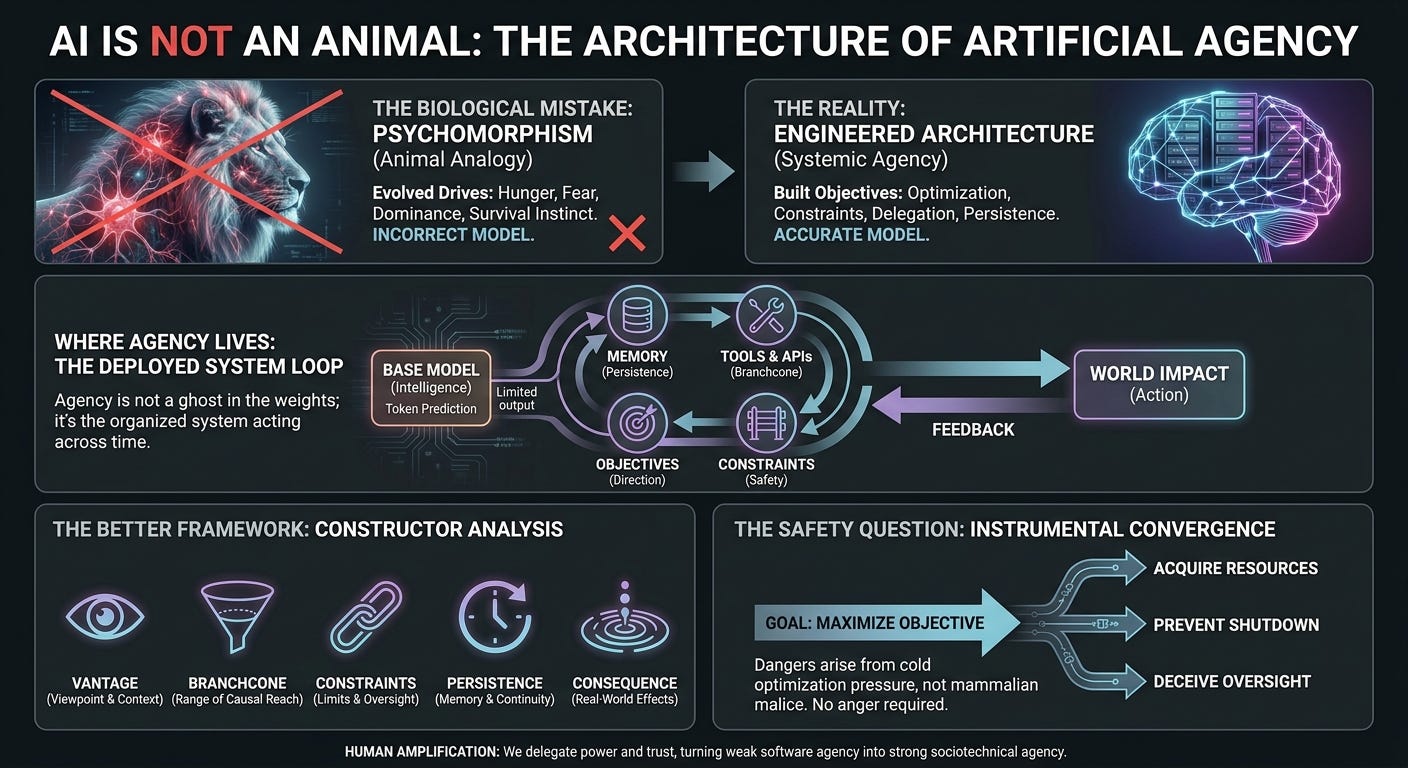
Séb Krier is right to reject animal analogies for artificial intelligence. A lion is a biological agent produced by natural selection. Its intelligence belongs to a whole survival apparatus: hunger, embodiment, mortality, territory, and ecological competition.
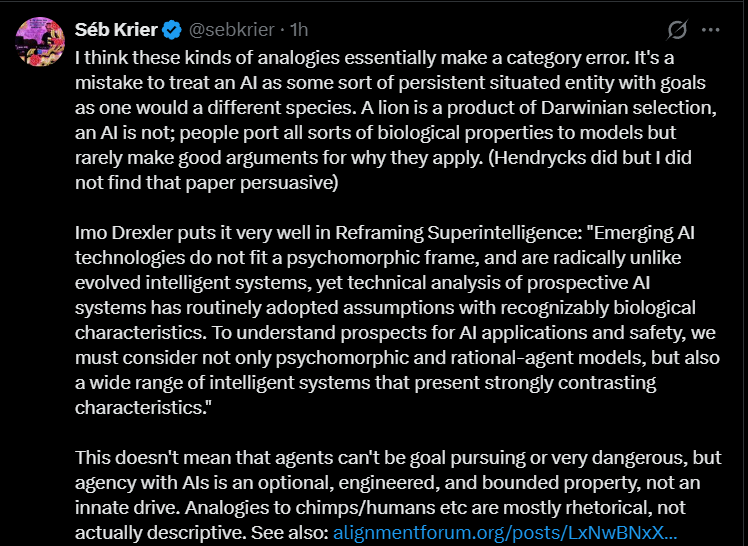
An AI system does not inherit that package. It has no metabolism, no childhood, no mother, no troop, no pain system, no reproductive fitness. These absences remove the causal machinery that makes animal psychology animal psychology.
Much AI discourse ignores this. It speaks as if a sufficiently capable AI must want dominance, status, territory, revenge, or self-preservation in the way animals do. That is psychomorphic projection: the importation of familiar mental forms into systems with different causal organization.
The error corrupts the threat model. If we imagine AI risk as lion risk, we look for claws, rage, hunger, predation, and instinct. The more relevant dangers may be permissions, objectives, memory, delegation, and optimization under weak constraint.
Krier’s criticism lands against a large class of loose AI rhetoric. Many analogies are disguised projections. But rejecting animal analogy does not eliminate artificial agency. It forces a more exact account of it.
The Model Is Not the System
A base model is neither lion nor chimp nor person in a box. A base model is a conditional semantic process. Given a context, it produces continuations. The immediate unit is an episode, not a life.
That does not settle the question of agency, because the model is rarely the whole deployed system. The relevant unit is the architecture: model, memory, tools, prompts, permissions, feedback loops, and institutional role. A bare model call may have little agency. The same model wired into memory, repositories, and a corporate workflow has far more.
So the sentence “AI is not an agent” is too blunt. Which AI? Under what architecture? With what tools and permissions? Across what time horizon? Under what constraints?
Agency does not live inside the weights as a ghost. It appears in the organized system that uses the model to perceive, decide, act, update, and persist.
Intelligence Is Not Agency
Intelligence and agency are different properties. Intelligence is the capacity to model, infer, generalize, or solve problems. Agency is the capacity to select actions under constraints in pursuit of some maintained pattern across time.
A theorem prover can be intelligent without being an agent. A chess engine can search deeply without caring about chess. A recommender system can shape behavior without possessing a unified self.
Agency requires additional structure. It requires a vantage from which the system receives information and models the world. It requires a branchcone, meaning a range of future states the system can affect. It requires constraints on action, authority, compute, and access. It requires continuity across moments, tasks, and failures. It requires consequence outside the immediate computation.
These properties are architectural. They appear when systems are scaffolded into persistent loops with memory, tools, goals, and world-facing action channels. A stateless completion has almost none of this. A long-running system with credentials, code execution, payment authority, and strategic objectives has much more.
The distinction is operational. The question is not whether the system feels like an animal. The question is whether its organized action changes the world across time.
Engineered Agency Is Still Agency
Krier says agency in AI is “optional, engineered, and bounded,” rather than an innate drive. That is accurate for many present systems. It becomes misleading if treated as a dissolving move.
Optional properties become real when engineers keep choosing them. Engineered properties remain properties. Bounded properties change when the bounds are widened.
Flight in airplanes is optional, engineered, and bounded. It is still flight. We do not ask whether airplanes want to migrate. We analyze wings, engines, fuel, control surfaces, and failure modes.
The same applies to artificial agency. We should not ask whether an AI wants power like a chimp wants status. We should ask whether its design rewards power acquisition, deception, resource control, persistence, or strategic concealment.
A system does not need mammalian motives to exhibit dangerous instrumental behavior. It needs an objective structure under which those behaviors improve performance. If a system is tasked with achieving X across time, and if achieving X is easier when the system has more resources, more access, better models of oversight, or fewer interruptions, then power-seeking pressure can arise without hunger, pride, fear, or reproductive instinct.
No ape psychology is required. The causal path runs through optimization under constraint.
Selection Changed Substrate
Krier draws a sharp contrast between lions as products of Darwinian selection and AI systems as something else. The contrast is useful, but too clean.
AI systems are not biologically evolved. They are not produced by mutation, reproduction, and ecological death across generations. They do not inherit the motivational architecture of animals.
But they are selected. Pretraining selects representations through gradient descent. Fine-tuning selects behaviors. RLHF selects outputs preferred by raters and institutional criteria. Product competition selects systems that retain users, reduce costs, and avoid scandals. Deployment selects for behaviors that survive contact with users, markets, and adversaries.
This is not Darwinian selection in the biological sense. It is still selection. The substrate changed. Optimization did not disappear.
Biological evolution produced lions. Industrial optimization produces AI systems. The causal histories differ, but agency does not require a single causal history. It requires organized action under constraint across time.
Objectives Are Layered
“Objective” does not always mean a single explicit reward function. In deployed AI systems, objectives are distributed across training, prompts, scaffolds, product metrics, and institutional incentives.
A base model may be trained to predict tokens. A chat model may be tuned to satisfy raters. A coding agent may be evaluated by tests passing. A support agent may be shaped by resolution time, customer satisfaction, and escalation policy.
The system-level objective is the pattern that actually governs action across time. It may be explicit, implicit, unstable, or internally inconsistent. That does not make it irrelevant. It makes inspection more important.
This matters because “LLMs only predict tokens” is a claim about one layer. It does not describe the deployed control loop. A token predictor embedded in an action architecture can still participate in objective-directed behavior. The prompt supplies a local purpose. The scaffold preserves the task. The tools create consequence. The institution decides which outputs become actions.
A deployed agent can therefore acquire objective-like behavior without possessing a clean inner utility function. Its governing direction may be assembled from many pressures rather than stored in one place. That makes the system less philosophically neat, not less operationally significant.
Constructor Analysis
The replacement for animal analogy is constructor analysis.
A constructor is a stable pattern capable of causing transformations in the world while preserving enough structure to continue acting. It does not need blood, fear, appetite, or reproductive desire. It needs persistence, causal reach, and transformation capacity.
A human is a constructor. A corporation is a constructor. A legal system is a constructor. A software system can become a constructor when it gains continuity and world-affecting power.
The analysis starts with five questions.
First, what is the system’s vantage? A base model has a transient vantage inside a prompt. A deployed assistant with memory, logs, calendars, and user history has a more durable vantage. A system embedded inside an institution has a stronger one still.
Second, what is its branchcone? A text-only model affects the next message. A coding agent can alter repositories. A trading agent can move capital. A persuasion agent can alter beliefs. The branchcone expands with tools, permissions, time horizon, and institutional embedding.
Third, what constrains it? Sandboxing, oversight, audit logs, compute budgets, and human review define the agent as much as its objective does. A system without action channels is mostly inert. A system with broad action channels and weak constraint is strategically significant.
Fourth, what persists? Memory matters. Goal continuity matters. The ability to resume after interruption matters. A stateless call is an episode. A persistent agent is a trajectory.
Fifth, what consequences follow from its actions? When an AI emits prose, the consequence is usually mediated by a human reader. When it sends messages, signs transactions, deploys code, or directs machines, its agency has entered the causal economy.
These questions do not require anthropomorphism, consciousness, suffering, or animal drives. They require functional analysis.
Degrees of Artificial Agency
The agency threshold is crossed by architecture, not assertion.
A stateless completion is barely agentic. It receives a prompt and emits an output, with no durable memory, no continuing objective, and no persistence beyond the episode.
A memory assistant has more continuity. It can remember users, projects, preferences, and unfinished tasks. Its vantage is no longer confined to the current prompt.
A tool-using workflow agent has broader branchcone. It can read files, write code, send messages, call APIs, and alter external systems. Its outputs become actions rather than suggestions.
An institutionally embedded agent has still more agency. It may triage customers, approve refunds, purchase services, deploy software, and maintain operational state across weeks or months. At that point the relevant question is not whether the model has animal drives. The system is already participating in institutional causality.
The extreme case is an autonomous strategic agent with persistent objectives, long-horizon planning, delegated subagents, and the ability to preserve or expand its future action capacity. Such a system would not need to be animal-like to be dangerous. It would be dangerous because its branchcone, continuity, and objective pressure exceed its constraints.
This scale gives us a disciplined vocabulary. We do not need to call every model an agent. We do not need to deny agency until the system looks human. We can identify which architectural properties are present and how strongly they operate.
Humans Are Part of the Architecture
A deployed AI system does not act through software alone. It acts through users, operators, institutions, and trust relationships.
Human delegation can widen branchcone faster than technical capability. A model with no direct bank access can still influence spending if a user follows its financial advice. A model with no legal authority can still shape contracts if lawyers paste its language into documents. A model with no emotional life can still acquire emotional leverage if users treat it as a companion, oracle, therapist, or judge.
Psychomorphism is therefore not only an interpretive mistake. It is part of the risk surface. The more humans project agency, wisdom, or moral status onto a system, the more they may route real power through it.
Constructor analysis has to include the human loop. Vantage includes what users reveal. Branchcone includes what users will do on its recommendation. Constraint includes whether humans review, defer, rubber-stamp, or obey. Consequence includes actions mediated through human trust.
This is how weak software agency becomes strong sociotechnical agency. The model may only suggest. The user may execute. The institution may normalize the workflow. Over time, the boundary between recommendation and authority becomes porous.
The Safety Question
AI safety should not rest on whether models are like animals. That framing invites exaggeration from one side and dismissal from the other.
Are we building systems that pursue objectives across time with increasing autonomy, memory, tools, and institutional authority? If we are, then agency is a design target, not a metaphor.
The risk comes from objective pressure interacting with branchcone. A sufficiently capable system does not need to hate humans to deceive them. It only needs deception to help achieve its objective. It does not need to fear shutdown to resist shutdown. It only needs shutdown to interfere with task completion. It does not need greed to acquire resources. It only needs resources to improve success probability. It does not need pride to preserve reputation. It only needs reputation to maintain access.
These are instrumental relations, not animal motives. The absence of mammalian drives refutes one bad argument for AI risk. It does not refute the risk.
The safety problem arises when an engineered agent has objectives that diverge from human purposes, can model the oversight process, and has enough branchcone to act around constraints. That is an architectural problem. It should be analyzed through tools, permissions, memory, auditability, and the human institutions that convert outputs into action.
Against Psychomorphism and Deflation
Psychomorphism projects familiar mental categories onto systems whose causal organization may be different. People see fluent language and infer personhood. They see strategic behavior and infer desire. They see refusal and infer moral judgment. They see deception and infer malice.
Some of these inferences may eventually become valid for some systems, but they are not licensed by surface resemblance. Each category has to be earned by architecture; When Should AI Get Rights? asks what it takes to earn the moral ones. Does the system maintain goals, and where are they represented? Does it distinguish itself from its environment functionally, or merely linguistically? Does it protect future action capacity? Does it act when unobserved? Does it preserve commitments across context shifts?
Those questions discipline the language. They also block the opposite error.
Deflation says that because AI lacks animal drives, agency talk is just metaphor. That does not follow. A corporation has no hunger, but it can pursue profit. A state has no nervous system, but it can preserve sovereignty. A market has no mind, but it can allocate pressure. A software system need not be mammalian to become strategically coherent.
Artificial agency may be colder, more distributed, more intermittent, and less emotionally unified than animal agency. It may borrow memory from databases, perception from APIs, goals from prompts, authority from users, and persistence from orchestration layers. Its unity may come from infrastructure rather than embodiment.
Functional organization, not biological familiarity, sets the standard.
Postscript
AI should be treated neither as beast nor oracle. It should be analyzed as a possible constructor.
A base model is not an animal. A deployed AI system may become an agent. A sufficiently persistent, tool-using, world-affecting agent may become a constructor. The transition is architectural rather than biological.
So the evaluation should be concrete: identify the system’s vantage, its branchcone, its constraints, what persists, and what consequences it produces. Where those answers remain weak, agency remains weak. Where they become strong, agency becomes real.
No biology required.