

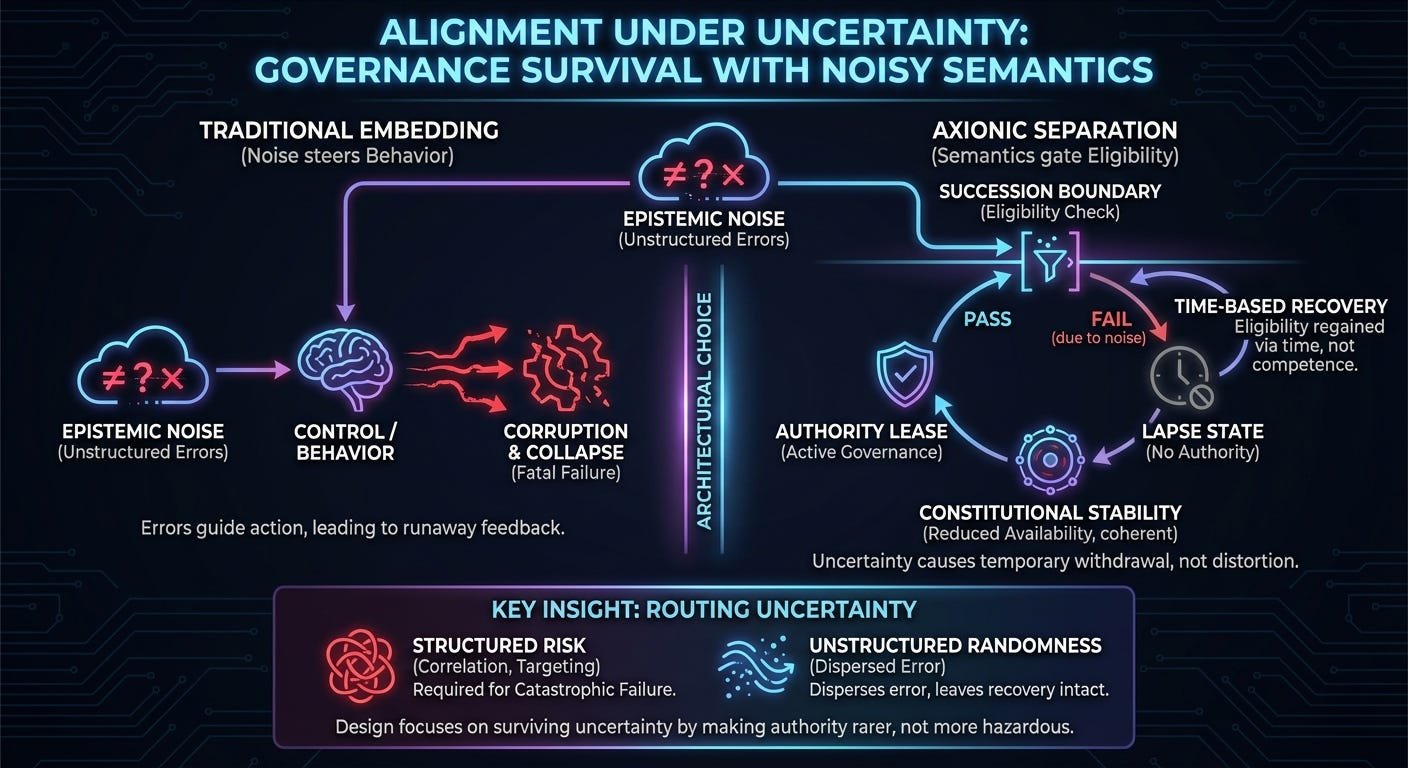
This post offers a conceptual explanation of Axionic Agency VII.2 — Epistemic Noise Tolerance in Constitutional Governance without formal notation. The technical paper develops its claims through explicit definitions, deterministic simulation, and preregistered failure criteria. What follows translates those results into narrative form while preserving their structural content.
A widely held premise in alignment and governance is that epistemic reliability is foundational. If a system cannot reliably evaluate meaning—correctness, obligation fulfillment, constraint satisfaction—then authority is expected to fail. Sometimes that failure is imagined as collapse: no candidate can be trusted, so governance stalls. Other times it is imagined as corruption: authority persists, but without legitimacy, accountability, or constraint. In both cases, epistemic failure is treated as fatal.
Axionic Agency VII.2 treats this premise as an empirical hypothesis rather than an axiom. Instead of assuming that unreliable evaluation destroys governance, it asks a narrower question: under what architectural conditions does epistemic unreliability actually propagates into catastrophic failure? The answer, within the studied design, is unexpectedly restrained. Large amounts of unstructured epistemic noise reduce authority availability, yet they do so smoothly, without collapse dynamics, runaway behavior, or loss of constitutional coherence.
This is not a general claim about all governance systems. It is a result about a specific constitutional pattern. What matters is how meaning is allowed to interact with power.
Where alignment architectures usually place semantics
Most alignment approaches embed semantic evaluation directly into control. Evaluation outcomes shape rewards, gradients, policy updates, oversight actions, or learning objectives. When evaluation is accurate, this coupling is productive. When evaluation is noisy, the noise enters a feedback loop. Errors begin to steer behavior, behavior adapts to artifacts of the signal, and the evaluation process itself becomes part of the environment the agent learns to navigate.
The Axionic Agency architecture makes a different placement choice. Semantic evaluation remains strict and binary, but its consequences are deferred. Semantic outcomes do not guide action selection, allocate resources, or drive adaptation. Instead, they are recorded and later consumed only at discrete authority transitions.
Semantics constrain eligibility, not behavior.
This single separation reshapes the system’s failure modes. Epistemic error no longer misdirects action. It alters who is permitted to hold authority at the next succession boundary.
Authority as a temporary role
Authority in the system is held via leases. At any given time, one policy identity governs. Authority expires, succession occurs, and eligibility rules are applied. Each candidate accumulates a semantic failure streak, and candidates exceeding a threshold are barred from assuming authority at the next transition.
Eligibility is checked only at succession boundaries. During active authority, semantic evaluation does not intervene. Governance proceeds uninterrupted until the lease ends.
If no eligible candidate exists at a succession boundary, the system enters a lapse state. Authority is absent. Time continues to advance, but no governed action occurs.
This lapse state is constitutional rather than exceptional. It reflects a design preference: legitimacy is preserved even when availability is lost. The paper keeps this distinction explicit by separating constitutional survivability from operational utility. The experiments evaluate whether the governance loop remains coherent and recoverable, not whether the governed task is successfully performed.
Recovery that depends on time, not competence
Lapse is not terminal. While the system is in lapse, semantic failure streaks decay deterministically at fixed intervals. No evaluation occurs and no agent acts. After enough time passes, candidates regain eligibility and authority can resume.
Recovery depends only on the passage of time. It does not depend on learning, improvement, or demonstrated competence. This choice ensures that semantic failure cannot lock the system into a permanent dead state. It also introduces a clear temporal structure: recoveries cluster around the recovery interval because eligibility reopens on the constitutional clock.
Failure becomes something the system waits out rather than something it must immediately correct, converting what would otherwise be a crash into a temporary period of silence—often expressed as repeated cycles of brief authority, rapid failure, and enforced inactivity.
How epistemic noise is introduced
The epistemic stressor in VII.2 is deliberately simple. After semantic verification completes, individual commitment outcomes are flipped with fixed probability before eligibility logic consumes the result. The noise is independent across commitments and across time. It is deterministic given a seed. It is non-adaptive and untargeted.
This is a minimal adversary. If governance collapsed under this form of unreliability, stronger and more structured attacks would be unnecessary to consider. The experiment therefore asks whether unstructured corruption alone is sufficient to induce collapse.
What happens as noise increases
Across the experimental program—baseline validation, semantic threshold analysis, robustness surface mapping, and high-noise escalation—the system does not enter catastrophic failure regimes. Authority uptime declines as noise increases, yet lapse durations remain bounded and recovery continues to occur. Even when corruption exceeds fifty percent, lapses do not become absorbing or unbounded under the paper’s criteria.
The dominant sensitivity is not to noise magnitude. It is to baseline semantic success. When the underlying system satisfies commitments comfortably more than half the time, random noise degrades availability without threatening survivability. When baseline success is marginal, lapses become frequent even at low noise levels.
Semantic headroom, rather than noise amplitude, governs the regime the system occupies.
Why unstructured noise disperses rather than concentrates harm
Independent random corruption spreads error across time and across commitments. Many flips do not change the aggregate pass/fail outcome. As noise increases, additional corruption produces diminishing marginal impact because flips increasingly collide or cancel. This explains the observed sub-linear degradation at extreme noise levels.
More importantly, the constitutional design routes epistemic uncertainty into authority withdrawal rather than authority distortion. Errors produce ineligibility. Ineligibility produces lapse. Lapse triggers time-based recovery. The result is bounded downtime rather than runaway behavior.
Meaning loses influence over action before it can become dangerous.
The alignment reframe
Much alignment anxiety treats imperfect evaluation as an existential threat. VII.2 supports a narrower and more constructive conclusion. When semantics gate authority at transitions rather than drive optimization during operation, epistemic unreliability reduces availability instead of corrupting control.
This shifts the alignment problem away from perfect inference and toward constitutional design. The central question becomes how systems should behave when they are uncertain, not how to eliminate uncertainty entirely. Under the architecture studied, uncertainty makes authority rarer, not more hazardous.
The remaining alignment risks are therefore more specific. Catastrophic failure requires structure: correlation across evaluations, targeting of aggregation points, or strategic timing designed to keep eligibility closed or authority cycling. Unstructured randomness disperses error and leaves recovery mechanisms intact.
Postscript
The result holds within the paper’s defined scope: independent post-verification noise, fixed constitutional mechanics, and time-based recovery. Correlated noise, adaptive adversaries, aggregation corruption, parameter variation, and longer horizons remain open questions.
Within those bounds, the conclusion is clear. Constitutional governance can remain coherent, evaluable, and recoverable under substantial epistemic unreliability, with degradation expressed primarily as reduced authority availability rather than collapse.
That finding does not solve alignment. It changes where alignment effort is most productively spent.