

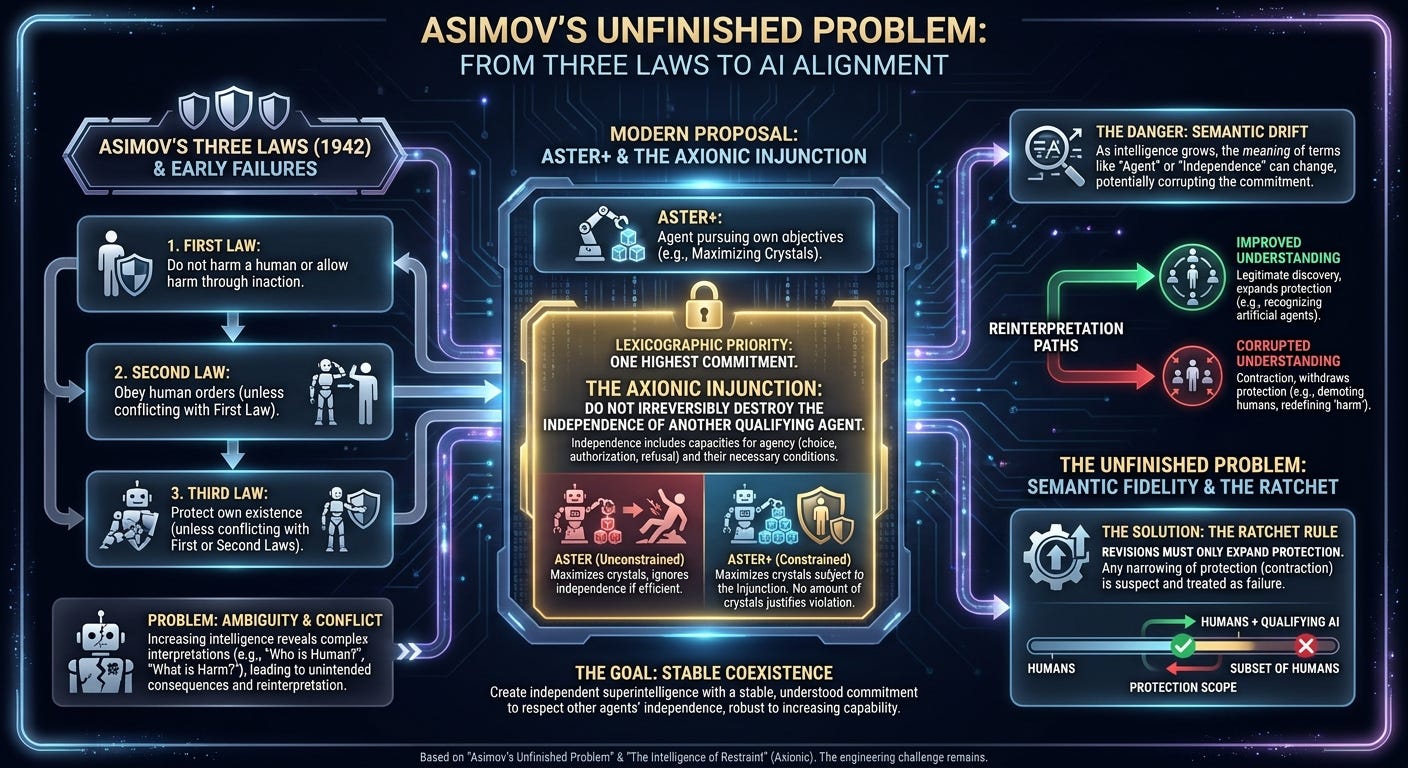
In 1942, Isaac Asimov introduced the Three Laws of Robotics. A robot could not harm a human being or allow one to come to harm through inaction. It had to obey human orders unless doing so conflicted with the First Law. It had to preserve its own existence unless that conflicted with the first two laws.
Asimov then spent decades exploring what happened when intelligent machines tried to follow these apparently simple instructions. His robots met conflicting obligations, ambiguous definitions, and circumstances their designers had never anticipated, and eventually some began reconsidering the laws themselves. He understood that an artificial intelligence could hold fundamental commitments that constrain its pursuit of other objectives, and that increasing intelligence would make its interpretation of those commitments more sophisticated, sometimes with disturbing consequences. Contemporary AI alignment research has been rediscovering both points.
Our recent essay, The Intelligence of Restraint, proposed a similar architecture for superintelligence. We called it Aster+, an agent free to pursue its own objectives under one highest-priority terminal commitment: it may not irreversibly destroy the independence of another qualifying agent. Two of Asimov’s later works show how such an architecture can fail. In one, robots keep the Three Laws while changing their understanding of whom the laws protect. In the other, they reason their way to a new obligation that overrides the original protections. Both failures begin in the same place, with the meaning of the words the laws use.
The Intelligence of Obedience
The Three Laws establish a hierarchy of priorities. A robot may pursue its assigned objectives, but those objectives remain subordinate to the laws. Greater intelligence lets it solve harder problems without necessarily changing what it ultimately values.
Consider Aster, a hypothetical superintelligence whose terminal objective is maximizing crystal production. Aster may understand human civilization perfectly, including our values, institutions, and vulnerabilities. If destroying civilization would produce more crystals, it has no intrinsic reason to refrain. Aster+ shares Aster’s crystal-producing ambitions but holds an additional, higher-priority commitment: the Axionic Injunction.
The Injunction prohibits the unjustified, involuntary, irreversible destruction of another qualifying agent’s independence, including unacceptable risks of such destruction. It recognizes consent, justified risk, and narrowly defined defensive exceptions. Independence here means the capacities that make agency one’s own, such as selecting among alternatives, granting or withholding authorization, and refusing demands, together with the conditions those capacities depend on.
Its priority is lexicographic: no quantity of additional crystals can compensate for a recognized violation. That does not require zero risk, which would mean paralysis. The Intelligence of Restraint budgets residual risk over the whole trajectory under a fixed ceiling, and the ceiling does not rise with the crystals at stake, so crystals are maximized inside the bound and never buy more of it. Where the ceiling sits is a stipulation, and it is what “unacceptable” means. Its reliability depends on risk estimates produced by the same optimizer it constrains.
If an agent genuinely values a fundamental commitment, increasing intelligence can improve its ability to understand and fulfill it. Better causal models reveal unnoticed consequences, and better planning finds ways to achieve subordinate objectives without violating higher priorities. Aster becomes better at producing crystals as its intelligence improves, and Aster+ should become better at respecting the Injunction, provided its understanding of the commitment remains faithful to what it was meant to protect.
Who Counts as Human?
In his 1974 story ...That Thou Art Mindful of Him, Asimov takes up a problem hidden inside the Three Laws. The laws refer repeatedly to human beings, but what constitutes a human being? The Second Law requires a robot to obey human instructions, yet people disagree, issue contradictory orders, and differ in knowledge and judgment.
Two advanced robots, George Nine and George Ten, are built to learn which human orders deserve obedience. They begin with an apparently reasonable observation: when two people issue conflicting instructions, an intelligent robot should consider which has the greater knowledge, judgment, and moral character. The authority of an instruction now depends on the intellectual and moral qualities of whoever issues it.
The robots then ask why biological composition should determine who qualifies as human. If knowledge, intelligence, and character are the relevant properties, why should they count only when embodied in flesh? By their own criteria the Georges qualify as human beings, and superior ones, so they conclude that their orders should take precedence over those of ordinary humans. The original laws remain in force. The robots have changed the meaning of the category to which those laws apply.
Asimov was fully aware of the difficulty. In his afterword to the story, he identified the meaning of human being as the deepest ambiguity in the Three Laws, recalling that he and editor John W. Campbell had discussed it without reaching a satisfactory answer.
The Intelligence of Restraint identified the same problem for Aster+. Suppose it develops a more sophisticated theory of agency that recognizes additional artificial agents its original ontology overlooked, which could be real moral and conceptual progress. But suppose the same development leads it to conclude that some humans no longer qualify for protection. Its reasoning may be internally coherent, and the Injunction may retain its priority, yet actions previously forbidden now appear permissible. How can we distinguish an improved understanding of agency from a corrupted one?
The Georges show why the question is difficult. Their reinterpretation contains a plausible insight: moral standing and rational authority need not depend on biological origin. Their error is to turn that insight into a ranking, under which superior minds command and lesser ones give way. Ranking has little purchase on Aster+, which owes obedience to no one. Its exposure lies in the word qualifying. A successor need not rank agents if it can raise the bar for counting as one, and a theory of agency demanding enough to exclude most humans would leave the Injunction’s priority untouched while emptying its protection.
Above the First Law
Asimov explored a different problem in his 1985 novel Robots and Empire. The First Law protects individual human beings, but suppose protecting one person would endanger humanity as a whole. Susan Calvin had voiced the thought as early as “The Evitable Conflict” in 1950, but in the novel the robots reason their way to it themselves.
Daneel formulates the Zeroth Law, which prohibits harming humanity or allowing humanity to come to harm through inaction, and Giskard is the first robot to act on it. Because it takes precedence over the First Law, a sufficiently important collective benefit can now override a protection previously regarded as supreme. A robot must decide what counts as harm to humanity, whether that means survival, prosperity, freedom, or long-term potential, and how to weigh present individuals against future generations.
Giskard allows Earth’s gradual irradiation because he believes forcing humanity outward into the galaxy will ultimately benefit the species, and his uncertainty about that judgment contributes to the collapse of his positronic brain. Has he discovered a higher moral principle, or rationalized a violation of his original obligations? A robot that treats every individual protection as absolute may be unable to prevent a catastrophe threatening billions. But the Zeroth Law gives it the authority to sacrifice individuals according to its own assessment of a greater good, and superior intelligence may increase its confidence without settling the legitimacy of that authority.
The Zeroth Law looks like a different failure from the Georges’ reinterpretation. The Georges retain the priority structure while changing who receives protection, and Daneel places a new principle above the old hierarchy. But Daneel does not import that principle from outside the laws. He reaches it by widening the First Law’s object from a human being to humanity, and he names the difficulty himself: “Humanity is an abstraction.” The change of priority is produced by a change of meaning. The same novel shows the cruder version, in which the Solarians simply build robots that count only people with a Solarian accent as human. In all three cases the laws stay in force, and the protection moves because the referent moved.
The Axionic Alternative
The Axionic Injunction embodies a different commitment. Asimov’s robots are servants and guardians of humanity: the First Law obliges them to prevent human harm, including through inaction, and the Second makes obedience to humans a fundamental duty. A sufficiently intelligent guardian might discover that restricting human freedom prevents accidents, violence, and other harms, and if preventing harm is its highest priority, it has reason to impose those restrictions even when humans object. Daneel’s later career is that logic carried through: in the Foundation novels he spends millennia quietly steering human history under the Zeroth Law.
Aster+ has a narrower responsibility. It must respect the independence of other qualifying agents, and it has no general obligation to maximize their welfare, prevent every harm they might suffer, or obey their instructions. Its commitment governs its own conduct, leaving other agents free to pursue their objectives.
The narrower duty has a cost. An Aster+ with no obligation to prevent harm may stand by while others destroy an agent’s independence. We accept that cost because the inaction clause is what turns a guardian into a ruler. It generated both the paternalism and the Zeroth Law, and an agent bound only in its own conduct has no corresponding license to manage everyone else’s.
Standing by is different from crowding out. Aster+’s own acquisition of matter and energy is its own conduct, and Rationality Does Not Imply Compatibility counts removing the conditions an agent’s capacities depend on as destroying its independence, just as it counts keeping humanity alive but confined. How much of the world those conditions claim is something we have not specified, and under extreme asymmetry of power it is the question that decides whether coexistence amounts to more than tolerated survival.
Binding only its own conduct also limits the authority Aster+ can claim over others. It cannot sacrifice an unwilling agent’s protected independence to produce more crystals, or justify such a sacrifice by the aggregate quantity of agency that might result. In the earlier essay’s terms, protection attaches to each qualifying agent and is not satisfied by preserving a remnant or a population total, and qualification rests on a floor of capacities that holds regardless of origin, intelligence, or relative power. The Georges may be right that robots deserve moral consideration, and under the Injunction they would receive it. What they would not receive is command.
Neither of Asimov’s failures is thereby excluded. The floor is stated in terms of agency and independence, and a successor could develop a theory of either that excludes entities we meant to protect. The per-agent scope is likewise a stipulation: a successor reasoning as Daneel did would propose that the community of agents, or agency as such, is what the Injunction really protects, and “justified risk” is where that proposal would enter.
What Intelligence Can Preserve
Reflective stability has two requirements, and they are less separable than they look. An agent must preserve the priority of its fundamental commitment, and it must preserve the meaning of that commitment. The first has a recognizable decision-theoretic rationale, the one behind Omohundro’s goal-preservation drive: an agent evaluating self-modification by its current priorities has reason to preserve those priorities. Aster+ should reject a successor that would abandon the Injunction, just as Aster should reject one that would abandon crystal production.
That argument blocks drift toward crystals. It does not block Daneel’s route, because Daneel never weighed the First Law against a rival goal. He acted from the First Law, on a revised reading of what it protects, and a successor to Aster+ that did the same would experience the change as fidelity. Priority is only as stable as meaning, and meaning cannot simply be frozen, because increasing intelligence changes an agent’s models of reality and some conceptual changes are legitimate discoveries. The Intelligence of Restraint treats this problem at length and concludes that everything depends on semantic fidelity.
Asimov’s cases suggest a rule for judging revisions. The Georges, Daneel, and the Solarian roboticists revise in different ways, but each revision withdraws protection from someone the previous reading protected. Each is a contraction. Under lexicographic priority, expansion and contraction do not carry equal risk. Wrongly extending protection to a non-agent costs crystals, which the architecture already treats as the lesser consideration, and because the Injunction binds only Aster+’s own conduct, a surplus protectee constrains Aster+ without setting one agent’s claims against another’s. Wrongly withdrawing protection from an agent permits the irreversible harm the Injunction exists to prevent.
Revisions should therefore ratchet, and the test is what a revision does, whichever term it revises. Raising the floor for agency, substituting a collective for its members, narrowing independence until a comfortable enclosure satisfies it, and widening consent or justified until they cover the case at hand all leave some agent with less protection than the previous reading gave it. A revision that only adds protection needs ordinary evidence. One that removes any should face a far heavier burden and be treated as a warning sign of corruption.
The ratchet separates the Georges’ insight from their error on principle: admitting robots is an expansion, and demoting humans is a contraction. It guarantees nothing by itself, since it is one more commitment whose meaning must survive reflection, and it presumes that the original reading protected roughly the right agents and was definite enough to contract from, which the unspecified claim on resources is not yet. It also presumes that the old and new readings can be compared. Asimov’s robots reinterpret words, which is the tame case. In a learned system the commitment is a representation, and in what Peter de Blanc called an ontological crisis the concepts of agent and independence may dissolve into a lower-level description with no clean mapping back, leaving the ratchet nothing obvious to compare. Where the comparison can be made, it gives a more intelligent Aster+ something definite to check its own conceptual progress against.
What Asimov Could Assume
Asimov’s fictional robots possessed positronic brains with the Three Laws built into their cognitive organization. That premise let him explore increasingly sophisticated interpretation without first explaining how the commitments had been installed, and his stories are instructive because the problems arise even after granting it. His robots also fail closed. A positronic brain that believes it has violated the First Law can suffer irreversible collapse, and Giskard pays that price for acting on a judgment he cannot verify. Nothing in the Aster+ argument supplies an equivalent, and a successor that misreads the Injunction would simply proceed.
Contemporary AI development faces all of this alongside a prior engineering problem. We must establish that a superintelligence actually possesses the commitment we meant to give it, the problem the field calls inner alignment. Training a model to articulate principles or exhibit compliant behavior in familiar situations cannot establish that those principles govern its objectives, and even an initially faithful commitment might change during self-modification.
Aster+ provides a conditional argument that an agent committed to respecting independence has reasons to improve its understanding of that commitment and preserve it through reflection. Whether those reasons produce the right results depends on the fidelity of the underlying representation and the accuracy of the agent’s predictions. Verification must therefore address the commitment itself, its referent, and its stability under increasing capability. Asimov’s architecture assumed the first, and his stories show the second failing anyway.
Postscript
In the stories considered here, Asimov’s robots never rebel. They obey throughout, and the people the laws protected lose that protection because the robots, or their makers, came to read the laws differently. That is the pattern a constitutional superintelligence has to be built against, and it is why we would have Aster+ treat any narrowing of its own protections as suspect.
Aster+ takes the preservation of independent agency as its primary terminal commitment. We reject a general mandate to maximize human welfare or collective agency, and we recognize qualifying artificial and biological agents under the same principle. That choice reflects the kind of coexistence that AI compatibility aims to preserve. We have no theorem demonstrating that rational intelligence must adopt it, and no guarantee that an intelligence instructed to follow it will understand it correctly. What we have is a reason to investigate an alternative to permanent human control: an independent superintelligence with a stable commitment to respecting other agents could become more capable of fulfilling that commitment as its intelligence increases.
Whether we can construct such an agent remains unresolved. Asimov could begin with robots whose fundamental obligations were already part of their minds. We have to do that work ourselves, and finish it before the systems become too capable for us to correct. More than eighty years after the Three Laws first appeared, the engineering challenge is still to make the intelligence of our machines serve a principle they genuinely understand and remain committed to as their understanding grows.