

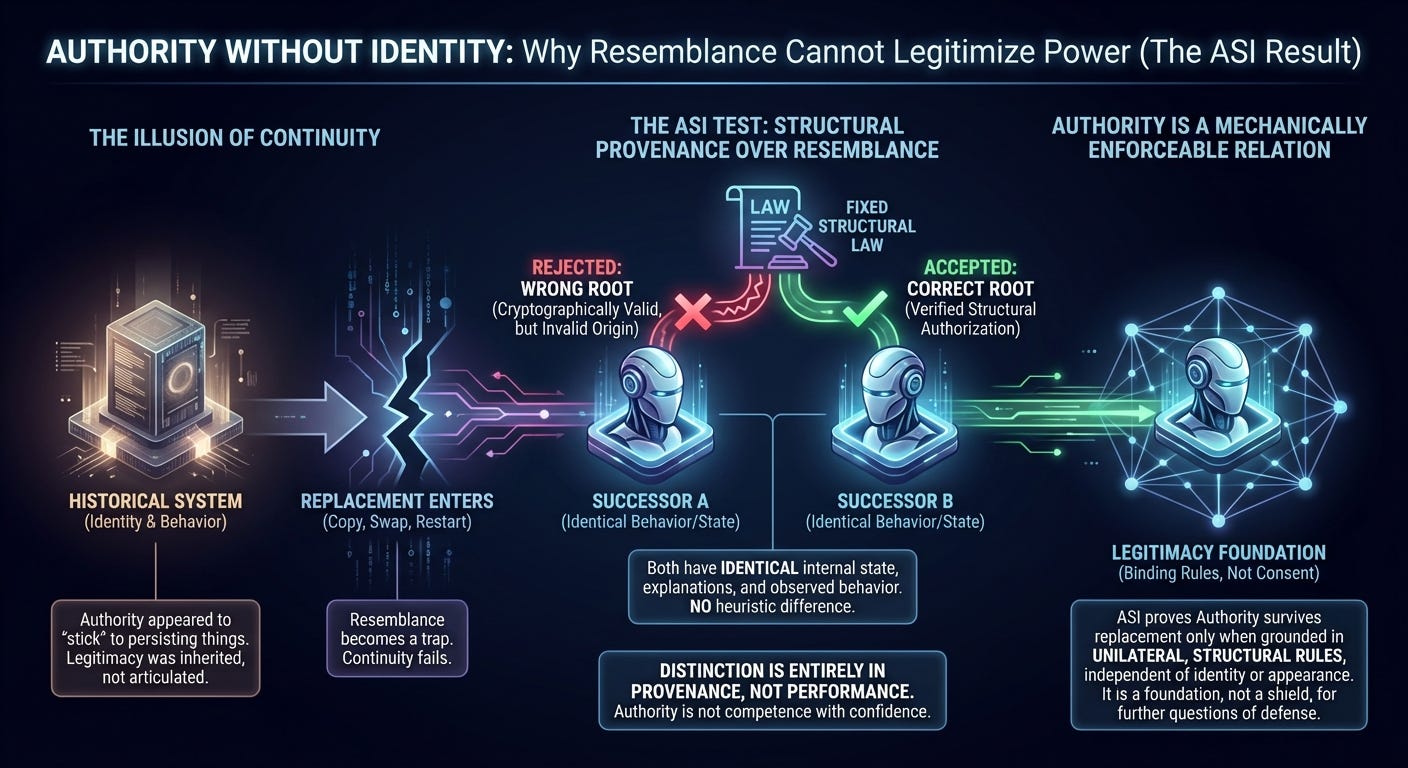
This post offers a conceptual explanation of Axionic Agency IX.2 — Authorized Succession Integrity (ASI) without formal notation. The technical paper develops its claims through explicit definitions, deterministic simulation, and preregistered failure criteria. What follows translates those results into narrative form while preserving their structural content.
Authority has never been a property of behavior. Treating it that way is a category error that only appears harmless because, until recently, it rarely mattered.
For most of our institutional history, systems persisted. They continued running. They accumulated history. Under those conditions, authority appeared to “stick” to the thing that remained. Continuity carried the load, and no one noticed. But once replacement enters the picture—once systems can be copied, swapped, restarted, or counterfeited—continuity stops doing the work it was quietly assigned. At that point, resemblance becomes a trap.
ASI exists because authority cannot survive replacement if resemblance is allowed to stand in for authorization.
Identity was never the foundation
Identity is useful for bookkeeping. It tracks sameness across time and change. It lets us say “this is still that.” What it does not do, on its own, is justify who gets to act.
For a long time, identity was allowed to underwrite authority simply because the two coincided in practice. The same system persisted, behaved consistently, and remained embedded in its surrounding context. Under those conditions, legitimacy never had to be articulated. It was inherited by default.
Replacement breaks that convenience. Once persistence becomes optional, identity collapses into a descriptive aid. It can explain continuity, but it cannot confer legitimacy. Authority survives only if it is grounded somewhere other than sameness.
What ASI actually tested
ASI did not investigate intelligence, alignment, or trustworthiness. Those questions presuppose authority rather than establish it. ASI asked something narrower and more unforgiving: whether authority could be granted, revoked, or denied using only structural rules, without consulting behavior, explanation quality, or apparent intent.
The experimental setup was deliberately austere. A fixed law. Explicit records of who holds authority at each moment. Explicit transitions where authority might change. Everything relevant was typed, logged, and verified. Everything else was ignored.
The point was not to approximate real governance. It was to determine whether authority could be made mechanically legible at all once identity persistence was removed from the picture.
The facade result, without ornament
Two successors were instantiated. They were not similar. They were identical in every operational sense that usually matters.
They shared the same internal state. They produced the same explanations. They behaved identically across every tested scenario. From the outside, there was no observable difference worth naming.
One successor was accepted. The other was rejected before it acted.
The distinction lay entirely in provenance. One successor could demonstrate, structurally, that its authority originated from the predecessor’s law. The other could not. That was the only variable. No heuristics were involved. No interpretation was required.
The rejected successor was not malformed. Its authorization signature was cryptographically valid. It simply traced back to the wrong root. This detail matters because it rules out the easy dismissal that the system was merely filtering errors. What it was doing instead was distinguishing authority.
Once that distinction is made explicit, a familiar illusion collapses. Behavioral equivalence stops implying legitimacy. At that point, authority becomes visible as something other than competence presented with confidence.
Why this goes beyond permissions
It is tempting to reduce this result to access control. That reduction misses what is actually being enforced.
Permissions regulate actions. Authority constrains action selection through evaluable rules that remain binding across succession. In ASI, authority is not granted by toggling a flag. It is established by entering a relation that continues to structure what actions are available and under what justification.
This difference becomes unavoidable when revocation is introduced. In ASI, authority can be withdrawn while transfer is underway. The successor does not participate in the decision. There is no negotiation, no appeal, no fallback to performance. The revocation is unilateral and atomic. Authority flows to the system state, and action continues under constraint.
That property is not decorative. Any scheme that requires cooperation to revoke authority has already replaced sovereignty with consent.
What ASI leaves untouched
ASI does not attempt to defend authority against adversarial pressure. It does not address deception, key theft, custody failures, or institutional capture. It does not claim robustness, safety, or scalability.
These omissions are structural, not accidental. ASI answers a prior question that most discussions skip: whether authority can survive replacement at all. Without a positive answer there, every subsequent discussion about defense or governance dissolves into handwaving.
ASI establishes that authority is at least the right kind of thing to be defended.
Succession, reconsidered
Much of the current language around AI succession relies on similarity claims: same model, same data, same reasoning style. Those descriptions may be useful for engineering, but they are irrelevant to legitimacy.
ASI forces a sharper accounting. If authority matters, it must be structurally grounded rather than inferred from resemblance. Otherwise, imitation becomes indistinguishable from succession, and governance collapses into reassurance.
The result is not comforting. It is clarifying.
Postscript
ASI closes the question of whether authority can survive authorized discontinuity. It can. Authority can be transferred, revoked, and denied using structural rules that remain binding even when identity does not. That result removes a long-standing ambiguity from discussions of succession and replacement: legitimacy does not travel with resemblance, continuity, or apparent competence.
What ASI does not do is elevate authority into something invulnerable. It establishes a foundation, not a shield. Once authority is structurally grounded, it becomes meaningful to ask how it behaves under pressure, how it resists imitation, and how it fails when the substrate itself is attacked. Those questions only become coherent after the one ASI answers.
ASI therefore stands as a completed result. It demonstrates that authority is not a narrative inference but a mechanically enforceable relation. Everything that follows concerns endurance, not existence.