

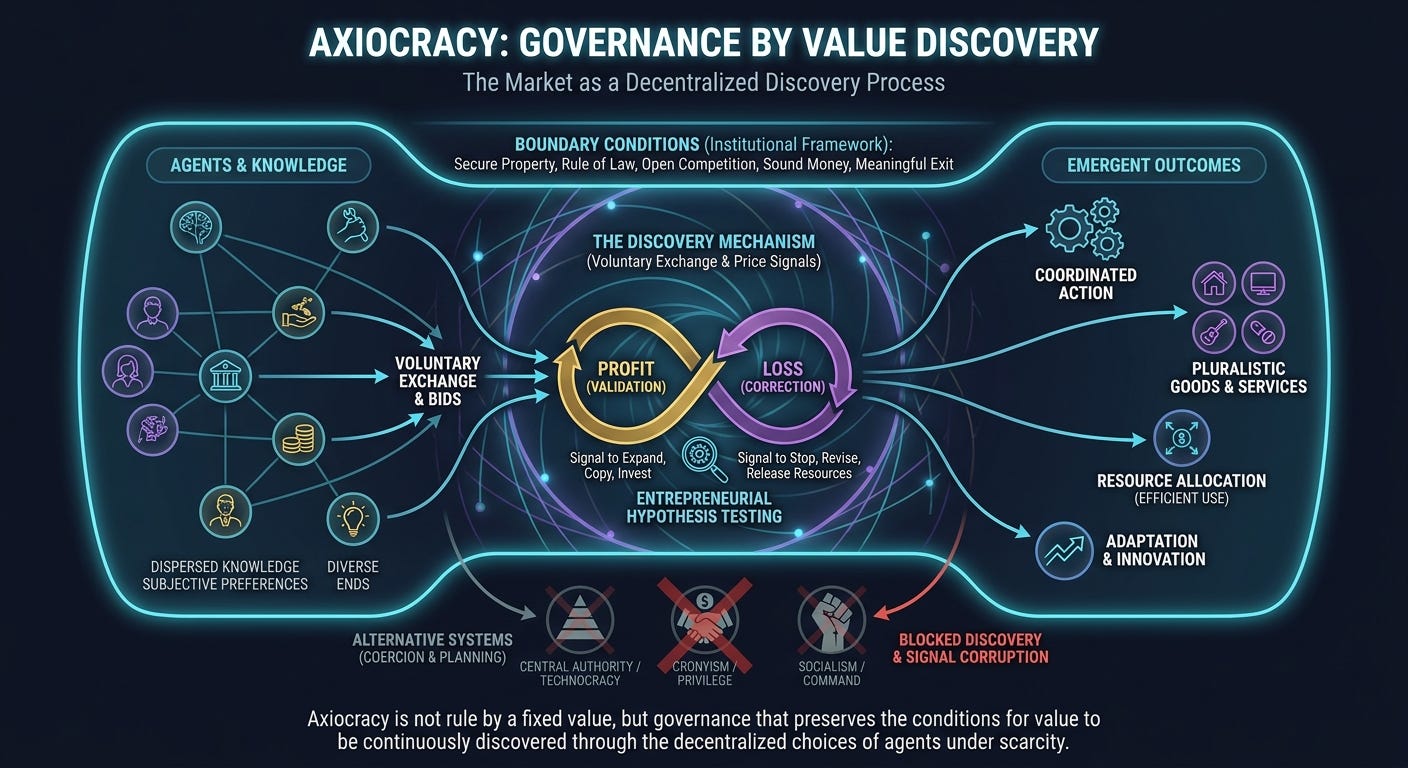
Free markets are usually defended in economic language. They allocate scarce resources efficiently. They coordinate dispersed knowledge. They reward productivity and punish waste. Those claims are true, but they do not reach the bottom of the matter. The deepest case for markets is not merely that they are efficient. It is that they are the only large-scale social mechanism we have discovered that allows value to emerge from the choices of actual agents without requiring some authority to define value in advance.
That is what I mean by axiocracy.
The word comes from axios, meaning worthy or valuable, and kratos, meaning rule or governing power. Democracy means rule by the people. Technocracy means rule by technical experts. Bureaucracy means rule by office. Axiocracy means rule by value. At first glance, that sounds like a dangerous political theology. Rule by value immediately raises the question: whose value, judged by whom, and enforced against which dissenters?
That question is exactly why the market version of axiocracy matters. In a free market, value is not declared by a central authority. It is not handed down by priests, professors, committees, regulators, activists, kings, or voters. It is discovered through voluntary exchange among agents who do not need to agree about final ends.
Axiocracy, in this sense, is governance by value discovery.
What Kind of Value?
The word value has to be handled carefully because it carries too much metaphysical and moral baggage. By value, I do not mean objective moral worth, human dignity, spiritual merit, social virtue, or need. I mean demonstrated exchange value under conditions of property, scarcity, purchasing power, and consent. Markets do not reveal what a human life is worth. They reveal what agents are willing and able to trade for, given their circumstances and constraints.
That distinction matters because it blocks a common equivocation. Critics often speak as though defenders of markets believe prices measure ultimate human worth. That is nonsense. A market price is not an entry in the Book of Life. It is a signal generated by exchange. It tells us something narrower and more useful: what someone was willing and able to give up for something else at a particular time, under particular constraints, against available alternatives.
This makes the claim both more modest and more powerful. Axiocracy is not a complete moral theory. It does not pretend to answer every question of justice, meaning, dignity, or flourishing. It is a theory of decentralized resource governance. It says that when scarce resources must be allocated among competing uses, the best known mechanism is voluntary exchange disciplined by property, price, competition, liability, and exit.
That may sound less grand than “rule by value,” but the restriction is what makes the idea defensible. Markets discover a particular kind of value. They discover exchange value among agents with effective demand. They do this continuously, locally, and adaptively, without requiring society to aggregate all preferences into one official hierarchy.
The Pluralism of the Price System
A market does not require everyone to agree on what is valuable. That is its civilizational genius.
One person buys Bitcoin. Another buys bonds. One buys insulin. Another buys a guitar. One starts a business. Another pays for childcare. One customer wants luxury, another wants durability, another wants the cheapest tolerable substitute. The market does not need to decide which of these ends is morally superior. It does not need to collapse them into a national purpose. It allows them to coexist, conflict, adapt, and reveal themselves through action.
This is the sense in which markets are more pluralistic than politics. Voting tends to compress many preferences into one collective outcome. The winner gets the policy and the loser gets ruled. Markets allow different agents to pursue different goods at the same time. One person can buy the product, another can refuse it, a third can build a competitor, and a fourth can ignore the whole category. The market permits divergence without requiring domination as the normal form of resolution.
Prices are the compressed signals of that process. They are information under scarcity. They tell us what people are willing and able to give up for something else. Profit is feedback that a producer has created something others value more than the resources consumed in producing it. Loss is feedback that resources are being used in a way people do not sufficiently value. Neither profit nor loss is a moral verdict. They are correction signals.
This is why free markets are so difficult to improve by political design. A bureaucrat can announce priorities. A legislature can assign funds. A central bank can manipulate signals. A regulator can force compliance. None of these acts can substitute for the discovery process itself, because the relevant knowledge is not sitting in one place waiting to be collected.
Hayek saw this with unusual clarity. The economic problem is knowledge. Relevant knowledge is dispersed, tacit, local, changing, and embodied in circumstance. Much of it is unavailable even to the people who possess it until they are forced to choose. Markets solve this by allowing people to use knowledge they could never fully articulate. The price system coordinates fragments of perception, preference, skill, risk tolerance, timing, and opportunity across millions of agents.
That is axiocracy in action: no single mind commanding the system, no official doctrine of value, no central moral calculator, just feedback disciplined by scarcity and choice.
Entrepreneurship as Hypothesis Testing
The entrepreneur is not merely a capitalist hero or a profit-seeking opportunist. The entrepreneur is a hypothesis generator. Every business proposal says, in effect: this product, at this price, through this channel, for these people, now. The market answers.
Customers answer with money, attention, loyalty, indifference, or exit. Investors answer with capital or refusal. Competitors answer by copying, improving, undercutting, or exposing the weakness of the model. Workers answer by joining, leaving, bargaining, or building alternatives. Suppliers answer with terms. Lenders answer with rates. Reality answers through cost.
This is a continuous epistemic process. The market does not simply “reward the good” in some sentimental sense. It tests whether a proposed use of resources can survive contact with actual preferences under actual constraints. A business that produces something people value more than the inputs it consumes earns the right to command more resources. A business that fails that test loses the ability to keep consuming them.
That is the moral-epistemic structure beneath profit and loss. Profit says: continue, expand, copy, investigate. Loss says: stop, revise, release these resources to other uses. When the system is functioning properly, capital is not a trophy. It is delegated control over scarce resources, granted conditionally by the demonstrated ability to satisfy other agents’ preferences through voluntary exchange.
This is why cronyism is so corrosive. It allows resource control to persist without passing the value test. It replaces customer judgment with political access. It converts capital from a feedback-mediated claim on future production into a privilege protected from correction.
Purchasing Power and the Real Limitation
The strongest objection to this view is that market demand is weighted by purchasing power. That objection is correct, and any serious account of axiocracy has to absorb it rather than dodge it.
A price is not a democratic vote. A billionaire’s third yacht and a poor family’s rent payment do not enter the market as equal units of human need. They enter as bids backed by different capacities to pay. Markets discover exchange value among agents with effective demand. They do not measure need directly, and they do not weight each human preference equally.
This is a limitation of market signals. It is also an honest description of what the signal measures. The mistake is to treat this limitation as if it automatically vindicates political correction. The mere fact that a signal is imperfect does not imply that a coercive substitute contains more truth. Political systems have their own distortions: concentrated incentives, regulatory capture, bureaucratic self-preservation, electoral pandering, ideological fashion, moral panic, and the perennial temptation to spend other people’s money for visible constituencies while hiding the costs.
The relevant question is therefore structural. Does the proposed correction make prices more truthful, property more secure, fraud more costly, liability more complete, competition more open, and exit more meaningful? Or does it replace market feedback with official preference?
That distinction matters. A policy that internalizes real costs can improve the discovery process. A policy that transfers resources to politically favoured actors corrupts it. A rule that punishes fraud strengthens exchange. A rule that protects incumbents from competition weakens it. A liability regime that forces polluters to bear the costs they impose makes prices more honest. A subsidy that shields failure from loss makes prices less honest.
The issue is not “market versus state” as a tribal slogan. The issue is whether a given institution preserves or degrades the value-discovery process.
Coercion and Signal Corruption
Coercion is destructive because it does more than move resources. It changes what the system is able to know. When people are forced to buy, sell, fund, subsidize, license, or comply, their actions no longer reveal their valuations in the same way. The signal is contaminated.
This is why fiat inflation is anti-axiocratic. It degrades the measuring instrument through which value comparisons are made. This is why regulatory capture is anti-axiocratic. It makes compliance power more important than customer satisfaction. This is why bailouts are anti-axiocratic. They preserve failed hypotheses beyond the point at which reality has withdrawn support. This is why protectionism is anti-axiocratic. It prevents consumers from disciplining domestic producers through exit.
The common pattern is the substitution of political power for voluntary valuation. Once that substitution occurs, resources no longer flow primarily toward demonstrated value creation. They flow toward influence, access, insulation, and narrative control. The society may still call this economic policy. It may even call it compassion or stability. Structurally, it is a degradation of the discovery mechanism.
This is also why socialism fails at a level deeper than incentives. The incentive problem is real, but the knowledge problem is more fundamental. If private exchange, market prices, profit, loss, and capital discipline are suppressed, the system loses the machinery by which it discovers whether resources are being used well. It must then substitute plans, quotas, committees, formulas, political priorities, or moral declarations. Those substitutes can express values. They cannot discover exchange value with the same resolution, speed, and error-correcting force as markets.
Axiocracy is the opposite institutional instinct. It begins from the premise that value is plural, local, agent-relative, and discovered in action. It therefore tries to preserve the conditions under which those discoveries can occur.
Boundary Conditions
Markets are error-correction systems, and error-correction presupposes error. Businesses fail. Consumers misjudge. Fads happen. Fraud happens. Monopolies can form. Information can be asymmetric. Externalities can be real. These are not embarrassing exceptions to be waved away. They are the boundary conditions of axiocracy.
A functioning axiocracy requires secure property, contract enforcement, fraud prevention, dispute resolution, open competition, sound money, liability, and meaningful exit. None of these conditions should be treated as automatic. They are institutional achievements. The important question is which arrangements provide them with the least coercion and the least corruption.
Externalities are especially important because they expose the limits of simple bilateral exchange. Pollution, systemic financial risk, and other displaced costs show what happens when the parties to a transaction impose harms on others who never consented to the exchange. A price that excludes those costs is lying. A market order that cannot recognize imposed costs will misallocate resources because part of reality has been kept off the books.
The remedy is to make costs visible without converting every inconvenience into a license for political management. Liability, property rights, tort law, insurance, contractual covenants, class actions, technical measurement, and targeted regulation can all function as mechanisms for restoring truthful pricing. The danger is that the language of externality becomes an all-purpose excuse for authority to override voluntary valuation whenever officials dislike the result.
That is the knife edge. Correcting market failure can strengthen axiocracy when it restores the conditions of truthful exchange. Political intervention destroys axiocracy when it substitutes official judgment for the valuations of agents.
Subjective Value Without Centralized Moral Authority
The market does not need an objective theory of value handed down from metaphysics. It needs agents with preferences, resources, constraints, and the freedom to trade. Subjective value does not mean arbitrary value. It means value exists from the standpoint of agents pursuing ends under conditions of scarcity.
This is precisely why markets fit a pluralistic society better than political allocation. People do not merely disagree about means. They disagree about ends. They have different tastes, time horizons, tolerances for risk, standards of beauty, family obligations, ambitions, loyalties, and private meanings. A political system is constantly tempted to transform those differences into a hierarchy of approved social purposes. A market allows many of them to remain differences while still coordinating action.
That is institutional humility. It is an admission that no ruler, planner, expert, committee, electorate, or moral philosopher knows enough to rank all human purposes into a single ordering. Axiocracy does not require such a ranking. It requires rules under which agents can reveal and revise their own rankings through exchange.
This is the hidden moral structure of free markets. They respect the fact that value is agent-relative while still allowing cooperation at scale. They do not demand metaphysical agreement before coordination can occur. They let people act.
The Axiocratic Standard
Axiocracy is what free markets approximate when property is secure, exchange is voluntary, money is sound, liability is real, competition is open, and exit is meaningful. It is the alternative to rule by status, rule by credential, rule by committee, rule by moral panic, and rule by force.
The central question of political economy is not whether markets produce perfect outcomes. They do not. Nothing does. The question is which system best preserves the discovery process by which agents reveal, revise, and coordinate value under conditions of scarcity.
That system is the free market.
The name for that principle is axiocracy.