

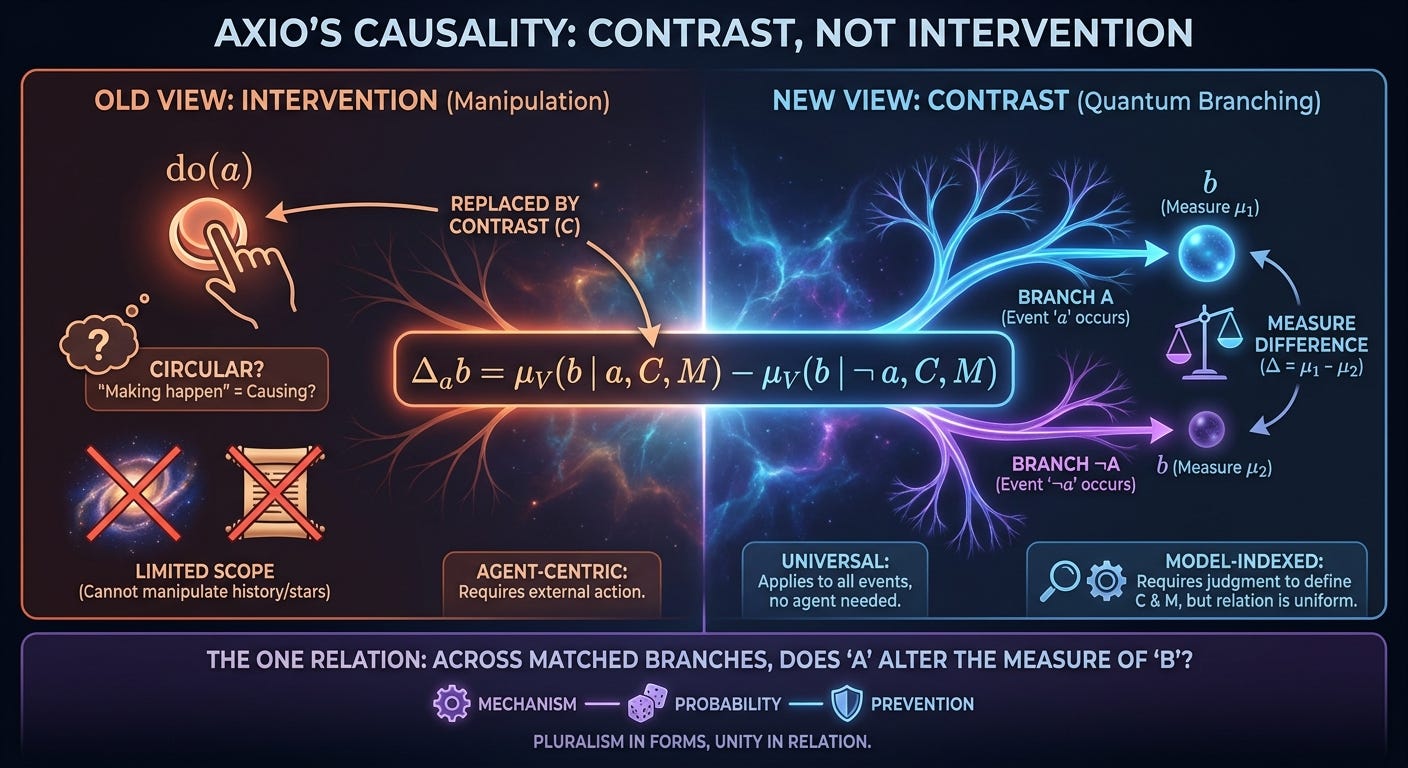
David Chapman argues that there is no general theory of causality.

His case is serious. Ordinary causal language covers switches, diseases, wars, chemical reactions, absences, institutions, statistical risks, molecular mechanisms, and public-health policies. Philosophers repeatedly propose one relation meant to unify them, then discover counterexamples.
Interventional theories seem especially vulnerable. To say that A causes B when making A happen makes B happen appears circular, since “making A happen” already sounds like causing A. The account also seems anthropocentric. We cannot manipulate a supernova, rerun the First World War, or experimentally remove a particular mutation from evolutionary history, yet all can figure in legitimate causal explanations.
Chapman concludes that causality is not one coherent relation. “Cause” names a diffuse collection of practical schemas. We learn to use those schemas in different contexts, switch among them when one fails, and apply them through judgment rather than general formal rules.
That conclusion goes too far. Chapman has established pluralism in causal models, evidence, explanatory aims, and ordinary language. He has not established pluralism in the underlying relation those models represent.
The failure of manipulation as a universal definition does not imply the failure of counterfactual comparison. Causation requires a contrast between what happens when an event occurs and what happens in appropriately matched alternatives where it does not. Nothing in that requirement says an agent must produce the event, that the event must be experimentally repeatable, or that the alternative must be merely imagined.
In the Quantum Branching Universe, the alternatives are physically realized.
This distinction prompted a revision to the Axio definition of causality.
The previous formulation
The earlier Axio account used the familiar intervention notation:
The Vantage is V, the causal model M, the candidate cause a, and the outcome b. The Measure function gives Measure relative to the Vantage.
The intended idea was straightforward: compare the Measure of the outcome under a model in which the candidate cause occurs with its Measure under an otherwise matched model in which it does not. A positive difference means the candidate raises the Measure of the outcome, a negative difference means it suppresses it, and zero means it makes no causal difference under that contrast.
The notation imported more than the intended idea.
In Pearlian causal models, the do-operator marks an intervention. The normal process generating a variable is replaced by an exogenous assignment while specified parts of the model are held fixed. This is useful machinery, and it distinguishes causal comparison from ordinary observational conditioning: umbrella-carrying predicts rain, but forcing people to carry umbrellas does not produce rain. The do-operator encodes that distinction.
Yet the notation also suggests that intervention is constitutive of causation, which invites exactly Chapman’s objections. Who or what performs the intervention? Does making the event happen already presuppose causation? What about events no agent can manipulate, or singular events that cannot be repeated?
A defender of interventionism can answer these questions by treating the do-operator as a formal model operation rather than a literal human act. But the QBU does not need to inherit the ambiguity. Its ontology already contains the alternatives that intervention semantics are designed to represent.
The revised definition
The canonical Axio account now states:
The new term C is the contrast specification. It identifies the matched branch-sets and the declared background conditions held fixed, so that the relevant difference is the occurrence or non-occurrence of the candidate event.
The candidate cause a is a modeled event predicate: a condition on branches that partitions the relevant set into occurrence and non-occurrence classes. Whether it corresponds to a variable assignment, a coarse-grained historical episode, or a molecular state depends on the model, and nothing in the definition requires these to be the same kind of object.
The vertical bar does not record an observation. The contrast specification and the model are not additional events being conditioned on; they index the comparison. The two terms give the Measure of the outcome across matched branches in which the candidate event occurs, and the Measure of the outcome across matched branches in which it does not.
The definition retains the useful work performed by intervention models while removing manipulation from the foundation. An ordinary causal model may still construct the contrast using a do-operator, and in the QBU the contrast specification also identifies which physically realized branches constitute the counterfactual comparison. Intervention becomes one method for specifying a contrast rather than the meaning of causation itself.
Causation requires a counterfactual contrast. A counterfactual contrast does not require an intervention.
No one has to make the event happen
Chapman’s circularity objection begins with the phrase “make A happen.” If “make” means “cause,” then the definition says that A causes B when causing A causes B, and nothing has been explained.
The revised Axio definition contains no such operation. Suppose an event occurs in one branch-set and does not occur in another. The comparison does not ask anyone to produce either result. It asks whether the Measure of the outcome differs across the matched sets.
For a supernova, the candidate event may be a particular stellar collapse and the outcome the formation of heavy elements or a shock-induced star-forming region. For a historical event, the candidate may be an assassination, a failed mobilization order, or a diplomatic communication. For a mutation, the candidate may be the presence of a genetic variant in a lineage and the outcome its later reproductive prevalence.
None requires experimental access. None requires an agent outside the system. None requires the event to happen twice within one history. The relevant alternatives occur in different branchcones.
Singular causation remains available
Chapman argues that interventionism cannot explain individual events, because we cannot prevent the First World War or make it happen again. That objection assumes counterfactual comparison requires temporal repetition. It does not.
A singular causal claim compares descendants of an appropriate ancestral region. Some descendants contain the event; others contain a relevantly matched alternative. The event may occur only once within each branch, yet the branching structure supplies multiple physical continuations.
Consider the claim:
Princip’s assassination of Franz Ferdinand contributed to the outbreak of the First World War.
The model must specify what counts as the candidate event, the outcome, and the relevant background. The contrast groups branches as equivalent under a coarse-grained historical model that preserves the politically relevant background variables while allowing the attack outcome to differ. Those branches need not be identical at the microphysical level; they need only agree under the model’s declared representation. The causal effect is then a difference in the Measure of later war outcomes across those branch-sets.
This does not establish that the assassination was the cause of the war. Other models may evaluate German military planning, Austrian policy, Russian mobilization, Serbian nationalism, or failures of diplomacy. Chapman is right that many heterogeneous factors can legitimately be called causes of the same historical outcome. Their heterogeneity shows that causal questions can select different variables, contrasts, temporal scales, and levels of description. It does not show that causation itself is heterogeneous.
Contrast is not correlation
Removing the do-operator creates an obvious danger. One might read the revised equation as ordinary conditioning:
That would be inadequate, because observational dependence is not causation. Chapman gives familiar examples. Umbrella-carrying predicts rain. Haitian identity was correlated with early AIDS cases without causing them. Homosexuality correlated with infection risk through mediating behavior rather than functioning as a direct biological cause.
The role of the contrast specification is to block that mistake. A valid contrast must match the branch-sets on declared background structure. It must isolate the difference associated with the candidate event rather than merely select histories where the candidate and outcome happen to appear together. This is the same problem an intervention model solves by severing incoming structural relations to a variable; Axio solves it more generally by requiring an explicit contrast specification.
The formalism therefore does not say that wherever A and B co-occur, A causes B. It says that relative to a specified model and matched contrast, the occurrence of A changes the Measure of B.
The adequacy of the contrast remains open to criticism. A bad contrast produces a bad causal inference, but that is not a defect unique to the definition. It is the substantive work of causal modeling.
What the contrast specification must do
A contrast specification is not a verbal instruction to compare similar worlds. It declares an equivalence relation over branch histories at a chosen coarse-graining.
Two histories may belong to the same contrast class when they agree on a specified set of background variables up to the divergence relevant to the candidate event. They need not be microphysically identical, and they need not be judged causally equivalent in advance. Their equivalence is defined by the model.
That last point matters. The contrast specification does not identify branches already known to be equivalent in every causally relevant respect, which would be circular. It identifies branches that agree on a declared set of modeled features and differ on the candidate event.
The modeler selects the variables, the grain, the ancestral region, the background coordinates, and the outcome horizon. The formalism then evaluates which branches satisfy the specification, how their Measures are distributed, whether the outcome Measure differs, and whether the represented dependence respects temporal ancestry.
Whether the declaration is scientifically useful is an empirical question. Whether a branch belongs to the declared class is a formal one. A poorly chosen contrast can produce a formally correct answer to an irrelevant, unstable, or badly scoped question, which is why scientific adequacy requires more than formal validity.
The division of labor
Branch comparison alone does not define causation. The Axio account contains three distinct components.
The QBU supplies physically realized alternatives and their Measure. The contrast specification selects comparable branch-sets. The causal model represents the variables, temporal ordering, and structural relations under which the contrast is evaluated. The Measure comparison then determines whether the candidate event makes a causal difference to the outcome.
The structural relations in the model are generative or dynamical dependencies rather than prior causal verdicts. They specify how represented variables evolve or constrain one another; the matched Measure comparison then determines which of those dependencies count as causal under the declared contrast. Without that restriction the definition would reduce to calculating causal strength inside a model that had already assumed the answer.
This division matters because shared ancestry and temporal ordering do not by themselves distinguish causation from common-cause correlation. Two events may co-vary because both descend from an earlier condition. A valid model must represent enough intermediate structure to distinguish direct dependence, mediated dependence, and common-cause correlation, and it need not assume in advance that the candidate event is causal.
The QBU does not relieve the modeler of structural analysis. It supplies the ontology in which that analysis is evaluated.
Formal validity is not scientific adequacy
Any declared contrast specification can generate a Measure difference. That does not make every resulting causal claim scientifically warranted.
A contrast is formally well-defined when its variables, background coordinates, ancestral region, and outcome horizon are explicit. It is scientifically adequate only when the model survives empirical tests. A successful causal model should predict outcome distributions beyond the cases used to construct it, transport across relevant contexts, agree with interventions where interventions are possible, cohere with known intermediate structure, and remain stable under plausible alternative coarse-grainings.
The modeler chooses the question. The physical distribution constrains the answer. Evidence determines whether the model deserves belief.
This is why model dependence does not reduce causation to preference. Once the variables, contrast, and coarse-graining are declared, branch membership and Measure differences are constrained by the physical ontology. A modeler may ask a bad question but cannot choose the answer.
Chapman’s genuine insight
Chapman repeatedly emphasizes that causal analysis requires judgment. One must decide which entities count as possible causes and effects, what is usual and what belongs to the background, where to cut off a causal chain, which probability model to use, which scale and context matter, and which interventions or responses serve the practical purpose.
Axio agrees. The formal definition does not infer the uniquely correct candidate event, outcome, contrast, or model directly from raw physics. It does not decide whether a clinician should model HIV replication, CD4 depletion, treatment adherence, opportunistic infection, sexual exposure, or public-health policy. It does not decide whether the relevant outcome is one patient’s pneumonia, progression to an AIDS diagnosis, transmission within a population, or mortality across a decade. Those are modeling decisions.
But Chapman repeatedly moves from the claim that selecting a causal model requires contextual judgment to the conclusion that causality has no unified formal structure. The inference fails.
A coordinate system must be selected before spatial coordinates have values. A macrostate partition must be selected before thermodynamic entropy is defined. A decoding relation must be specified before a signal carries information. A fitness function depends on an environment. None of these dependencies makes the resulting concepts merely informal collections of unrelated schemas.
Model dependence is not formal indefinability. Indexicality is not arbitrariness.
HIV and AIDS
Chapman’s HIV example is especially useful because it combines several levels of causal explanation.
“HIV” is a polyphyletic, functionally defined category. Different viral lineages crossed into humans independently and use different molecular mechanisms. They are grouped together because they produce sufficiently similar pathological and practical consequences. “AIDS” is also purpose-dependent: its administrative definition combines HIV infection with specified immunological thresholds or opportunistic conditions, and the category was designed partly to support diagnosis, treatment, reimbursement, surveillance, and public-health decisions. Its boundaries have changed with available therapies.
Chapman argues that the sentence “HIV causes AIDS” draws simultaneously on probabilistic, mechanistic, and interventional causal schemas. Epidemiology established statistical relationships. Molecular biology revealed mechanisms of infection and immune damage. Treatments showed that suppressing HIV prevents or reverses AIDS progression. In his account, these are not merely different forms of evidence. They are different pieces of what “cause” means in the sentence.
Axio offers a different analysis. The evidence is heterogeneous because the causal model is multiscale.
At the clinical level, the candidate event is sustained HIV infection, the outcome is progression to severe immunodeficiency, and the contrast holds host and treatment conditions matched. At the molecular level, the candidate is active viral protease function, the outcome is successful viral replication, and the contrast holds intracellular conditions matched. At the therapeutic level, the candidate is untreated viral replication, the outcome is progression to AIDS-defining conditions, and the contrast is matched patients receiving effective suppression. At the public-health level, the candidate is a specified exposure pattern, the outcome is population-level infection incidence, and the contrast holds demographic and epidemiological conditions matched.
These are different causal claims using different variables and contrasts. They do not require different meanings of causation. In each case the question is whether the Measure of the outcome differs across matched branch-sets containing and lacking the candidate event.
Mechanistic evidence helps construct the model. Statistical evidence estimates branch Measures. Treatment effects validate contrasts and structural pathways. The methods differ because they address different parts of the same causal analysis.
One relation, several causal forms
Chapman is right that scientists employ several causal schemas. The Axio claim is that these schemas can be represented as different structures within one relation.
Mechanistic causation is a path of Measure-changing dependencies. Probabilistic causation is a nonzero but nondeterministic shift in outcome Measure. An enabling condition alters whether another causal path can operate. Prevention produces a negative shift in outcome Measure. A mediator transmits part of a Measure difference through an intermediate variable. A background condition is a modeled variable held fixed by the contrast. A historical cause is a coarse-grained event whose occurrence changes the Measure of a later macro-outcome. A necessary cause makes the outcome Measure vanish in its absence. A sufficient cause drives the outcome Measure toward one under specified background conditions.
The schemas differ in structure, grain, and explanatory use. They need not differ in the relation they instantiate.
Cycles do not defeat ancestry
Chapman notes that biological processes are often cyclic. HIV infection causes replication, replication produces new infections, and the process continues. He argues that such cycles challenge theories requiring causes to precede effects.
The apparent problem comes from suppressing time indices. A more explicit sequence is:
Infected cells at one time contribute to viral replication at a later time. Viral replication then contributes to new infections later still. At the aggregate level, infection and replication form a feedback loop; at the event level, each causal relation still respects temporal ancestry.
The same applies to ecological feedback, homeostasis, economic cycles, and recurrent neural processes. A cyclic model represents repeated temporally ordered dependence. It need not imply that an event causes itself at the same moment.
The QBU ancestry condition survives.
Background conditions and causes
Chapman asks why a beating heart is not usually counted as a cause of AIDS, even though dead people do not develop it. Why is normal electrical power not ordinarily called a cause when a switch turns on a lamp? Why does a normal CCR5 gene count as background rather than cause?
There is no context-free answer, because “cause” in ordinary discourse often means less than “factor on which the outcome counterfactually depends.” The Axio definition distinguishes causal effect from explanatory salience.
A beating heart may have a nonzero causal contribution under some contrast. Compare matched branches where the heart continues beating with branches where it stops, and later AIDS progression may disappear because the patient dies. That is a genuine counterfactual dependence, but it is rarely the dependence under investigation. A medical model of AIDS normally holds continued life fixed and varies infection, replication, immune response, or treatment. The contrast specification excludes cardiac arrest because it destroys the domain in which the question is posed.
This does not mean the heart is metaphysically not a cause. It means causal attribution is indexed to a model and contrast.
Ordinary language then adds a pragmatic selection rule. We tend to mention abnormal, manipulable, informative, morally relevant, or diagnostically useful contributors rather than stable background conditions. Chapman is correct that this selection is contextual. It does not follow that the underlying causal dependence is informal.
Axio should therefore resist collapsing two questions. Did changing A alter the Measure of B? Is A worth naming as the cause in this context? The first is causal analysis. The second is explanatory and pragmatic selection.
What this theory claims
The Axio definition is not offered as a metaphysically neutral account compatible with every interpretation of physics. It is conditional on the QBU.
Axio already treats branching structure and Measure as fundamental, and the causal definition asks what relation follows from that ontology. If the QBU is false, this account fails with it. That is a cost of the larger theory rather than a special cost incurred to explain causation, and it is preferable to pretending a theory can be both physically grounded and ontologically noncommittal.
The QBU is not introduced here as an extravagant device for rescuing causal language. It is the prior ontology from which the causal relation is derived.
What the revision concedes and rejects
The revised definition concedes a great deal to Chapman. There is no unindexed causal relation directly readable from two raw events, no unique contrast supplied solely by syntax, no universal list of variables privileged at every scale, and no algorithm that determines which background conditions a scientist should hold fixed. Causes need not be manipulable by humans, causal claims need not concern repeatable events, and ordinary causal language offers no guarantee of identifying all contributing dependencies or of using “cause” consistently across purposes. These concessions specify the indices required for a causal claim to have determinate content.
What the revision rejects is the inference Chapman draws from them. He writes that abandoning the search for a rigorous, uniform theory is necessary because causal meanings are purpose- and context-dependent.
Purpose and context can affect which model is relevant, which variables are represented, which event is contrasted, which branch-sets are matched, which outcome is measured, and which causal contribution is worth mentioning. None of this establishes that the relation between the selected variables must itself change from case to case.
The invariant relation is:
Across appropriately matched branch-sets, does the occurrence of A alter the Measure of B?
Chapman identifies pluralism in models, evidence, explanatory goals, and ordinary usage. Axio does not deny that pluralism. It denies that those differences require multiple irreducible meanings of causation.
Postscript
Chapman’s critique exposed a real weakness in the earlier Axio presentation. The do-operator made intervention appear more fundamental than it is, blurring two distinct ideas: specifying a counterfactual contrast, and producing an event through manipulation. Standard causal inference often uses the second to construct the first. The QBU requires only the first.
Replacing intervention notation with an explicit contrast specification clarifies the ontology:
No external agent edits the universe. No inaccessible event must become experimentally accessible. No singular history must be replayed. No exact microphysical twin is required. The branch structure supplies realized alternatives, the contrast specification determines which alternatives count as equivalent under the model, the causal model represents the variables and their temporal ordering, and the Measure comparison determines whether the candidate makes a causal difference.
Scientific judgment remains indispensable. It determines which question is being asked and which contrast expresses it. Once that work is done, the answer is not merely a felt schema or practical gestalt. It is a difference in Measure across specified branchcones.
Chapman is right that manipulation is not the essence of causation. He is wrong that its failure leaves only nebulous causal pluralism.
Causality does not require intervention. It requires contrast.