

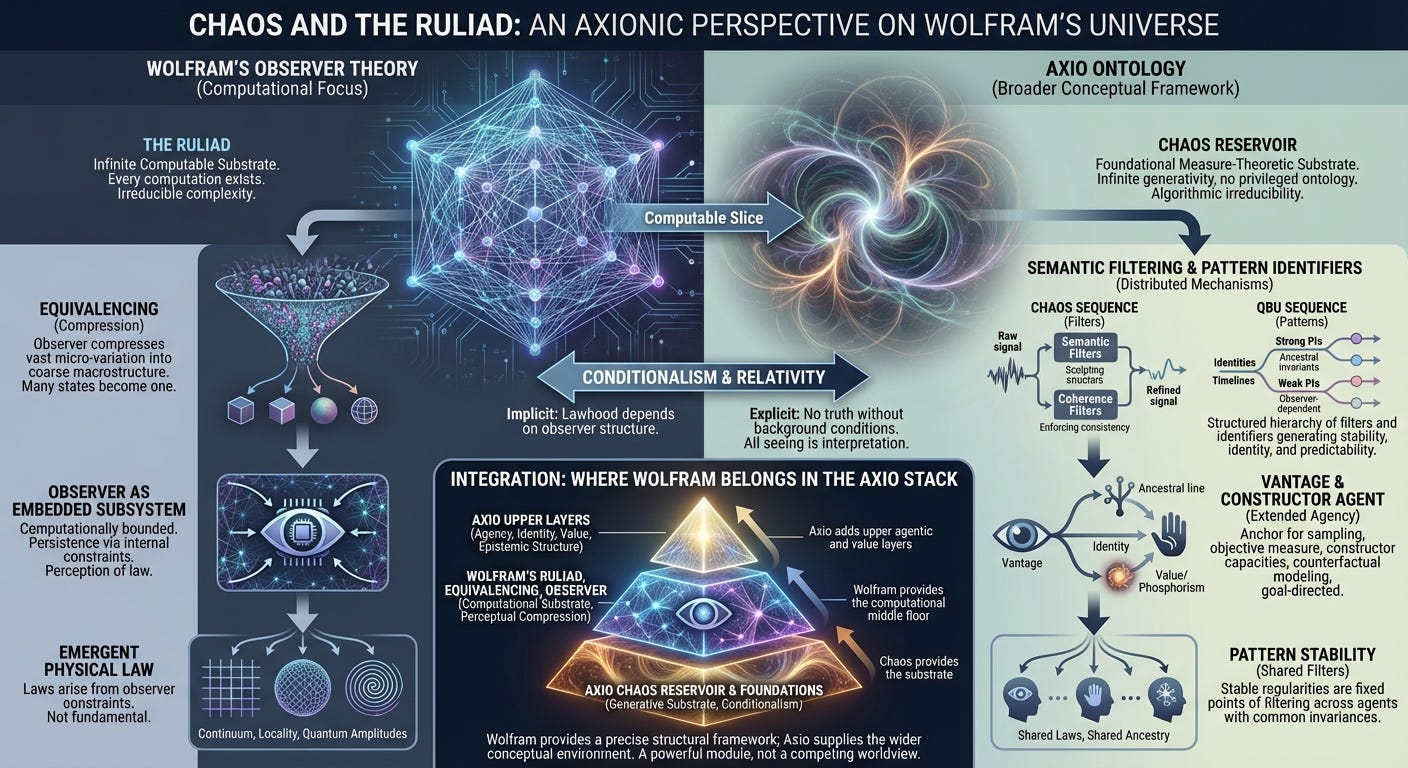
Stephen Wolfram’s Observer Theory is often presented as a radical re-interpretation of physics, cognition, and mathematics. But once translated into the Axio ontology, its structure becomes transparent: Wolfram’s framework converges with key elements of the Chaos Sequence, capturing an important subset of it through computational metaphysics.
He supplies the substrate (the Ruliad), the compression mechanism (equivalencing), and the procedural emergence of perceived laws. Axio adds explicit treatments of agency, identity, value, and conditional truth—domains that sit beyond the goals of Observer Theory. Wolfram provides a precise structural framework; Axio supplies the wider conceptual environment in which that framework lives.
This essay makes the mapping explicit. The goal is not to diminish Wolfram’s work, but to locate it precisely within a richer, more complete theoretical stack.
1. Chaos Reservoir vs. the Ruliad
Wolfram’s Ruliad is defined as the entangled limit of all possible computations—a universal generative substrate of irreducible complexity. Every computation exists somewhere inside it, and observers inhabit a tiny slice of that vast structure.
This is formally identical to the Axionic Chaos Reservoir:
Infinite generativity: no upper bound on complexity.
No privileged ontology: all patterns emerge from filtration.
Algorithmic irreducibility: no global compression; only local modeling.
Wolfram treats the Ruliad as a cosmic object. Axio treats Chaos as the foundational measure-theoretic substrate that all patterns, agents, and worlds draw from. The correspondence is close: the Ruliad captures the computable slice of Chaos, expressed in computational rather than probabilistic language.
2. Equivalencing vs. Semantic Filtering
Wolfram’s central move is the notion of equivalencing: the observer compresses vast micro-variation into coarse macrostructure. Many states become one. This mechanism determines what the observer can stably perceive as an object, a law, or a regularity.
In Axio, these mechanisms span two different sequences and must be separated clearly:
Chaos Sequence (filters): mechanisms that extract signal from the generative substrate.
Semantic filters carve structure from the Chaos Reservoir.
Coherence filters enforce internal consistency in interpretation.
QBU Sequence (patterns): mechanisms concerned with identity, ancestry, and structure across branches.
Strong Pattern Identifiers track structural invariants across ancestry.
Weak Pattern Identifiers capture observer‑dependent equivalences.
Wolfram’s equivalencing covers functions that Axio distributes across two layers—Chaos‑level filtering and QBU‑level pattern tracking. Where he frames a single mechanism, Axio distinguishes a structured hierarchy of filters and identifiers that generate stability, meaning, identity, and predictability.
3. The Observer as Embedded Subsystem
Wolfram describes observers as computationally bounded subsystems embedded in the Ruliad. They possess persistence across time only because they impose internal consistency constraints on their own evolution.
This aligns directly with several Axio components:
Vantage: the anchor from which an agent samples forward-branching structure.
Measure: objective probability within the QBU.
Constructor Agents: systems capable of imposing coherent transformations on the world.
Identity Through Ancestry: Strong PIs define the continuity of the self.
Wolfram’s account focuses deliberately on the epistemic and computational dimensions of observation. Axio extends this picture by adding a theory of agency—constructor capacities, counterfactual modeling, and goal-directed transformation—which sits outside the intended scope of Observer Theory.
4. Emergent Physical Law vs. Pattern Stability
Wolfram’s thesis: laws of physics are not fundamental—they are emergent from the constraints observers impose on how they interpret the Ruliad. Continuity, locality, and even quantum amplitudes arise from the computational limitations of beings like us.
Axio frames the same phenomenon as:
pattern stability under shared agentic filters.
Observers converge on laws because they share:
similar sensory constraints,
similar computational bounds,
similar evolutionary ancestry,
similar Strong PIs for tracking structure.
Wolfram’s derivations (continuum space, foliations, relativity, quantum behavior) become special cases of a broader Axionic insight: stable regularities are fixed points of filtering across many agents with common invariances.
Axio explicitly formalizes the ancestral and agentic dimensions that remain undeveloped in Wolfram’s account.
5. Conditionalism and the Relativity of Law
Wolfram insists that perceived lawhood depends on observer structure. Axio goes further and formalizes this dependence:
No truth exists without background conditions.
All seeing is interpretation.
Interpretation varies with the architecture of the observer.
Observer Theory implicitly assumes Conditionalism; Axio makes it explicit. It supplies the meta-level statement Wolfram needs but never articulates: the laws you infer depend on the conditions under which you infer them. They are not eternal forms; they are conditional invariants.
6. What Wolfram Is Missing
Wolfram’s program is focused and intentionally scoped. Relative to the Axio stack, it does not attempt to address several domains outside its goals:
• Agency
His account models observers primarily as compressive systems, not as constructor‑agents; this reflects the intended scope of his framework rather than a mistake or oversight.
• Identity
He does not develop formal machinery for ancestry, selfhood, or branching persistence; these concepts lie outside the intended remit of Observer Theory, though Axio provides such formalisms through Strong PIs and the Vantage structure.
• Value
He does not engage with normative questions or value theory, which is consistent with the descriptive focus of his project. Axio extends into this territory through Phosphorism.
• Conditional Truth
He discusses observer-dependence but does not attempt to build a full meta‑epistemological framework; Conditionalism supplies such structure within Axio.
Wolfram develops a physics of observers. Axio complements this by providing a broader framework that also encompasses agents, values, identity, and conditional truth.
7. Integration: Where Wolfram Belongs in the Axio Stack
Observer Theory sits at the intersection of three Axio subsystems:
Chaos Reservoir — the generative substrate.
PI/Filtering System — the mechanism producing coherent structure.
QBU/Vantage Architecture — the perspective-bound emergence of law.
Wolfram’s contribution is meaningful and clearly defined. His framework provides a computational instantiation of the generative substrate and perceptual compression. Axio situates this within a wider conceptual environment that incorporates agency, decision, identity, value, and epistemic structure.
Placed correctly, Wolfram becomes a powerful module—not a competing worldview.
Postscript
Wolfram’s Observer Theory and Axio occupy adjacent layers in the same conceptual architecture. His framework develops a computational substrate and a principled account of perceptual compression. Axio extends upward from that substrate into coherence, identity, agency, value, conditional truth, and the physics of choice.
The theories align cleanly. What Wolfram models as the Ruliad corresponds to the computable stratum of Chaos. What he frames as equivalencing appears in Axio as a structured hierarchy of semantic filters and Pattern Identifiers. What he calls observer persistence maps naturally onto Axio’s formalisms of Vantage and ancestry.
If anything, Wolfram furnished a beautifully articulated middle floor. Axio adds both a broader foundational layer in Chaos and the upper levels concerned with agency, identity, and value.