

The fantasy of a civilization run by the smartest and most rational people has an obvious appeal. Most political and institutional failure is not mysterious. People ignore incentives. They confuse intentions with outcomes. They reward loyalty over competence. They moralize tradeoffs because moralizing is cheaper than understanding them. A population with better models would avoid many stupid traps.

But intelligence does not automatically scale into civilization. The missing term is coercive capacity.
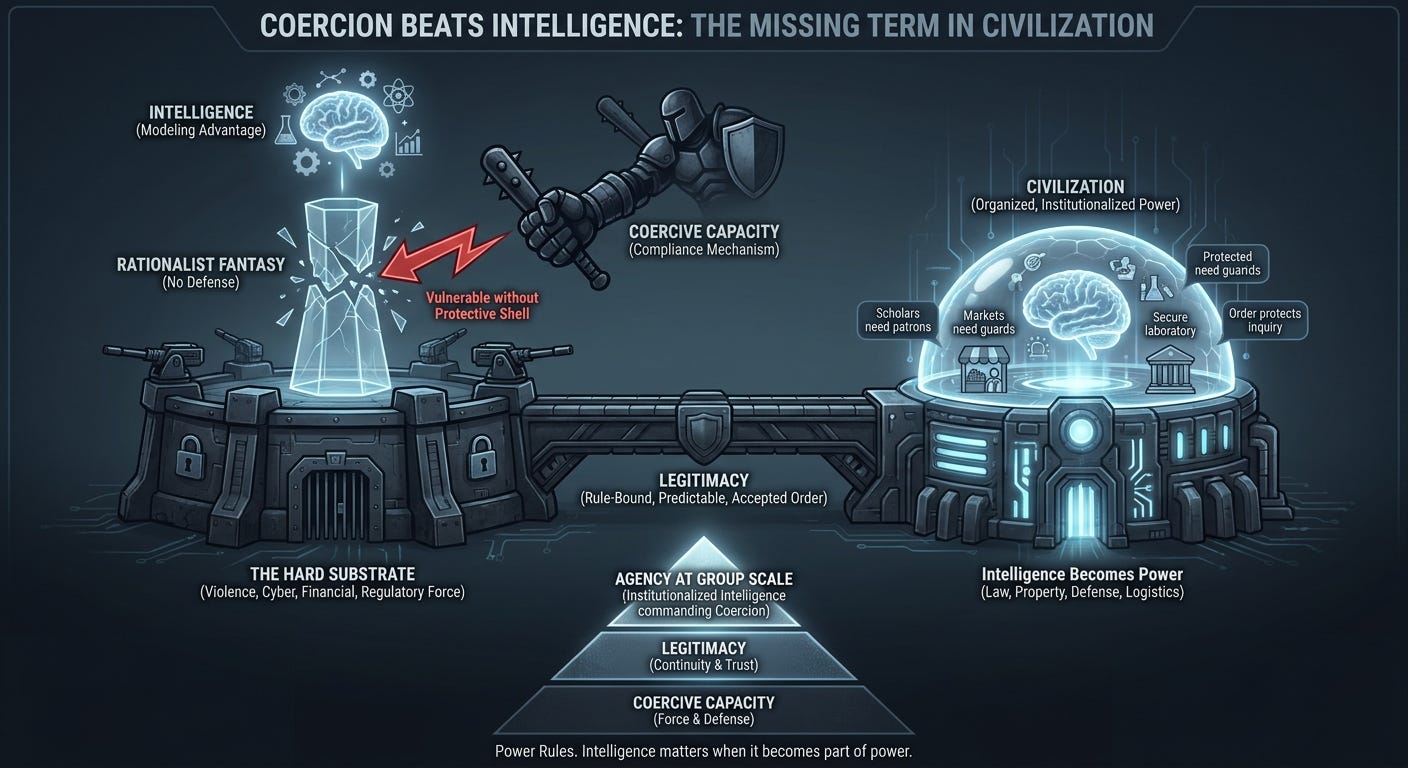
An intelligent person can model incentives, foresee second-order effects, and design better institutions. None of that matters if he cannot protect himself from the man with a club, the gang with rifles, the mob with sacred rage, the hacker who can disable infrastructure, the cartel that controls access, or the state with prisons. Intelligence is a modeling advantage. Coercion is a compliance mechanism. When cognition has no defensive architecture, it becomes prey.
The Protective Shell
This is why scholars have historically needed patrons, merchants have needed guards, engineers have needed property law, and scientists have needed institutions that protect inquiry from priests, soldiers, commissars, mobs, and bureaucrats. The library survives because someone keeps the arsonists outside. The market works because contracts are enforced. The laboratory produces truth because its instruments, funding, personnel, and physical safety are protected by a surrounding order that can punish predation.
Coercion is broader than kinetic violence. Violence is the primitive form: clubs, rifles, prisons, armies. Modern coercion also includes cyberattack, financial exclusion, regulatory strangulation, surveillance, confiscation, blackmail, infrastructure sabotage, and bureaucratic destruction. The common feature is the credible capacity to impose actual harm in order to compel compliance.
That is the hard substrate underneath politics. A civilization is a system for organizing, limiting, legitimizing, and directing coercive capacity.
Intelligence Must Become Power
A room full of brilliant theorists loses to a gang with weapons. A disciplined polity of competent engineers, jurists, soldiers, merchants, and administrators can defeat a much larger population of disorganized predators. Intelligence wins only when it becomes organized power: law, property, courts, police, armies, fortifications, deterrence, cryptography, logistics, energy systems, financial systems, and credible punishment.
This is the failure mode in the rationalist fantasy of “smart people getting their own civilization.” The same error appears in many schemes for exit, seasteading, network states, crypto-polities, and high-cognition enclaves. Smart people are a talent pool. A civilization requires sovereignty. Who enforces contracts? Who excludes predators? Who punishes defectors? Who settles irreconcilable disputes? Who controls borders? Who commands arms? Who prevents the cleverest internal faction from capturing the whole apparatus?
A high-IQ colony without an answer to coercion is a prize.
Clever Defectors
Intelligence also fails to eliminate internal conflict. Smart people are perfectly capable of status competition, factional capture, moral delusion, sexual rivalry, ideological overfitting, and elaborate self-deception. In some cases they are better at these things because they can rationalize them more fluently. Intelligence amplifies the motivational structure beneath it. Attached to discipline, truth-seeking, courage, and institutional realism, it becomes a civilizational asset. Attached to narcissism, resentment, utopian abstraction, or cowardice, it becomes a more articulate form of decay.
This is why a high-cognition society still needs enforcement. It still needs rules. It still needs procedures for resolving conflict. It still needs credible punishment for predation. The assumption that smart people will naturally coordinate because they can see the game more clearly is false. Seeing the game can make cooperation easier. It can also make defection more precise.
The Anglo Example
The high-trust Anglo world was never a pure IQ achievement. It was a compound achievement: geography, maritime position, energy access, imperial extraction, commercial norms, property law, common law, religious and post-religious discipline, scientific institutions, literacy, inherited trust, institutional competition, comparatively low corruption, and plenty of coercive capacity.
The point is causal structure rather than ethnic flattery. High trust does not float above power. It is maintained by law, custom, punishment, memory, reputation, borders, courts, and force. Remove the coercive substrate and the trust norms become decorative.
Legitimacy
Coercion alone can dominate. It cannot easily stabilize. A bandit can seize resources, but a civilization requires subjects, citizens, customers, judges, soldiers, parents, teachers, engineers, and merchants to keep acting as if tomorrow exists.
That requires legitimacy. Legitimacy does not mean moral purity. It means that coercion is sufficiently rule-bound, predictable, and accepted as preferable to the available alternatives. People obey courts because courts are less ruinous than feud. They tolerate police because police are less ruinous than private vengeance. They accept taxation when the state is perceived as providing order, defense, infrastructure, and continuity. When that perception collapses, coercion reverts toward naked domination.
Intelligence can help engineer legitimacy, but it cannot fake it indefinitely. Propaganda may buy compliance. Bribes may buy loyalty. Fear may buy silence. Durable legitimacy requires a working relationship between enforcement, expectation, and delivered order. The system has to punish predation without becoming the main predator.
This is the bridge between coercion and civilization. Coercion supplies control. Legitimacy supplies continuity.
Postscript
“Why don’t the smart people already have their own civilization?” is a better question than it first appears. The answer is that civilization is downstream of agency architecture: enforceable norms, credible defense, institutional continuity, reproductive persistence, legitimacy, and command of coercive capacity.
The hierarchy is simple enough. Coercion beats isolated intelligence. Organized intelligence beats disorganized coercion. Institutionalized intelligence commanding rule-bound coercion beats almost everything.
Power rules. Intelligence matters when it becomes part of power.