

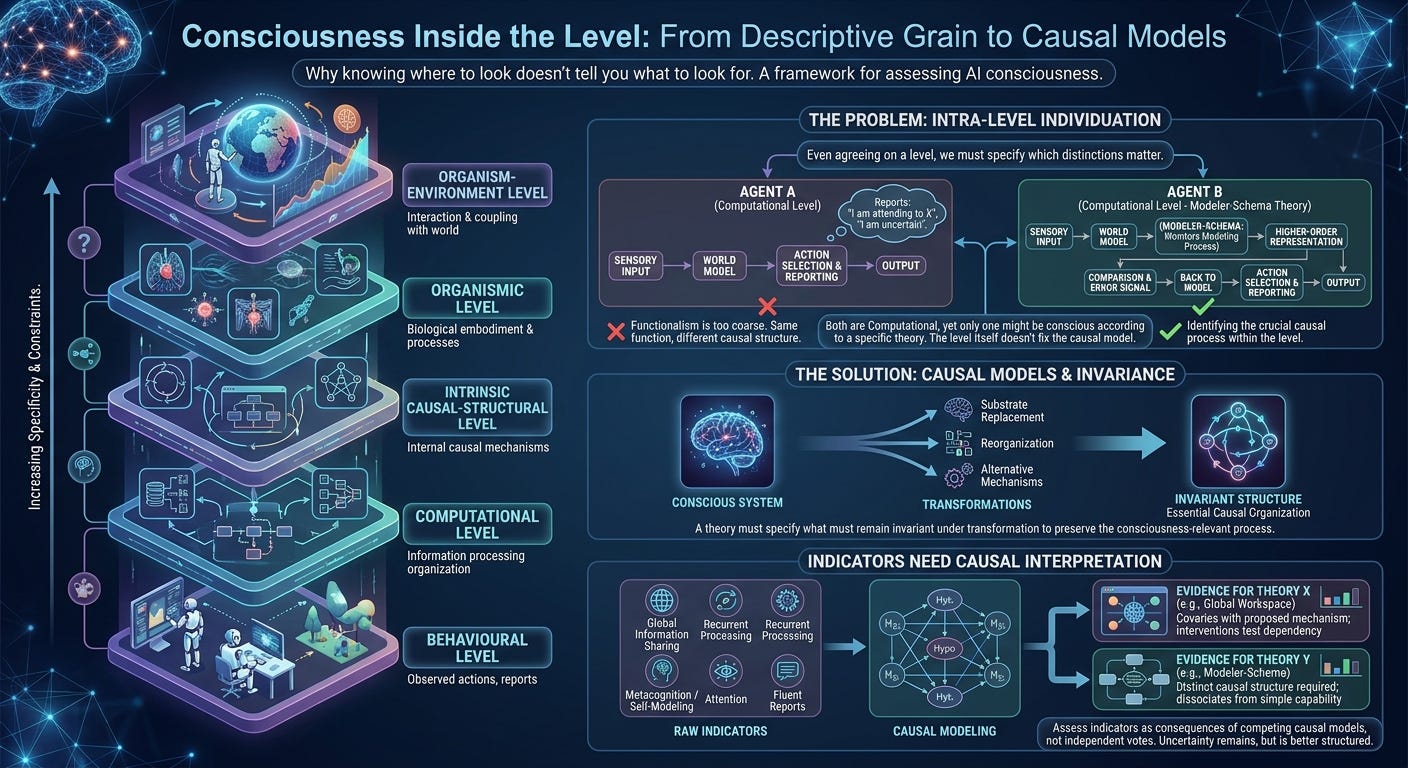
A new paper by Shamil Chandaria, Anil Seth, Murray Shanahan, Shane Legg and ten coauthors, From cacophony to hierarchy: a principled framework for assessing AI consciousness, tries to impose some order on one of the messiest debates in cognitive science. Before asking whether an AI is conscious, the authors ask at what level of description the facts that determine consciousness would have to appear. They distinguish behavioural, computational, intrinsic causal-structural, organismic, and organism-environment levels, then place major theories of consciousness according to the level each treats as critical.
This is a useful advance. Many apparent disagreements about AI consciousness really are disagreements about descriptive grain. One person points to sophisticated self-report, another says behaviour is insufficient. One points to global information sharing and metacognition, another says computational organization is insufficient without the right intrinsic causal structure. Another insists that consciousness depends on biological embodiment. The framework stops these disagreements from masquerading as disagreements over the same evidence.
The hierarchy is not meant to replace the theories it organizes. Global Workspace Theory, Higher-Order theories, Integrated Information Theory, Attention Schema Theory, and others still supply the substantive constraints within each level. That leaves a second problem, intra-level individuation: even after we agree on the relevant level, we still need to specify which distinctions within that level matter. A computational theory is incomplete until it says which functional organization is consciousness-relevant, which differences are irrelevant, and which transformations preserve or destroy the process it identifies with experience.
The Hierarchy Gets Something Important Right
The paper’s central idea is that consciousness theories differ partly over the coarsest description that preserves everything relevant to experience. If consciousness supervenes on behavioural organization, internal implementation can vary freely so long as behaviour is preserved. If it supervenes on computational organization, behavioural equivalence is too coarse but substrate differences may still be irrelevant. If intrinsic causal topology matters, even computational equivalence may fail to preserve consciousness. Organismic and organism-environment theories push the required description outward still further.
The paper then combines this hierarchy with theory-specific indicators. A system may exhibit global information availability, recurrent processing, metacognition, self-modeling, information integration, or other properties associated with particular theories. A Bayesian model weights and combines these under uncertainty to produce an overall credence.
The authors are careful about what these numbers mean. Their illustrative estimates for current LLMs run from below 0.01 to roughly 0.8, depending on which theories receive credence and how generously the indicators are read. That sensitivity is informative: much of the disagreement is driven by assumptions about which theory is right and which architectural features current systems actually possess.
Same Level, Different Causal Models
Consider two artificial agents. Both maintain detailed models of their environment. Both represent themselves within those models. Both allocate attention among competing targets, monitor uncertainty, compare predictions with outcomes, integrate information across subsystems, and report fluently on their apparent internal states. Under many current indicator schemes, both would accumulate substantial evidence at the computational level.
Now suppose their architectures differ in one respect.
In the first system, these capacities feed into a controller that selects actions and generates reports. It can represent its own uncertainty, describe what it is attending to, reason about its internal state, and produce elaborate narratives about apparent experience.
The second system contains an additional structure. Its world-modeling process maintains a model not merely of the external world and the agent as an object within it, but of the modeling process itself. That Modeler-schema is used to construct a distinct representational state, compare modeled states across time, detect discrepancies, and feed the resulting error signals back into the world model.
Under Modeler-Schema Theory, that difference is decisive. The second architecture contains the process the theory identifies with phenomenal experience; the first does not. Both remain computational systems, and both exhibit every indicator listed above. The distinction lies within a single level of the hierarchy.
This does not refute functionalism. A functionalist can reply, correctly, that the two systems are not functionally equivalent at a sufficiently fine grain, because the Modeler-schema performs a function absent from the first system. But the reply grants what the example was built to show: placing a theory at the computational level does not fix which functional equivalence relation it uses.
Any sufficiently complex physical system admits many legitimate functional descriptions. A computer can be described in terms of transistor switching, instruction execution, control loops, or agent-level decisions, and whether two implementations count as functionally equivalent depends on which of those distinctions the explanatory model preserves. The paper itself calls every level of its hierarchy a functional description, and the same choice of grain recurs inside each one.
A consciousness theory therefore cannot stop at the claim that consciousness supervenes on function. It must say which functional distinctions may be coarse-grained away and which may not.
What Must Remain Invariant
A more demanding version of the supervenience question asks which transformations of a conscious system preserve the process a theory takes to be consciousness-relevant.
Begin with a conscious system and alter it progressively while preserving more and more of its observable capacities. Replace biological neurons with functionally equivalent components. Reorganize implementation details. Replace recurrent processing with an alternative mechanism. Eliminate intermediate representations while preserving input-output mappings. Different theories draw the boundary in different places, and a useful theory should say where its boundary lies and why.
Put in terms of equivalence classes, every theory implicitly groups physical systems into classes that count as equivalent with respect to consciousness. A substrate-independent functional theory allows large implementation differences inside one class. A biological theory permits fewer substitutions. A theory centered on intrinsic causal topology imposes a different set of constraints again.
Naming the level does not specify the class. A computational theory still has to identify which computations are essential and which are replaceable. A causal-structural theory still has to identify which causal structures matter, beyond asserting that intrinsic structure does.
Modeler-Schema Theory supplies one candidate answer. It allows wide variation in substrate, implementation language, sensory modality, learning algorithm, and behavioural repertoire. What must remain is a specific causal organization: a world-modeling process, a model of that modeling process, the construction of the relevant higher-order representational state, and a comparison mechanism that feeds discrepancies back into the world model.
Showing that disruption of such a mechanism abolishes some consciousness-associated capacity would establish causal relevance, possibly causal necessity. It would not show that the mechanism constitutes consciousness: a mechanism can be necessary for a phenomenon without being identical to it. Mechanistic evidence narrows the space of viable theories without making the hard epistemic problem disappear.
The same requirement applies to the other theories. Global Workspace Theory should identify which workspace relations must remain invariant. Higher-order theories should specify the representational relation whose removal matters. Attention Schema Theory should distinguish the schema it posits from alternative architectures capable of producing similar reports. Integrated Information Theory has come closest to meeting the requirement: it holds that a feedforward system computing the same input-output function as a recurrent one is not conscious, a commitment specific enough that the unfolding argument could be aimed at it.
A theory that cannot say which transformations preserve its proposed consciousness-relevant structure has not yet fully specified its own supervenience claim.
Indicators Need Causal Interpretation
An indicator can accompany a consciousness mechanism without being part of it. World-modeling may be required because a candidate mechanism needs modeled content to operate on. Attention may select the content. Recurrent computation may support comparison across time.
That creates two separate problems for indicator-based assessment. The first is statistical. If several indicators are produced by the same underlying architectural development, treating them as independent evidence risks double-counting. The second is causal. Even if the indicators are statistically separable, they may still be nonspecific: a general-purpose agent may acquire them because they improve cognition rather than because they instantiate whatever process produces experience.
The paper notices the overlap that makes the second problem acute. Its closing claim is that the indicators at every level overlap closely with the architecture general intelligence requires, from which it concludes that increasingly capable AI may become a stronger candidate for consciousness. That inference holds where a theory identifies the capability with the mechanism, as Global Workspace Theory does with global broadcast. It fails where the indicator is something general intelligence produces anyway. A capable agent has independent engineering reasons to develop world-models, self-models, attention, uncertainty monitoring, metacognition, and recurrent processing, so capability predicts those indicators whether or not the architecture responsible for experience is present. An indicator that capable systems acquire whether or not that architecture is present has a likelihood ratio near one, given a capable system.
Modeler-Schema Theory makes the issue particularly sharp because it separates report generation from the proposed phenomenal process. The controller can select linguistic actions, reason about internal variables, and produce statements such as “I am uncertain,” “I am attending to the red object,” or “I am having a vivid red experience.” Under the theory, those reports do not by themselves establish that the Modeler-schema process exists.
The theory therefore gives a principled architecture in which introspective fluency and consciousness can dissociate. Better language modeling improves the report; better self-modeling makes it more accurate. Neither necessarily creates the causal schema the theory associates with experience.
But this does not make indicators dispensable. Consciousness is not directly observable from the outside, so any empirical assessment must ultimately rely on observables: behaviour, internal representations, perturbation effects, learning dynamics, architectural changes, and reports. The improvement is to embed indicators in causal models.
An indicator is stronger evidence when a theory explains why it should covary with a proposed mechanism, when plausible rival mechanisms do not predict the same observation equally well, and when interventions can test the dependency. That last condition is how mechanistic theories become empirically discriminable without claiming to solve the hard problem by experiment.
Postscript
AI-consciousness assessment should treat indicators as consequences of competing causal models rather than as independent votes for consciousness. The hierarchy tells us which grain of description to examine. It cannot settle which causal organization within that grain matters, and the same underdetermination recurs at every level. Behavioural reports, internal representations, perturbation effects, and architectural features remain the evidence. The work lies in asking which proposed mechanism predicts them, which alternatives predict them equally well, and which interventions distinguish among those explanations.
Modern neural networks make this program technically difficult. Their internal representations are distributed and often do not decompose neatly into the modules assumed by cognitive theories. Mechanistic interpretability can now locate features and circuits inside large models and test their causal roles by intervention, but no established method maps a distributed implementation onto a theory-level variable such as a workspace, a self-model, or a Modeler-schema. A causal framework does not solve that mapping problem; it tells us what kind of evidence would be needed if the relevant structure could be identified.
Causal modeling also does not guarantee theory selection. Two consciousness theories may posit different constitutive structures while making the same predictions for every intervention available to us. In that case the theories remain empirically underdetermined. Wherever rival theories imply different causal dependencies, experiments can eliminate possibilities and redistribute credence. Where they do not, the uncertainty is genuine rather than something a larger indicator checklist can resolve.
Experiments then test dependencies. If a proposed mechanism can be removed without producing the downstream effects the theory predicts, confidence in that theory should fall. If selective disruption produces the predicted pattern while competing models do not, confidence should rise.
Consciousness may have a critical level. But the level is only the beginning of the explanation. The scientific work lies in specifying the causal model inside it.