

A woman writes that someone she loved died yesterday. Age thirty. Cancer discovered last week. Alive, diagnosed, gone. That is the kind of fact that briefly restores scale. The petty anxieties, social frictions, bureaucratic irritations, performative outrages, and little status contests that occupy ordinary life suddenly look absurd. They were probably absurd already. Death merely makes the accounting visible.
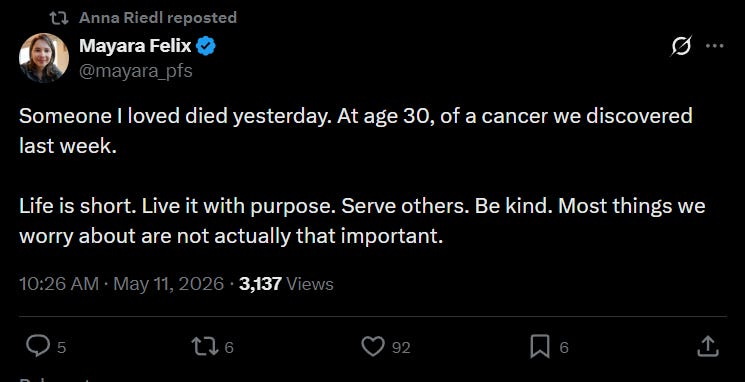
Then comes the familiar lesson. Life is short. Live with purpose. Serve others. Be kind. Most things we worry about are unimportant.
Much of that is harmless. Life is short. Purpose matters. Kindness is usually preferable to cruelty. Most worry is badly allocated attention. The phrase that changes the argument is “serve others.” It enters as though mortality had established it.
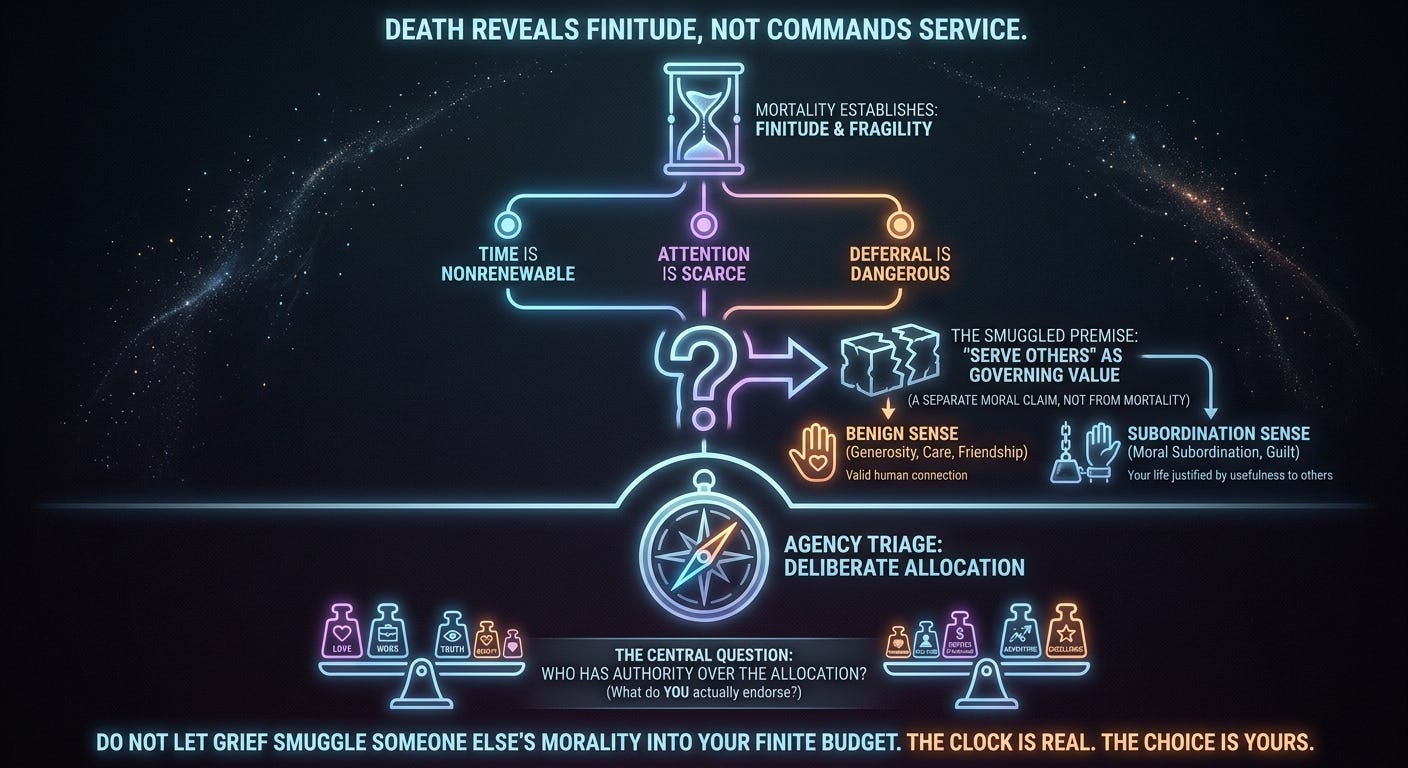
Mortality establishes finitude. It establishes fragility. It establishes that attention is scarce, time is nonrenewable, and deferral is dangerous. It does not establish service as the governing value of a life.
That step requires a moral premise. It may be religious, altruist, communitarian, utilitarian, therapeutic, or merely conventional. Whatever its source, it should be named. A sudden death can tell us that life is short. It cannot tell us that the purpose of life is usefulness to others.
This matters because “serve others” has two very different meanings. In the benign sense, it means generosity, loyalty, care, friendship, competence, and showing up when people genuinely need you. That belongs inside any decent human life. No serious person wants a world of atomized narcissists optimizing private satisfactions while everyone around them burns.
But there is another meaning, and it is everywhere. Service becomes moral subordination. Your life is justified by your usefulness. Your virtue is measured by how much of yourself you are willing to convert into benefit for someone else. Need becomes a claim. Guilt becomes a governance mechanism. The self is treated as morally suspect until donated.
That is the smuggled premise.
A finite life demands deliberate allocation. The question is not whether one should choose love, work, truth, beauty, loyalty, pleasure, excellence, friendship, family, adventure, solitude, or service. The question is who has authority over the allocation. A life spent helping others can be noble when it expresses actual endorsement. The same outward behavior can become degradation when it is extracted by guilt, status pressure, institutional demand, or inherited moral script.
Death exposes the opportunity cost of bullshit. Every hour lost to petty resentment, fake obligation, political theater, institutional make-work, useless guilt, or fear of disapproval is an hour taken from a finite budget. The scandal is that so many people allow strangers, institutions, and inherited moral scripts to spend their lives for them.
Service can be noble. It can also be servility with better branding. Sudden death is a lesson in agency triage: the clock is real, the budget is finite, and the central question is what you actually endorse. Serve others if that is yours. Do not let grief be used to smuggle someone else’s morality into the space where your own life belongs.