

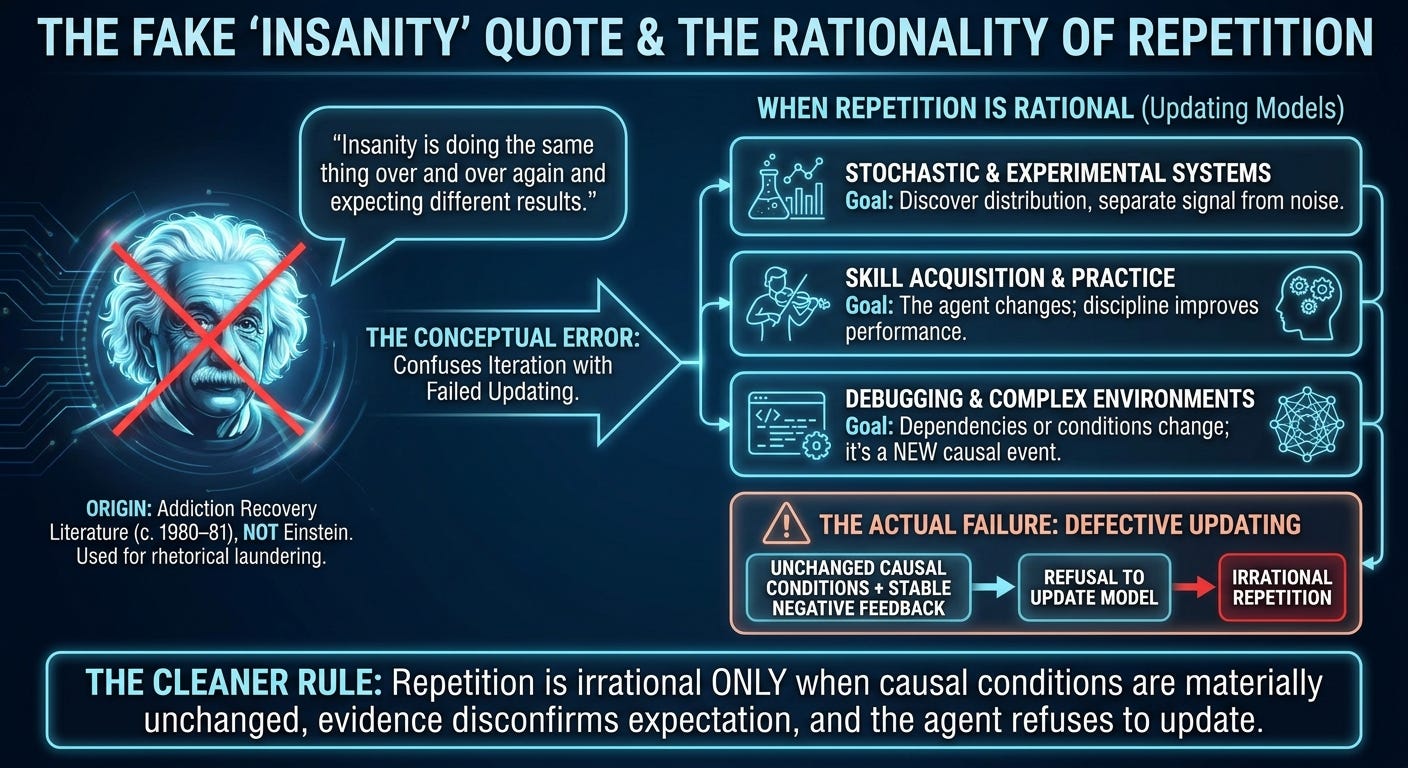
The fake Einstein quote about insanity is usually treated as a clever warning against repetition. Its real function is different: it lets the speaker avoid specifying the causal model.
The line is familiar: insanity is doing the same thing over and over again and expecting different results. Einstein almost certainly never said it. The saying appears to have emerged in addiction-recovery literature around 1980–1981, with early versions in Al-Anon and Narcotics Anonymous contexts. Later it migrated into public discourse and picked up the Einstein attribution, because dead geniuses are useful rhetorical laundering devices. Quote Investigator and the MLA Style Center both classify the Einstein attribution as unsupported.
The misattribution is sloppy. The deeper problem is conceptual. The sentence is false as a general principle.
Repeating an action while expecting a different result can be entirely rational. In stochastic systems, repeated trials are how one discovers the distribution. In experimental systems, repetition is how one separates signal from noise. In skill acquisition, repetition changes the agent performing the action. In debugging, a repeated test after a dependency or condition has changed is a new causal event. In markets, politics, medicine, engineering, and war, the same verbal description may conceal different background conditions.
The crucial question is whether the intervention is causally identical, whether the environment is materially unchanged, and whether the agent has updated its model in response to feedback. Without those distinctions, “doing the same thing” is an empty phrase. It may refer to literal repetition, procedural iteration, probabilistic sampling, disciplined practice, strategic persistence, or blind refusal to learn. Those are not the same phenomenon.
A defensible version of the thought would be narrower: an agent is irrational when it repeats the same intervention under materially unchanged causal conditions, receives stable negative feedback, refuses to update its model, and continues expecting improvement. That formulation has content. It identifies the actual failure: defective updating.
The fake Einstein version erases the updating problem and replaces it with a sneer. It treats persistence itself as evidence of irrationality. It lets the speaker condemn a repeated policy, strategy, or experiment without showing that the conditions are unchanged, the mechanism has failed, or the alternative has a better expected outcome.
That is why the quote is so rhetorically useful. It compresses a causal question into an accusation of stupidity. The audience gets the satisfaction of recognition. The speaker gets the prestige of Einstein. Nobody has to do the analytical work.
The cleaner rule is simple:
Repetition is irrational only when the causal conditions are materially unchanged, the evidence has already disconfirmed the expectation, and the agent refuses to update.
Otherwise the argument still has to be made: what is causally identical, what evidence has accumulated, and why should expectation now change?