

Agency as Pattern Formation
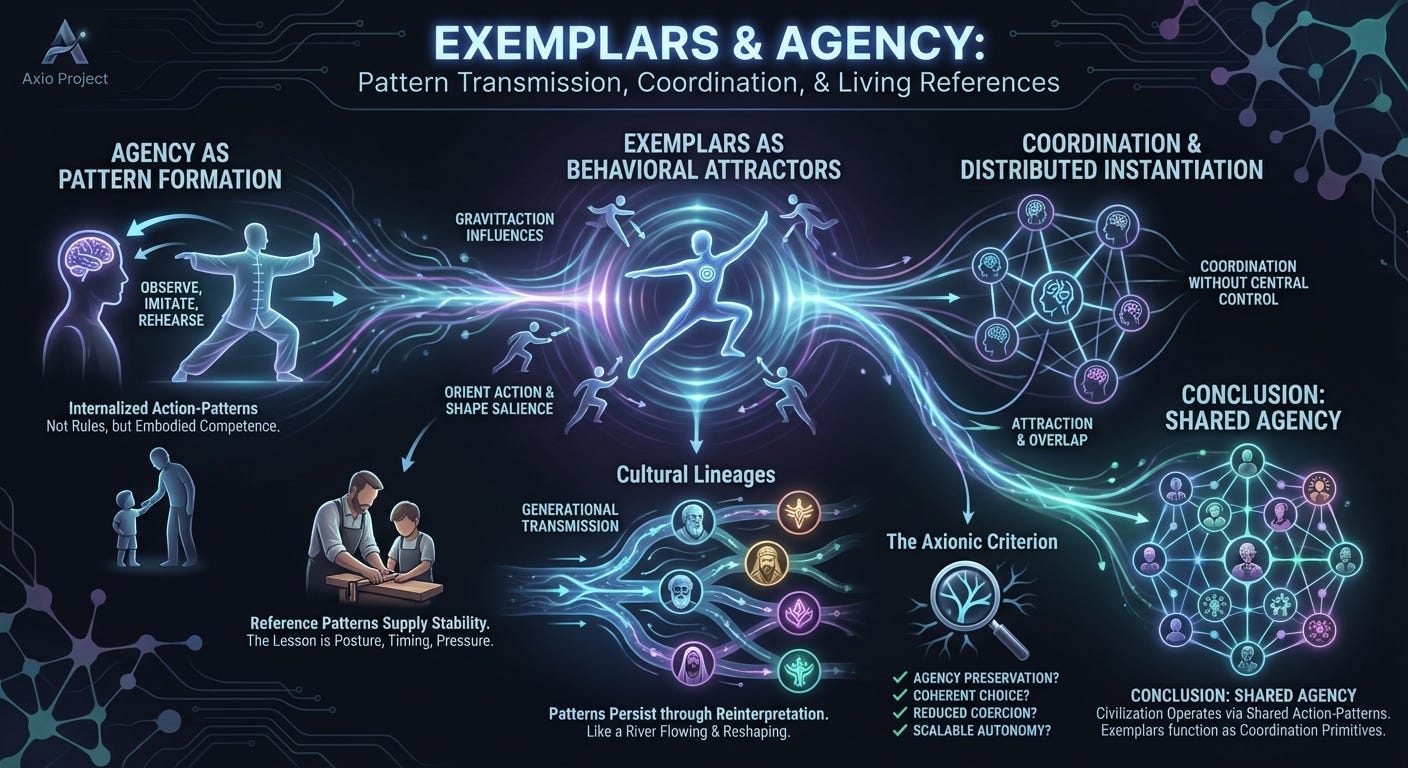
Human agents develop as pattern-forming systems embedded in social environments. Action arises from internalized schemas acquired through observation, imitation, and rehearsal. This structure appears early in development and remains operative throughout life.
A child does not learn how to stand by consulting a rule. They watch, sway, fall, adjust, and try again, guided by the moving example of another body already balanced. That process never disappears. Adult agency continues to rely on absorbed patterns rather than explicit calculation.
Imitation functions as the primary channel through which practical competence forms. Skills, norms, and values propagate through lived examples that can be perceived, compressed, and recomposed. Cultural inheritance therefore proceeds through embodied behavior as much as through instruction.
Agency consists in the capacity to internalize action-patterns and deploy them flexibly under changing conditions.
Exemplars as Behavioral Attractors
Open-ended environments require judgment under variation. Reference patterns supply stability.
An exemplar is an agent whose behavior functions as an attractor in behavioral space. Exemplars orient action by shaping salience, expectation, and perceived affordances. Their influence scales with the coherence, generality, and compressibility of the associated pattern.
An apprentice watches a master carpenter cut a joint. The lesson does not arrive as a proposition. It arrives as posture, timing, pressure, restraint. The pattern embeds itself and later re-emerges through the apprentice’s hands.
Exemplars persist through reinterpretation. Agents selectively adopt, modify, and recombine aspects of a reference pattern as conditions change. Over time, this process constitutes evolutionary selection over action-patterns.
Cultural Transmission and Pattern Lineages
Cultural continuity arises from the persistence of shared reference patterns across generations. Lineages form around exemplars whose patterns remain legible, teachable, and adaptable over time.
Religious figures represent one historical class of high-bandwidth exemplars. Their narratives encode dense bundles of behavior, motivation, and constraint. These bundles propagate through repetition, reinterpretation, and partial instantiation across large populations.
A pattern that survives centuries does so in the way a river survives: by flowing, branching, eroding obstacles, and reshaping itself while retaining a recognizable course.
Persistence reflects selection over performance.
Interpreting “Lord” as Pattern Centrality
Within a cultural lineage, compressed phrases such as “Jesus is Lord” function as diagnostics that identify a central reference pattern. “Lord” designates salience and gravitational pull within a shared pattern space.
The phrase marks a convergence point for interpretation and imitation. It signals that a particular behavioral pattern serves as a common reference for evaluating action within that lineage. Centrality arises through adoption, repetition, and refinement across agents.
As long as the pattern remains coherent under reinterpretation and continues to support agency in lived contexts, it retains its pull.
Coordination Through Attraction
Exemplars constrain behavior through attraction. Agents orient toward patterns that appear to support stable coordination, reduce destructive conflict, and preserve agency across interaction contexts.
Participation remains interpretive and revisable. Patterns persist insofar as agents continue to find them locally coherent and useful. Overlap among shared patterns enables coordination without constant enforcement.
Plurality of exemplars supports adaptability. Different domains sustain different reference patterns, with partial overlap providing resilience under environmental change.
Distributed Instantiation
Collective participation takes the form of distributed instantiation of a pattern across agents. Each agent realizes the pattern under local constraints, contributing to its evolution over time.
This process unfolds without centralized control. Pattern survival depends on continued replication under selective pressure. As environments shift, instantiations diverge, converge, or attenuate.
The same dynamic governs cultural norms, ethical frameworks, and institutional practices.
The Axionic Criterion (Operational)
For a pattern to persist within an agent population, it must demonstrate agency preservation under ongoing instantiation.
This evaluation occurs locally and continuously:
Does the pattern support coherent choice under constraint?
Does it reduce reliance on coercive stabilization?
Does it scale across agents without collapsing autonomy?
Patterns that pass this test continue to propagate through imitation and recomposition. Patterns that fail gradually lose salience as agents disengage, reinterpret, or abandon them.
Postscript
Human civilization operates through shared action-patterns instantiated by agents embedded in social environments. Exemplars function as coordination primitives within this structure. Their influence arises from attraction, compressibility, and sustained performance across contexts.
Religious exemplars occupy a historically significant region of this space due to narrative density and transmission efficiency. Their continued relevance depends on how well associated patterns preserve agency across branching futures.
Coordination emerges as a property of exemplar-based transmission. It rests on the continuous selection of those patterns that, like a river shaping its course or a craft refined through practice, succeed in carrying agency forward through time.