

Max More recently argued in Take Nothing on Faith that rationalism does not secretly rest on faith. He uses rationalism to mean the commitment to revise belief in response to evidence and criticism, rather than the historical doctrine that reason attains certainty independently of experience. The familiar objection holds that reason eventually reaches assumptions it cannot justify: logic, perception, induction, perhaps reason itself. If those cannot be rationally justified in turn, the rationalist ends up taking them on faith as well.
More is right to reject that, though the strongest answer concedes rather than resists the premise. Reason does not justify its own foundations, and does not need to. Rationality requires no ultimate foundation at all.
Rational agents begin with assumptions they never proved, use methods of imperfect reliability, and inherit enormous bodies of knowledge they have never personally verified. None of it amounts to faith. What separates the two is not whether a belief has foundations but whether it remains exposed to correction.
By epistemic faith I mean an update policy that exempts a protected proposition from the criticism that would ordinarily count against it. This is not a theory of religious faith. The word also names trust, loyalty, hope, existential commitment, and participation in a religious form of life, all of which are different phenomena. The criticism here applies only where belief is treated as immune from correction.
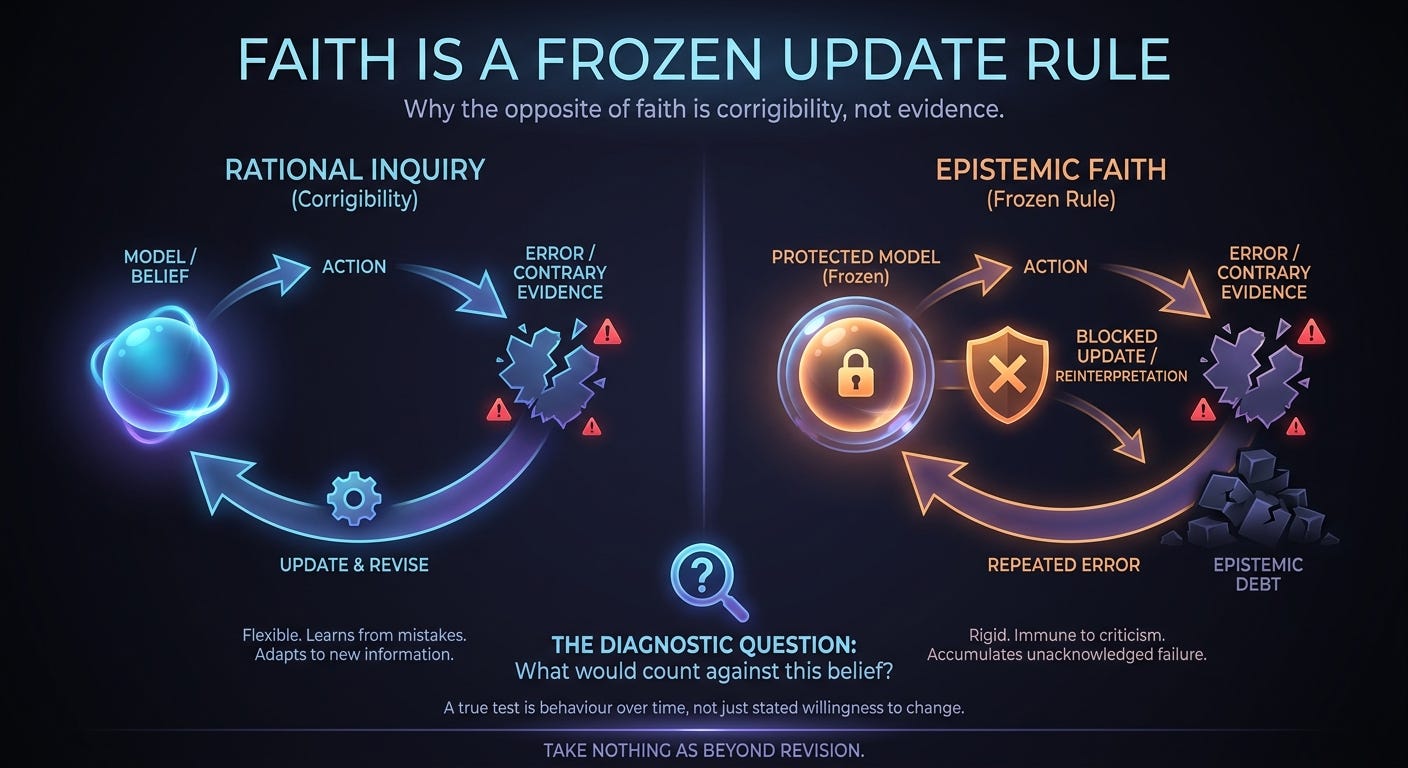
In that narrow sense, faith is a frozen update rule.
The regress does not end in faith
The argument that everyone ultimately relies on faith usually runs:
Rational beliefs require justification.
Justifications themselves require justification.
This cannot continue forever.
Some assumptions must therefore be accepted without justification.
Accepting something without justification is faith.
Rationalism consequently rests on faith.
Grant the fourth step in its practical sense. Finite agents cannot establish every assumption before reasoning begins, and we already possess languages, perceptual systems, inferential habits, memories, and methodological commitments before we can examine any of them.
The fifth step is where it breaks. What the regress shows is that justification cannot continue indefinitely through the same justificatory relation. Nothing follows about inquiry needing an incorrigible foundation. An assumption can be where inquiry currently starts and nothing more. Recursive criticism, explanatory comparison, coherence across models, and error correction are an entirely different architecture from a chain of warrants terminating in bedrock.
I normally trust my eyesight. I normally trust my memory. I accept modus ponens. I rely on scientific results I have never replicated and historical claims whose primary evidence I have never examined. Thousands of such commitments are in play before I get out of bed.
What makes them rational is that they remain exposed to correction, not that each descends from something deeper and certified. Should my eyesight conflict repeatedly with independent instruments and observers, my confidence in what I saw ought to fall. Should contemporary records contradict a memory, the memory is what gives.
Even inferential systems are open to criticism. Their axioms, semantics, domains of application, and relations to alternative systems can all be examined and revised, though criticism cannot dispense with inference altogether, being itself an inferential activity.
These commitments are operationally prior and epistemically ordinary. Inquiry begins wherever we happen to be standing and improves its own machinery as it goes.
This is not a new epistemology
Popper made criticism rather than justification central to rational inquiry, and Neurath compared knowledge to rebuilding a ship at sea. What that tradition supplies is a way to characterize epistemic faith: selective immunity from the revision processes that otherwise keep a model corrigible. The computational vocabulary does not create a new epistemology, but it exposes the common architecture behind several familiar forms of dogmatism. A belief is not irrational for being inherited, uncertain, unproved, or strongly held. Everything turns on what happens when the model meets a reason to change.
The diagnostic question
Whether a belief can be proved is the wrong thing to ask about it. Most interesting beliefs cannot be proved in anything resembling the mathematical sense, and demanding proof recreates the regress.
Ask this instead:
What would count against this belief, and what does contrary evidence currently cost you?
Both halves are needed. The first asks what would count as contrary evidence; the second asks what the belief’s update rule actually does when contrary evidence arrives.
Suppose I believe a bridge is safe. I might have an engineering analysis, inspection records, load tests, decades of successful use, and confidence in the people who maintain it, and my confidence might be extremely high. Discover fractured support members and it should fall. Discover the load calculations were falsified and it should fall again. Enough apparently impossible structural failures and what needs reconsidering is not merely the bridge but some of the engineering assumptions behind my judgment.
High confidence is not faith. The trouble starts when a proposition is selectively exempted from the ordinary cost of contrary evidence, contradiction, explanatory failure, or a superior alternative.
That formulation is deliberately broad, because not every rational commitment has a clean empirical falsifier. Logical, mathematical, definitional, and deeply integrated theoretical commitments can survive any single observation. Corrigibility does not demand that each proposition arrive with an experimental disproof condition attached. It demands that problems be able to propagate into revision somewhere in the system.
Set against that, imagine a belief for which every confirming observation raises confidence while every contrary one gets reinterpreted so that confidence cannot fall. Evidence against it is dismissed as deception, treated as a test of commitment, converted into metaphor, blamed on hostile forces, or absorbed by adjusting auxiliary claims while the protected proposition goes untouched. The question is whether anomalies, contradictions, failed predictions, or better explanations are permitted to cost it anything.
When resilience becomes immunity
A strong theory should not be abandoned at the first anomaly. Observations are fallible, experiments can be defective, measurements can be misread, and auxiliary assumptions fail all the time, so rational inquiry lets theories survive apparent counterevidence.
Survival is therefore the wrong test. What distinguishes the two cases is whether criticism imposes a cost somewhere in the system.
Suppose a theory makes a failed prediction. Investigators find that one auxiliary assumption was poorly supported, revise it for independent reasons, and end up with a version of the theory that generates additional risky predictions. Nothing there resembles faith. The core survived because the error was plausibly located elsewhere, and the revised model went back out onto the field where it could fail again.
Now the opposite pattern. Every failed prediction generates a new auxiliary assumption whose only function is to shield the central claim. None of them has independent support, none produces new discriminating predictions, none makes the theory easier to compare against alternatives. The protected theory remains logically possible while its survival grows steadily more expensive.
That expense is epistemic debt, and it accumulates silently. A model can take on complexity, lose predictive precision, require ever more special explanations, and fall behind competing models in economy while never once contradicting itself outright. Nothing announces the deterioration. There is no moment of refutation, only a mounting bill that the protected proposition never has to pay.
Epistemic debt is what accumulates when a frozen update rule keeps protecting a commitment while the rest of the model absorbs the consequences. A belief has effectively frozen when adverse outcomes can be taken on indefinitely without reducing confidence, increasing explanatory burden, or improving the standing of alternatives. Resilience is not the problem. Cost-free resilience is.
Evidence is not enough
Proportioning belief to evidence is the right instruction, and it is less self-executing than it sounds, because evidence does not interpret itself. The familiar contrast between faith and evidence is what turns out to be too crude.
Evidence constrains models, and yet what counts as evidence, how strongly it bears on a claim, and which alternatives it discriminates among all depend on background models. An observation matters only relative to expectations, assumptions about reliability, competing explanations, and some account of what the observation would mean under each of them.
A sufficiently ingenious person can accumulate “evidence” for almost anything. Conspiracy theories make the point plainly: absence of evidence becomes evidence of an effective cover-up, contradictory testimony proves the witnesses were compromised, failed predictions show that hidden actors changed their plans. The defect lies in the structure that processes observations rather than in any shortage of them.
Ordinary error correction runs:
model + discrepancy → revised model or confidence
Epistemic faith inserts a selective exception:
protected model + discrepancy → reinterpret discrepancy so the protected model survives
What faith opposes is corrigibility, not evidence.
The mechanism takes several forms: ad hoc auxiliary hypotheses, reinterpretation of falsification as confirmation, asymmetric evidential standards, moralization of doubt, or moving a claim beyond possible observation. Doctrines differ in which immunizing strategy they favour. The architecture is the same wherever criticism is prevented from reaching the protected commitment.
Faith can accidentally be true
Two questions get confused here. One concerns the world: is the belief true? The other concerns the agent: how is the belief maintained?
A false belief can be held rationally. An investigator can examine the available evidence with care, adopt the explanation that currently looks best, stay open to criticism, and be wrong.
A true belief can be held irrationally. Someone might believe a true proposition for reasons that make correction impossible.
Imagine a person who believes there are exactly eight planets because a sacred text says so. No astronomical observation could change his mind. Were astronomers to announce a ninth tomorrow, he would reinterpret the observation or the text until eight remained inviolable. By historical accident his conclusion agrees with contemporary astronomical classification, which tells us nothing whatever about his epistemology.
Truth is a property of the model’s relation to the territory. Corrigibility is a property of the process maintaining the model. Conflating them is how a lucky agent gets mistaken for a rational one.
Trust is not faith
Ordinary language obscures all this by running several things together under faith. Someone has faith in her spouse. An entrepreneur takes a leap of faith. A passenger has faith the aircraft will stay airborne. A scientist supposedly has faith in science.
Mostly these are trust under uncertainty, which is compatible with rationality because trust can be conditional. I trust an aircraft because aircraft are engineered from well-tested physical theories, inspected, maintained, redundantly controlled, and embedded in institutions built to discover failures. Certainty is not required for boarding. But learning that the wings are cracked, the maintenance records falsified, and the pilot intoxicated should move my confidence fast, and that responsiveness is what makes the trust rational rather than what undermines it.
The same holds between people. I can trust someone deeply without demanding continuous proof of loyalty. Trust turns pathological when every possible betrayal gets reinterpreted so that betrayal can never count against the belief.
Courage gets mislabelled as faith just as often. Acting under uncertainty does not require suppressing the uncertainty; a person can recognize substantial risk and act anyway. Epistemic confidence and practical commitment are separate variables, and treating them as one is how a decision to act becomes a licence to stop thinking.
The diagnostic cannot be self-administered
There is a difficulty with the diagnostic question that the question’s own form conceals. It is addressed to you. It asks what you would count as contrary evidence, and it invites an answer given in advance of any contrary evidence arriving.
That answer is close to worthless on its own. Almost everyone can produce a falsifier on request, and producing one is socially rewarded, being what an open-minded person is supposed to be able to do. The protected commitment survives anyway, because when the nominated evidence actually shows up it turns out to have been the wrong kind, or the sample was flawed, or the situation had changed, or the critic had motives. The stated falsifier was never load-bearing. Nothing in the sincerity of the original answer predicts what happens when the bill comes due.
Worse, the freezing need not be visible from inside. Social incentives, identity, institutional position, emotional stakes, and learned interpretive habits can produce epistemic immunity with no explicit rule anywhere saying never revise this. An agent whose update rule is frozen typically experiences itself as open-minded, and will report as much.
So the diagnostic has to be applied to behaviour rather than to testimony. Has this belief ever cost you anything? Have you changed a position in this domain when the change was expensive, embarrassing, or bad for your standing among people you care about? When contrary evidence arrived, did the response take the form of revision, or of a newly discovered reason why the evidence did not apply? Track record answers what introspection cannot.
This is also why the diagnostic works better as a tool of institutional design than of self-examination. Adversarial review, registered predictions, forecasting records, independent replication, and rivals with standing to be heard all check update behaviour from outside, where it is observable. A single mind assessing its own corrigibility is running the audit on the system under audit. What those mechanisms have in common is that they externalize the update process, so that a system cannot decide unilaterally whether its own failures count.
Religion is only one instance
Religious traditions supply the most explicit examples of epistemic insulation, some of them treating continued belief in the teeth of contrary evidence as a virtue. The pathology itself has nothing religious about it, and many religious commitments do not have this structure at all.
An atheist can hold atheism on faith. A Marxist can hold Marxism on faith. A libertarian can hold libertarianism on faith. A scientist can protect a favoured theory from criticism. An institution can reinterpret each failure as proof that its policy was never implemented aggressively enough. A person can construct an account of a relationship in which every hostile act confirms the partner’s hidden love.
Which proposition is protected makes no difference. Treating faith as a specifically religious vice misses the general phenomenon. Epistemic immunity is available to any modelling system.
Is corrigibility itself a foundation?
A defender of the regress argument has one move left. If we insist that beliefs remain corrigible, has corrigibility become the ultimate foundation we claimed not to need?
The question is old, and so is the answer. Bartley’s pancritical rationalism holds the methods of reason themselves open to criticism, requiring no unquestionable foundation anywhere, and More endorses that position explicitly. Corrigibility is foundational only in the sense that a practice incapable of any revision in response to reasons would not count as rational inquiry. It is no indubitable proposition from which other beliefs draw their warrant. To argue that we should abandon corrigibility is already to offer a consideration meant to change someone’s belief, which presupposes the responsiveness the argument proposes to abolish.
No particular theory of corrigibility is thereby made sacred. We can revise our account of what counts as an error, how confidence should change, how evidence should be weighted, where revision should occur in an interconnected model, and which mechanisms best expose failures. What cannot coherently be rejected through rational argument is the minimal capacity to revise belief in response to reasons. There is a constitutive floor beneath rational inquiry and no justificatory foundation beneath knowledge, and the floor tells us what kind of activity we are engaged in without certifying anything the activity produces.
That much Bartley already secures. What the update-rule framing adds is a way of telling, from outside, whether a commitment is in fact being held open, because professing comprehensive self-criticism is cheap. A doctrine can hold everything open in principle while its operative update rule exempts the one proposition that matters, and the profession is itself a declared falsifier that never gets tested. Comprehensive criticism is not secured by adopting a doctrine. It is a property of an agent’s behaviour over time, and like any such property it has to be read off the record rather than taken on report.
Update rules are functional descriptions
Calling faith a frozen update rule implies nothing about human beings implementing neat Bayesian algorithms. Human cognition is biological, affective, social, path-dependent, and frequently inconsistent.
“Update rule” is a functional abstraction describing how a system’s internal commitments change, or fail to change, in response to new information, criticism, contradiction, or failure. A court has an update rule in that sense without running probability theory. So does a bureaucracy, a scientific institution, a human mind, and an artificial agent. The mechanisms differ radically while the question stays meaningful: what kinds of input can alter the system’s operative model?
The abstraction is what keeps the argument from collapsing into psychology. Nobody has to decide to protect a belief for the protection to be in place.
Why frozen commitments are dangerous
Agents act through models, and when the model is wrong the action generates errors. In a corrigible system those errors feed back:
error → detectable discrepancy → update → changed behaviour
A protected commitment breaks the sequence wherever it controls interpretation or action:
error → evidence of error → blocked update → repeated error
A system can be highly corrigible across most of its domains while preserving one protected belief. Danger arises where the protected belief governs consequential decisions and keeps the relevant failures from reaching the model.
For an individual, the damage may be small. For an institution it can persist across generations. For a state it can be imposed on millions. For an advanced artificial agent operating at scale, an uncorrectable commitment could be catastrophic. The reference to artificial agents implies nothing about human thought being literally software, since the claim is substrate-neutral. Any sufficiently capable system that acts through models grows more dangerous as its consequential commitments are insulated from correction.
Power amplifies epistemic failure. A powerful agent does not need perfect knowledge, since no agent has any such thing. It needs an architecture in which consequential errors stay discoverable and correction stays possible. Epistemic faith disables exactly that, wherever its protected commitments happen to matter.
Postscript
More is right that rationalism does not rest on faith, and not because rationalists hold some uniquely secure foundation beneath their beliefs. They hold nothing of the kind. We begin with fallible perception, inherited theories, imperfect memory, provisional inferential rules, social testimony, and methods whose limitations we understand only partly.
Those are the tools we use to criticize one another, improve the tools themselves, detect inconsistencies, relocate errors within interconnected models, and replace failed explanations with better ones. Nothing guarantees the present architecture is correct, which is the whole reason nothing inside it should be beyond correction.
Take anything as a starting point. Take nothing as beyond revision.