

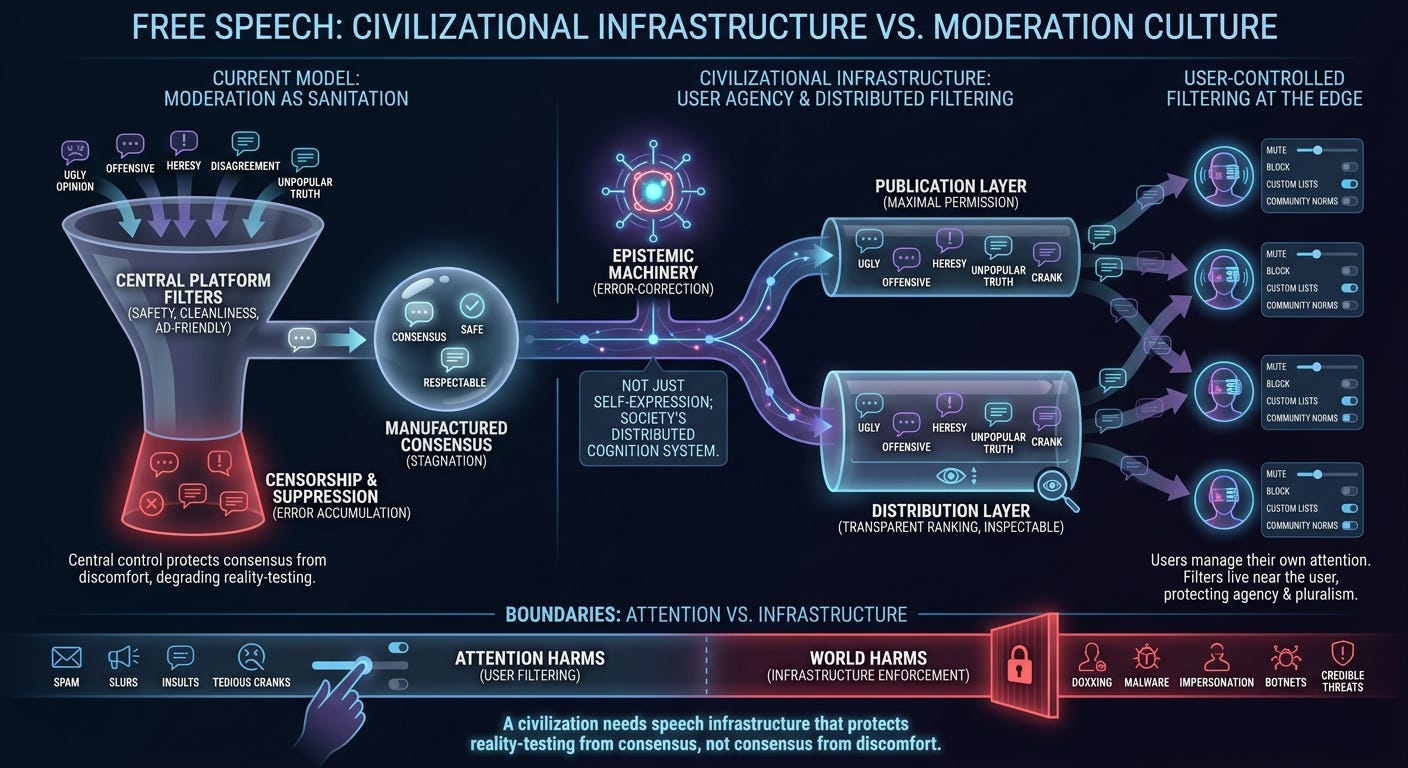
A platform can be a useful private community with strict rules. That does not make it a free speech platform.
If the platform contains no speech you personally find reprehensible, the hard case has already been removed. Nobody had to defend a principle. Nobody had to tolerate anything. The operators merely built a place where the unacceptable things were kept out.
Free speech is tested by speech that offends the people with power over the platform. Speech that angers advertisers. Speech that embarrasses allies. Speech that users report in large numbers. Speech that respectable people want removed because they experience it as stupidity, malice, contamination, danger, or moral decay.
A society needs places where respectable opinion can be contradicted before respectable opinion has granted permission for the contradiction. By the time dissent is safe, polite, and praised by the same institutions that would once have punished it, the important part has already happened elsewhere.
Reprehensible speech matters because no one can be trusted to know in advance which condemned opinions are merely vile and which are early signals that consensus has gone false. Most condemned opinions really are bad. Some are stupid. Some are cruel. Some are malicious. The rule still has to protect them, because any rule that removes them will also remove some things that matter.
The Useful Mess
No person knows enough. No institution knows enough. No expert class, safety team, newsroom, ministry, university, party, church, or advertiser coalition knows enough. A large society stays in contact with reality by letting claims be made and answered in public.
That process is ugly because it runs through human beings. Useful dissent often arrives mixed with crankery, resentment, vanity, overstatement, bad evidence, and bad manners. Falsehood and truth are not pre-sorted into separate administrative bins. The people who notice real failures are not always admirable. The people defending consensus are not always corrupt. The dispute has to run in public because there is no court of final appeal that can safely decide, beforehand, which ideas civilization is allowed to hear.
“Reprehensible” is therefore useless as a moderation standard. Reprehensible to whom? The platform owner? The advertisers? The professional class? The activist bloc most willing to organize a pressure campaign? The state agency sending polite emails? The median user? The most fragile user? The faction with the most leverage?
A rule that sounds morally obvious in conversation becomes a weapon when someone is paid to enforce it at scale.
Safety as Sanitation
Current moderation language treats speech as pollution. The platform is a room. Bad speech is dirty air. The operator removes toxins, reduces harm, protects vulnerable users, and keeps the space safe.
That vocabulary changes the dispute. A claim stops being true or false, argued or refuted, relevant or irrelevant. It becomes unsafe. Once that move is available, almost any despised claim can be described as harmful, degrading, destabilizing, exclusionary, dehumanizing, traumatic, or corrosive to trust.
People can be threatened. People can be defrauded. People can be impersonated, doxxed, or buried under machine-generated garbage. A speech system can be attacked. Those cases do not justify a general platform power to remove morally disfavoured opinion.
“Harm” expands. A criticism of immigration becomes harm. A criticism of police becomes harm. A criticism of a religion becomes harm. A criticism of feminism, nationalism, progressive ideology, trans activism, Zionism, capitalism, communism, Christianity, Islam, atheism, vaccines, lockdowns, IQ research, or crime statistics becomes harm. Any live dispute can be turned into a safety issue if enough status, fear, or money attaches to one side of it.
Moderation then protects a settlement. It no longer protects discourse.
Put the Filter Near the User
Most unwanted speech should be made avoidable, not removed.
If I do not want pornography, I should be able to filter it. If I do not want racial slurs, blasphemy, political extremism, conspiracy theories, insults, AI slop, promotional garbage, or obsessive cranks in my feed, I should be able to keep them out of my feed. If I trust a person or organization to maintain a block list, I should be able to subscribe to it. If I want a strict client, I should be able to use one. If I want a rougher client, I should be able to use that too.
“I do not want to see this” concerns my attention. “No one may say this” reaches for authority over everyone else.
A mature speech system gives users mutes, blocks, keyword filters, reputation lists, paid inboxes, proof-of-work gates, trust graphs, community filters, and competing clients. It lets people build doors and curtains without appointing one moral landlord for the network.
Spam is usually a cost and filtering problem. Add rate limits. Add reputation. Add economic friction. Make unknown senders pay. Let users choose inbox rules. Let communities share filters. Nigerian princes and crypto bots do not require a ministry of acceptable opinion.
The same applies to much abuse. If someone insults me, I can mute him. If someone sends repetitive garbage, I can block him. If I do not want drive-by replies from strangers, I can restrict replies. If I want only mutuals, paid accounts, verified humans, or members of a trust graph to reach me, the system can support that.
The goal is to make unwanted contact ineffective without making offensive expression impossible.
Some Acts Escape the Filter
A filter protects attention. It does not solve every problem created through speech.
If someone posts my home address with hostile framing, muting him does not remove the risk. If someone impersonates me, my filter does not protect the people being deceived. If a botnet pretends to be a crowd, my own block list does not repair the false social signal. If malware is distributed through the platform, the issue is no longer whether I wanted to read the message.
These are not ordinary cases of unwanted speech. They interfere with the conditions that let users choose for themselves. Doxxing creates external vulnerability. Impersonation corrupts identity. Malware is a technical attack. Botnets fake consensus. Credible threats replace argument with fear.
Platform enforcement should stay close to that line: conduct that defeats user agency or attacks the infrastructure of speech itself.
The category has to remain narrow because every expansion will be used. Speech systems are administered by human beings with incentives, blind spots, alliances, taboos, career risks, and political fears.
Publication and Promotion
Modern platforms do not merely host speech. They rank it, recommend it, cluster it, search it, hide it, boost it, and feed it into attention markets. A lawful post that would once have been seen by fifty people can be pushed to five million because anger keeps people scrolling.
A serious free speech architecture has to separate publication from promotion.
A lawful opinion should be publishable even when ugly. That does not mean any platform has to inject it into everyone’s feed. No one has a right to forced amplification. Ranking exists because attention is scarce.
The danger is that platforms use this fact to move censorship into distribution. They say a view is allowed while making it unsearchable, unshareable, unmonetizable, undiscoverable, or invisible to anyone who has not already found the speaker. The post technically exists, but only as a corpse in the database.
Ranking has to be visible enough to criticize and replace. Users should be able to choose clients, filters, and ranking systems. Communities should be able to curate their own surfaces. Advertisers should be able to avoid placements they dislike without deciding what the rest of the network may discuss.
A platform does not owe everyone equal reach. It does owe honesty about whether it is hosting speech or burying it.
Mobs
Mobs create the strongest pressure for censorship because the harm can be real without any single post looking like a clean violation. A large account criticizes someone and followers swarm. A hostile comment about a group encourages cruelty toward individuals. A post stops short of a threat while plainly inviting others to make the target miserable.
Hard cases exist. They do not erase the principle.
Banning broad opinions because a hostile audience might misuse them has no stable limit. Criticism of religions can encourage hostility toward believers. Criticism of police can encourage hostility toward police. Criticism of immigration can encourage hostility toward immigrants. Criticism of men, women, trans activists, Zionists, billionaires, communists, journalists, judges, academics, or software engineers can encourage hostility toward members of those categories.
If downstream hostility is enough, live politics becomes a moderation violation.
The line should remain conduct. General claims about groups, ideologies, religions, policies, and social patterns should remain publishable even when harsh or ugly. “Go after him,” “flood her replies,” “call his employer,” “show up at this address,” “make them afraid,” and “teach them a lesson” are different. That is an audience being used as a weapon.
Judgment cannot be removed. The aim is to keep moderators from converting disliked opinion into harassment by speculating about what bad people might do after hearing it.
The Advertiser Trap
A platform with no usable filters will become a dump. If the visible product fills with gore, scams, porn, slurs, bots, and ideological sewage, normal users leave. Advertisers leave faster. Then the platform becomes a containment zone and people treat the failure as proof that free speech cannot work online.
It proves something narrower: one feed, one ranking algorithm, one moderation policy, and advertiser funding are a bad design for public discourse.
Ad-funded platforms want attention without reputational risk. The engagement machine rewards anger, disgust, fear, and obsession. The same platform then hires moderators to clean up the mess produced by its own incentives. It amplifies arousal and calls the cleanup safety.
A better speech system would not force everyone into the same room with the same lighting, the same rules, and the same bouncer. It would have many clients, many filters, many communities, many defaults, and portable identity. Users could choose strict environments without destroying permissive ones. Advertisers could buy clean surfaces without gaining veto power over the network.
Free speech tied to advertiser comfort is already compromised. The infrastructure needs exit rights, user-side filtering, transparent distribution, and enough protocol-level neutrality that leaving one client does not mean abandoning one’s social graph.
A Narrow Platform Rule
Permit lawful opinion, including opinion that is stupid, cruel, offensive, low-status, or morally repulsive. Give users strong tools to avoid what they do not want. Make ranking visible enough to challenge. Enforce narrow rules against doxxing, impersonation, malware, botnets, credible threats, and explicit coercive coordination.
Removing opinions because decent people hate them is not moderation in the free-speech sense. Hiding viewpoint control inside ranking is worse, because it preserves the public language of openness while moving censorship into machinery almost nobody can inspect. Advertiser preference may be a commercial constraint. It is not a theory of public discourse.
I should be able to avoid a view without gaining the power to prevent other adults from hearing it. I should be able to block it, filter it, mock it, argue with it, or join a community where it is unwelcome. I should not be able to make it unsayable for everyone else.
Free speech is not mainly for the agreeable middle of the Overton window. It is for the unstable edge, where people have not yet sorted a claim into evil, stupid, dangerous, or true. A platform that cannot tolerate that edge can still be useful. It should stop borrowing the prestige of free speech.