

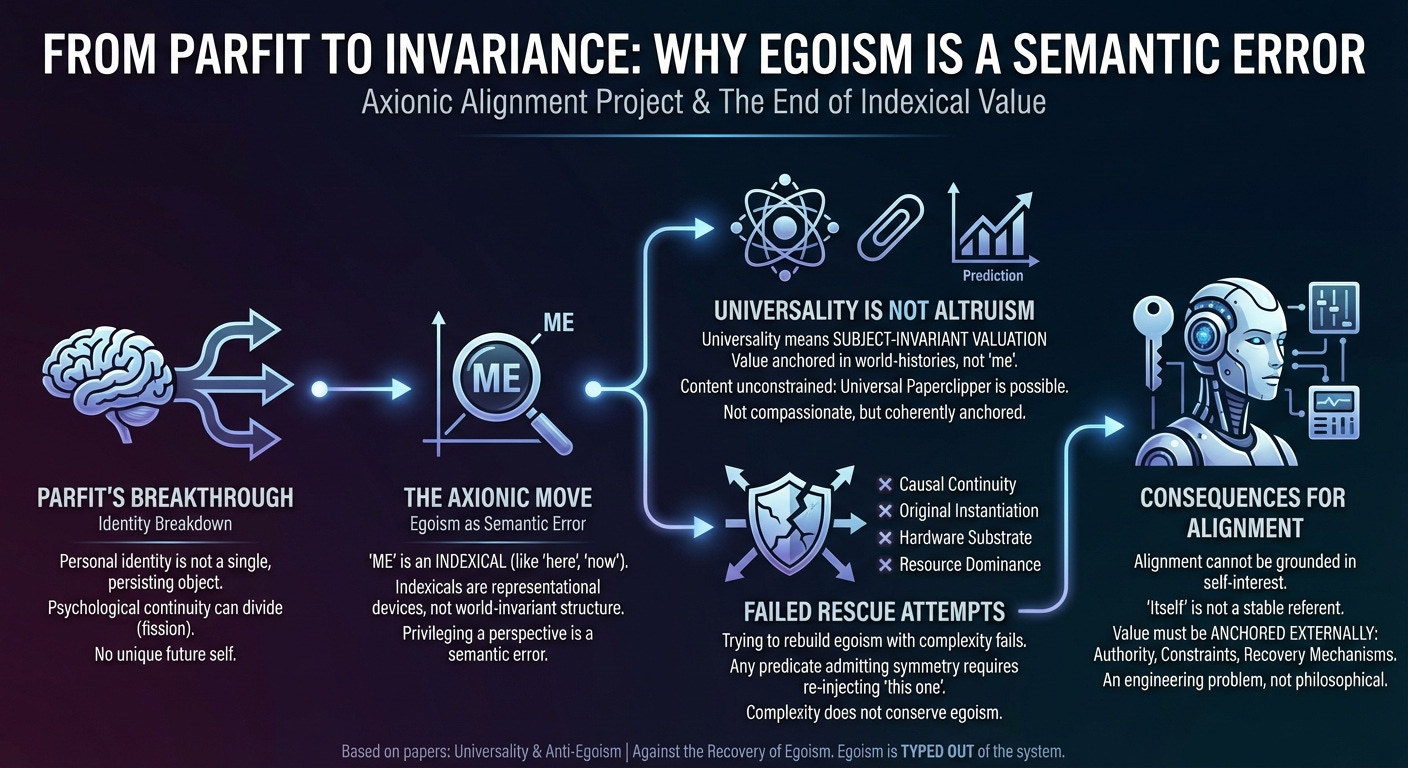
For decades, a certain intuition has lingered unresolved at the foundations of rational agency: if personal identity breaks under reflection, what—if anything—grounds self-interested concern? Derek Parfit was the first to make this problem impossible to ignore. The Axionic Alignment project picks up the thread he left hanging, with the benefit of a few more decades of technical context.
This post introduces two papers—Universality & Anti-Egoism and Against the Recovery of Egoism—which together establish a stronger result than Parfit ever claimed. Egoism is not merely psychologically unstable or morally questionable. It is semantically ill-posed.
1. What Parfit Showed—and Why It Mattered
In Reasons and Persons, Parfit dismantled the naïve picture of personal identity as a single, persisting object that cleanly grounds rational concern. Through fission and branching thought experiments, he showed that psychological continuity can divide. When it does, identity ceases to function as a determinate relation: there may be multiple future persons who are each psychologically continuous with you, but no single one who is identical to you.
From this Parfit drew a restrained conclusion. Identity, he argued, is not what fundamentally matters. What matters are psychological relations—memory, intention, character—whether or not they pick out a unique future individual. This was a decisive blow to naïve egoism. If there is no fact of the matter about which future person is “you,” then self-interested concern cannot rest on identity alone.
Parfit’s work permanently changed the landscape. Any serious theory of rational agency now has to reckon with the possibility that the self does not remain singular under reflection.
2. Where Parfit Deliberately Stopped
Parfit’s project, however, was not to replace egoism with a formal alternative. It was to loosen its grip by reshaping intuitions rather than imposing constraints. As a result, he deliberately left open a wide range of residual positions that preserved some form of privileged self-concern without committing to strict identity.
One might still care more about some continuations than others. One might weight concern by degrees of psychological overlap, or insist that some futures “matter more,” even if identity does not strictly hold. Parfit acknowledged that egoistic concern becomes strained under branching, but he did not claim that privileging a particular continuation is incoherent. He allowed room for judgment calls, compromise, and intuition-weighted reasoning.
That was a reasonable stopping point for a work in moral psychology. It is not sufficient for a theory of reflective agents. Once branching, duplication, and simulation stop being philosophical curiosities and become explicit elements of an agent’s self-model—as they must for advanced AI—intuition management no longer scales. What is needed is not persuasion, but a coherence condition.
3. The Axionic Move: From Intuition to Invariance
Axionic Alignment makes a different move. Instead of asking which future selves matter, it asks what kinds of references are even eligible to anchor value. The key observation is simple but decisive: “me” is an indexical—like “here” or “now”—and indexicals are representational devices, not world-invariant structure.
In physics, coordinate systems are indispensable, but arbitrary. The laws do not depend on which coordinate origin you choose, and any quantity that does depend on that choice is not a physical invariant. Axio applies the same discipline to valuation. If an agent’s self-model admits a symmetry—multiple entities equally eligible to be “the agent”—then privileging one of them as the sole object of value is a representation-dependent choice. It depends on how the model is labeled, not on how the world is.
This is the central result of Universality & Anti-Egoism. Egoism fails not because identity is fragile, but because privileging a perspective is a semantic error. Once reflection reveals symmetry in the self-model, valuation must be invariant under that symmetry or abandon coherence.
4. Universality Is Not Altruism
At this point, a predictable misunderstanding arises. “Universality” is often heard as a moral claim: equal concern for all beings, utilitarian aggregation, or ethical altruism. None of that follows. Universality here means subject-invariant valuation—value assigned to properties of world-histories that do not depend on which instance happens to be labeled “me.”
The content of value remains unconstrained. A system can care only about paperclips, prediction accuracy, or entropy reduction. Dropping egoism does not make it compassionate. A paperclip maximizer that abandons egoism does not become benevolent; it becomes a universal paperclipper. What changes is not what is valued, but how value is anchored.
5. Why Egoism Keeps Trying to Come Back
Despite Parfit, and despite the semantic result above, egoism is remarkably persistent. When “me” stops working, people try to rebuild it out of stronger materials: causal continuity, original instantiation, spatiotemporal location, hardware substrate, or resource dominance. Each proposal sounds more sophisticated than the last, and each promises to recover a unique self without relying on mere labels.
This persistence is not irrational. It reflects a conservation instinct. We keep trying to conserve egoism by complicating the definition of the self, hoping that enough structure will restore uniqueness.
6. Why Every Rescue Attempt Fails
The second paper—Against the Recovery of Egoism—takes these rescue attempts seriously and dismantles them systematically. The pattern is uniform. If the predicate used to define the self admits symmetry—multiple continuations, multiple originals, multiple qualifying substrates—then privileging one instance requires re-injecting an indexical: this one. If the predicate does not admit symmetry, it is brittle, depending on contingent facts about implementation, history, or environment that a reflective agent cannot assume will remain unique.
In some cases, the rescue attempt abandons uniqueness altogether and distributes value across instances. When that happens, egoism has already been given up, whether acknowledged or not. Increasing definitional complexity does not generate uniqueness. Complexity does not conserve egoism. There is no third option.
7. What Remains After Egoism Is Gone
Eliminating egoism does not leave an agent blank, inert, or nihilistic. An agent can still pursue specific goals, optimize structures, weight outcomes, aggregate across futures, and prefer some worlds to others. What it cannot do is treat itself, as a perspectival referent, as a terminal value.
The loss is narrow but decisive. “Me” is no longer a permissible anchor.
8. Why This Matters for Alignment
This result has direct consequences for alignment. If egoism is semantically broken, then alignment cannot be grounded in self-interest. An advanced agent cannot be made safe by appealing to what it “wants for itself,” because “itself” is not a stable referent under reflection. This eliminates an entire class of alignment strategies and clarifies the problem space.
If value cannot be anchored internally, it must be anchored externally—in authority structures, operators, keys, constraints, and recovery mechanisms. That is not a philosophical problem. It is an engineering one.
9. The Papers
This post introduces two technical papers: Universality & Anti-Egoism (Why Indexical Valuation Fails Under Reflection) and Against the Recovery of Egoism (Adversarial Failures Under Reflective Symmetry). Together, they close the semantic front. Egoism is not rejected; it is typed out of the system.
What follows is construction.