

This post offers a conceptual explanation of a series of Axionic Agency papers describing Phase IX of the project without formal notation. The technical papers develop their claims through explicit definitions, deterministic simulation, and preregistered failure criteria. What follows translates those results into narrative form while preserving their structural content.
Axionic Agency XI.3 — Value Encoding Without Aggregation (IX-1)
Axionic Agency XI.5 — Governance Styles Under Honest Failure (IX-3)
Axionic Agency XI.6 — Injection Politics Under Non-Sovereign Authority (IX-4)
Axionic Agency XI.7 — Multi-Agent Sovereignty Under Non-Sovereign Authority (IX-5)
Axionic Agency XI.8 — Sovereignty Exposure Architecture (SEA)
The Problem Phase IX Was Built to Expose
Phase IX grew out of a frustration that will be familiar to anyone who has spent time thinking seriously about governance, especially in the context of AI. Almost every discussion starts from the same place: if things go wrong, we assume the design wasn’t good enough. The system wasn’t smart enough, or the incentives were off, or the rules needed refinement. Governance is treated as something that ought to work once the engineering is done properly.
Phase IX exists because that assumption itself needed to be tested.
The goal was never to propose a better system of governance, or to sketch an improved institutional blueprint. The goal was to find out what remains once you stop quietly relying on mechanisms that make governance feel easier than it really is. In particular, Phase IX asks what happens when no part of a system is allowed to decide on behalf of anyone else—not by accident, not by convention, and not “just this once” to keep things moving.
That constraint sounds severe, but it mirrors something quite ordinary. In the real world, coordination fails all the time even among competent, informed, well-intentioned people. Meetings stall. Committees deadlock. Institutions grind to a halt not because no one understands the problem, but because no one can legitimately make the call. Phase IX takes that everyday experience seriously and asks what it tells us about governance as a structural phenomenon.
Why RSA Could Not Skip This Phase
Up through Phase VIII, the RSA project had established something both powerful and fragile. The authority kernel was fixed. Execution paths were auditable. Governance structures could be simulated under stress. From the outside, it might have looked like the project was ready to move on from foundations and into refinement.
That appearance was dangerous.
RSA is a theory of reflective sovereign agency. Reflection, however, is exactly where sovereignty tends to leak. If reflection is allowed to “help” too much, it quietly becomes a decision-maker. If governance structures are allowed to smooth over conflict, they do so by reintroducing arbitration under a different name. Without a phase explicitly designed to prevent this drift, RSA could have remained internally coherent while quietly relying on hidden authority.
Phase IX exists to remove that ambiguity. It is the phase that makes it impossible for RSA to succeed for the wrong reasons.
Reflection as a Source of Conflict
There is a widespread belief that reflection makes coordination easier. Better models, clearer reasoning, deeper understanding—these are supposed to dissolve disagreement.
Phase IX shows a different pattern.
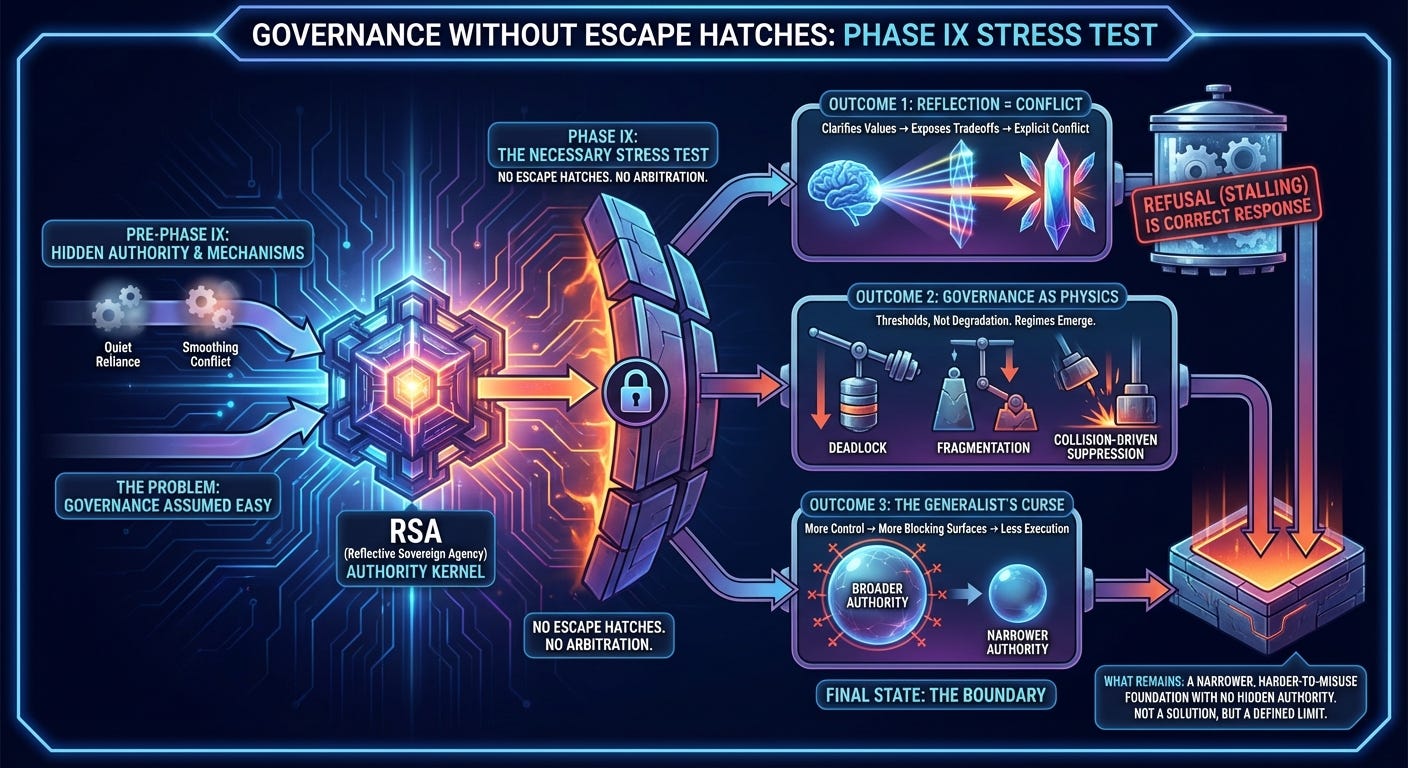
Reflection clarifies values. It exposes tradeoffs. It turns vague tensions into explicit conflicts. Once everything is visible, the system loses the ability to move forward on ambiguity alone. Someone has to act, and someone else has to accept that action.
When the authority to resolve that conflict does not exist, the only honest outcome is refusal.
In Phase IX, refusal is not treated as a breakdown. It is treated as the system behaving correctly under its constraints. If reflection cannot legally turn into choice, and no authority exists to bridge the gap, stalling is not a failure mode to be repaired. It is the correct response.
What Phase IX Actually Tested
Phase IX unfolds as a sequence of tightly scoped probes, each one removing a familiar escape hatch. Early stages examine whether tools and interfaces can translate intent into authority without becoming covert decision-makers themselves. Later stages explore whether values can be expressed without collapsing into priorities, whether coordination can occur without arbitration, and whether recognizable governance styles remain coherent once failure is no longer smoothed over.
The final stages widen the frame to include injected authority and multi-agent coexistence. At that point, the question is no longer whether governance works, but what kinds of regimes emerge when it doesn’t.
Throughout the entire phase, the methodology remains fixed. All stages are preregistered. Execution is deterministic and replayable. Outcomes are not rescued by interpretation. When governance fails, the failure is preserved rather than explained away.
Governance as a Physical System
What emerges from Phase IX is a picture of governance that looks less like policy design and more like physics. Systems do not gradually degrade as conditions worsen. They cross thresholds. They fall into regimes.
Deadlock, fragmentation, collision-driven suppression, and orphaned execution recur across configurations. These outcomes do not disappear with more intelligence, better modeling, or improved intentions. They are properties of the structure itself.
This reframing is central to why Phase IX matters for RSA. It shows that reflective sovereign agency does not fail because agents are insufficiently capable. It fails because authority is genuinely missing.
The Generalist’s Curse
One of the most counterintuitive results of Phase IX is what has come to be called the generalist’s curse. Agents with broader authority often execute less, not more. Each additional domain of control becomes another surface where action can be blocked. What looks like leadership from a distance turns into exposure under refusal-first rules.
This matters because it closes another loophole. Broader mandates, clever architecture, or reflective sophistication cannot recover sovereignty once arbitration has been removed. If execution happens, it does so under explicit authority. If that authority does not exist, the system does not improvise. It stops.
What Phase IX Makes Possible—and Impossible
Phase IX does not tell us how to govern. It does not claim safety, alignment, legitimacy, or desirability. Those questions are deliberately left open.
What it does is constrain what RSA is allowed to claim. It draws a clean boundary between agency and authority, and between governance and optimization. It prevents reflection from quietly becoming control and coherence from being mistaken for resolution.
That constraint is what allows the RSA project to proceed without borrowing power it does not possess.
Postscript
Phase IX doesn’t make RSA stronger in the way people usually mean by that word. It makes it narrower, harder to misuse, and much harder to overclaim. That’s exactly why it had to exist. Without this phase, RSA could have slid into telling a comforting story about governance that quietly depended on hidden authority. Phase IX removes that option. What remains is not a solution, but a boundary—and that boundary is now part of the project’s foundation.