

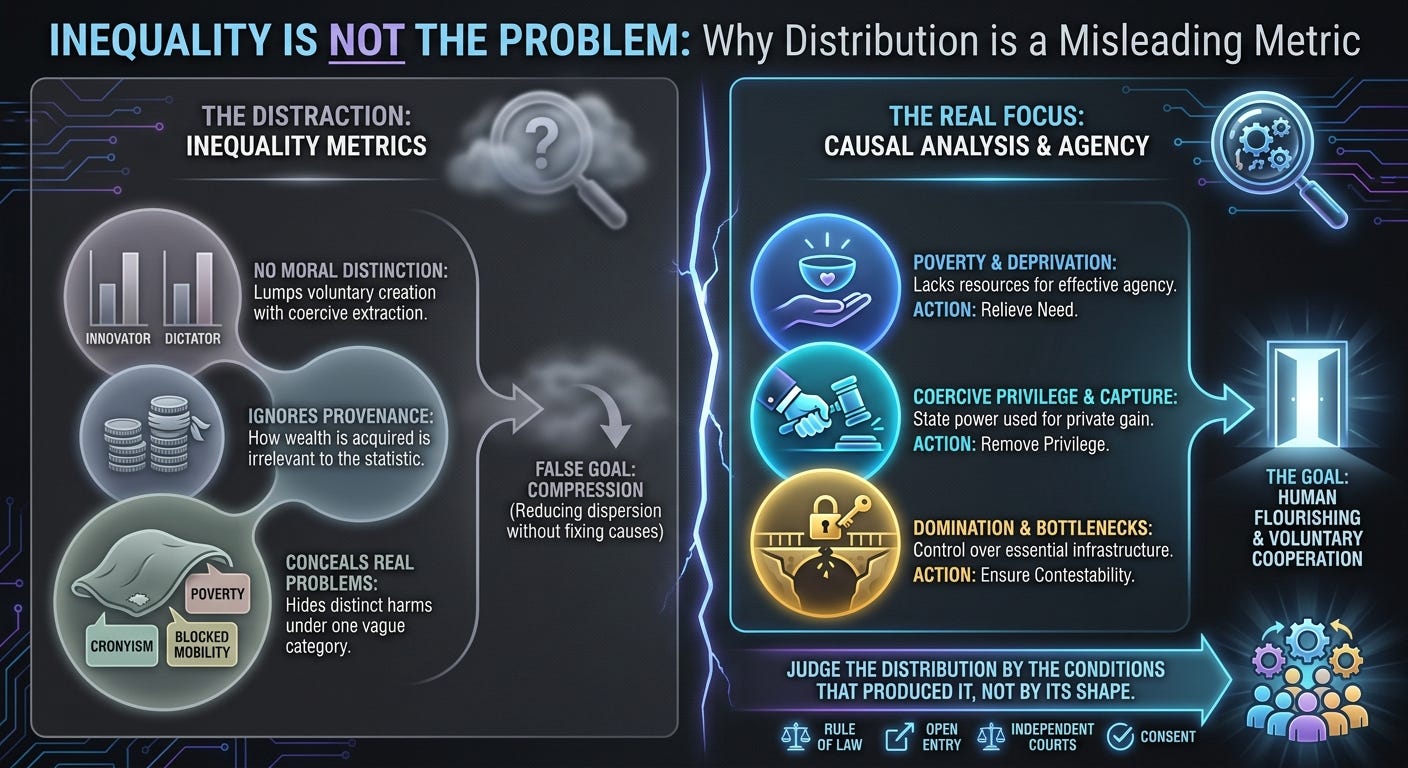
Inequality Is Not a Problem
A distribution cannot tell you what is wrong
I previously argued that inequality is not the problem—poverty is. Poverty deprives people of resources needed for effective agency. Inequality merely describes a difference between people.
The error runs deeper. Inequality is not a coherent category of social harm. It compresses creation, extraction, deprivation, privilege, inheritance, and voluntary difference into a single description of how far apart people’s holdings are.
A society may be unequal because innovators created enormous value, because dictators stole public wealth, because monopolists captured the state, because families transferred property across generations, or because birth assigned different legal rights. An inequality statistic cannot distinguish among these causes. It registers only the resulting distribution.
That distribution may be evidence of deprivation or domination. It is not itself either one.
This distinction matters because influential institutions increasingly discuss inequality as though its status as a social problem had already been established. A recent Nature editorial, “Why there needs to be a global debate on inequality,” called inequality a “crucial issue” on which researchers should seek consensus. It was responding to a modelling report proposing extensive global redistribution in the name of equality, prosperity, and planetary limits.
The title assumes what would first need to be proved: that inequality itself requires collective correction.
It does not.
A distribution is not a moral diagnosis
Imagine two societies with identical wealth distributions.
In the first, the richest citizen acquired his fortune by developing a technology that millions of people voluntarily purchased. The buyers benefited. The inventor became much richer. No one was coerced or deceived.
In the second, the richest citizen is a dictator who confiscated productive assets, suppressed competitors, and diverted public revenue into private accounts. The population is poorer because of his wealth.
The distributions may be numerically identical. The moral character of the two societies is opposite.
Now consider another pair.
In one society, nearly everyone lives at subsistence level and wealth is distributed almost equally. In the other, the poorest citizens enjoy secure housing, abundant food, advanced medicine, and discretionary income, while a small number possess immense fortunes.
The second society is more unequal. It is also plainly preferable for nearly everyone who must live in one of them.
A measure of dispersion contains no information about consent, coercion, production, deprivation, legitimacy, or welfare. It cannot tell us how wealth was obtained, whether anyone was harmed, or whether the poorest are flourishing.
Inequality is a measure of difference, not a theory of justice.
The category conceals the actual problems
Arguments about inequality usually move among several distinct complaints.
People may lack food, shelter, medical care, or the resources required to direct their own lives. That is poverty.
Fortunes may arise from monopoly protection, corruption, regulatory capture, or privileged access to the state. That is rent extraction.
Wealth may purchase exemptions from law or control over political institutions. That is political domination.
People may be assigned lower legal status by caste, race, sex, or citizenship. That is unequal treatment under law.
Licensing barriers, exclusionary zoning, cartelization, poor institutions, or inherited privilege may prevent people from improving their condition. That is blocked mobility.
Some goods may be scarce or positional, allowing richer people to outbid others for access. That is a problem of scarcity and allocation.
These phenomena differ in cause, moral status, and remedy. Poverty calls for relief or institutional reform, depending on its cause. Monopoly calls for competition. Corruption calls for prosecution and structural reform. Legal hierarchy calls for equal rights. Blocked mobility calls for removal of barriers.
Calling all of them “inequality” discards the distinctions required to address any of them intelligently. It places differences produced by voluntary exchange, innovation, inheritance, preference, and luck in the same category as differences produced by theft and political privilege.
The distribution cannot tell them apart. Public rhetoric generally does not try.
Provenance matters more than position
Suppose two people each possess ten million dollars.
One earned it by building a successful company. The other received it through political corruption.
Their positions in the wealth distribution are identical. Their claims to the wealth are not.
Suppose two other people each have very little.
One suffered an involuntary catastrophe. The other chose a low-income life that permits more leisure or artistic work.
Their positions in the income distribution are identical. Their circumstances are not.
Any serious moral evaluation must ask how a condition arose, whether the relevant choices were voluntary, whether anyone’s agency was violated, and whether the resulting claims are legitimate.
Inequality metrics erase this history. A dollar created through productive cooperation and a dollar extracted through coercion enter the same column. A voluntary difference and an imposed hierarchy appear as the same distance.
This limitation follows from what inequality measures. Dispersion is insensitive to provenance by definition.
The morally relevant variables are acquisition, consent, deprivation, contestability, and power. Relative position may provide evidence about them. It cannot answer them.
When wealth becomes power
Wealth and political power do not inhabit separate worlds.
Large fortunes can finance campaigns, lobbying organizations, litigation, media networks, research institutes, and durable institutions capable of influencing the rules under which future wealth is acquired. Wealth can purchase existing privileges and help create new ones.
No constitutional order can eliminate this pressure.
A state with opaque institutions, broad discretionary powers, and saleable privileges invites capture. A state constrained by general rules, transparency, decentralization, and independent courts is harder to capture, but never capture-proof.
Concentrated wealth and concentrated state power can therefore form a dangerous feedback loop. Private wealth bends public authority; public authority creates and preserves private fortunes.
Some private assets also acquire quasi-governing functions. A dominant payment network, digital platform, utility, communications system, or transport hub may control access on which others depend. Its owners may exclude competitors, impose terms without meaningful negotiation, or shape the conditions under which others exercise agency.
The concern is not merely that the owners possess a great deal. It is that the asset functions as infrastructure or a bottleneck.
Scale can increase this risk, but size alone does not settle the question. A billion-dollar firm in a contestable market may wield less durable power than a smaller regulated utility or payment processor protected by high switching costs and legal barriers.
The relevant variables are market contestability, network effects, switching costs, legal privilege, exclusionary conduct, dependence, and political influence.
Extreme concentration is therefore a legitimate object of scrutiny. But inequality is still not the offense.
The offense is domination.
Extreme inequality can be evidence that something is wrong. It is never a sufficient diagnosis of what is wrong.
Scarcity and relative purchasing power
Relative wealth matters where access is allocated by bidding for fixed or tightly constrained supply.
A richer person can outbid others for land in a desirable location, scarce medical capacity, elite educational places, or exceptional legal representation. In such cases, one person’s increased purchasing power may reduce another person’s effective access even if the latter’s nominal resources remain unchanged.
This is a genuine distributive effect. It still requires analysis of the specific good, supply constraint, and allocation rule.
Housing in Manhattan is naturally scarce. Housing across a metropolitan region is often made scarcer by zoning and restrictions on construction. A scarce luxury location and basic access to shelter are different problems.
Medical labour presents a harder case. In the short run, specialists, operating rooms, and clinical capacity may be highly inelastic. Rich buyers can bid scarce resources away from poorer patients. Where an essential good is allocated primarily by price under fixed supply, relative purchasing power can reduce agency directly.
The response must address the actual mechanism: expand supply where possible, remove artificial barriers, or reconsider the allocation rule where the good is essential and supply cannot respond.
This does not establish inequality as a universal harm. It establishes that relative purchasing power matters in particular markets.
Inheritance and persistence
A society cannot be evaluated only at the moment wealth is created.
Fortunes persist and pass across generations. Descendants may receive resources they did not earn and use them to acquire education, security, influence, and access unavailable to others.
This can reduce mobility and magnify the conversion of private wealth into public power.
But “unearned” does not mean “illegitimate.” A gift does not become wrongful because the recipient did not produce it. People ordinarily have strong claims to decide what happens to property they legitimately own, including the right to transfer it to their children.
The relevant distinction is between inheriting private resources and inheriting coercive privilege.
A child may inherit a house, a business, or a portfolio. No child should inherit legal immunity, regulatory authority, political office, monopoly rights, or control over public institutions.
At large scales, inherited assets may also confer quasi-governing power. A descendant who inherits a dominant platform, infrastructure system, or protected monopoly may inherit control over systems on which others depend.
The problem arises from the asset’s function and institutional position, not from inheritance as such.
Inherited wealth becomes a structural concern when it secures durable exclusion, suppresses contestability, preserves monopoly, or purchases political authority. A society committed to mobility should attack those mechanisms directly rather than treating every intergenerational transfer as an injustice.
Correlation is not diagnosis
Highly unequal societies are often said to exhibit worse health, lower trust, more crime, weaker mobility, and greater instability.
Some of these correlations may be real. They still do not establish inequality as the cause.
Corrupt institutions may produce both high inequality and low trust. A caste system may produce both high inequality and poor mobility. Monopoly and state capture may generate concentrated wealth while independently producing social dysfunction.
In such cases, inequality is a symptom of the causal structure.
This matters because interventions aimed at the symptom can leave the mechanism intact. A state may tax the nominally rich while preserving the regulations, privileges, and political connections through which wealth is extracted. It may reduce measured inequality while expanding the discretionary power that enabled capture.
A correlation between inequality and some harm supports investigation. It does not make distributional compression the default remedy.
One must still ask whether poverty, privilege, scarcity, segregation, institutional weakness, or political capture is doing the causal work.
Without that analysis, “inequality causes bad outcomes” functions less as an explanation than as a permission slip for redistribution.
Redistribution requires an independent justification
A policy that takes resources from one person and gives them to another will usually benefit the recipient. That does not establish that the recipient had a valid claim against the person compelled to pay.
Benefit alone cannot justify coercion. If it could, any taking would become permissible whenever the recipient’s expected gain exceeded the owner’s estimated loss. Property, consent, and individual agency would survive only at the discretion of whoever performs the calculation.
Axionic ethics rejects this aggregation. Coercive redistribution harms those subjected to it because it reduces their agency through threats of fines, seizure, or imprisonment. Compassionate intentions do not erase the coercive structure, and benefits to one group do not cancel harms imposed on another.
Restitution is different. If property was acquired through theft, fraud, corruption, or coercive privilege, returning it to those with a valid claim is justified because the current holding is illegitimate, not because the transfer improves equality.
Need also creates a reason for assistance without automatically creating an enforceable claim against a particular stranger. Need and entitlement are not synonyms.
A politics that treats inequality itself as the target eventually asks how much force is required to produce a preferred statistical pattern. That project requires a justification independent of the fact that the distribution will become more equal.
When intervention is justified
Rejecting inequality as a policy target does not require leaving every concentration of wealth untouched.
Intervention may be justified where wealth is sustained by fraud, coercive privilege, corruption, exclusionary monopoly, or control over essential bottlenecks that others cannot reasonably avoid.
These are not offenses of possession. They are offenses of domination, exclusion, or illegitimate acquisition.
Antitrust enforcement, forced divestiture, ownership limits, or utility regulation may therefore be defensible in some cases. Their justification must rest on a demonstrated mechanism of harm, not on the size of the fortune alone.
Risk is not guilt. A person does not become liable to coercion merely because his resources might someday be used badly.
The threshold should be actual or credibly imminent domination: control over market entry, political authority, indispensable infrastructure, or systems on which others depend.
This boundary will always be contested. That does not justify replacing it with a wealth percentile.
The social contract does not settle the question
A common response is that property rights depend on state enforcement, so society may alter those rights through taxation and redistribution.
This does not follow.
Courts enforce contracts, bodily autonomy, freedom of association, and property rights. The fact that an institution protects a right does not mean it owns the right or may redefine it without limit.
Even if some theory of political obligation justified taxation to fund a legal order, it would not justify distributional compression as an independent objective. The argument would still need to identify the public function being funded, the obligation being enforced, and the limits of the authority claimed.
Invoking a “social contract” does not answer those questions. It merely names the theory under dispute.
Why institutions prefer inequality
Inequality remains institutionally attractive because it is measurable.
Poverty, coercion, legitimacy, mobility, and political capture require causal analysis and resist reduction to a single index. Income shares and Gini coefficients are easy to calculate, compare, and display.
A scalar measure creates the appearance of scientific precision. Countries can be ranked. Targets can be established. Progress can be plotted.
Inequality is also administratively convenient. Governments can change post-tax income distributions directly through taxation and transfers. They cannot as easily produce competent schools, open markets, high-trust institutions, or governments resistant to capture.
A metric that responds immediately to state action is attractive even when the action leaves the underlying problem intact.
The term also blurs unequal outcomes with unequal legal status. Moral condemnation properly directed at caste systems, discriminatory laws, and inherited political rank is transferred to ordinary differences in income or wealth.
The resulting politics rarely needs to prove that a particular disparity caused harm. The disparity is presented as the harm.
Science cannot discover the correct wealth ratio
Researchers can investigate how taxes affect investment, migration, employment, and capital formation. They can study poverty, mobility, monopoly, and political capture. They can estimate environmental constraints and externalities.
They cannot derive an ideal income or wealth ratio from data alone.
A claim that no person should possess more than ten, one hundred, or one thousand times the wealth of another is normative. It depends on assumptions about entitlement, freedom, authority, welfare, and the moral significance of relative position.
Scientific credentials do not convert those assumptions into findings.
What causes poverty is an empirical question.
Whether one person may be coerced to relieve another person’s poverty is a moral question.
Which institution may exercise that coercion is a political question.
A model can estimate consequences under specified assumptions. It cannot establish the legitimacy of those assumptions by producing numerically precise outputs.
When a desired distribution is built into the objective function, the model does not discover that distribution. It operationalizes it.
Compression is not progress
A society can become more equal through mass impoverishment. It can become more unequal through broad prosperity combined with exceptional gains at the top.
It can reduce inequality by destroying productive industries, driving away skilled workers, or preventing successful firms from scaling. It can increase inequality because a technology creates immense consumer value and rewards its creators.
The direction of the inequality statistic does not tell us whether the change was good.
A policy may compress incomes while making nearly everyone poorer. Another may increase dispersion while raising the living standards of the poorest. A third may leave the distribution unchanged while replacing corrupt fortunes with legitimate ones.
Reduction in inequality is not evidence of success. Increased inequality is not evidence of failure.
Postscript
A society should not ask whether it is too unequal.
It should ask whether people possess the resources required for meaningful agency. It should ask whether wealth was acquired through production or extraction, whether markets remain contestable, whether political power can be purchased, and whether legal rights apply equally.
It should ask whether concentrated wealth controls essential bottlenecks, whether private assets have acquired quasi-governing functions, and whether inherited fortunes preserve coercive privilege rather than merely transfer property.
It should ask whether the distribution is feeding back into the conditions that produced it. Can private resources secure public privilege? Can economic dominance become legal dominance? Can political authority manufacture private fortunes?
No state can be made immune to capture. No distribution can guarantee freedom. The objective is continuous contestability: dispersed authority, open entry, independent courts, general rules, and direct action against coercive control where it appears.
These questions do not collapse into a single metric. That is a virtue.
A measurement that cannot distinguish creation from extraction, abundance from deprivation, or freedom from domination cannot serve as a social objective.
Relieve poverty. Remove coercive privilege. Punish corruption. Preserve equality before the law. Prevent private wealth from becoming unaccountable public power. Defend voluntary cooperation.
Judge the resulting distribution by the conditions that produced and sustain it, not by its shape.
Nice job of framing and discussing the epic fail of the inequality rhetoric currently being used for political propaganda by endless 'kids'. Thx! In a just world, this would be on every oped page across the nation.