

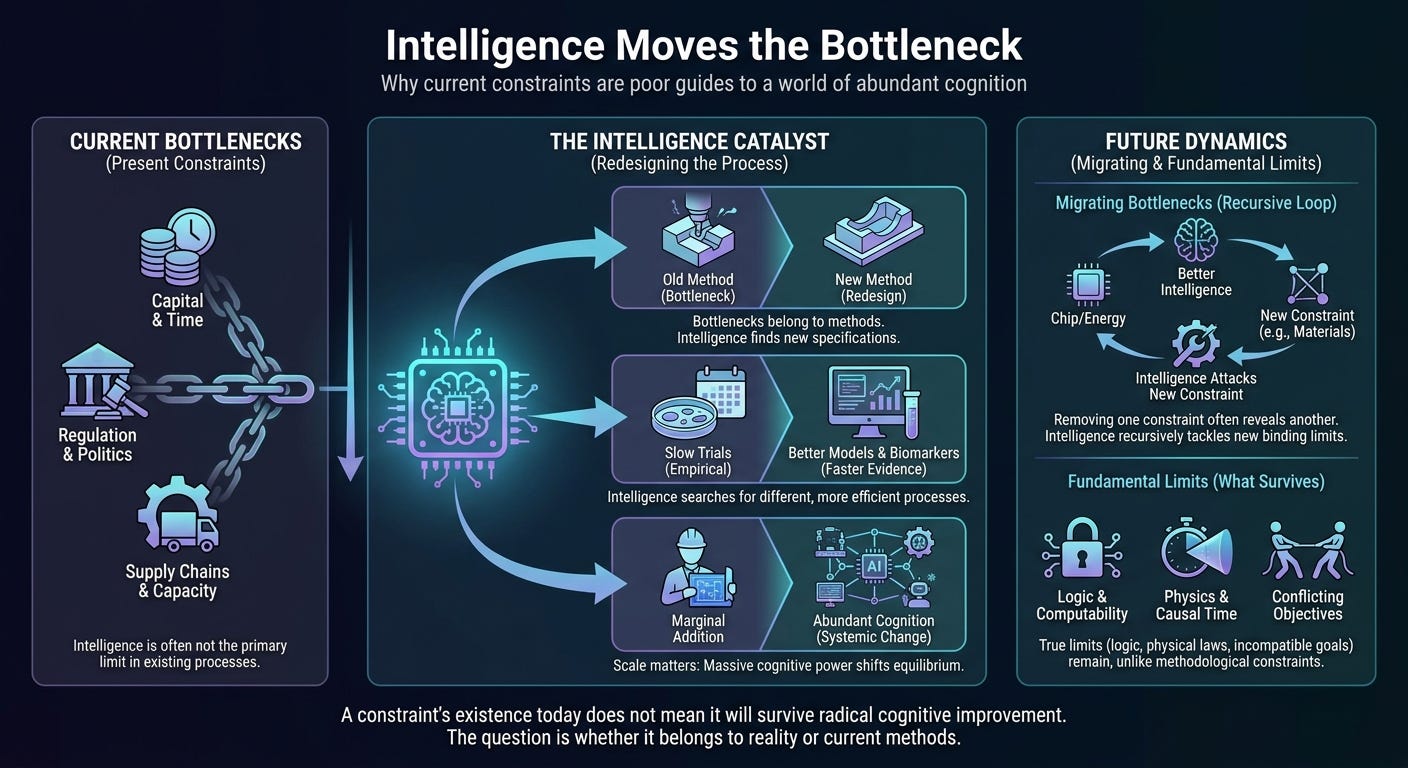
David Bellamy recently offered what he called a difficult pill for scientists and engineers to swallow: “intelligence is not the biggest bottleneck in most of the world’s problems.” As a description of the world today, that may be right. Large projects are constrained by capital, regulation, supply chains, construction capacity, politics, or time far more often than by a shortage of clever people.

But a bottleneck describes a process under a given set of conditions. Change the process and the bottleneck may move or disappear. That matters when the resource being increased is intelligence, because intelligence can help redesign the process itself.
Bottlenecks belong to methods
Suppose a factory can produce only a thousand parts per day because one milling machine handles a thousand parts a day. The mill is the bottleneck. Redesign the part for injection molding and milling may cease to matter entirely.
Calling the mill the bottleneck identifies what constrains the current production system, not a permanent feature of making the product. The constraint is real, but its persistence depends on keeping roughly the same production architecture.
Much discussion of AI quietly freezes that architecture in place. AI may discover drugs faster, but clinical trials still take years. AI may design buildings faster, but construction remains physical. AI may optimize the grid, but energy remains scarce. Better policy proposals still have to pass through a bureaucracy.
Each of these may be true today. None establishes that a much more intelligent civilization would keep solving the same problems in the same way. A Phase III trial is not a law of nature, nor is a zoning hearing, a construction site organized around human trades, or a regulatory agency processing documents through its present workflow.
Intelligence searches for different processes
Most resources increase what an existing process can do. Intelligence has the additional property that it can search for a different process.
More copper increases the supply of copper. More intelligence can search for substitutes, reduce the amount required, improve recycling, or redesign the component so that it needs none. More agricultural land increases acreage, while more intelligence can improve crops, irrigation, fertilizer, or automation.
Cheap energy and abundant capital can also transform production, so the property is not unique to cognition. What distinguishes intelligence is that its direct output can be a new specification for the process itself. It can deliberately search across technologies, institutions, and designs rather than expanding the resources available to an existing method.
This is why “intelligence is not the bottleneck” says less than it seems. Even when cognition is not the immediate constraint, cognition may be the means by which that constraint is reduced, substituted, reorganized, or bypassed.
That a constraint is open to attack does not make attacking it easy, cheap, or certain to pay. It means only that the existence of a bottleneck today is insufficient evidence that the same bottleneck will bind after a radical increase in cognitive capability.
One more engineer is not the experiment
There is also a scale equivocation hidden in the phrase “more intelligence.” Add one excellent engineer to a housing project and little changes, because land, permits, financing, or construction capacity already bind.
Now imagine reducing the cost of competent engineering cognition by six orders of magnitude. The systems providing it can be copied, work continuously, span disciplines, coordinate with one another, and operate automated tools directly. That one more engineer cannot solve a housing shortage tells us little about a world in which engineering cognition becomes nearly as abundant as raw compute. Marginal analysis around the current equilibrium does not automatically survive a technological discontinuity that changes the equilibrium.
Abundant cognition is itself a physical achievement. AI runs on chips, electricity, cooling, fabs, and supply chains, so the expansion of intelligence can run directly into material bottlenecks of its own. This does not break the argument; it makes the recursion explicit.
Medicine makes the distinction clear
Drug development looks like a strong case for non-cognitive bottlenecks. Once an AI proposes a molecule, biology still has to cooperate. The drug must be synthesized, tested, administered, and observed. No amount of reasoning makes a five-year survival endpoint arrive tomorrow.
But that establishes a limit on one way of acquiring evidence, not a five-year lower bound on acquiring the relevant knowledge. More capable systems can search for earlier biomarkers, improve patient stratification, design adaptive trials, automate laboratories, and construct models that extract more information from fewer experiments.
Those models still have to be grounded in reality. Some uncertainty can only be resolved empirically, and some evidence becomes available only after a physical system has evolved long enough to produce it. A rare autoimmune failure that appears only after three years of cumulative exposure cannot be observed before the biological process capable of producing it has occurred.
Where a valid shortcut exists, intelligence can find it. Where none exists, the causal sequence itself has to run. “Empirical evidence remains necessary” still does not imply “the present empirical pipeline remains necessary.”
Physical systems remain physical
Manufacturing is physical, but factories are designed systems. Their robots, layouts, materials, scheduling, and construction methods are all open to redesign. Intelligence cannot think a factory into existence, but it can change how much factory is required, how quickly one can be built, how autonomously it operates, and what inputs it consumes.
Energy looks harder because civilization ultimately faces physical constraints on available energy and conversion. But “energy is constrained by physics” is very different from “our present energy system is near the relevant physical limit.” Primary energy, conversion efficiency, storage, transmission, and delivery at a particular place and time are different problems, several of which intelligence can attack without violating any conservation law.
Physics defines the feasible set. Engineering determines where inside it we currently operate. Confusing those levels turns current technology into a law of nature.
Institutions are equilibria as well as designs
Bureaucracy and politics are harder because institutions contain agents with interests. Some institutional failures are genuine engineering problems involving information costs, principal-agent failures, weak monitoring, or poor mechanism design. Better intelligence can plausibly improve those.
But apparent inefficiency is sometimes equilibrium rather than error. A zoning restriction may persist because incumbent homeowners expect to benefit from the scarcity it creates. A regulatory delay may survive because some constituency values the veto. An occupational barrier may be costly to society while benefiting the people who control entry.
In those cases there is no neutral optimization waiting to be discovered. Intelligence can search for bargains, compensation, institutional redesign, or ways to alter the underlying payoffs, but it cannot make conflicting interests disappear.
Coordination failure and distributive conflict come apart here. A coordination failure may have an outcome everyone prefers but cannot reliably reach. A distributive conflict may contain no unanimously preferred feasible outcome at all.
Bottlenecks migrate
A stronger objection remains. Remove one bottleneck and another becomes binding. Make drug discovery cheap and laboratory capacity becomes scarce. Automate the laboratories and manufacturing becomes the constraint. Expand manufacturing and energy or raw materials take its place.
That is correct, and it describes technological progress. Mechanized agriculture did not abolish scarcity; it changed which inputs were scarce. Steam power, electrification, containerization, computing, and telecommunications repeatedly shifted the limiting constraint.
Intelligence is unusual in that it can participate in this process recursively. Once one constraint becomes binding, intelligence can work on that constraint next. Improvements in chips, energy systems, robotics, logistics, and fabs can in turn make more intelligence affordable, creating a feedback loop between cognition and the physical systems that instantiate it.
There is no reason to expect this process to continue without limit. Returns may diminish, and some constraints cannot be engineered away. The interesting question is which ones survive repeated attempts at redesign.
What survives intelligence?
Some limits sit much deeper than any current technology.
Logic supplies the clearest cases. Mutually contradictory requirements cannot all be satisfied, however capable the reasoner.
Computability gives absolute limits such as the halting problem. Computational complexity adds resource limits, although we should distinguish proven lower bounds from problems that are merely slow under current algorithms.
Information and causal time draw another boundary. Some evidence is unavailable because it has not yet reached us; other evidence has to wait on a physical process that has not yet run. Intelligence can look for predictive proxies or faster equivalent processes, and sometimes there are none to find.
Physics constrains propagation speed, energy, matter, and thermodynamics. Greater intelligence can move civilization toward those boundaries; it cannot repeal them.
Conflicting objectives give another kind of limit, sharper than the institutional case. If Alice and Bob both insist on exclusive possession of the same indivisible object, no allocation satisfies both preferences as stated. Changing what they want is a different achievement from satisfying what they want.
These are qualitatively different from present-day bottlenecks such as trial protocols, zoning systems, battery chemistry, factory design, or administrative workflows. A constraint can be real without being fundamental.
Postscript
When someone identifies a bottleneck that greater intelligence supposedly cannot solve, ask what kind of constraint it is. Does it follow from logic, physical law, causal information limits, proven computational bounds, or genuinely incompatible objectives? If so, it may survive radical improvements in cognition.
If instead the constraint is a technology, institution, experimental protocol, or organizational design, its persistence has to be shown. It may prove stubborn, expensive, politically entrenched, or impossible to overcome in practice. Its existence today is still not enough to establish that conclusion.
Bellamy may be right that intelligence is not the largest immediate input into many current problems. The stronger inference, that radically greater intelligence will remain boxed in by roughly the same bottlenecks, does not follow. The question worth asking about any bottleneck is whether it belongs to reality or to the way we currently do things.