

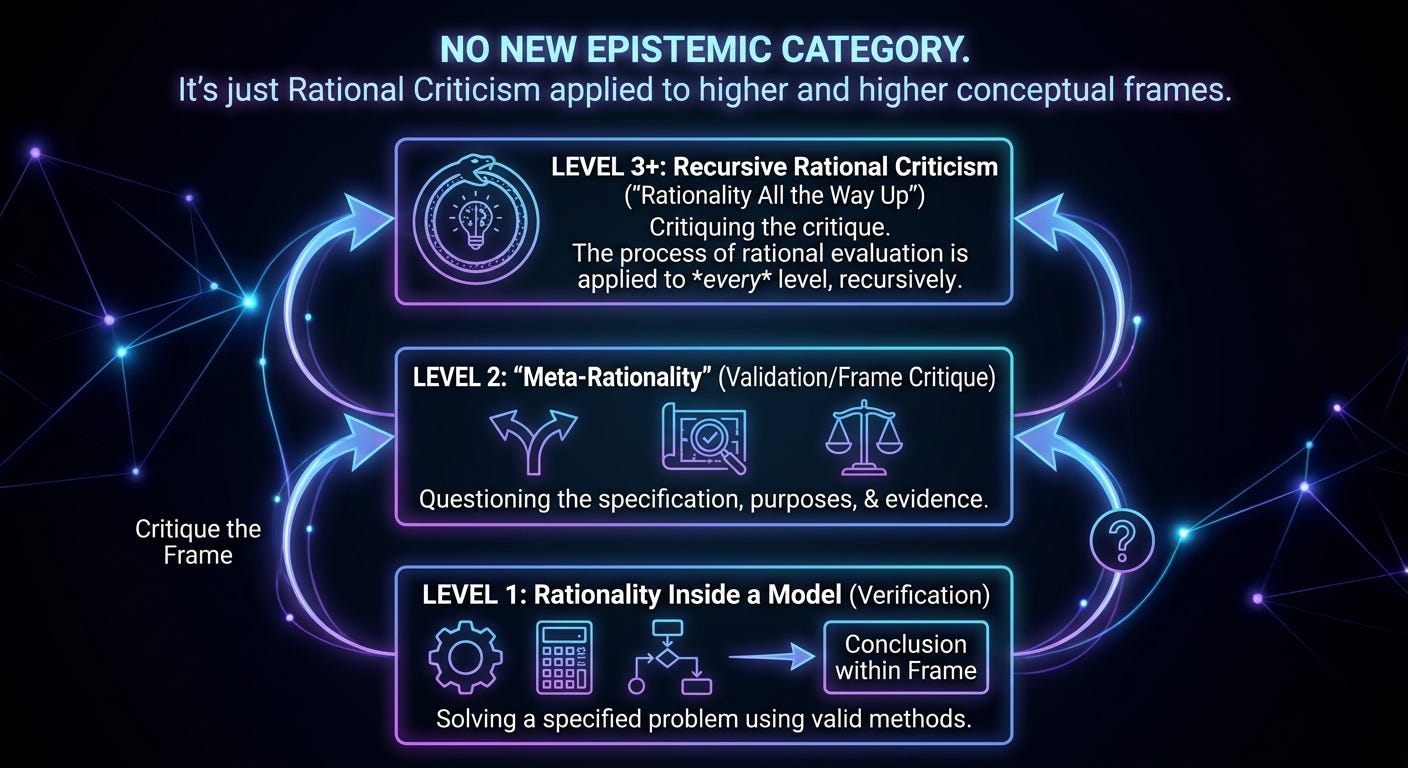
A system can reason correctly inside the wrong representation of a problem. Its procedures can be valid, its experts competent, and its conclusions internally justified while the whole apparatus remains aimed at the wrong target. David Chapman has identified this failure mode and given it a name.
His COVID case study makes the point vividly. The World Health Organization treated respiratory transmission through an inherited infection-control framework that emphasized droplets, surfaces, distance, and hand hygiene. Aerosol scientists and engineers approached the same phenomenon as a problem in fluid dynamics: particles of different sizes are expelled into air, remain suspended for varying periods, accumulate indoors, and are transported by airflow. The disagreement ran beneath the level of which conclusion followed from shared premises. It was about which premises, categories, disciplines, and forms of evidence were relevant in the first place.
Chapman calls the capacity to deal with such failures meta-rationality. Rationality, in his technical usage, solves a specified problem using validated formal methods. Meta-rationality questions the specification itself: what the problem is, what purposes matter, who the participants are, which evidence counts, what expertise is relevant, and whether the established methods still fit the situation.
That distinction identifies a genuine change in level. Reasoning inside a model is different from asking whether the model should be used at all. But a change in the object of criticism does not by itself require a change in epistemic kind. What Chapman calls meta-rationality looks like rational criticism applied recursively.
When the frame becomes the problem
Software engineering has a familiar distinction between verification and validation. Verification asks whether a system conforms to its specification. Validation asks whether the specification describes the system we actually need. A project can succeed at the first and fail at the second, because correct execution cannot rescue a defective specification.
The same distinction appears in reasoning. A procedure may correctly manipulate a model in pursuit of an objective while the model omits the relevant causal structure or the objective no longer reflects what matters. At that point, more competent execution inside the existing frame does not help. The frame itself has become the object of criticism.
We can ask whether the model is adequate, whether a different discipline has more relevant expertise, or whether the objective itself should change. These are higher-order questions, but each remains a question about whether a conjecture survives criticism.
Chapman draws the boundary differently. Rationality operates inside a supplied problem representation, while meta-rationality evaluates the representation. That terminology is coherent, and if “meta-rationality” is only a convenient name for rational criticism directed at frameworks rather than conclusions, my disagreement with him is mostly terminological. There may even be good pedagogical reasons to give the activity a separate name.
The disagreement becomes substantive when the taxonomy is used to infer limits on rational judgment. Chapman says that competing scientific theories cannot be resolved by rational calculation and that incommensurable purposes cannot be weighed rationally. At that point, a useful distinction between levels of reasoning has become a claim about different kinds of reasoning.
A fallibilist conception of rationality has no reason to accept that boundary. If a meta-rational judgment about the proper frame is itself mistaken, we need some way to criticize it. Chapman need not introduce an infinite tower of meta-meta-rationality; he can simply say that meta-rationality includes the capacity to reconsider its own framing judgments. But once that recursive capacity is admitted, the question becomes why it belongs to a separate epistemic category. We can instead allow rational criticism to operate on whatever level contains the current source of error.
None of this implies that frame criticism feels like ordinary problem solving, develops through the same training, or is equally distributed among people. Someone can become expert at applying a framework while remaining reluctant or unable to question it. Chapman may therefore be identifying a psychologically distinct competence, and his broader project treats this kind of fluidity as something people often find difficult and uncomfortable.
But psychology and epistemology are different questions. Difficulty of acquisition does not imply a different standard of justification. Learning to question the model may require different habits, temperament, training, and institutional permission from learning to calculate within it. That does not establish that reasons cease to be reasons when their object moves up one level.
No algorithm is not no rationality
Chapman’s distinction becomes most vulnerable when he moves from the absence of a formal decision procedure to the conclusion that rational adjudication has run out. He observes that competing scientific theories may disagree over which evidence matters, which concepts are appropriate, and which standards of explanation should govern. Because there is no mechanical procedure that settles such disputes, he concludes that theory replacement cannot be resolved by “rational calculation.”
If “rational calculation” means an algorithm that accepts evidence and outputs the uniquely correct theory, that is unobjectionable. Science has no such procedure. But there is a large middle ground between deterministic calculation and arbitrary choice, and much of scientific reasoning takes place there.
Competing explanations can be criticized for failed predictions, ad hoc modifications, unexplained anomalies, incompatibility with independently successful theories, unnecessary complexity, or failure to account for the phenomenon that motivated them. None of these supplies an infallible scoring rule. Together they provide reasons for preferring some explanations over others, and those reasons themselves remain open to criticism.
The same issue appears when Chapman considers conflicting purposes. He writes that the interests of different participants in the COVID response were incommensurable and therefore could not be weighed rationally; qualitative trade-offs accordingly become a meta-rational practice. But lack of a common unit does not imply lack of rational comparison. Engineers routinely trade reliability, latency, safety, and cost without reducing them to one natural scalar.
Such comparisons may remain underdetermined. Several alternatives may survive every criticism we know how to make, leaving no uniquely mandated choice. That is rational underdetermination rather than irrationality. The absence of an algorithm shows only that reasons do not always compose into a mechanical decision rule.
Chapman’s own COVID argument works better under this interpretation. The strongest criticism of the WHO is not that it backed a theory that later proved false. That would lean on hindsight. It is that decision-makers demanded too much certainty before acting on a plausible high-consequence transmission mechanism when the cost of precaution was much smaller than the cost of being wrong. Chapman makes essentially this argument himself when he contrasts the short-term costs of precautions with the potentially enormous costs of ignoring airborne transmission.
That argument was available ex ante. In early 2020, one did not need proof that aerosol transmission was dominant before considering ventilation, filtration, respirators, and avoidance of crowded indoor spaces. One could instead ask what followed under model uncertainty. If aerosol transmission turned out to be minor, some precautions would impose unnecessary cost and inconvenience. If it turned out to be important, failing to take them could cause enormous harm. The asymmetry in losses was itself relevant to the decision.
This still leaves a harder institutional problem. Authorities do not face one heterodox theory at a time. During a crisis they face thousands of claims, many of them false, and they cannot investigate each one exhaustively. “Remain open to criticism” is therefore not an allocation procedure for scarce institutional attention.
Challenges deserve escalation when several signals converge: directly relevant expertise, a plausible causal mechanism, persistent anomalies in the incumbent model, independent lines of evidence, and an asymmetric risk profile in which the loss from acting needlessly is bounded and the loss from failing to act is not. Team Airborne mattered not simply because outsiders disagreed with the WHO, but because several of those signals were present at once.
Those signals are themselves a hypothesis about which challenges repay investigation, and they inherit the status of everything else in this account: open to criticism, revisable when they start misallocating attention, replaceable when something better is proposed.
A triage rule is also applied from inside a frame, and the frame can corrupt the triage. Directly relevant expertise was among the signals available in early 2020, but the infection-control framework scored relevance by discipline, which made aerosol physics look like an outside interest rather than the field that owned the mechanism. Under that scoring the first signal read as absent when it was present. A rule for deciding which challenges deserve attention can fail in the way the first-order model fails, and it needs the same remedy.
Expertise, institutions, and frame responsibility
Chapman is right about epistemic trespassing. Experts frequently embarrass themselves when they wander outside their fields, and institutions have good reason to discount prestigious outsiders who confidently challenge established knowledge. Team Airborne initially looked like this kind of trespass. Engineers, aerosol scientists, and physicists were telling medical and public-health authorities that they misunderstood disease transmission, while the infection prevention and control establishment could reasonably ask why people outside medicine should have authority over a medical question.
But that challenge already assumes a map of intellectual territory. If the disputed mechanism concerns how particles expelled from lungs move through air, fluid dynamics may be more relevant than clinical medicine. Calling someone an outsider therefore presupposes a judgment about what kind of problem is being solved, and that judgment may itself be wrong.
Expertise is indexed to a problem representation. Disciplinary boundaries are not epistemically fundamental; they are conjectures about where useful knowledge is likely to be found. Most of the time those conjectures work well enough to organize institutions. During a scientific crisis, they can become part of what needs criticism.
Chapman notes an important asymmetry in the COVID case. Team Airborne did not merely reject the infection-control framework from outside. Its members worked to understand that framework while bringing detailed knowledge of aerosol physics that the incumbents lacked. A serious challenge earns attention by engaging the incumbent model, identifying specific explanatory failures, connecting an alternative to independent evidence, and surviving criticism from both domains.
The institutional dimension deserves to be preserved even if Chapman’s epistemic taxonomy is rejected. Organizations cannot ask every participant to reopen foundational assumptions continuously. Stable roles and procedures exist because constant reconsideration would make coordinated action impossible. Most people in an institution should usually work inside an accepted frame.
Someone, however, must remain responsible for whether that frame is still adequate. Chapman argues in a companion essay that supervisory roles acquire a moral responsibility to notice when the rational machinery they oversee no longer fits the situation. If people’s welfare depends on a procedure, responsibility does not end with ensuring that subordinates follow it correctly; it extends to deciding whether the procedure should still be followed.
I would call this frame responsibility. A practitioner may be responsible for competent execution within a model, while a supervisor bears additional responsibility for whether the model, objective, evidential standards, and institutional division of expertise remain fit for purpose. The distinction is organizational and moral. It does not require a separate epistemology; it identifies where recursive criticism must be assigned inside an institution.
Chapman’s discussion of nobility fits naturally here. He defines nobility as using whatever power one has wisely, creatively, and justly, and praises Team Airborne for attending to the demands of the situation rather than to formal professional identity. “I am the expert, therefore outsiders should defer to me” and “I am not the expert, therefore this is not my responsibility” appear opposed, but both allow identity to substitute for judgment.
That virtue-ethical point survives the critique of meta-rationality. Nobility concerns whether someone is willing to assume responsibility when circumstances demand it; rationality concerns whether the judgment on which that action rests survives criticism. The distinction between courage and epistemic warrant is useful precisely because a person can possess either without the other.
Postscript
A system can optimize successfully inside a representation that no longer fits the world well enough. Metrics become detached from objectives, departments keep solving obsolete problems, safety procedures preserve assumptions whose causal basis has disappeared, and disciplines mistake institutional jurisdiction for explanatory competence. Chapman sees this class of failures clearly.
His mistake is to treat their correction as evidence for an epistemic mode beyond rationality. If “meta-rationality” names the practical skill of shifting attention from a problem to its frame, the term is harmless and perhaps useful. But when the distinction is used to imply that non-algorithmic judgments about theories, purposes, or values cannot be rational, the taxonomy has begun doing philosophical work it cannot support.
Once rationality is understood fallibilistically, everything Chapman places at the meta-level can remain open to the same basic operation. Models, problem statements, purposes, disciplinary boundaries, and decision procedures are all conjectural. Even the rules telling us when to reconsider those things can themselves be criticized. Nothing gains epistemic immunity merely because lower-level reasoning depends on it.
The concessions are substantial. Institutions do need people responsible for noticing when the frame has failed. Expertise boundaries can become obstacles when they encode the wrong causal decomposition, and formal procedures can become ways of evading responsibility. Scientific revolutions require reopening assumptions that ordinary work treats as fixed, which may demand unusual psychological flexibility and institutional courage.
None of that requires rationality to stop. Chapman has identified a change in the level at which criticism must operate and, at least in his stronger formulations, mistaken it for a change in the kind of reasoning required. There are models all the way up, and criticism can follow them all the way.