

Almost no argument against advertising says who should pay instead.
People want a rich open web: independent writers, free tutorials, searchable archives, niche forums, the whole long tail of culture made by people who are not large companies. They also want clean pages, no paywalls, no tracking, no subscriptions, no donation appeals, no state patronage, and no drop in quality. Line those two lists up next to each other and the wish does not survive contact with arithmetic. Making something worth reading costs money to research, edit, host, moderate, and keep online, and the near-zero cost of copying a file does nothing to lower the cost of producing one worth copying.
So someone has to pay. Either the reader pays, the state pays, the creator eats the cost, or an advertiser pays. Those are the options, each with its own distortions, and anyone who claims to have escaped the choice is selling moral cleanliness with the invoice torn off.
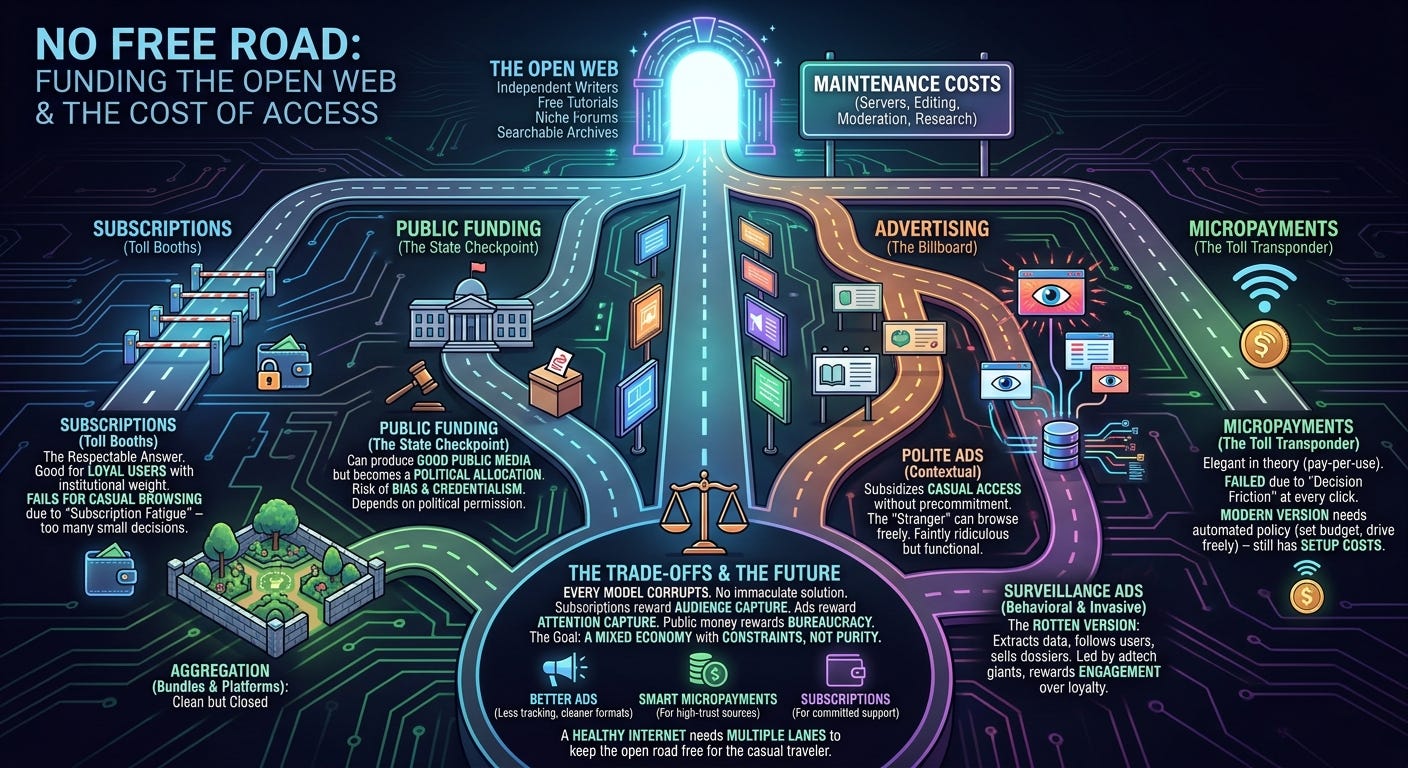
The whole dispute is a question about roads. The open web is a network of roads anyone can travel, and roads cost money to build and maintain whether or not a toll booth stands at the entrance. Every funding model is just a different answer to who pays for the upkeep, and most of the answers put a booth somewhere. Advertising is the one that keeps the road free at the point of use (imagine a road paid for not by tolls but by the billboards along it) and sells the billboards instead.
Toll booths don’t scale down
Subscriptions are the respectable answer, and they feel honest because the exchange is visible: I want the work, I pay the maker, the maker keeps working. For a newspaper with institutional weight, a famous podcaster, a handful of writers who can convert loyalty into recurring revenue, it works well. For most of the web it fails, and it fails for a structural reason rather than a moral one.
Nobody will hold a paid relationship with every site they touch in a week. Subscription fatigue is not laziness; it is a rational refusal to take on dozens of small standing liabilities, each with its own login and renewal and mental overhead. A person pays for a streaming service or two, a newspaper, some software, maybe one creator, and then the wallet shuts, not because the remaining work is worthless but because the administration has become intolerable. A booth at every on-ramp does not just cost money. It costs a decision at every entrance, and the decisions are what exhaust people.
The predictable result is aggregation. Bundles, platforms, toll roads owned by a few operators, with everyone else competing for placement inside someone else’s package. That is a cleaner world for affluent users with settled tastes. It is a bad default for open culture, which lives or dies on the casual visit.
The tax-funded road and its politics
Public money has a different pathology. It can produce good work (libraries, archives, some public media), and there is no need to pretend otherwise. But once the state pays, culture becomes an allocation managed through politics, and someone has to decide what counts as public value, which institutions are legitimate, which creators qualify, and which speech sits outside the approved perimeter.
That process will not stay neutral, because nothing about it is built to. Bureaucracies have preferences. Parties have incentives. Credentialed insiders learn the grant language while outsiders, amateurs, cranks, and unfashionable minorities receive polite procedural letters explaining why the money went elsewhere. A tax-funded road is a road whose map is drawn in a ministry: it reaches the districts the planners favour and bypasses the ones they don’t, and it forces people to pay for routes they may find contemptible. For a few narrow public goods that trade can be worth making. For the web as a whole it makes culture dependent on political permission, which is a poor thing to depend on.
What the billboard buys
Advertising solves the payment problem by letting commerce subsidize access. A business pays to put a message beside something people already want; the maker gets paid; the audience arrives without opening another billing relationship; the advertiser carries the risk that the attention never converts. The arrangement is faintly ridiculous on its face — a serious essay beside a mattress ad, a grave podcast interrupted to sell meal kits, modernity clearing its throat — but the awkwardness is aesthetic and the function is real.
The function is that a stranger can consume the work without first deciding whether this source deserves a place in their monthly budget. A teenager learns from a tutorial. A retiree reads a local blog. A broke student uses an archive that would otherwise have closed behind a gate. The billboard kept the road free, and they drove on without stopping to buy a pass they would never have bought. That is a genuine moral advantage, and the people quickest to sneer at it tend to be the ones most able to buy their way out (premium tiers, private newsletters, clean apps), who then mistake a consumer preference they can afford for a universal principle. A web rebuilt to their taste would be prettier and more closed.
Most of the current stack is rotten anyway
Defending advertising does not mean defending the machine built around it, and everything depends on keeping the two apart. A billboard you pass on the road is one thing. A billboard that photographs your car, follows you home, records every other road you take, and sells the dossier through a chain of intermediaries you will never see is a different thing wearing the same word.
Much of modern adtech is the second thing, and it earns its contempt: invasive, fraudulent, insecure, and ugly. It has trained publishers to chase engagement over loyalty and taught the market to treat human attention as a seam to be strip-mined. Autoplay video, pop-ups, fake download buttons, pages that lurch while loading, scam products dressed as editorial. None of these is an argument against advertising. They are evidence of a market where intermediaries can shove the cost of their abuse onto readers who never agreed to carry it.
Both sides of the usual fight collapse the two billboards on purpose. Critics merge them because it makes advertising indefensible; defenders merge them because they would rather not admit how bad the surveillance version got. Both moves are evasions. Advertising can be contextual instead of behavioral, sponsorship disclosed instead of covert, measurement bounded instead of total. Fraud can be punished and formats made less hostile. None of that abolishes the payment problem; it only refuses the claim that paying the bill requires the entire surveillance apparatus.
Why the rotten version won
Polite advertising already had its turn. The early web ran on banners, sponsorships, classifieds, and contextual placement, much of which still exists, but the center of gravity moved to behavioral targeting because behavioral targeting sold something the billboard couldn’t: identity, prediction, attribution, and scale. An advertiser never just wanted space on a car website. He wanted the people likely to buy cars, wherever they happened to be, and proof afterward of which impressions led to which sales. Once that machinery existed, the plain billboard looked crude.
Google and Meta did not win digital advertising by making prettier ads. They won by owning search intent, social identity, the behavioral data, the auction infrastructure, and the measurement that told advertisers it had worked. A healthier market will not arrive because everyone agrees to show more restraint, because the rot is an incentive structure, not a failure of manners. The costs that make surveillance advertising profitable (lost privacy, page bloat, irritation, fraud risk) are externalized onto users who never see them in the transaction, so the system keeps drifting toward whatever extracts more from attention. Users install blockers, platforms route around them, regulators arrive badly or late.
Google’s Privacy Sandbox is the warning case. It tried to keep targeting and measurement while removing third-party cookies, and it ran straight into the contradiction at the heart of the market: advertisers wanted performance, publishers wanted revenue, intermediaries wanted addressability, regulators feared Google entrenching itself, and privacy advocates did not believe the new APIs removed tracking in any serious sense. The outcome was not a clean transition to privacy-preserving ads. It was delay, low adoption, and quiet abandonment, proof that better advertising cannot be produced by a clever API layer while the payoffs stay the same. If surveillance keeps paying better, the market routes around polite reform. If the dominant browser belongs to the dominant ad company, every privacy fix is also a competition-policy problem. The user is not the customer here; he pays in attention and privacy and degraded experience, and none of it shows up in the bill that passes between advertiser, exchange, and publisher. Advertising can keep the open web alive or mutate into surveillance infrastructure, and any honest defense of it has to argue for the first while attacking the second.
Every funding model corrupts
The strongest objection is that advertising corrupts the work. It rewards attention capture, prefers scale, and pushes creators toward outrage, spectacle, and parasocial intimacy; it can make publishers serve advertisers before readers and platforms treat users as inventory. All true. The mistake is imagining the alternatives are clean.
Subscriptions corrupt too. They reward audience capture and ideological enclosure, run on permanent retention anxiety, and quietly convert a writer into a servant of his paying audience’s prejudices. A subscriber-funded writer is not automatically independent; he is dependent on a different master. Patronage teaches the maker to please donors and whales and foundations, and even a patron of good taste narrows the range of what can be said. State funding corrupts through credentialism and bureaucratic caution. Volunteer production corrupts through burnout, amateurism, abandoned archives, and the invisible subsidy of a day job or a spouse. There is no immaculate model, only tradeoffs, and for much of the open web, advertising’s distortions are not obviously worse than the replacements on offer.
The anti-ad position often smuggles in class
A subscription-first internet flatters people with money, settled preferences, and established habits. They can pay to strip out the ads, back a few favourites, afford the newspapers and the bundles and the clean interfaces, and from that seat the ad looks like grime left over from a worse era.
For everyone else, the ad is often the difference between access and exclusion: students, low-income workers, people outside rich countries, casual readers, children, hobbyists, anyone whose interest in a subject is real but not strong enough to open a billing relationship. The casualness is the point. A vast share of the web’s value comes from browsing without commitment, and a paywall punishes curiosity exactly at the margin: it demands the decision before the reader has enough context to know whether the decision is worth making. People respond by reading fewer sources, sampling fewer perspectives, and retreating into the bundles they already own. The billboard keeps more doors open, and it funds the long tail that the subscription hierarchy would never carry, because small sites can pull a little value from visitors who would never subscribe — messy, but pluralistic.
Creators are allowed to want money
A strange moralism hangs over creative work online. The same people who rightly object when a corporation extracts unpaid labour will turn around and expect writers, programmers, video makers, and maintainers to produce public goods for love. Love is good. Love does not pay rent. The maker is allowed to want compensation, and a culture that runs on permanent volunteerism will be thinner and more fragile than one with working payment channels.
Advertising is one such channel, and its particular virtue is that it earns from diffuse attention rather than extracting direct payment from each reader. Many audiences are broad but shallow: a million people value something a little, almost none of them value it enough to subscribe. Ads aggregate that weak preference into revenue. That is not a moral failure. It is a mechanism for pricing low-intensity value, which is most of the value on the web.
Micropayments deserve another look
Micropayments are the elegant answer that never quite worked. Pay tiny amounts for actual use (a fraction of a cent for an article, a few cents for a video), and the maker is funded by the people who actually consume the work, with no ads, no bundle, no manufactured loyalty contract. The old versions died on a real flaw: they put a purchase decision at the point of access, and nobody wants to approve a transaction every time they click. Even a trivial price carries a non-trivial decision, and attention does not become free because the payment is small.
But that kills the crude version, not the idea. A competent system would let you set the budget and the rules in advance: ten dollars a month for reading, nothing to sites with hostile trackers, more for long pieces you finish, only sources you’ve visited before, a slice reserved for new ones, a monthly audit, the power to cap or blacklist or boost. At that point the payment vanishes into the wallet and you stop buying articles one at a time; you allocate a media budget through policy. This is the transponder on the windshield instead of the coin in the booth: you set up an account once, fund it, define the rules, and then drive the toll roads without ever stopping. No payment decision at any single gate.
The hard problem just moves. It is no longer the tiny payment; it is the policy machinery: what counts as a legitimate claim on the budget, how to keep out clickbait, scraper pages, accidental opens, and bot slop, how to give new creators a path in without letting spam farms drain the pool. And the setup cost is real: a wallet, a funded balance, trust defaults, audit tools, and confidence the thing won’t leak money to slop. That cold start is exactly what advertising never imposes, because the billboard asks nothing of you but the visit. There is a deeper risk too. Whoever runs the transponder network (identity, reputation, dispute resolution, default policies, payout rails) could acquire the same leverage the ad networks and subscription platforms already hold. The escape from one toll operator can install another.
None of which makes micropayments a fantasy. Automatic budgeted micropayments could fund a real share of what advertising funds now, especially for high-trust sources, technical material, archives, independent writers, and open-source maintainers, the categories where a user already values the work and wants to support a class of creators without managing dozens of subscriptions. They still have to beat advertising’s one unbeatable feature: zero precommitment. The ad monetizes casual attention before it ever becomes deliberate support, from a visitor who arrived with no wallet, no policy, and no intention to pay. Micropayments can shrink the need for ads. They probably cannot abolish it across the open web, and a healthy internet should run both — ads for casual access, micropayments for people who want to fund what they read.
Paywalls are not neutral
The clean story about paywalls is that they involve consent: the user chooses whether to pay. That is too simple, because a paywall changes what kind of internet exists. It privileges incumbents with strong brands and punishes small publications with weak billing. It reduces linking, breaks search, and makes public conversation depend on private access, which is why so much discourse now runs on screenshots and second-hand summaries of pieces most participants cannot read.
It also changes what people know. Readers increasingly read inside the sources they already fund, and the marginal article from an unfamiliar outlet goes invisible unless someone else quotes it, so the people most willing to pay become better informed within a narrower channel while public argument grows more derivative and less inspectable. Advertising has its own epistemic costs; clickbait and engagement farming are real. But open access can be linked, checked, shared, disputed, archived, and stumbled into by accident, and a society that wants public argument needs a supply of publicly reachable text. Ads help pay for it.
The mental cost is real
Advertising also reshapes the mental environment, and this is where the objection bites hardest. A single ad beside an article is easy to ignore. A whole digital world tuned for commercial interruption is not. When every surface is a bid for attention, the reader pays in irritation and a permanent defensive crouch, and the page stops feeling like a place to read and starts feeling like a market stall run by merchants who have all studied behavioral psychology.
Commercial persuasion itself is normal and fine; a world with none would be sterile and quietly coercive. Sellers may tell buyers that goods exist, publications may sell access to their audiences, creators may take sponsors. What the internet did was intensify persuasion past that ordinary point, making it personalized, measurable, adaptive, and recursive. Platforms could test which headlines trigger sharing, which images produce arousal, which users are vulnerable to which pitch, and which emotional states convert. The problem was never that commerce appears near culture. It is that every digital surface can become an auction for behavioral modification. That strengthens the case for constrained advertising without touching the case for advertising as such. The cure for an over-commercialized attention environment is not a subscription-only internet; it is fewer ads, cleaner formats, less tracking, hard rules against dark patterns, and more user control over what gets into the field of view.
Postscript
A better internet would still carry ads, but it would not leave the shape of advertising to the firms that profit from surveillance and compulsion. Some pressure is already working. Apple’s App Tracking Transparency changed mobile tracking simply by forcing apps to ask before following users across other companies’ apps. The EU’s Digital Markets Act handed regulators real tools against gatekeepers. Neither solves advertising, and that is the point: they show where the fight actually is, in defaults, platform rules, browser architecture, liability, data brokerage, and competition law.
The browser should make cross-site tracking hard by default. Law should make data brokerage risky rather than routine. Platforms should carry real liability for the obvious scam advertising they run at scale. Measurement should be bounded, sponsorship disclosed, context valued over dossiers. None of this makes advertising pure, and purity is the wrong test. Can advertising fund open access without turning the reader into an involuntary data asset and every page into a behavioral trap? Yes, but not automatically. The worst formats won because they paid better under bad rules. Better formats need rules that change the payoff.
The open web has a payment problem, and advertising is one of the few mechanisms that can pay the bill without putting a booth at every door. To call ads illegitimate is to make a political-economic claim, and that claim owes an answer: who pays instead? Micropayments may take over part of the load. Subscriptions will keep serving committed audiences, donations the unusually loyal, public money the narrow institutional goods. But casual access — the stranger who drives on without stopping — still has to be paid for by someone, and the billboard, kept honest, is one of the better places to send the bill.