

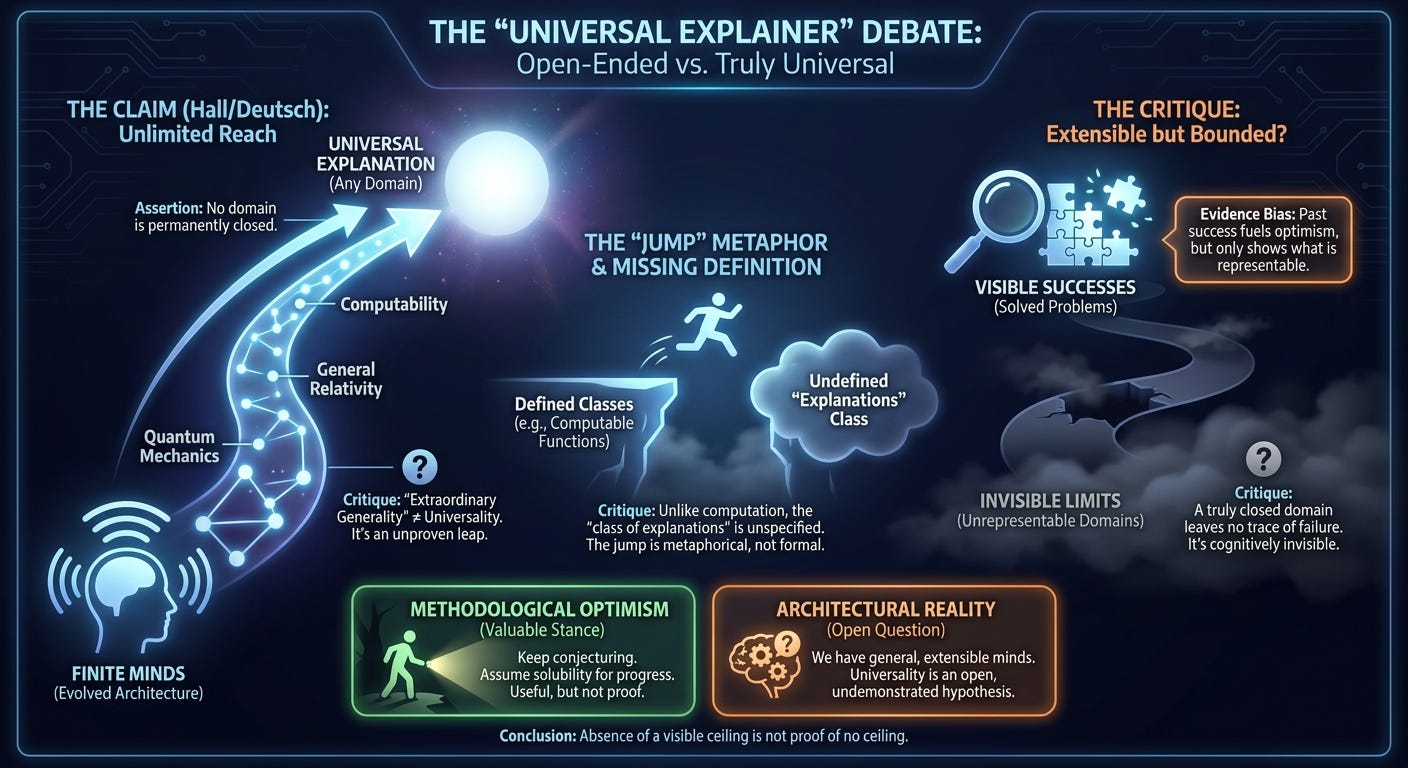
Brett Hall makes a strong claim about human reason: the world is comprehensible, and comprehensible to us. Discussing David Deutsch’s The Fabric of Reality, he argues that because human beings are universal explainers, we should expect never to meet anything permanently beyond our understanding. The claim is not confined to the podcast. Writing on artificial intelligence, Hall glosses Deutsch’s criterion for personhood as our being universal explainers, and describes the algorithm an AGI would require as one capable of generating explanations for any problem whatever.
Take the position in its strongest form. Hall is not saying that people have infinite memory, unlimited time or unbounded computational resources; he would presumably grant that every actual person and every actual civilization is finite. He is saying something more interesting: that human explanatory cognition is architecturally universal, and that no domain of objective explanatory knowledge lies intrinsically beyond a human-type mind.
Human cognition is remarkable enough to make this tempting. Our brains evolved under pressure from food, predators, mates, coalitions, tools and terrain, and we can nonetheless work in quantum mechanics, general relativity, natural selection, computability and mathematical structures with no analogue whatever in the environment that shaped us. We are plainly not confined to a catalogue of evolutionarily familiar problems. Extraordinary generality, though, is a weaker property than universality, and Hall needs the second.
Granting the easy cases
Several familiar objections miss. Suppose we understand the generating rule of a cellular automaton but cannot determine a distant state without running the computation. That still counts as understanding the system, and understanding why no shortcut exists is itself part of the explanation. Understanding quantum mechanics does not require predicting the outcome of a particular measurement. Understanding an algorithm does not require solving the halting problem for every input. Computational irreducibility, uncomputability and finite resources therefore establish nothing about cognitive closure.
What they do show is that “understanding everything” runs together questions that come apart. Whether we can form the relevant concepts, whether we can construct an explanation, whether we can obtain the evidence to test it, whether we can derive its consequences, whether we can predict particular outcomes, and whether we can know every truth about a system are six different questions with six different answers. Hall’s claim survives only if restricted to the first two. Restricted that way, it still asserts that human cognitive architecture spans every explanatory domain, and that assertion is unargued.
Universality is always relative to a class
A physically instantiated computer can have a computationally universal architecture while having finite memory, finite processing capacity, finite energy and a finite lifetime. Universality never meant that the machine can execute every conceivable computation whatever the resources. It means the architecture is general and not specialized to one predetermined family of tasks. A universal computer cannot decide the halting problem in general, cannot compute non-computable functions, and cannot run a computation whose resource demands exceed what physics supplies. Its universality holds relative to a formally characterized class.
That is where the analogy stops carrying Hall’s weight. For computers we can specify the class of computations, construct a machine, and prove that it simulates any machine in that class given the program and the resources. The demand transferred to explanation need not be for that much formal apparatus. Physics makes substantive universality claims without a complete enumeration of the target class, and the Church-Turing thesis is itself an informal conjecture and not a theorem. What cannot be dispensed with is a characterization that declines to help itself to the conclusion. What makes something an explanation of a given kind, in terms that do not reduce to the explanations we have so far produced? What property of human cognition shows that it reaches every member of the class so characterized? What separates universal explanatory reach from reach that is indefinitely extensible and still bounded? Hall supplies none of the three.
My laptop is computationally universal. It is not a universal physicist.
What the jump is a jump to
Deutsch’s “jump to universality” is the obvious reply. Some systems do not merely get gradually better; they cross a threshold, as when a specialized calculator becomes a universal computer, or a limited notation becomes capable of representing arbitrarily many constructions. Deutsch argues that human explanatory cognition made an analogous transition.
The phrase leaves the burden where it was. A universal computer is universal over the computable functions; a universal notation is universal over the expressions its syntax admits. In each case the domain is specified well enough that the claim has content, and the specification came first. Explanation has had no such specification, so calling the transition a jump to explanatory universality only renames the thing in dispute. Where the class is uncharacterized, the jump is a metaphor.
Conjecture and criticism is not a search algorithm
A further Deutschian reply treats explanation as a species of computation. Knowledge creation proceeds by conjecture and criticism; if the brain is computationally universal, and conjecture and criticism is the general mechanism by which explanatory knowledge gets created, then a computationally universal mind is a universal explainer.
That argument needs a premise it does not have. Criticism exposes errors in existing conjectures and rejects contradictions, empirical failures and explanatory defects. It describes a mode of error correction, and nothing in it maps arbitrary problems onto their explanations. Hall himself endorses Deutsch’s argument that future knowledge cannot be predicted, since predicting it would amount to already possessing it. That establishes unpredictability and leaves the deeper question open, since a deterministic procedure can produce states that no cheaper route reaches, which is what computational irreducibility describes. The gap holds on either answer. A universal computer runs any algorithm in the computable class, and that bears on explanation only if some computable procedure spans the space of possible explanations. No such procedure has been exhibited.
The comprehensibility leap
Three claims are in play. Reality is intelligible, containing objective regularities susceptible to explanation. Human explanatory ability is open-ended, with no known finite catalogue of domains outside which reason stops working. And no explanatory domain is in principle cognitively closed to people. The first two do not entail the third, and “universal explainer” is the phrase that carries the argument across the gap.
Read the phrase one way and Hall’s conclusion fails. If a universal explainer is a domain-general, open-ended system capable of constructing new explanatory representations, it can have indefinitely extensible reach without being guaranteed access to every possible explanatory domain. Read it the other way and the conclusion was never in question: if a universal explainer is a system capable in principle of understanding every objectively comprehensible domain, the premise already contains what the argument was supposed to deliver. Either the premise is too weak for the conclusion, or it is the conclusion.
Deutsch blocks the second reading himself. In the discussion of Tipler’s hypothetical Omega Point, he grants that even enormously powerful future intelligences would fall short of all possible knowledge, with the overwhelming majority of abstract truths staying out of reach. Whatever a universal explainer is, then, it is not an entity that can know every truth. Hall’s available reply is that his claim concerns explanatory domains and not truths: no domain of objective explanatory knowledge is cognitively closed to people. That version is more defensible, and it puts the circularity in plain view. People can understand every explanatory domain because they are universal explainers. They are universal explainers because no explanatory domain is inaccessible to them. The label does no work until explanatory universality has been established some other way.
Closure would not announce itself
Other animals have architecture-dependent limits. A dog will not be brought to differential topology by extending its working memory or giving it another decade; the machinery for constructing the relevant concepts is absent, and no amount of patience supplies it. Hall’s claim is that we differ in kind, that human explanatory architecture is universal and not simply roomier than a dog’s.
Notice what the dog cannot do besides topology. It cannot represent the boundary it is running into. Differential topology appears on no list of open dog problems, because nothing in the dog’s cognitive economy so much as points at it. A domain closed to us would be invisible in the same way. It would not sit in our catalogue of hard unsolved problems. It would sit nowhere at all, leaving no trace in the record of what we have tried and failed to explain. Our history of solved problems is evidence about the domains we can represent well enough to fail at, and evidence about nothing else.
Hall’s anti-inductivism turns against him
Hall’s support for the stronger claim is historical. We have repeatedly understood what once looked beyond us, and he takes this as evidence that reality really is comprehensible to us. It supports optimism. As an argument for universality it has the form: humans have repeatedly solved problems previously regarded as inaccessible, therefore no explanatory problem can ever be inaccessible to humans. The record gives us excellent reason to refuse any declaration that a problem is permanently insoluble merely because we cannot currently solve it, and excellent reason to keep conjecturing. It does not reach the universal quantifier, and by the sampling point above it is drawn from a set that excludes the cases at issue.
Hall is otherwise hostile to induction, and he correctly rejects the idea that a finite run of observations establishes an unrestricted law. The same structure reappears here in optimistic dress, with past explanatory success taken as evidence of unlimited future explanatory reach. Inductive pessimism goes out and inductive optimism comes in.
Extending the explainer
Every reply so far leans on one premise: that a human mind together with external machinery can be extended indefinitely while remaining a human explainer. Pen and paper extend the mathematician. Notation, instruments, institutions and computers extend the physicist. Treating the extended system as the relevant unit is what allows Deutsch to concede our unaided limits while giving up nothing.
The premise needs a boundary condition it does not have. Give a dog a proof assistant and the assistant does topology while the dog watches. Nobody counts that as extending the dog, so extension cannot mean bolting capacity onto a system. Some criterion separates the tools that extend an explainer from the tools that replace one, and Deutsch needs that criterion to fall in a particular place.
One candidate says that extension counts when the agent retains comprehension of what the equipment produces. That assumes the reach at issue. Whether we still comprehend the outputs while leaning on the apparatus that generates them is the question, and it cannot double as the test for answering it.
The better candidate is bootstrapping. A dog cannot build the notation, cannot be taught to use it, and cannot join the criticism that improves it, while humans do all three, and that capacity is what a jump to universality is meant to name. The asymmetry is real and deserves credit. It has also only ever been observed operating inside the range of concepts we have so far managed to construct. An architecture that bootstraps freely until it meets a structure it cannot get a foothold on would leave exactly the record we have, and the stall itself would go unrecorded.
Push the scaffolding harder. Suppose comprehending some domain requires a million times the memory, the processing and the elapsed time. On the Deutschian accounting that is a resource fact, absorbed by the same clause that absorbs Aristotle’s distance from quantum field theory. Yet at that scale no individual ever holds the explanation. It exists in an institution or a machine, and each participant’s relation to it is testimony about what the apparatus reported. Somewhere between pen and paper and a million lifetimes of derivation, machinery stops extending an explainer and becomes an oracle the explainer consults. Deutsch has no principled place to draw that line, and “comprehensible in principle” conceals that there is a line to draw. An explanation nobody can survey is not obviously comprehended by anyone, which locates an equivocation in the very word the dispute turns on.
The difficulty can be put as a test case. Imagine explainers with a billion-year head start discussing domains we have never approached. Either they can always bring us to comprehension, given the notation, the machinery and the centuries, in which case something must guarantee it, or they cannot, in which case closure is real. Hall needs the first horn. The theory of computation does not supply it, because what would need guaranteeing concerns the closure properties of human representational bootstrapping and not the class of computable functions.
What would settle it
Four things would have to be in place. A non-circular characterization of the explanatory class, in terms that do not reduce to the explanations we happen to have. A relation between explanatory architectures answering to simulation between machines, specifying what it is for one architecture to reconstruct another’s explanation instead of merely reproducing its predictions. A demonstration that human architecture reaches every member of the class, or a physical argument that the primitives required for any physically explicable structure are finitely generable from the ones we have. And an evidential rule capable of telling an unsolved problem from an unrepresentable one.
The first is prior to the others, which cannot be stated without it. The fourth is the one Hall most needs, because his evidence is one-sided by construction. A solved problem counts for universality. An unsolved problem counts for nothing against it, since any unsolved problem can be classified as temporarily unsolved. Some domain we have not explained admits two diagnoses. On one, we lack the theory. On the other, we lack the concepts in which the theory could be written. Nothing in the historical record separates them, and a closed domain emits no signal of its own.
Deutsch would answer that the thesis concerns the capabilities of people, and that capability claims are not refuted by particular failures. Granted. A capability claim still needs some rule connecting it to evidence, or it fits every possible history of inquiry, and fits because failure was defined out of the evidence before the counting started.
What survives
None of this licenses cognitive pessimism. Present inability is weak evidence of impossibility, and when someone announces that humans will never understand quantum gravity, consciousness, the origin of life or some mathematical structure nobody has yet invented, the burden lies with the claimed limit. Our history is strong reason to distrust confident declarations that a problem lies forever outside comprehension, and treating unsolved problems as soluble and continuing to work on them remains the productive stance.
Methodological optimism is not a theorem about the architecture of cognition. The absence of a demonstrated ceiling is not the demonstration of no ceiling. What we have are finite physical minds with unusually general and extensible explanatory architectures. That may be enough for endless intellectual progress.