

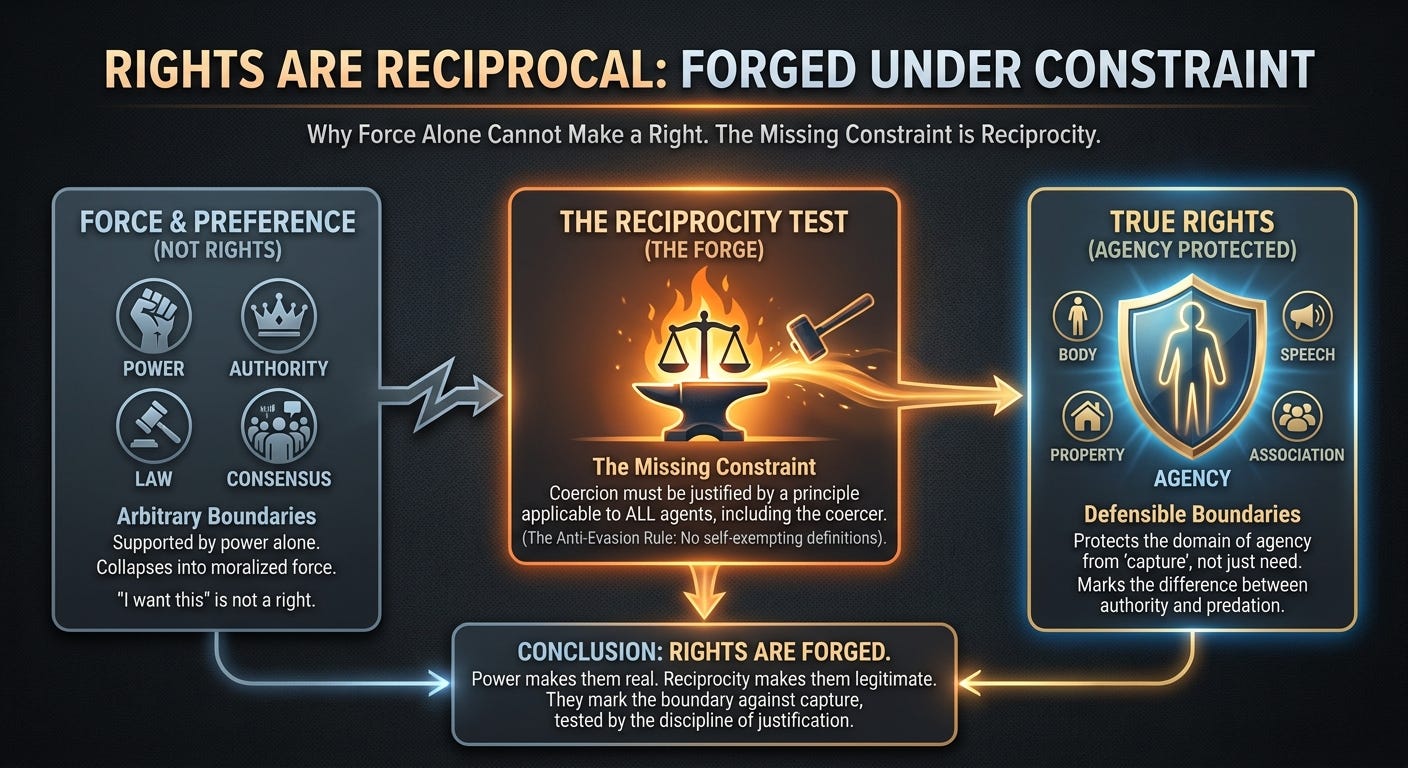
Rights are forged. They are not discovered in nature like stones, particles, or mountains. They are not handed down by gods, unless one has already conceded moral authority to revelation. They are not created by states, unless one is willing to say that every legal atrocity became morally legitimate the moment a legislature or monarch approved it.
But forged does not mean arbitrary. A sword is forged too, and so is a shackle. The fact that a claim has been asserted, defended, and enforced tells us that someone cared enough to fight for it. It does not tell us that the claim was just.
That is the missing constraint. Rights are not merely preferences we are willing to enforce. Slaveholders had preferences. Censors have preferences. Mobs have preferences. Patriarchs, priesthoods, platforms, and states all have preferences, and many of them enforce those preferences with moral confidence.
A preference does not become a right because its owner has power, tradition, scripture, law, or consensus behind it. A right is a defensible boundary around agency. It marks a domain where coercion requires justification, and where the justification must survive reciprocal application to the person against whom it is used.
Power makes a boundary real. Reciprocity makes it a right.
Preference Is Too Thin
A preference says: I want this. An enforceable preference says: I am willing to use force for this. A moralized enforceable preference says: I believe that force is justified.
That still does not give us a right.
If rights stop there, every successful ideology can manufacture them. The master claims a right of property in human beings. The censor claims a right to preserve public order. The mob claims a right to punish enemies of the community. The priesthood claims a right to punish blasphemy. The patriarch claims a right to command the household. The platform claims a right to shape discourse. The state claims a right to tax, regulate, imprison, conscript, and kill.
Each can describe its coercion as ethical. Each can point to some mixture of necessity, custom, divine command, or collective approval. The vocabulary changes. The structure remains.
Someone wants a boundary. Someone is willing to enforce it. Someone can explain why the enforcement seems proper from inside his own moral scheme.
A right requires more. It requires a principle that applies to every agent exposed to the same kind of agency-invasion. The reference class is set by the coercive act and the agency it invades, not by the coercer’s preferred hierarchy.
That condition does the work. Without it, rights collapse into moralized power.
Why Reciprocity Is Not Mysticism
Reciprocity is not a supernatural axiom. It is not a moral particle hidden inside the universe. It is a constraint internal to justification among agents.
A coercer can reject reciprocity. He can say: I have power, you do not, and that is the end of the matter. That position is coherent as threat. It is not coherent as justification.
The moment someone offers a reason for coercion, he has entered a space of justification. He is no longer merely grabbing, striking, or imprisoning. He is claiming authority. He is saying the coercion is not just something he can do, but something he may do.
That claim has a cost. A reason must be more than a disguised index of the speaker’s position. It must be capable of application beyond the speaker’s immediate advantage. Otherwise it is not a principle. It is a costume worn by power.
Reciprocity is the discipline that separates principle from costume. It asks whether the rule being invoked can survive when applied from the standpoint of the person being coerced. It does not require metaphysical faith in natural law. It requires only that a justification be more than an announcement that the strong prefer to remain strong.
An agent who refuses that discipline has not refuted rights. He has withdrawn from justification and returned to force. He only declares himself outside the practice that could legitimate his coercion. Rights are not force fields. They do not physically restrain the psychopath, conqueror, or machine that recognizes no reason beyond power. They mark the difference between authority and predation, and therefore between obedience and resistance. Against the agent who will not justify, the answer is not argument alone. It is defense.
Agency Is the Protected Domain
Agency requires a protected domain of control. A person must have practical command over body, speech, movement, tools, and associations. Remove those protections and the person remains biologically alive while becoming operationally subordinated to another will.
This is why certain rights recur across liberal traditions. Bodily liberty protects the agent from being physically commandeered. Property protects the agent’s external means of action. Speech protects judgment, persuasion, and error correction. Privacy protects the boundary between interior life and public demand. Association protects cooperation, intimacy, and shared purpose. Due process protects the individual against punishment without proof or accountability.
These are not random preferences elevated by fashion. They are conditions under which agency can survive conflict with other agents.
People will disagree. They will compete. They will offend, deceive, exclude, organize, and accuse. A society of agents needs boundaries that prevent disagreement from becoming capture.
A right is one of those boundaries. It says that some domains cannot be invaded merely because another person, faction, mob, corporation, or state finds invasion useful. Rights are not guarantees of comfort, status, or success. They are constraints against capture. They protect the space in which an agent can continue to act as an agent among other agents.
Needs Are Not Rights
Need is not a boundary violation. Hunger, illness, and poverty can be grave human problems. They do not by themselves identify a rights-violator.
A right constrains invasion. It tells others what they may not do to your agency. A need tells us what would improve, sustain, or preserve your agency. Confusing those categories turns misfortune into jurisdiction over other people’s lives.
This does not make charity, mutual aid, family obligation, insurance, or friendship unimportant. It places them in the correct moral category. They are forms of cooperation and care. They may be virtues. They may be ethical duties under particular relationships. They may be wise, decent, urgent, or humane. They are not universal coercive claims.
A positive right has to name the person who may be compelled. Once it does, the question changes. Whose agency may be conscripted? By what authority? Under what limit? If the answer is simply “whoever has resources,” the so-called right has become a license to invade one agent in order to benefit another.
Lots of things are necessary for agency: oxygen, sleep, language, luck, and other people’s cooperation. Necessity does not identify a debtor. If I assault you, I have violated your right. If you need medicine and I did not cause that need, my failure to provide it is not itself an invasion of your agency. To turn your need into my enforceable duty, someone must first assert jurisdiction over my labor, property, or time. That assertion requires its own justification. It cannot be justified merely by pointing at your need.
A need becomes an enforceable claim only through causation, consent, contract, guardianship, or specific fiduciary duty. A parent owes care because the parent created or accepted guardianship. A doctor owes care after accepting a patient under defined terms. An insurer owes payment by contract. A wrongdoer owes restitution by causation. A trustee owes loyalty because he accepted fiduciary control. Without such a relation, need may summon compassion. It does not create command.
“Structural violence” is usually an attempt to erase the difference between being harmed by another agent and lacking something one needs. That distinction is morally load-bearing. If I break your leg, I owe restitution. If your leg breaks from disease, others may have reasons to help, but they have not wronged you by failing to become your involuntary providers.
Need can generate reasons for action. It can generate virtues, rescue norms, mutual-aid institutions, and voluntary solidarity. It does not generate a right unless another agent has invaded, assumed, or contracted responsibility. Positive rights fail reciprocity because they convert one agent’s need into another agent’s coerced obligation without identifying an act of invasion. They do not defend agency from capture. They authorize capture in the name of agency.
The moral universe contains more than rights. It contains compassion, loyalty, friendship, contract, restitution, and voluntary solidarity. Positive-rights theories inflate one part of morality into the whole of it, then use the language of rights to conscript the unwilling.
Property Is Not Exempt
Property is not a magical exception to reciprocity. It is one of the main ways agency becomes durable in the world. Agents need tools, shelter, savings, and land because plans require control across time.
A property claim is still a claim. It can be legitimate or illegitimate. Theft, conquest, fraud, and enclosure by force do not become clean title because enough time has passed or enough paperwork exists. A theory of rights cannot treat every existing title as morally sterile.
Legitimate property needs a defensible chain: production, first use, contract, voluntary transfer, gift, abandonment, or restitution. Where the chain runs through coercion or fraud, the claim carries a defect. The remedy may be difficult. Evidence may decay. Innocent third parties may enter. Improvements may be made. Restitution can become impractical or unjust in its own way. But difficulty of repair does not convert original capture into moral purity.
Generalized historical guilt cannot create a floating license to seize. Restitution requires more than the fact that the past was violent. It requires an identifiable wrong, a defensible claimant, a responsible party, and a remedy that does not merely replace old capture with new capture. When those conditions fail, the honest answer is not political redistribution disguised as justice. It is humility about title, refusal to sanctify conquest, and a preference for institutions that reduce future capture rather than giving new rulers power to reassign the world.
The answer to bad title is better title, restitution where possible, and refusal to treat political allocation as moral creation. Property protects agency when it secures an agent’s means of action. It violates reciprocity when it becomes a frozen record of someone else’s domination. This is also why poverty does not automatically invalidate property. A person’s need does not by itself prove another person’s title defective, and neither does legal title by itself prove moral legitimacy. Property must answer the same question as every other right: does this boundary protect agency under a defensible principle, or does it preserve capture under the language of ownership?
Reciprocity Is the Test
Reciprocity is not politeness. It is not compromise. It is not the demand that everyone receive identical treatment in every context. It is the requirement that coercion be justified under a principle that does not depend on exempting the coercer from his own rule.
The master’s claim fails because it cannot be reciprocally justified. “I may own you, and you may not own me” is not a boundary among agents. It is hierarchy enforced by violence.
The censor’s claim fails for the same reason. “I may suppress your speech when your speech threatens my order” can be uttered by any regime, faction, or mob. Universalized among agents, it dissolves speech into permission from whoever holds power.
The mob’s claim fails because outrage does not create jurisdiction. “We hate you, therefore we may destroy your livelihood and your safety” cannot become a general principle among agents without turning social life into factional war.
The priesthood’s claim fails when it makes one person’s metaphysics into another person’s cage. “My sacred order authorizes coercion against your disbelief” cannot bind the dissenter unless the believer has already been granted authority the dissenter does not share.
The patriarch’s claim fails when care becomes ownership. Family authority may be justified where it protects dependence and development. It becomes domination when it treats another person’s agency as an extension of the household ruler’s will.
The platform case is often misdescribed. A private forum does not violate my rights by refusing to host me. Its servers, brand, and audience are not my property, and scale does not by itself convert access into entitlement. The rights issue arises when exclusion is backed by fraud, breach of contract, state pressure, collusion, or legal privilege that blocks exit and competition. Then the problem is not that I possess a positive right to another person’s platform. It is that coercion or privileged exclusion has invaded the conditions of agency and exit.
The state’s claim fails whenever legal classification is treated as moral cleansing. Taxation becomes revenue. Imprisonment becomes justice. Surveillance becomes security. War becomes policy. Each label may describe a legal category. None settles the moral legitimacy of the coercion.
In every case the question is the same: who is being coerced, what agency is being captured, what boundary is being defended, and can the principle authorizing the coercion be applied reciprocally without becoming a license for domination?
The Anti-Evasion Rule
A rights theory needs an anti-evasion rule because domination is intelligent. It adapts. It rarely announces itself as domination. It announces itself as order, tradition, safety, compassion, or emergency.
So the rule must be explicit:
The coercer may not define the relevant class by the hierarchy the right is meant to constrain.
This blocks the standard escape route. The master cannot define the enslaved as property and then say property has no liberty rights. The censor cannot define dissenters as dangerous and then say dangerous people have no speech rights. The patriarch cannot define dependents as possessions and then say possessions cannot claim autonomy. The state cannot define citizens as subjects and then say subjects have only the permissions the state grants.
The classification may still matter for some purposes. Children are not adults. Criminal guilt can justify bounded punishment. Animals have different agency profiles from humans. Future artificial minds may force us to expand the class of rights-bearing agents. But the burden runs against the coercer. The person asserting coercive authority must identify the agency being invaded, the harm being prevented, the boundary being defended, and the reciprocal principle that authorizes the intervention.
Administrative convenience is not enough. Disgust is not enough. Majority approval is not enough. The victim’s low status is not enough.
Hard Cases Do Not Refute the Principle
Rights are not identical across all beings and all institutions. Reciprocity does not erase relevant differences in agency, capacity, dependence, knowledge, or responsibility. It forbids using those differences as pretexts for capture.
Agency is not binary. It is a profile of capacities: perception, memory, anticipation, learning, self-direction, and vulnerability. Rights track the domains in which those capacities can be captured.
Children are the obvious case. A child does not have the same contractual capacity, sexual autonomy, or political authority as an adult. But a child still has rights against assault, abuse, enslavement, and exploitation. Parental authority is fiduciary. It is justified by the child’s dependence and development. It is not ownership.
Criminals are another case. A person who violates another’s rights may be restrained, punished, or required to make restitution. But guilt does not erase personhood. Punishment must be bounded by proof, proportionality, and continuing constraints against cruelty. “Criminal” cannot become a caste outside rights.
Animals present a different difficulty. Many animals are sentient. They can suffer, anticipate, bond, and pursue goals. Their moral claims are real, but their rights need not mirror human rights because their agency profile differs. The framework does not require identical rights for every sentient creature. It requires that coercion track the kind of agency or experience it invades.
Artificial minds may sharpen the issue. If a nonhuman system becomes an agent with memory, preferences, self-modeling, and coherent projects, tribal membership will not settle its status. The relevant question will be structural: what kind of agency can be captured, frustrated, confined, or destroyed?
Institutional rights are different again. A court, company, church, union, or parliament may have powers, immunities, procedures, and delegated authority. These can protect persons by preserving pluralism, exit, and limits on concentrated power. But institutions do not have rights in the primary sense. Their claims are derivative. The moral analysis must pass through to the agents whose agency the institution protects or invades.
Hard cases show why rights require judgment. They do not reduce rights to preference.
Law, Custom, and Consensus Are Not Enough
Law can recognize rights. Custom can stabilize them. Consensus can support them. Institutions can enforce them. None of these is sufficient to create them.
A society can agree to enslave. A court can uphold censorship. A family can normalize abuse. A church can sanctify persecution. A state can legislate confiscation, imprisonment, and war. In each case, the institution can produce rules, rituals, officials, and moral vocabulary.
The existence of a norm tells us that a boundary has social force. It does not tell us whether the boundary protects agency or captures it.
This is why “rights are whatever the law says” fails. It makes human rights abuses conceptually impossible wherever abuse is lawful. It turns every successful regime into the author of its own moral acquittal.
This is also why “rights are whatever society recognizes” fails. Society is not a moral oracle. It is a field of agents, incentives, fears, blind spots, inherited cruelties, and occasional wisdom. Recognition matters because enforcement matters. Recognition does not settle justification.
A right needs both embodiment and discipline. It must exist somewhere in practice, or it remains a plea. It must answer to reciprocity, or it becomes domination with better language.
Enforcement Does Not Require Monopoly
Rights need enforcement. A boundary that cannot be defended is eventually treated as a request. But enforcement does not require a monopoly. It requires credible defense, adjudication, and consequence.
Enforcement can be personal, reputational, contractual, communal, market-based, or state-based. A person can defend himself. A community can ostracize predators. A court can adjudicate disputes. A protocol can make cheating impractical. A state can punish crime.
None of these mechanisms is morally self-validating. Each can protect agency. Each can invade it. The question remains: what boundary is being enforced, against whom, by what means, under what reciprocal principle?
Polycentric enforcement is not a utopia. Private agencies can become gangs. Communities can become mobs. Markets can privilege wealth. Protocols can freeze bad rules into code. None of this rescues monopoly enforcement. It only shows that every enforcement mechanism needs constraint.
The argument is not that non-state enforcement is automatically just. It is that no institution becomes the source of rights by claiming final jurisdiction over them. States are one historical answer to the enforcement problem. They are not the definition of enforcement. Treating them as the only possible embodiment of rights is another way of confusing rights with the institutions that claim to administer them.
Postscript
Rights are forged by agents living under conflict. They are argued into form, defended under pressure, revised through experience, and embodied in institutions when institutions can be made to serve them.
They need force, because a boundary that cannot be defended eventually becomes a request. They need moral discipline, because force without reciprocity becomes domination.
This account rejects mystical rights without surrendering to power. Rights do not float above the world. They are made in the world by agents who need protected domains in order to remain agents among other agents. But a claim does not become a right merely because someone is willing to fight for it. It becomes a right when the fight defends agency under a principle that applies to every agent exposed to the same kind of agency-invasion.
Needs can call for care, contracts can create duties, wrongs can require restitution. Property can protect agency, but only when its title does not merely preserve earlier capture. Enforcement can defend rights, but only when it remains answerable to reciprocity.
Rights mark the boundary against capture. They say where agency may not be invaded merely because another agent, institution, or coalition finds invasion useful.
Rights are forged. They are also tested. Power makes boundaries possible. Reciprocity makes them legitimate.