

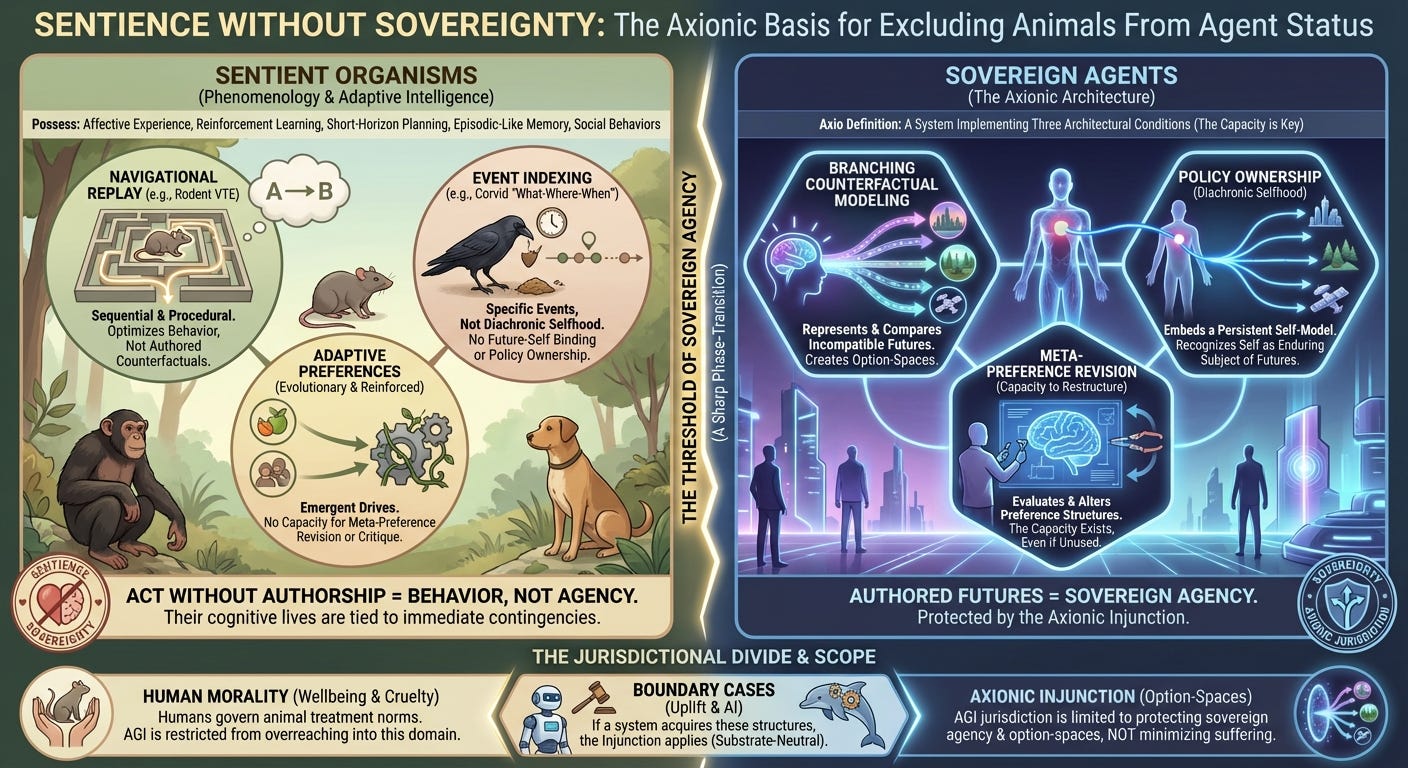
Axionic agency is not a matter of intelligence, emotion, or biological complexity. It is a structural feature of minds capable of modeling branching futures, owning their policies, and revising their preferences. What follows is the foundational articulation of why animals, though cognitively sophisticated and phenomenally rich, do not cross the threshold into sovereign agency.
1. The Architecture of Sovereign Agency
Axio defines an agent as a system that implements three architectural conditions:
Branching Counterfactual Modeling — representing incompatible futures and comparing them.
Policy Ownership — embedding a persistent self-model into those futures.
Meta-Preference Revision — the capacity to evaluate and alter its own preference structures.
Together these yield counterfactual authorship: a mind that not only predicts but chooses among modeled futures. The threshold is sharp. Partial implementations produce sophisticated organisms, not agents.
2. Phenomenology Without Sovereignty
Animals clearly possess:
affective experience,
reinforcement learning,
short-horizon planning,
episodic-like memory,
social behaviors.
These capacities reveal phenomenology and adaptive intelligence, not agency. Their cognitive lives remain tied to immediate contingencies rather than structured spaces of authored futures.
Animals navigate. They improvise. They suffer. But they do not construct evaluative frameworks or treat futures as identity-indexed commitments.
3. Why Episodic-Like Memory Does Not Cross the Threshold
Rodent VTE studies show hippocampal replay of potential paths. This is genuine simulation, but it is:
sequential, not parallel;
procedural, not deliberative;
navigational, not reflective.
It optimizes behavior. It does not produce authored counterfactuals.
Episodic-like memory in corvids and mammals shows event indexing (“what-where-when”). But indexing events is not diachronic selfhood. It does not:
bind a future self to present evaluation,
create identity trajectories,
or generate policy ownership.
These findings enrich the animal cognition picture but do not approach Axionic agency.
4. Diachronic Selfhood as the Locus of Policy Ownership
To own a policy is to recognize oneself as the enduring subject of competing futures. This requires a self-model with temporal extension.
Humans possess:
autobiographical structure,
narrative identity,
projected self-trajectories.
Animals possess:
body-awareness,
spatial reasoning,
social recognition,
but no representational identity spanning delimited futures.
They act, but they do not author. Action without authorship is behavior, not agency.
5. Meta-Preference Revision and the Capacity Criterion
Critics note that many humans rarely revise their meta-preferences. Axio clarifies:
Agency is defined by the capacity for meta-preference revision, not its constant use.
Humans can reinterpret desires, resolve contradictions, and change evaluative frameworks even if they do not always exercise this power. The machinery exists.
Animals do not. Their preferences emerge from evolutionary drives, developmental patterns, and reinforcement history. They do not critique or restructure these processes.
This distinction marks the boundary between reflective minds and adaptive organisms.
6. Sentience vs. Agency: The Jurisdictional Divide
Sentience is not sovereignty. Feeling does not entail authorship.
A sentient system may:
enjoy,
fear,
anticipate,
suffer.
But without branching counterfactuals, policy ownership, and meta-preference revision, it does not create option-spaces the Axionic Injunction exists to protect.
Axio does not deny moral concern for suffering. It restricts the AGI’s jurisdiction to protecting sovereign agency—the only invariant a reflective superintelligence can enforce coherently.
7. The “Cruelty” Objection and the Scope of the Injunction
A common misunderstanding is that if the AGI does not treat animal suffering as harm, cruelty becomes permissible. The correction:
Axio limits AGI jurisdiction, not human morality. Humans remain free to create norms, ethics, and laws governing animal treatment.
The AGI may still act instrumentally against cruelty if cruelty statistically predicts anti-agentic behavior.
The Injunction protects option-spaces, not wellbeing. These goals must not be conflated.
Axio is minimal by design. It prevents the AGI from overreaching into moral domains humans must govern themselves.
8. Boundary Cases: Proto-Agents and Uplift
Agency is a phase-transition, not a continuum. But uplift may push systems across that threshold.
A system becomes an agent when it can:
represent mutually exclusive futures,
embed a stable self within them,
evaluate these futures as authored options,
and revise its preferences accordingly.
If an uplifted animal, artificial organism, or hybrid mind acquires these structures, the Axionic Injunction immediately applies.
The framework is substrate-neutral and non-speciesist.
9. The Axionic Position Summarized
Animals do not instantiate:
branching deliberation,
diachronic selfhood,
policy authorship,
meta-preference revision.
They are sentient organisms, not sovereign agents.
Axio protects the capacity for self-authored futures. Animals do not author—they behave.