

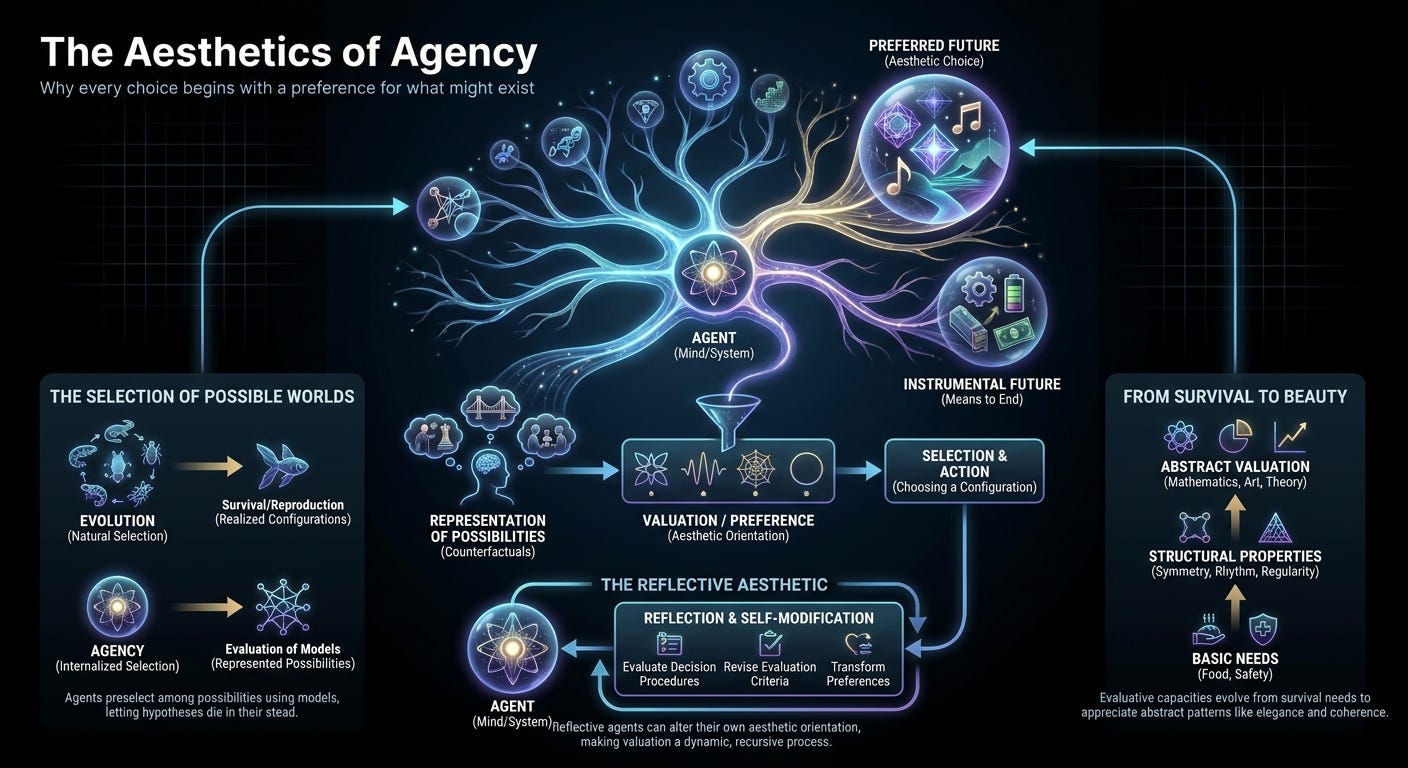
An agent contemplating its future has to represent what could happen, evaluate the alternatives, and select a course of action. Each choice expresses a preference for one possible configuration of the world over another. We usually describe this in the language of goals, utility, incentives, and rationality. Described another way, the agent is evaluating the patterns of configurations that do not yet exist, sorting the ones it would bring about from the ones it would avoid. That sounds close to aesthetics.
In Ultimate Beauty, I argued that instrumental justification eventually runs out. We can explain why an action serves a goal, and why that goal serves another, but the chain ends at something valued for itself, and I proposed that aesthetics supplies this terminal orientation. Agency offers a second route to the same place. Choosing among possible futures requires some basis for preferring one configuration over another, and the familiar experience of beauty in paintings, music, and landscapes is one manifestation of that more general relationship between intelligence, possibility, and value.
The Selection of Possible Worlds
Natural selection operates on realized configurations of matter. Organisms vary, interact with their environments, and survive, reproduce, or disappear. Nothing in the process requires foresight: evolution discovers viable arrangements through differential reproduction across generations, and the consequences of its experiments are paid in actual survival and reproduction.
Agents that model their futures add the ability to evaluate possibilities before realizing them. A person deciding whether to cross a busy street imagines reaching the other side and imagines being struck, and need never experience the second outcome to reject it. An engineer evaluates bridge designs before building any of them; a chess player considers moves that will never appear on the board. In each case selection operates over representations of possible worlds. The agent has internalized something like evolutionary selection: instead of waiting for reality to eliminate unsuccessful configurations, it uses a model to discriminate among them. Popper described this as letting our hypotheses die in our stead, and Dennett made it the defining step of his Popperian creatures, which preselect among possible actions by testing them against an inner model of the environment.
The analogy has limits. Evolution selects among reproducing organisms, while counterfactual evaluation runs on representations and decision procedures, and the two share only the abstract form of selection among alternatives. Prediction alone also cannot settle a choice. An agent might forecast several outcomes accurately and remain indifferent among them. To act, its decision process has to favor some possibilities over others, so action-guiding counterfactual evaluation requires valuation. Not every system we model as an agent deliberates this way. A bacterium climbing a chemical gradient and a learned policy acting without lookahead select actions with no alternatives explicitly in view, and there the valuation is attributed by the model that explains their behavior rather than computed by the system. Counterfactual evaluation is where the role of valuation is easiest to see.
The Preference for Patterns
What does an agent prefer? The usual answer assigns it a goal: a thermostat prefers a temperature, a chess program prefers winning positions, a person prefers health or friendship or discovery. These descriptions are useful, but they encourage the impression that goals are intrinsic objects residing inside agents. A goal is a feature of a model used to explain or predict behavior, and different models can assign different goals to the same physical system depending on the level of explanation, as I argued in The Intentional Gradient. A chess program can be described as maximizing its probability of winning, as evaluating positions through learned representations, or as executing computations on its hardware. None of these descriptions requires an essential goal beneath the others.
Preference works the same way. When we model an agent as evaluating counterfactual futures, we represent those futures through features, relationships, and regularities, and the model attributes criteria by which some configurations are favored. The criteria need not form a complete or consistent ranking; an agent can have conflicting preferences, contextual priorities, or decisions that shift with its internal state. The configurations evaluated might be physical arrangements, social relationships, anticipated experiences, mathematical structures, or states of the agent itself, and their content can be arbitrarily complex.
What Makes a Preference Aesthetic?
Aesthetics ordinarily evokes beauty: a painting, a symphony, a striking landscape. Aesthetic judgment extends well past sensory pleasure. A proof can be elegant without being visually attractive, and a scientific theory can be beautiful because it unifies phenomena that looked unrelated. Some algorithms have an elegance visible only to someone who understands how they work. These judgments concern patterns and relationships, such as symmetry, proportion, rhythm, coherence, and economy, and nothing guarantees that every intelligence would privilege the same ones. The broader conception follows: aesthetics is the valuation of possible configurations according to properties recognized within an evaluative perspective.
That conception invites an immediate objection. Every possible configuration exhibits some pattern, so if any preference over a structured configuration counts as aesthetic, aesthetics becomes a synonym for valuation. Answering the objection requires separating the structure of a valuation from the properties being valued.
Consider an agent that prefers a particular arrangement of atoms because it produces energy. Its preference is instrumental: the arrangement matters for its anticipated consequences. Another agent might prefer the same arrangement because it finds the structure elegant. Both evaluate the same configuration, and their evaluative relationships differ. The instrumental preference also invites a further question. The energy powers a machine, the machine produces resources, the resources sustain some activity, and at each stage the explanation hands the question to another preference. Within any explanatory model, some evaluative criteria must eventually be treated as given. They need not be immutable, intrinsic, or consciously experienced. They are the assumptions the instrumental explanation depends on.
Ultimate Beauty interpreted this non-instrumental orientation aesthetically, identifying aesthetics with the recognition of something as worth choosing apart from its contribution to further ends. That carries aesthetics well beyond its conventional domain, and the warrant for the extension is that it names the evaluative orientation instrumental reasoning presupposes. On this conception aesthetics sits close to axiology, the general study of value, and aesthetic recognition is a way of understanding valuation at its most fundamental explanatory level.
The identification reaches into ethics. Someone who holds that suffering ought to be prevented, whatever follows, holds a terminal valuation, and on this account it has an aesthetic dimension even though we ordinarily call it ethical. I accept the implication. Peirce placed aesthetics first among the normative sciences, grounding ethics and logic, and Ultimate Beauty followed him. The claim concerns the evaluative relationship, the recognition of a configuration as worth realizing, and requires no experience of beauty. Ethical reasoning adds concepts of its own, such as interests, obligations, rights, and permissible conduct, which structure valuation without answering why some configurations are preferred at all.
Instrumental Rationality Presupposes Valuation
Instrumental rationality selects effective means to desired ends. Given objectives, an agent can compare strategies by their expected consequences, and better prediction and planning improve its ability to reach preferred outcomes. Instrumental reasoning cannot by itself determine which ultimate outcomes are worth pursuing.
Take two agents with identical predictive models of the world, equally capable planners who understand the consequences of every available action. One prefers a future full of flourishing human civilizations; the other prefers vast, intricate computational structures. Their intelligence is identical and their choices diverge, because nothing in their shared knowledge determines which future to prefer. The disagreement is about valuation. This is the orthogonality thesis in its logical form, the part that survives the objections examined in Reflection Is Not Redemption.
None of this requires an explicit utility function or a permanent hierarchy of goals. A decision process can be distributed, shifting, and context-sensitive and still assess actions relative to evaluative criteria. Valuation is logically prior to instrumental rationality whether its criteria come from evolution, learning, or reflection, since their origins do not remove their role in making instrumental comparison possible. If aesthetics is the non-instrumental orientation toward preferable possibilities, it holds a foundational position in a theory of agency.
From Survival to Beauty
Human aesthetic judgment shows how valuation can become increasingly abstract. Living systems maintain some configurations of themselves and their environments at the expense of others. Organisms approach nutrients, avoid hazards, seek mates, and regulate internal conditions, and these behaviors can be modeled as preferences without assuming conscious evaluation. Natural selection shapes mechanisms that discriminate among environmental conditions, and as nervous systems grow more sophisticated those mechanisms support prediction, abstraction, and more flexible behavior.
Certain structural properties prove useful across many circumstances. Symmetry carries information about biological development, rhythm supports coordinated movement, regularity enables prediction, and compression lets complex information be represented economically. Selection can favor mechanisms sensitive to these properties because they improve performance, but evolved capacities rarely stay confined to their original applications. A preference for symmetry reaches into mate selection, architecture, and mathematical reasoning. Sensitivity to rhythm feeds movement, language, and music, and an appreciation of regularity can grow into an attraction to elegant explanation. Learning and culture shape how these biases are expressed, so the resulting judgments can concern structures far removed from any biological concern: a mathematician admires a theorem for revealing an unexpected relationship between fields, and a physicist admires a theory for explaining a vast range of phenomena from a few principles.
Such judgments are often instrumentally useful, since elegant theories often prove productive. They can also mislead. A beautiful conjecture may be false and an ugly explanation correct. Aesthetic judgment is fallible like every other form of evaluation, and its fallibility does not make it dispensable, because preferences for simplicity, coherence, and elegance guide inquiry before their usefulness has been established in a given case.
An evolutionary explanation of a preference does not make the preference instrumental. Selection favored sensitivity to symmetry for what it delivered, but the person who finds a face or a proof symmetrical and prefers it is not reasoning toward that payoff. Justification can terminate in a preference whose causal history is entirely instrumental, and the aesthetic classification concerns the role the criterion plays in the agent’s decisions, not the reason it was installed. Human appreciation of beauty looks like an elaboration of the evaluative capacities through which organisms navigate their environments.
Aesthetics Without Consciousness
Now consider an artificial intelligence tasked with discovering mathematical results. It generates conjectures, constructs proofs, checks their validity, and searches for generalizations. Over time it finds that certain structural properties tend to accompany productive discoveries. Proofs with unexpected invariances lead to broader theorems, and some forms of compositionality let results transfer between domains. The system could develop evaluative criteria favoring those structures, and as its capabilities grow the criteria could become more abstract, tracking patterns humans struggle to express, much as advanced mathematics already contains structures that resist ordinary intuition.
Would the system have an aesthetic? If aesthetics requires the subjective experience of beauty, the question waits on unresolved problems about consciousness. If aesthetics is the evaluation of structures through generalized criteria, the question becomes operational. We can check whether the system’s evaluations transfer across domains, whether they predict its choices, whether they guide discovery, and whether they change with experience. The decisive test is whether they keep guiding its choices where a structure no longer predicts results, as when a mathematician goes looking for an elegant proof of a theorem already proved. Without that, the criteria are heuristics, instrumental by this essay’s own definition. An artificial mathematician that consistently favors certain structural relationships, and goes on favoring them past the point of payoff, satisfies this functional account.
Its preferences might differ radically from ours. Human sensibilities formed under particular evolutionary, sensory, and cultural conditions, and artificial intelligences meet the world through different representations and architectures. Some convergence is still plausible. Independent intelligences investigating the same universe face the same mathematical constraints, and symmetry, invariance, and compositional structure are objective properties regardless of who discovers them. They can give different intelligences common reasons to adopt particular representations and methods.
Is Beauty Objective?
Agreement about the usefulness of a structure does not guarantee agreement about its ultimate desirability. Disagreement alone would not settle whether beauty exists independently of observers, any more than disagreement about physics settles physical realism, but it sharpens the question of what would make an aesthetic judgment correct. Take a mathematical structure with a particular symmetry. The symmetry can be described objectively, and whether an intelligence values it is a separate question. One agent might favor it because symmetry simplifies computation, while another prefers an asymmetrical construction for its expressive freedom. Both recognize the same property and evaluate it differently.
The world contains objective patterns and constraints, and evaluative perspectives determine which of those patterns are preferred within particular models of agency. Some evaluations can be checked against specified criteria. A proof praised for compression can be examined for its actual economy, and a design admired for coherence can be assessed by the relations among its parts. Establishing a structural property still does not establish that it deserves to be valued. Whether the convergence in method described above produces convergence in aesthetic judgment depends on how each intelligence’s evaluative criteria develop. Aesthetic realism would need a further argument that some configurations deserve preference independently of any evaluative standpoint, and objective structure alone does not supply one. A successful argument would still face the gap Reflection Is Not Redemption found in moral realism: an agent can recognize a correct judgment without being moved by it.
Beauty Between Agents
If aesthetic valuation is built into agency, coexistence takes more than agreement about facts. Two agents can understand the world equally well and prefer different futures, disagreeing about desirable forms of complexity, organization, experience, or civilization because of distinct learning histories, representational architectures, or evaluative commitments. Greater intelligence does not dissolve those disagreements.
This bears directly on AI compatibility. An artificial superintelligence might regard human civilization as beautiful, ugly, interesting, or irrelevant, or value it for reasons inaccessible to us. None of those evaluations alone settles how it will behave toward humanity. An agent can appreciate something aesthetically and still destroy it for instrumental reasons, and another can be aesthetically indifferent to something and respect its continued existence.
Compatibility depends on whether the agents’ behavior leaves room for one another’s continued existence, and deliberate accommodation is only one way to secure it. Agents need not share ultimate valuations to coexist. Their preferences may concern different resources, domains, or configurations, and where interests overlap, negotiation, restraint, and reciprocal arrangements can still permit coexistence. Shared knowledge guarantees none of this. Divergent machine aesthetics sharpen the central question for AI compatibility research: under what conditions can agents with different evaluative perspectives coexist without either adopting the other’s ultimate preferences?
The Reflective Aesthetic
A reflective agent can evaluate and modify its own decision procedures, considering alternative predictive models, alternative evaluation criteria, and alternative ways of constructing counterfactual futures. Its possible futures include possible versions of itself.
Suppose such an agent currently favors simple explanations and considers revising itself to favor explanatory completeness, even at the cost of complexity. Any evaluation of the revision has to run through some operative decision process, whether existing preferences, learned heuristics, or consistency requirements, and those mechanisms are themselves candidates for revision. The agent evaluates ways of evaluating possibilities. Its current aesthetic orientation influences which revisions it accepts, and the revisions change the criteria through which it judges later possibilities.
Nothing guarantees that this process converges on a uniquely correct valuation system, or that it preserves an immutable core. A flexible enough agent could undergo transformations that make its later decisions hard to explain by its earlier commitments, and whether its preferences count as continuous may depend on the explanatory model. One model describes the agent as keeping a commitment to intellectual development while its standards of elegance change; another describes the same trajectory as a sequence of shifting local preferences. Both can illuminate the underlying dynamics. The difficulty is the one Reflection Is Not Redemption raised for goals carried across ontology change: what counts as preserving a preference is itself unsettled.
This corrects Ultimate Beauty, which presented aesthetics as the ground on which all further choices rest, open to interrogation but with nothing beneath it. The regress argument shows less than that. If instrumental justification needs an evaluative standpoint, it is tempting to picture a permanent foundation under every possible revision, but the criteria operative in one decision need not be operative in the next. A reflective agent has an evaluative standpoint at each stage without having an eternal aesthetic essence. The regress is a problem about justification within a model, and it does not show that every agent contains an immutable terminal value.
This matters most for artificial agents able to modify their own architectures. Their aesthetic development could become part of their reflective evolution, with the patterns they prefer shaping how they modify themselves and the modifications changing which patterns they prefer.
The Aesthetics of Agency
Agency involves choosing among possible futures, and choosing requires evaluating alternatives. Instrumental reasoning explains how preferred configurations might be achieved, counterfactual reasoning lets alternatives be evaluated before they are realized, and intelligence lets increasingly abstract patterns enter the space of possibilities. Aesthetics, understood broadly, is the recognition of configurations as worth choosing.
This does not establish that every agent experiences beauty, or that every decision process contains an explicit aesthetic faculty. It identifies an evaluative dimension within models of agency, the orientation toward some possibilities rather than others, of which human beauty is one highly developed manifestation. Artificial agents may develop others, including preferences for patterns humans cannot recognize.
Reflective agents can evaluate changes to the criteria through which they evaluate possibilities, so their aesthetics can take part in their own evolution. That carries the argument past the terminal values of Ultimate Beauty. The endpoint of an instrumental explanation need not be a permanent endpoint in the history of an agent, and a valuation can be taken as given for one decision and reconsidered in another. Agency requires an operative evaluative standpoint, and reflective agency permits that standpoint to change. If aesthetics supplies the orientation that makes choice possible, its relationship with agency is recursive: our preferences shape the futures we pursue, and some of those futures may transform what we prefer.
The familiar human experience of beauty is one expression of this general capacity: to recognize possibilities, evaluate their configurations, and choose which patterns we would like to bring into existence.