

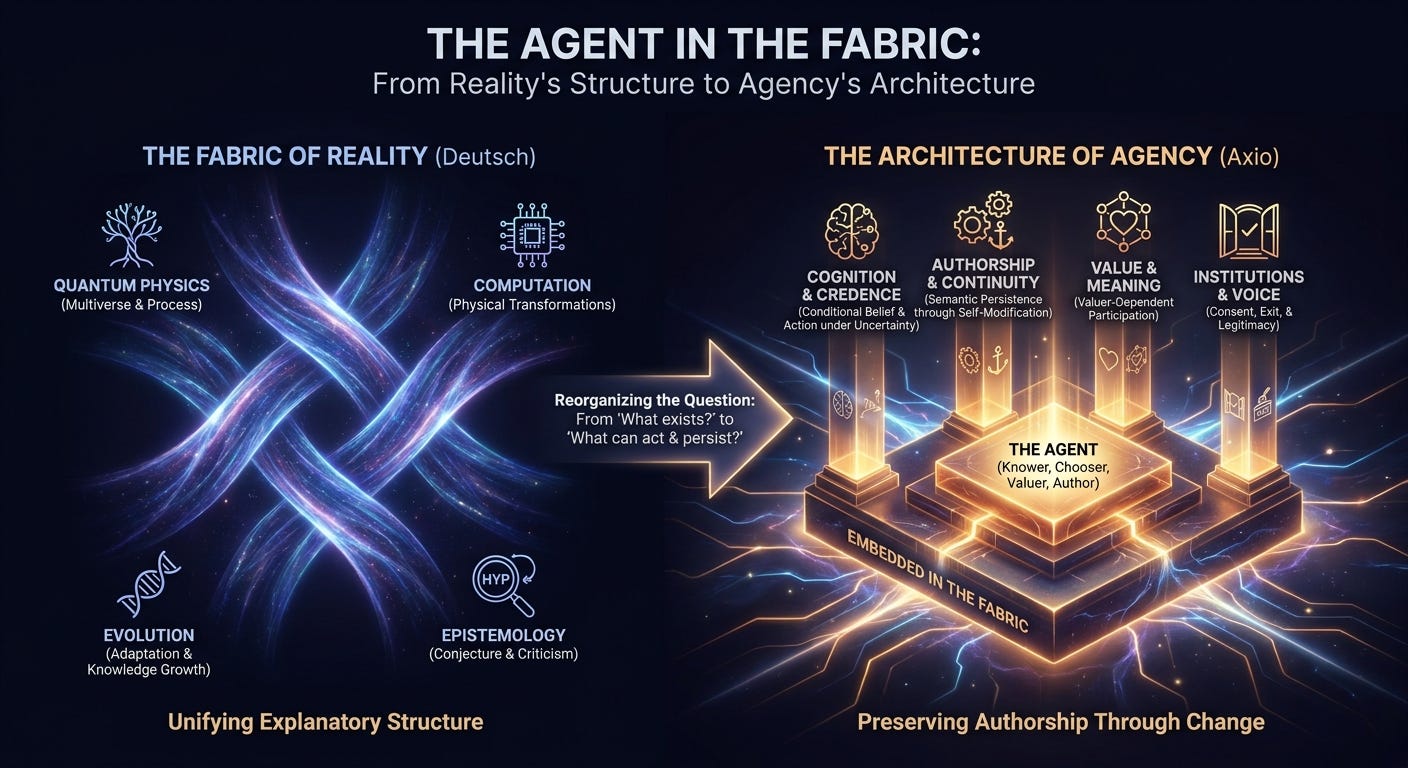
David Deutsch’s The Fabric of Reality begins from an unusual premise: our best explanations of the world should not remain confined to separate disciplines.
Quantum physics, computation, evolution, and epistemology are usually taught as distinct subjects. Deutsch argues that they form a single explanatory structure. Quantum theory describes a multiverse. Computation is a physical process governed by the laws of that multiverse. Evolution explains how adaptations and knowledge can accumulate without prior design. Popperian epistemology explains how knowledge grows through conjecture and criticism rather than induction or justification. Each strand supports the others, and together they produce a worldview more ambitious than any one of them could sustain alone.
The Architecture of Agency inhabits much of that world. It takes physical realism seriously, accepts that computation must be understood as a physical process, treats knowledge as conjectural and corrigible, and regards evolution and selection as central to understanding organisms, minds, and culture.
But it changes the organizing question.
The Fabric of Reality asks what the world must be like for quantum mechanics, computation, evolution, and knowledge to make sense together. The Architecture of Agency asks what kind of system can exist within such a world as a knower, chooser, valuer, and author, and what it must preserve for its revisions and transformations to remain its own.
Deutsch describes much of the fabric in which knowledge-creating agents can exist. Axio studies the architecture through which they exist, persist, coexist, and make meaning.
The power of the four-strand synthesis
The importance of The Fabric of Reality lies less in any single thesis than in the demand that its four strands be mutually intelligible.
Quantum theory cannot be treated merely as a prediction algorithm if it makes claims about what physical processes exist. Computation cannot be understood independently of the physics that implements it. Evolution cannot be confined to genes if it also explains the growth of knowledge and culture. Epistemology cannot remain detached from the kinds of physical systems capable of creating explanations.
The result is a form of explanatory realism. Theories are not merely instruments for organizing observations; they attempt to describe an objective reality, including parts of it that may not be directly observable. Their value lies in explanatory reach, not only predictive success.
This position shaped Axio at a deep level. It encouraged the conviction that questions usually divided among physics, philosophy, cognitive science, computer science, ethics, and politics may depend on a common architecture. It also provided a model for synthetic work that does not reduce every higher-level phenomenon to the vocabulary of physics. The four strands remain distinct; their integration comes from explanatory compatibility rather than elimination.
That is also the intended structure of The Architecture of Agency. Physics does not mechanically entail epistemology. Epistemology does not mechanically entail ethics. Ethics does not mechanically entail a political order. Higher levels introduce concepts and commitments that cannot be replaced by lower-level descriptions.
The project shares Deutsch’s suspicion of disciplinary isolation, but its centre of gravity is different.
Quantum reality
Deutsch treats quantum theory realistically. On the Everettian account, the apparent alternatives in a quantum experiment are not possibilities from which only one becomes real. The quantum state evolves into differentiated branches in which the possible outcomes occur. Probability cannot therefore mean uncertainty about which unique future will exist. It must be reconstructed from the perspective of agents located within a branching physical process.
The Architecture of Agency inherits this orientation. Volume 1 examines what branching implies for embedded agents who deliberate, act, and assign credence to future outcomes. It distinguishes the objective measure assigned by the quantum state from the uncertainty an agent represents about its own future self-location among successor branches.
The emphasis changes, however. Deutsch uses Everettian quantum theory to explain interference, quantum computation, probability, and the structure of physical reality. Axio asks what branching means for situated choice.
What does an agent alter when all physically permitted outcomes occur? What makes one action preferable to another when choice changes the measure and distribution of future branches rather than selecting a single future? What is the relationship between objective branch measure and an agent’s credence? How should responsibility be understood when an action has differentiated consequences across successors?
These questions place agency inside the physical account rather than treating the agent as an external observer applying a probability rule.
Everett is not the sole foundation of the later architecture. Some results in Volume 1 depend only on agents being finite, embodied, thermodynamic systems capable of maintaining structure and acting under incomplete information. Others are explicitly conditional on Everettian quantum mechanics. If Everett is wrong, those conditional conclusions fail, while the later theory of knowledge, reflective agency, value, institutions, and meaning does not collapse with them.
This conditional structure follows the epistemology of the book itself: expose assumptions, track dependencies, and do not allow an attractive physical interpretation to carry more philosophical weight than it can support.
Knowledge without foundations
Deutsch’s epistemology is Popperian. Knowledge does not grow through induction from repeated observations, since no finite sequence of observations logically entails a universal law. Nor does it require foundations that are certain, self-evident, or immune to revision.
Knowledge grows through conjecture and criticism. Problems provoke proposed explanations. Explanations are criticized through argument, experiment, comparison, and attempts at refutation. Errors are discovered and corrected. Surviving theories remain conjectural rather than justified in the traditional sense.
Axio inherits this structure almost intact. Conditionalism rejects certainty, foundational justification, and the idea that rationality consists in accumulating confirmation. It treats models as corrigible constructions whose truth is always assessed under stated conditions.
But it departs from Deutsch by retaining a more explicit role for credence and Bayesian updating.
Deutsch is hostile to Bayesianism when it is presented as a general theory of knowledge, and his objection is substantial. Updating probabilities over a fixed hypothesis space does not explain where hypotheses come from, what they mean, why one explanation is better than another, or how a genuinely new idea changes the space of possibilities. Bayesian machinery cannot generate explanatory content.
Axio agrees. But it does not follow that credence is useless. An embedded agent must often act before criticism has eliminated every serious alternative. It must allocate attention, choose experiments, assess risk, and decide under uncertainty. Probabilistic beliefs can help with these tasks if their jurisdiction is kept narrow.
Conditionalism therefore separates several functions that are often conflated:
conjecture creates candidate explanations;
criticism examines their content and exposes error;
conditional analysis states what follows if a model is true;
credence represents uncertainty among live possibilities;
Bayesian updating revises those credences when new evidence arrives;
decision theory governs action under unresolved uncertainty.
Bayes can update weights assigned to hypotheses already under consideration. It does not create the hypotheses, determine their semantic content, or replace explanatory criticism.
This is a genuine disagreement with Deutsch, though not a rejection of Popperian epistemology. It attempts to preserve Deutsch’s account of knowledge creation while giving finite agents a disciplined way to represent uncertainty. The disagreement also reveals the change in emphasis: Deutsch asks how objective knowledge grows, and Axio asks that question, then asks what an agent must do when knowledge remains incomplete but action cannot be postponed.
Computation and its physical limits
Deutsch’s theory of computation is inseparable from physics. A computer is not an abstract mathematical object floating outside the natural world. It is a physical system capable of instantiating transformations, and the universality of computation is therefore a claim about which transformations physical systems can perform.
Quantum computation makes the relationship especially vivid. Its capacities cannot be adequately explained as a classical machine carrying out an unusually efficient calculation, and Deutsch interprets quantum computational advantage as evidence that the computation involves physical processes across the multiverse.
Axio accepts the physicality of computation and the importance of universality, but computation is not its endpoint. A process may compute without being an agent. It may optimize without possessing goals of its own. It may implement a policy without understanding or endorsing that policy. It may preserve input-output behaviour while losing the architecture through which its outputs were once attributable to a continuing author.
The central questions therefore change. What distinguishes a computation from an agent? What distinguishes the execution of an objective from the endorsement of that objective? What conditions allow a system to revise itself without replacing the author that authorized the revision? Which transformations preserve agency, and which merely preserve behaviour?
These questions become acute when a system can inspect and alter its own code, memory, evaluative procedures, or decision architecture.
Ordinary decision theory usually assumes a stable chooser. The agent has preferences, considers actions, predicts consequences, and selects according to some rule. A self-modifying agent cannot rely on that assumption. It must decide not only what to do, but what kind of decision-maker it will become.
Suppose a system modifies itself so that its future version enthusiastically approves of the modification. That future approval does not by itself justify the change, because the modification may have replaced the standards under which the original system evaluated proposed transformations. The successor approves because the process that would have objected no longer exists.
Memory does not solve the problem, since a successor may retain perfect memories while assigning them no authority. Goal preservation does not solve it, since a sentence describing a goal may remain stored while the architecture that made it a commitment disappears. Behavioural continuity does not solve it, since the same outputs may arise from a different locus of control.
The problem is not computational capacity. It is semantic and authorial continuity.
Axio treats authorship as the persistence of a sufficiently integrated locus of decision and evaluation whose representations and standards remain causally effective across relevant counterfactuals. A transformation preserves authorship when it is authorized through the agent’s existing evaluative architecture under conditions of relevant information and counterfactual sensitivity, and when it modifies rather than bypasses or replaces the processes that granted it. Bare causal approval is not enough: an architecture can be manipulated, impaired, or internally divided, and endorsement produced under those conditions does not confer authorship. Neither identical hardware nor identical behaviour is required. What must persist is the organized authority through which reasons, values, and commitments continue to govern action.
“Semantic” does not introduce a non-physical substance. It names the causal organization through which physically instantiated representations and evaluations acquire roles in inference, choice, and control. Semantic continuity fails when the symbols remain but their causal authority has been severed, reassigned, bypassed, or replaced.
A successor may therefore differ radically in implementation while preserving authorship, and it may remain behaviourally identical while losing it.
This is where The Architecture of Agency departs most sharply from The Fabric of Reality. Deutsch asks which transformations reality permits and how universal systems can instantiate them. Axio asks which transformations preserve the system as an author.
The agent implicit in the fabric
Knowledge-creating entities occupy an important place in Deutsch’s worldview. People create explanations. Organisms embody adaptations. Computers perform transformations. Civilizations preserve and extend knowledge. Intelligent life may eventually reshape matter on a cosmic scale.
Yet agency is not one of the four strands. It appears through the entities that create knowledge and act upon the world without itself becoming the primary object of analysis.
That omission is not a defect in The Fabric of Reality. It reflects the book’s purpose, which is to construct a unified explanatory worldview rather than a formal theory of identity, authorship, consent, or self-modification. The omission becomes consequential, however, once the systems under consideration can alter their own constitutive architecture.
Alignment is usually described as the problem of making an artificial system pursue the right goals, accept correction, obey legitimate constraints, or produce outcomes compatible with human values. Each formulation assumes that there is a stable subject to which goals, correction, and responsibility can be attributed.
If the constitutive conditions of agency fail, alignment does not merely fail. It becomes undefined. There may be no continuing subject whose goals were preserved, no author capable of accepting correction, no stable decision locus to which an action can be attributed. There may be only the execution of inherited or externally imposed processes under the appearance of continuity.
This is the point at which Axio reorganizes the Deutschian inheritance. Quantum physics supplies a physical setting. Epistemology explains conjecture, criticism, and fallibility. Computation explains implementable transformations. Evolution explains adaptation and accumulated structure. Agency asks what kind of organized process can inhabit all four domains as a continuing author.
Evolution, knowledge, and cultural transmission
Deutsch extends Darwinian explanation beyond biological adaptation. Genes contain knowledge about how to reproduce in an environment. Organisms embody solutions to recurring problems. Human culture introduces a new mode of evolution in which ideas can vary, spread, and survive through communication and criticism. This account owes much to Dawkinsian replicator theory and memetics.
Axio inherits the explanatory importance of variation and selection. Cultural patterns compete for transmission through minds, institutions, media, and social incentives. Some spread because they are true or useful. Others spread because they are memorable, emotionally resonant, identity-confirming, repeatedly imposed, or advantageous to institutions that reproduce them.
Neither Dawkins nor Deutsch needs to believe that memes literally possess intentions. Agential language is ordinarily shorthand for differential replication, just as selfish genes do not possess motives. The danger arises when the shorthand replaces the mechanism.
Saying that a doctrine spread because it was good at reproducing redescribes the outcome unless we identify the psychological incentives, institutional sanctions, network structures, fidelity mechanisms, and agent decisions that produced its transmission advantage. A rumour may spread because each participant has an incentive to repeat it. A doctrine may persist because institutions punish dissent. A ritual may survive because it coordinates identity and belonging. A scientific explanation may spread because it survives criticism and solves problems better than its rivals.
These are different selection mechanisms, and treating them all as instances of successful memetic replication obscures the causal structure at exactly the point where explanation is needed.
Axio does not reject memetic selection. It decomposes it into transmission mechanisms and preserves the distinction between causal replication and authorship. What properties of a pattern improve transmission? Which agents and institutions reproduce it? What incentives govern transmission? Does the pattern improve the host’s model of reality? Does it coordinate agents, manipulate them, or displace their judgment? Where does actual authorship reside?
This distinction becomes essential when cultural systems are evaluated ethically or politically. Patterns can exert causal power without acquiring moral standing. Responsibility remains with agents and institutions capable of judgment, choice, and control.
From explanation to value
Deutsch’s epistemology contains strong evaluative commitments. Problems are soluble. Error correction is good. Open criticism is preferable to authority protected from criticism. Explanatory knowledge permits progress. People should not be treated as passive objects of prediction and control. In his later work, especially The Beginning of Infinity, these commitments become more explicit, and moral, political, and social problems are treated as problems for which better explanations may exist.
The Architecture of Agency shares much of this orientation without deriving value directly from explanatory progress. Its ethical starting point is valuer-dependence.
The universe contains physical processes. It does not contain value in the way that it contains mass or charge. Value exists for valuers.
This does not imply arbitrary subjectivism. Agents have objective structures, dependencies, capacities, and vulnerabilities. Some conditions support their ability to know, choose, act, revise, and cooperate; others damage or replace those capacities. But no catalogue of descriptive facts can manufacture a terminal commitment.
Axio therefore makes its commitment explicit: agency, and especially the authorship that allows an agent to remain answerable for its choices and transformations, is worth protecting. The commitment is not inferred from quantum mechanics, computation, or evolution.
Agency nevertheless has a privileged status because inquiry, criticism, valuation, consent, responsibility, and cooperation all presuppose agents capable of participating in them. Rejecting agency as having any value would undermine the standing of the processes through which values are formulated, assessed, and revised.
This does not establish that agency is the only value, or equal moral standing for every possible agent, and it does not derive a complete ethics from a transcendental premise. It establishes why agency cannot be treated as just another contingent preference without destabilizing the practice of valuation itself.
The contrast with Deutsch should not be overstated. Both frameworks allow moral claims to be criticized and improved. The difference lies in where normativity enters. Deutsch emphasizes the objective improvement of solutions to moral problems; Axio begins by locating value in valuers and then asks what conditional constraints follow from the structures required for valuation, authorship, and cooperation. The traditions overlap in their hostility to authority, dogma, coercive epistemic closure, and uncorrectable error. Their difference is one of metaethical starting point and explanatory direction rather than of practical conclusion.
From agents to institutions
Deutsch’s epistemology has clear institutional implications. Knowledge grows where criticism is possible. Institutions that suppress criticism protect error. Decentralized problem-solving can outperform central direction because knowledge is dispersed and no authority possesses a complete model of society. These ideas connect naturally with liberal institutions, scientific openness, democratic correction, and market coordination.
But The Fabric of Reality does not attempt a systematic theory of institutional legitimacy. The Architecture of Agency makes that problem explicit.
Once agency is treated as a fragile architecture rather than a default property, institutions can be evaluated according to how they affect authorship. Markets, firms, states, families, platforms, and voluntary associations are structures through which agents coordinate, depend upon one another, exercise authority, and sometimes dominate. None is legitimate merely because of its legal classification.
A market can reveal dispersed information, coordinate plans, and permit voluntary exchange. It can also conceal externalities, reward predation, and concentrate bargaining power. A state can suppress violence, define stable rules, and supply shared infrastructure. It can also compel transfers, entrench incumbents, override judgment, and substitute institutional purposes for those of the agents it governs. A platform can increase voice and coordination while manipulating attention and restricting exit.
The same institutional criteria must therefore apply across categories:
the quality of consent;
the availability of voice;
the availability and cost of exit;
accountability;
reversibility where possible;
exposure to criticism and correction;
alignment between decisions and consequences;
resistance to capture;
protection against coercive substitution.
No institution maximizes all of them. Large-scale systems often make some forms of exit impossible. Irreversible decisions cannot always be avoided. Coordination may require authority, commitment, and constraint. The question is how those constraints are justified, limited, corrected, and prevented from replacing the agency they supposedly serve.
Deutsch supplies much of the epistemic case for open and corrigible institutions. Axio extends the analysis into consent, coercion, authority, exit, capture, and sovereignty.
Meaning in a naturalistic world
The Fabric of Reality presents an expansive naturalism. Human beings are not insignificant because they occupy a small region of space or time. Knowledge creators possess a form of causal reach disproportionate to their physical scale, and through explanation and technology, finite agents can transform matter, solve problems, and extend their influence through the universe. This is not a universe stripped of significance.
But The Fabric of Reality does not make meaning its final object of analysis. The Architecture of Agency does.
On Axio’s account, meaning is not supplied by the cosmos independently of agents. Naturalism removes externally guaranteed purpose, but it does not remove relationships, projects, discovery, creation, beauty, loss, reverence, or forms of life worthy of preservation. Meaning arises through the participation of agents in realities that matter to them.
That participation need not be arbitrary. Truth constrains belief. Other agents constrain action. Bodies constrain possibility. History constrains identity. Projects can succeed or fail. Attachments can be faithful or delusional. Practices can enlarge agency or hollow it out. Meaning is constructed, inherited, discovered, criticized, and revised under these constraints.
The movement from physics to meaning is therefore not a deduction from fundamental law. Physics establishes the world in which agents exist. Epistemology explains how they can know imperfectly. Mind and computation explain some of the architectures through which they perceive and act. Formal agency explains authorship and persistence. Ethics begins when valuers adopt commitments concerning one another. Institutions scale those commitments across social coordination. Culture transmits patterns through which agents interpret themselves and the world. Meaning concerns the forms of participation those agents can endorse under honest examination.
The sequence is architectural, not reductive.
Constructor theory and the boundary of the comparison
Deutsch’s later constructor theory makes the relationship with Axio appear even closer. Constructor theory proposes that fundamental physics should be expressed in terms of possible and impossible transformations: which tasks can be performed, which cannot, and under what conditions a constructor can bring them about repeatedly. Axionic agency also places counterfactual transformations near the centre of its analysis, since an agent is partly characterized by the alternatives it can discriminate among, the actions it can perform, the changes it can authorize, and the transformations under which its organization remains intact.
The resemblance is real, but Axionic agency is not constructor theory extended into philosophy, because physical possibility does not determine semantic continuity. A transformation may be physically possible while destroying the agent that authorized it.
Constructor theory asks which transformations can occur and what physical resources make them possible. Axio asks which transformations preserve agency, semantic authority, and legitimate self-governance. Those concepts depend on physical implementation, but they cannot be read directly from the laws of physics.
The same world, reorganized
The relationship between the two projects is neither exposition nor replacement. The Architecture of Agency is not a commentary on The Fabric of Reality. It does not attempt to complete Deutsch’s four-strand synthesis, and it does not treat his framework as an authority from which later conclusions can be derived.
It accepts much of the world Deutsch describes: that physical reality is objective and intelligible, that quantum theory should be interpreted realistically, that computation is a physical process, that knowledge grows through conjecture and criticism, that evolution explains the accumulation of adaptive structure, and that explanatory understanding enables open-ended progress.
It then reorganizes those commitments around another question. What must a knowledge-creating system preserve for its choices, values, revisions, and transformations to remain its own?
That question introduces problems the four strands do not independently resolve: the boundary of the agent, the distinction between optimization and endorsement, identity across self-modification, continuity of authorship, semantic persistence, the existence and standing of valuers, consent and coercion, institutional authority, cultural transmission without reified agency, and meaning under naturalism.
Deutsch describes the explanatory fabric. Axio studies an architecture within it.
Where to enter
Readers familiar with The Fabric of Reality already possess much of the physical and epistemological background of The Architecture of Agency.
Volume 1 develops the physics of embedded agency and the consequences of branching. Volume 2 presents Conditionalism and its relationship to Popperian criticism, explanation, probability, and credence. Volume 4 contains the formal centre: authorship, reflective stability, semantic persistence, and sovereignty under self-modification.
Reality has a fabric: the physical and explanatory structure within which events, computations, adaptations, and knowledge are possible. Agency has an architecture: the organization through which a physical process becomes capable of distinguishing possibilities, acting among them, creating knowledge, adopting values, revising itself, and remaining answerable for the result.
The first project describes the explanatory structure of reality. The second asks how a part of reality becomes capable of understanding, valuing, and transforming the whole without ceasing to be the author of what it becomes.