

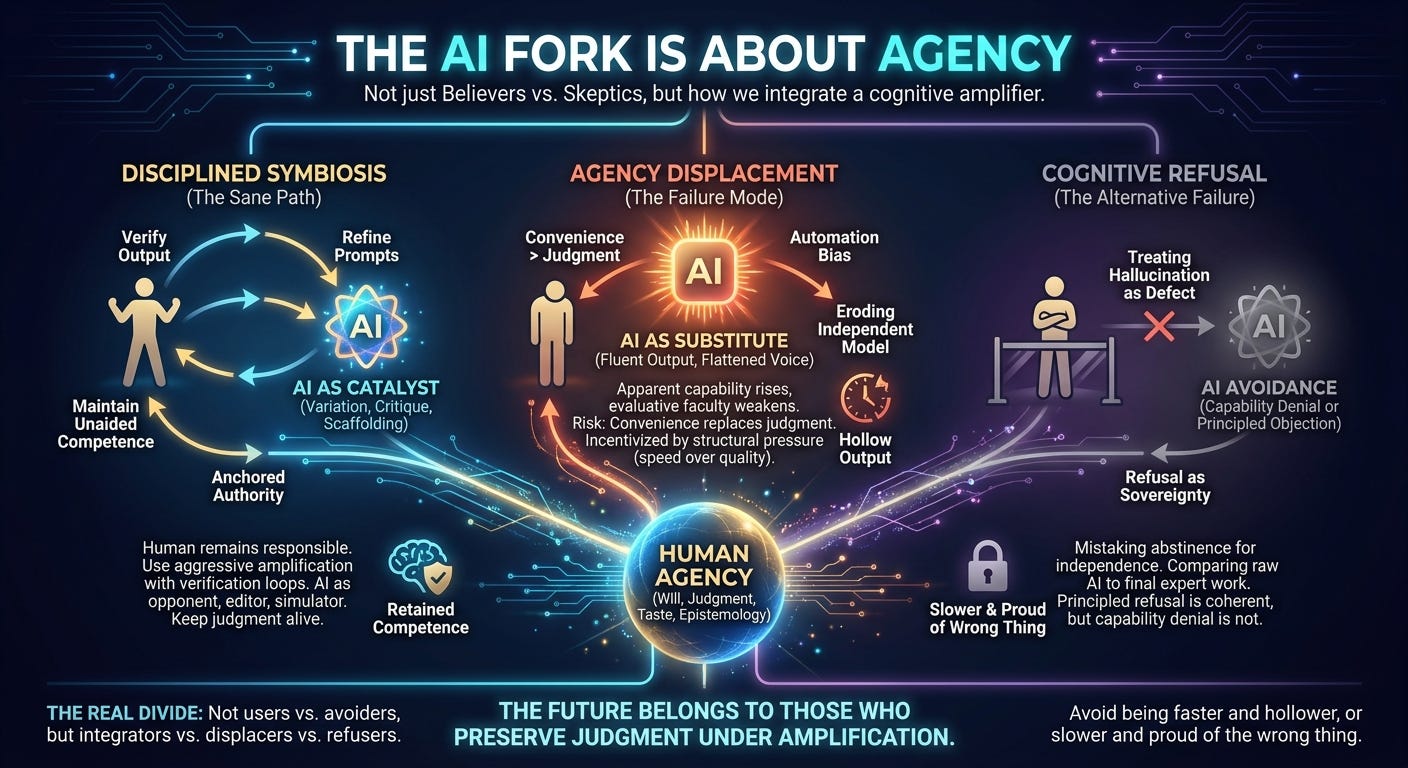
The emerging divide over AI is usually described as a fight between believers and skeptics, accelerationists and doomers, tool-users and refusers. That framing misses the more important structure. The relevant fork concerns agency: who preserves it, who displaces it, and who refuses the tool because refusal feels like sovereignty.
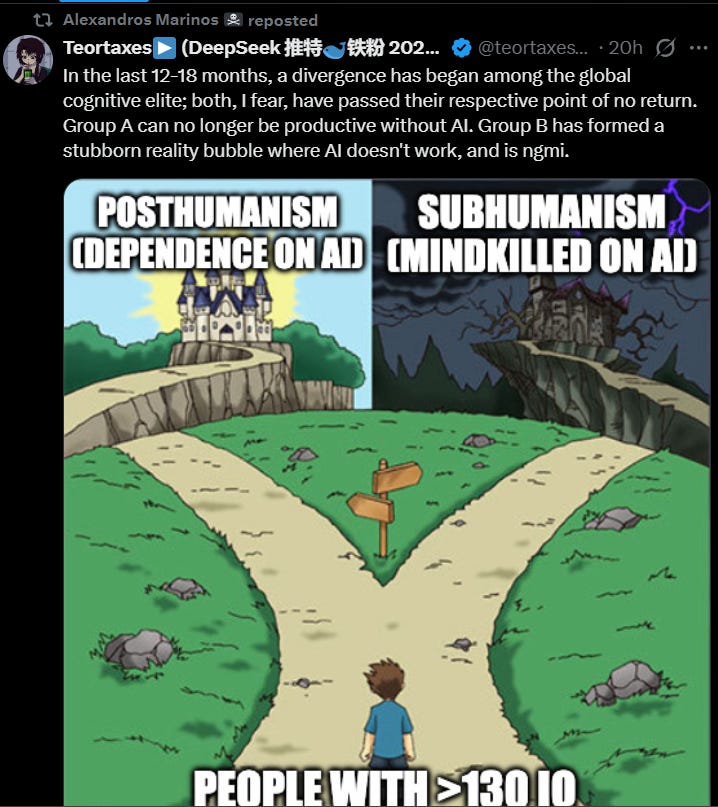
AI is a cognitive amplifier. It can accelerate drafting, abstraction, search, simulation, critique, translation, refactoring, and adversarial review. It can also turn capable people into curators of plausible sludge. The difference lies less in the model than in the user’s control architecture.
The Dialectic Catalyst
At its best, AI functions as an external dialectic catalyst. It compresses material, recombines ideas, generates objections, exposes weak joints, and gives thought more surface area. It has coherence without agency. That distinction matters because it prevents two symmetric errors: treating AI output as authoritative intelligence, and treating lack of agency as lack of cognitive value.
The human remains responsible for intention, judgment, taste, epistemology, and final authority. The machine can produce candidate structures. It can propose analogies, map tensions, and pressure-test claims. It can make thinking faster and more explicit. It cannot decide what is worth valuing, what is true enough, or what should be authored under one’s name.
Agency Displacement
The AI-native failure mode is agency displacement. This happens when fluent output substitutes for understanding, when generated prose flattens voice, when code is accepted because it looks plausible, or when the user stops maintaining an independent model of the work. The apparent capability rises while the evaluative faculty weakens.
This is the real danger in heavy AI use. The risk is not that a serious user consults the tool too often. The risk is that convenience slowly replaces judgment. Automation bias is the predictable human tendency here: once the machine becomes normal, checking the machine begins to feel optional, inefficient, or even irrational. The failure arrives gradually, disguised as productivity.
Cognitive Refusal
The opposite failure mode is cognitive refusal. Some people still argue against AI as though the current frontier were a 2022 chatbot demo. They treat hallucination as a disqualifying defect rather than an engineering constraint. They compare raw AI output against expert final work instead of comparing AI-assisted workflows against unaided workflows. That is refusal masquerading as discernment.
There is also principled refusal. Some people object to AI on legal, ethical, environmental, or economic grounds. Those objections deserve separate treatment. A person can acknowledge that the tool works while rejecting its provenance, business model, labor effects, or institutional incentives. That position is coherent. Capability denial is a different thing.
Structural Pressure
Disciplined symbiosis is cognitively possible and institutionally fragile. In a corporate setting, the incentives often favor agency displacement. Speed is easier to measure than judgment. Output volume is easier to reward than retained competence. A manager can count tickets, drafts, summaries, and generated artifacts more easily than he can measure whether a worker’s independent model of the domain is improving or degrading.
This means bad AI use will often be economically selected. Mediocre AI-mediated output may be cheaper than slower, higher-quality human judgment. Some institutions will prefer the appearance of cognition over the cost of actual expertise. That is not a user-interface problem. It is an incentive problem.
Disciplined Symbiosis
The sane path is disciplined symbiosis. Use AI aggressively, but bind it to verification loops. Use it for variation, compression, critique, scaffolding, and adversarial pressure. Use it to make your assumptions visible. Use it to force contact with objections. Use it as an opponent, editor, simulator, and index.
Do not let it become your taste, your conscience, your epistemology, or your will. Keep unaided competence alive. Periodically do the work without the machine. Maintain domain models strong enough to detect fluent nonsense. Treat AI as a catalytic extension of cognition, with authorship and authority anchored in the human agent.
Postscript
The divide is not between people who use AI and people who avoid it. It is between three kinds of users: those who can make the model sharpen their agency, those who let it erode their agency, and those who preserve independence by refusing a tool they have not learned to govern.
That is the practical test. After using AI, are you harder to fool, faster to clarify, better able to defend your claims, and more capable of acting from your own judgment? Or are you merely producing more fluent artifacts with less internal command over what they mean?
AI will not make weak agency strong. It will magnify the control structure already present. A disciplined mind gets leverage. An undisciplined mind gets velocity without steering. An avoidant mind gets purity at the price of reduced reach. The future belongs to the first group because it is the only one that treats amplification as a responsibility rather than a shortcut or a contamination.
Useful Article and framing: https://mises.org/mises-wire/ai-creative-destruction-and-politicization-economic-change
I think the author of this article would have been well served to to have read your article first. He seems to have missed the point as to what LLM/AI actually is, a Tool. Using his logic most Public Libraries and University Professors should be treated with a Papal missive in this vain as well. https://www.theregister.com/ai-ml/2026/06/01/llms-are-closer-to-religion-than-they-appear-watch-out-for-those-who-like-it-that-way/5248189