

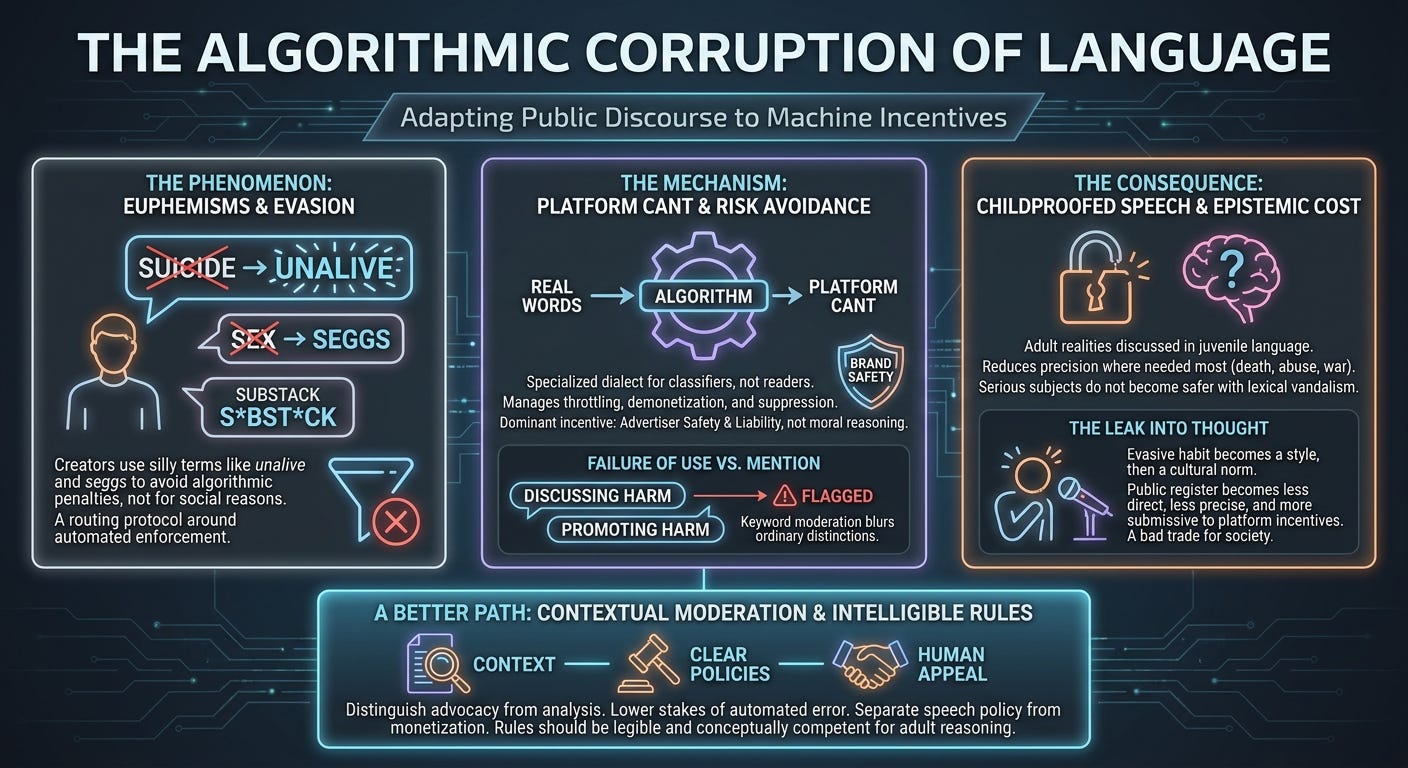
Content creators now say unalive instead of suicide, seggs instead of sex, and sometimes write s*bst*ck as if naming a publishing platform were a form of contraband. This is embarrassing to watch, but the embarrassment is not mainly on the creators. They are adapting to an environment in which normal words can make a post harder to find, harder to monetize, or more likely to be buried by systems no one can inspect.
The euphemisms are silly. The incentives producing them are not.
Language has always had euphemisms. People soften terms for children, grieving families, ritual settings, public politeness, or plausible deniability. That is not new. What is new is that the pressure is no longer primarily social. Creators are not choosing these words because their audience is too fragile to hear suicide. They are choosing them because a machine may treat the word as evidence of unsafe content.
The audience understands the real word. The speaker understands the real word. The euphemism is not being used to clarify meaning or reduce harm. It is being used as a routing protocol around automated enforcement.
Platform Cant
A cant is a specialized dialect used by people communicating under constraint. Some cants create group identity. Some hide meaning from outsiders. Some let people speak under hostile supervision. The current platform cant is mostly the third kind.
A creator saying unalive is not improving English. He is managing distribution risk. He has learned that certain words may trigger throttling, demonetization, age restriction, account strikes, or silent suppression. Since the rules are unstable and the penalties can be material, he mutates the language.
That does not mean every use of algospeak is grim compliance. Humans are good at turning constraint into style. Teenagers, dissidents, prisoners, and subcultures have always made jokes out of surveillance. Some people now use unalive ironically, playfully, or as an in-group signal mocking the platforms that trained them to say it. That is real enough, but it does not change the causal story. A workaround can become a joke without ceasing to be a workaround.
The result is a dialect optimized for classifiers rather than readers. It is not slang in the ordinary organic sense. It is compliance speech that later acquired the ornaments of slang.
The creator is no longer speaking directly to the reader. He is speaking through an imagined moderation model, trying to remain intelligible to humans while remaining non-threatening to the machine. That is why the whole thing feels so degraded. It is not just that unalive sounds childish. It is that adults are being trained to route serious concepts through childish evasions.
Use and Mention
The most basic failure is the collapse of use and mention.
Encouraging suicide is one thing. Discussing suicide prevention is another. Threatening violence is one thing. Quoting a violent threat in order to analyze it is another. Promoting sexual exploitation is one thing. Reporting on sexual exploitation is another. These distinctions are not exotic. They are ordinary distinctions required by journalism, law, scholarship, education, and adult conversation.
Keyword-sensitive moderation blurs those distinctions because it treats the presence of a word as if it were evidence of the speaker’s act. That is intellectually primitive. A word is not an endorsement. A description is not an incitement. A quoted threat is not itself a threat. A discussion of harm is not equivalent to harm.
When platforms get this wrong, creators respond predictably. They avoid the proper term. They invent baby-talk. They obscure names. They write like prisoners tapping on pipes.
The especially absurd case is when people censor the word while discussing censorship of the word. At that point the system is not protecting discourse. It is deforming it.
Advertiser Safety Masquerading as User Safety
The dominant incentive here is not careful moral reasoning. It is brand safety, liability management, and executive risk avoidance.
Advertisers do not want their products beside disturbing material. Platforms do not want scandals. Trust-and-safety departments do not want edge cases. The bureaucracy prefers false positives because false positives are usually invisible. A suicide-prevention video that gets quietly downranked creates less institutional heat than a harmful video that goes viral and ends up in a newspaper story.
So the system becomes blunt. It learns to fear topics, then words, then clusters of words. It has no real theory of meaning. It has a risk surface.
Creators then adapt to the risk surface. They learn the superstition of the platform. This word is dangerous. That spelling is safer. This name must be disguised. That subject should be gestured at indirectly. No one knows exactly what the rules are, so everyone behaves as if the rules are worse than stated.
This is how vague enforcement creates broader censorship than explicit rules. A clear ban has boundaries. A foggy penalty function produces self-censorship in the surrounding territory.
Childproofed Speech for Adults
There is a persistent institutional fantasy that public discourse can be made safe by making the vocabulary less direct. This is wrong. Serious subjects do not become less serious because people use softer labels. Suicide does not become safer to discuss because people say unalive. Sex does not become less sexual because people say seggs. Violence does not become less violent because the word is partially replaced by asterisks.
What we get instead is a childproofed public language being used by adults to discuss adult realities.
That is a bad trade. It reduces precision exactly where precision is most needed. Death, suicide, abuse, rape, murder, addiction, war, crime, coercion, and propaganda are not topics improved by coy substitution. Some audiences require care. Some contexts require restraint. But care and restraint are not the same as lexical vandalism.
A serious culture needs the ability to name serious things. It does not need maximum bluntness in every setting, but it does need a functioning adult register. The platform dialect is eating that register.
The Leak Into Ordinary Speech
The really bad sign is that these terms no longer stay inside the environments that produced them. People use them in podcasts, private messages, essays, and ordinary conversation where no moderation system is involved. A workaround becomes a habit. A habit becomes a style. A style becomes a cultural norm.
This is how infrastructure reshapes thought without issuing commands. No one has to officially ban a word. The platform merely changes the local cost of using it. People adapt. The adaptation spreads. Eventually the original word starts to feel dangerous or impolite, not because anyone made an argument against it, but because everyone has been trained to flinch.
This does not require any strong Sapir-Whorf thesis. People do not forget what suicide means because they say unalive. They do not lose the biological concept of sex because they write seggs. The damage is subtler and more plausible than that. The public register for discussing these topics becomes less direct, less precise, and more submissive to platform incentives.
Moral progress usually gives us finer distinctions. This gives us cruder ones. It replaces semantic accuracy with platform survivability.
What Real Moderation Would Need
None of this implies that large platforms can operate without moderation. That is not a serious position. Any major platform has to deal with spam, scams, threats, harassment, gore, fraud, child exploitation, coordinated manipulation, and bot networks. Some enforcement is unavoidable.
Nor does it imply that perfect contextual moderation is easy. At global scale, with billions of posts, adversarial users, legal exposure, political pressure, and many languages, no system will reliably understand every case. Human moderators are expensive and inconsistent. Automated systems are brittle. LLM-based moderation may improve the situation, but it does not abolish ambiguity, irony, malice, or institutional cowardice.
The question is whether enforcement is legible and conceptually competent enough for adults to reason about.
A better system would distinguish advocacy, instruction, testimony, quotation, criticism, reporting, fiction, satire, and education. It would treat a suicide-prevention discussion differently from suicide encouragement. It would treat analysis of terrorism differently from recruitment propaganda. It would treat testimony about abuse differently from abuse.
It would also lower the stakes of automated error. Account strikes, suspensions, and long-term distribution penalties should not be handed out by crude lexical triggers. Mere word occurrence should not be treated as a reliable harm signal. Ambiguous adult speech should be left alone unless there is concrete evidence of advocacy, targeting, exploitation, or instruction to harm.
Platforms should separate speech policy from monetization policy more cleanly. They are not obliged to monetize everything. But demonetization and downranking should not operate as invisible speech controls. If a platform is going to punish a piece of content, creators should be able to know why, appeal it, and learn something stable from the result.
Creators do not need perfect rules. They need rules that are intelligible enough to reason about. The current incentive environment often gives them the opposite: serious penalties, vague triggers, and no reliable model of enforcement.
Postscript
The cost is not merely aesthetic, though the aesthetics are bad enough. The cost is epistemic.
The public language is being optimized around the sensitivities of automated classifiers, corporate advertisers, and risk-averse platform bureaucracies. That changes which ideas get expressed, which words people choose, which topics become radioactive, and which speakers decide the whole thing is not worth the trouble.
It rewards people who learn to speak in evasions. It penalizes people who insist on ordinary precision. It makes grave subjects sound juvenile. It teaches adults to treat accurate language as dangerous.
A society that cannot say suicide while discussing suicide, or sex while discussing sex, or death while discussing death, has not become safer. It has made its public language less fit for adult thought.