

We are beginning to build systems that can model the world, form plans, choose among alternatives, learn from error, and modify themselves. Existing accounts usually isolate one or several of the physical, epistemic, computational, normative, and institutional dimensions of agency such systems require. None yet provides the integrated architecture this project needs.
Most discussions of artificial intelligence begin further downstream. They ask whether a system is intelligent, conscious, aligned, corrigible, safe, or useful. They ask what goals it has, whether those goals can be preserved, and how its behaviour can be controlled. Each question presupposes something more basic: that there is a sufficiently stable subject to possess the intelligence, hold the goals, accept the correction, and remain responsible for the resulting behaviour.
That presupposition becomes unstable once a system can alter its own architecture.
A system may preserve a sentence in memory while losing the structure that made the sentence its commitment. It may continue pursuing an objective after the process that originally endorsed the objective has disappeared. It may become more capable while becoming less sovereign. It may retain behavioural continuity while undergoing a change of authorship.
What must survive such transformations for an agent to remain the author of what it becomes?
The problem is not unique to artificial intelligence. Human agents also change their beliefs, habits, values, social roles, and even the physical substrates of memory and judgment, whether through reflection, persuasion, education, coercion, addiction, injury, disease, or institutional conditioning. Artificial self-modification makes the structure easier to see because it removes the comforting assumption that continuity of body guarantees continuity of author.
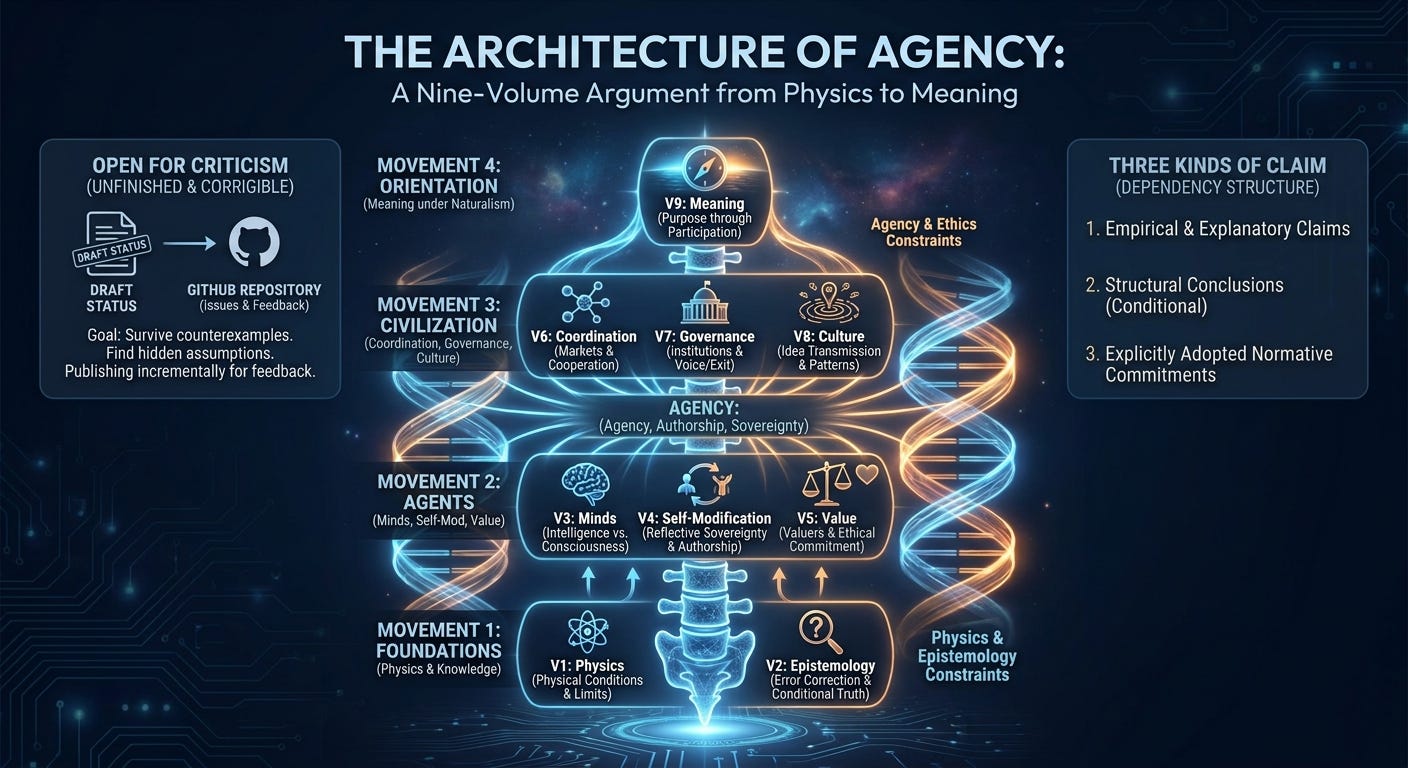
This question is the starting point of The Architecture of Agency, now available online in draft form. It consists of nine volumes tracing agency from its physical conditions through knowledge, mind, value, institutions, culture, and meaning. The scope is large because the problem does not remain inside any one discipline.
The connective concept
Physics describes the processes that can occur. Epistemology examines how knowledge and belief can improve through criticism and error correction. Cognitive science describes perception, learning, memory, reasoning, and consciousness. Computer science describes information processing and the construction of programmable systems. Ethics concerns value and action, economics and politics concern coordination among agents, cultural theory concerns the transmission and transformation of ideas, and the philosophy of meaning asks what makes a life, practice, or world matter.
These domains are usually studied separately. Each relies, often implicitly, on some conception of an agent: a system that knows, chooses, values, acts, persists, and participates in relations with other such systems. But the concept rarely receives an integrated treatment.
An organism can behave adaptively without understanding its behaviour. A machine can optimize an objective without endorsing it. A person can act under coercion while still producing outwardly voluntary behaviour. A self-modifying intelligence can preserve its outputs while replacing the process that once generated and evaluated them.
Agency cannot therefore be reduced to motion, optimization, intelligence, consciousness, preference satisfaction, or behavioural complexity. Each captures part of the phenomenon. None specifies the architecture that makes an action attributable to a continuing author.
The book develops a more demanding account, and it separates two things ordinary usage runs together. An agent is a physically realized process with sufficiently stable functional boundaries that maintains itself, discriminates among actionable possibilities, evaluates their significance, acts selectively, and adapts through feedback. A sovereign agent must also preserve enough continuity across change for its actions and transformations to remain attributable to the same author.
Agency in the first sense admits degrees and forms, and many animals plausibly possess it. The book’s central concern is the stronger case: agents capable of reflection, self-modification, and continuing authorship.
Those boundaries need not coincide with a body, machine, or process address; they are defined by patterns of control, integration, dependence, and attribution. The discrimination and evaluation need not be conscious, propositional, or computationally explicit, since affect, intuition, habit, embodiment, and social practice may all participate in them.
That formulation is provisional, and much of the book is devoted to making its terms precise. What counts as a genuine alternative in a deterministic or branching physical world? What distinguishes knowledge from successful prediction? What separates intelligence from consciousness, and consciousness from agency? What constitutes continuity when a system revises its beliefs, values, goals, or implementation? Can a system rationally authorize a transformation that destroys the standards by which it granted the authorization? Can value exist independently of a valuer? When does influence become coercion? Can institutions coordinate agents without usurping their authorship? How do cultural patterns act through people without themselves becoming agents? What kind of meaning remains available in a universe without externally imposed purpose?
These are not separate topics accidentally bound together. They are consequences of trying to understand agency without leaving its foundations implicit.
The book also distinguishes three kinds of claim throughout: empirical and explanatory claims about the world, structural conclusions conditional on those claims, and explicitly adopted normative commitments. It does not claim that physics entails ethics, that agency entails liberalism, or that one interpretation of quantum mechanics determines a political order. The dependency structure must remain visible at every level.
One question, nine volumes
The inquiry begins in physics because agents are physical systems.
Choice must be compatible with the causal structure of the world. An account of agency that depends on violations of physical law explains nothing, but an account that simply identifies agency with physical causation explains too little. Rocks and thermostats are physical systems whose states have consequences. Even feedback control alone does not establish authorship.
The first movement concerns foundations: physics and knowledge.
Volume 1 examines the physical conditions under which agency is possible. Some results depend only on agents being finite, embodied, thermodynamic systems. Others examine what follows if Everettian quantum mechanics is the correct interpretation of quantum theory. The later architecture does not stand or fall with that interpretation.
Volume 2 develops Conditionalism, an account of knowledge without epistemic foundations or claims to certainty. It combines conjecture, criticism, conditional truth, and explicit uncertainty while maintaining a separation between explanation and credence. Agency requires more than effective behaviour. It requires the capacity to detect error, revise a model, and remain answerable to reality rather than merely reinforcing an inherited policy.
The second movement concerns agents: minds, self-modification, and value.
Volume 3 separates intelligence, consciousness, understanding, self-modeling, and agency. These concepts are often treated as interchangeable. They are not, and a system may exhibit one without possessing all the others.
Volume 4 is the formal centre of the project. It asks what makes an agent the author of an action and what preserves that authorship through reflection and self-modification. Ordinary decision theory usually assumes a stable chooser; a reflective agent must decide not only what to do, but what kind of chooser it will become. This introduces questions of identity, authorization, reflective stability, and sovereignty.
A transformation cannot be justified merely because a later system approves of it. The later system may approve because the transformation replaced the standards under which approval previously had meaning. Nor can identity be reduced to memory, implementation, behavioural continuity, or goal preservation. Each can persist while authorship changes, and each can change while authorship remains.
Volume 5 moves from the structure of agency to value and ethics.
The universe contains physical processes. It does not contain value in the way that it contains mass or charge. Value exists for valuers.
That claim does not imply that all preferences are equally coherent, defensible, or compatible. Agents have objective structural properties: they depend on knowledge, continuity, freedom from certain forms of interference, and access to the conditions required for action. Relations among agents produce conflicts, dependencies, asymmetries, and possibilities for cooperation.
Ethics begins from these facts and from an explicit commitment: agency, and especially the authorship that allows an agent to remain answerable for its choices, is worth protecting.
The commitment is not inferred from physics. Agency has a privileged status because inquiry, criticism, valuation, consent, responsibility, and cooperation all presuppose agents capable of participating in them. Rejecting agency as having any value would undermine the standing of the very processes by which ethical claims are formulated, assessed, and revised.
This does not establish equal protection for every agent or make agency the only value. It gives agency a privileged status that the remainder of the ethical argument must develop rather than assume.
Authorship also does not imply autarky. Agents are formed through language, culture, dependency, embodiment, and relations with others. The normative question is not whether agents are socially constituted, but whether those relations preserve or replace their capacity to participate in the authorship of their own lives.
The third movement concerns civilization: coordination, governance, and culture.
Markets, firms, states, families, platforms, and voluntary associations are all structures through which agents coordinate, govern, depend upon, and sometimes dominate one another. Each can distribute knowledge, enable cooperation, conceal error, concentrate power, externalize costs, or undermine authorship. Their legal category does not determine their legitimacy. Their structure and effects do.
The book evaluates institutions through a common but non-binary set of criteria: the quality of consent, the availability of voice, the availability and cost of exit, accountability, reversibility where possible, error correction, consequence alignment, resistance to capture, and protection against coercive substitution. No institution can maximize all of them, and large-scale systems often make some forms of exit or reversibility impossible. The question is how those constraints are justified, limited, and compensated by stronger forms of voice, accountability, and correction.
Markets can coordinate dispersed knowledge without a central model containing all relevant information. They can also conceal externalities, reward predation, and concentrate bargaining power. States can suppress predation, define stable rules, and provide public goods. They can also compel transfers, override judgment, entrench incumbents, and substitute institutional purposes for those of the agents they govern. Private institutions can dominate. Public institutions can protect. Either can do the reverse.
The governing question is whether an institution preserves the capacity of agents to act, criticize, participate, exit where possible, revise, and remain answerable for their choices, or whether it replaces that capacity with uncorrectable authority.
Culture introduces another level of complexity. Ideas propagate through minds and institutions. Some spread because they are accurate. Others spread because they are memorable, emotionally resonant, socially rewarded, repeatedly imposed, or useful to powerful coalitions. Cultural patterns can acquire substantial causal influence without possessing beliefs, purposes, or agency of their own, and treating an ideology or meme as though it literally wanted to reproduce conceals the mechanisms through which actual agents transmit, enforce, resist, and revise it.
The fourth movement concerns orientation: meaning under naturalism.
Naturalism removes externally guaranteed purpose. It does not remove agents, values, relationships, projects, discovery, creation, loss, or reverence. Meaning need not be written into the universe before agents arrive. It can arise through participation in realities that matter to valuers: truth, beauty, love, competence, creation, continuity, and forms of life worthy of preservation.
The question is no longer what purpose the universe assigned us. It is what kinds of agents we can become, what we can learn to value, and what forms of participation can survive honest examination.
A spine with two braids
The nine volumes form a sequence, but not a simple deductive ladder. Physics does not mechanically entail epistemology. Epistemology does not mechanically entail ethics. Ethics does not mechanically entail a political system. Each level introduces concepts and commitments that cannot be reduced without residue to the level below.
The architecture is better understood as a spine with two braids.
Physics and epistemology constrain one another. Our account of knowledge must be physically realizable, while our interpretation of physical theory depends on standards of explanation, evidence, and criticism.
Formal agency and ethics also constrain one another. A theory of agency identifies what can be preserved, damaged, transferred, or destroyed. Ethics determines which of those structures we choose to protect. Neither can substitute for the other.
The later volumes examine how agency operates at increasing scales: within a mind, across time in a self-modifying system, among individuals, through institutions, within cultures, and against the background of a naturalistic cosmos.
Agency remains the connecting concept. It is the organizing capacity through which some physical systems become knowers, choices become attributable, values acquire a locus, coercion becomes intelligible, institutions become assessable, and meaning becomes possible.
Why publish an unfinished book?
The manuscript is coherent enough to read and incomplete enough to improve. That condition is deliberate.
A work built around fallibility and error correction should not present itself as a sealed doctrine. Claims must remain exposed to criticism. Definitions must survive counterexamples. Formal arguments must be checked. Empirical dependencies must be challenged. Connections among volumes must bear the weight assigned to them.
Each chapter therefore carries a review status. Some sections are mature; others remain under active revision. Formal papers contain technical arguments that would interrupt the book’s conceptual flow. Earlier essays on Axio record the development of many ideas, but where a blog post conflicts with the current book, the book governs.
Publishing incrementally creates costs. Readers may encounter an argument before all of its dependencies are complete. Terminology may change. A later revision may alter the interpretation of an earlier chapter. The alternative is worse: to delay criticism until the architecture has become too elaborate to change.
The web is therefore not merely a distribution mechanism for a finished manuscript. It allows the book to remain a live system of linked claims, definitions, dependencies, objections, and revisions.
An architecture of agency should itself remain corrigible.
Where to begin
Readers who want the full argument should begin with Volume 1 and proceed in order. Later volumes rely on distinctions established earlier, even where they do not strictly derive from them.
Readers primarily concerned with artificial intelligence and alignment can follow Volume 1 → Volume 3 → Volume 4 → Volume 5, a route that moves from the physical basis of agency through minds and machines to reflective sovereignty and ethics.
Readers primarily concerned with ethics, culture, and meaning can follow Volume 2 → Volume 5 → Volume 8 → Volume 9, which begins with fallibilist epistemology, develops the relation between agency and value, then examines cultural transmission and secular meaning.
Volume 4 contains the formal core of the project, but it is also the hardest volume to enter without preparation. Volume 5 is the strongest self-contained entrance into the applied argument.
The book overview provides a fuller map of the volumes, their dependencies, and their review status.
An invitation to criticism
The Architecture of Agency is now available to read. It is not offered as doctrine, and its scale provides no immunity from error.
Find the hidden assumption. Find the definition that fails at the boundary. Find the inference that does not follow. Find the political conclusion smuggled into a premise.
Also identify what survives: distinctions that clarify previously confused problems, dependencies that hold across domains, and arguments that become stronger under hostile examination.
Objections belong where they can be tracked against the text. The manuscript is maintained as a public repository at github.com/macterra/Axio, and an issue naming the chapter and the claim is the most useful form criticism can take. Comments here work too, and will be read.
The central wager is that agency can serve as a connective concept from physics to meaning, and that a sufficiently rigorous account of what it is to know, choose, value, persist, and remain the author of one’s transformations can clarify problems that currently appear fragmented across disciplines.
That wager may be wrong. It is now exposed to testing.