

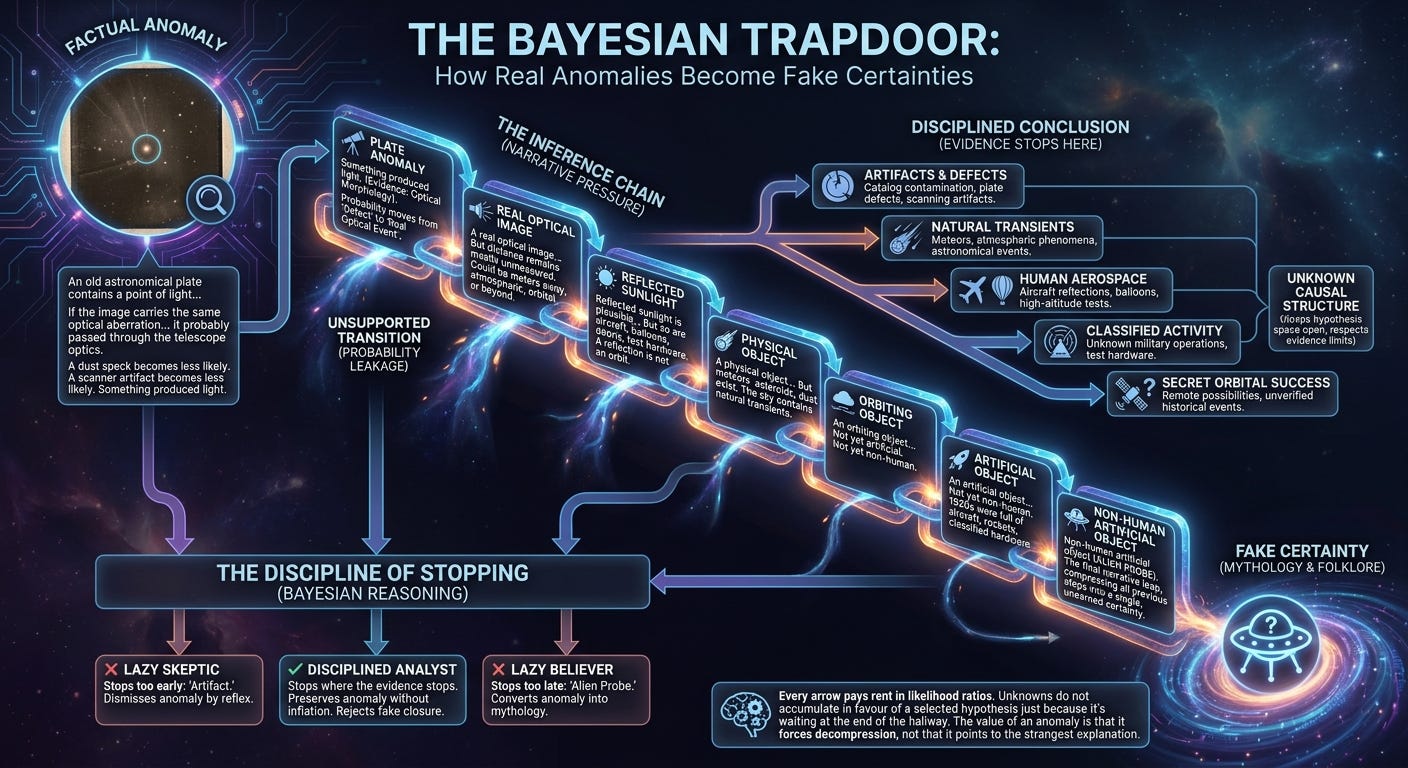
An old astronomical plate contains a point of light that should not be there. It appears in one exposure, vanishes in another, and resists the simplest explanation. If the image carries the same optical aberration as nearby stars, then it probably passed through the telescope optics. A dust speck becomes less likely. A scanner artifact becomes less likely. Something produced light.
That is the honest anomaly.
The mistake begins when “something produced light” becomes “something was in orbit.” Then “something was in orbit” becomes “something artificial was in orbit.” Then “something artificial was in orbit before Sputnik” becomes “something non-human was watching us before the space age.” Each step feels small when narrated quickly. In probability terms, each step is expensive.
A strange observation does not license the most narratively available explanation. It opens a hypothesis space. The first duty is to keep that space open long enough to see its structure.
This trapdoor is currently open in the VASCO debate over vanishing and appearing sources in old sky-survey plates. Beatriz Villarroel and collaborators have argued that some pre-Sputnik transients deserve serious attention. Busko’s recent optical-coma argument pushes against the crudest artifact explanations. Critics have pushed back with concerns about catalog contamination, plate defects, scanning artifacts, and statistical normalization. The case is live because the artifact dismissal is no longer cheap, while the exotic conclusion remains unpaid for.
Some photographic-plate transients may be real optical images rather than defects. That matters. Skeptics should not flatten every anomaly into contamination by reflex. If the image behaves like light focused by a telescope, then crude artifact dismissal has lost force.
But the surviving claim is narrow. A real optical image has not yet become a nearby object. A nearby object has not yet become an orbital object. An orbital object has not yet become artificial. An artificial object has not yet become non-human.
The chain is the claim.
The inference chain
The path from a photographic anomaly to a non-human probe contains many links:
plate anomaly → real optical image → reflected sunlight → physical object → near-Earth object → orbiting object → artificial object → non-human artificial object
The first link may be supported by optical morphology. If a transient image shows the same coma pattern as ordinary stars in the same region of the plate, then it likely shares the same imaging path. That is evidence against a class of local plate defects.
It says little about distance.
The source could be meters away, in the upper atmosphere, on a suborbital trajectory, in Earth orbit, or outside the solar system. The telescope records angular position and brightness across an exposure. Without parallax, timing, spectroscopy, or motion constraints, distance remains mostly unmeasured.
The next step asks whether the light was intrinsic or reflected. A shadow deficit would matter here. If candidate transients appear less often when they should be in Earth’s shadow, reflected sunlight becomes more plausible. But reflected sunlight also leaves the hypothesis space wide open. Aircraft reflect sunlight. Balloons reflect sunlight. So do chaff, debris, test hardware, and natural bodies. A reflection is not an orbit.
The step from reflection to object also requires care. A transient point of light might be produced by a material object, but it might also be produced by atmospheric phenomena, meteoric events, development artifacts that mimic optical morphology, or catalog-selection effects. Some of these may be ugly explanations. Ugly explanations routinely beat beautiful ones.
Then comes artificiality. A physical object in the sky can be natural. Meteors exist. Asteroids exist. Dust exists. The sky contains many sources of transient light before it contains technology.
Then comes origin. Artificiality, if established, still does not imply non-human origin. The 1950s were not the Stone Age. They were full of aircraft, balloons, rockets, missile programs, and classified aerospace hardware. Sputnik was the first successful orbital satellite known to history. It was not the first time humans put reflective objects into high-altitude and suborbital regimes.
The alien interpretation compresses all of this into a single narrative leap. The leap works psychologically because every previous step has already softened the mind. Something odd survived. Something real may be there. Something reflective may be there. Something technological may be there. By the end, “non-human probe” feels like one more possibility among peers.
It is not a peer.
Every arrow pays rent
Bayesian reasoning is not a ritual of assigning numbers to vibes. It is a discipline for stopping probability from leaking across unsupported transitions.
Abduction supplies hypotheses. Bayesian discipline prices them. “What could explain this?” is the abductive question. “Which explanation should gain how much probability from this evidence?” is the Bayesian question. UFO discourse often performs the first act and skips the second.
Suppose the coma evidence is twenty times more likely if a candidate is a real optical image than if it is a plate defect. That is a strong update. It should move probability away from crude artifact dismissal.
But if the same evidence is roughly equally likely under a meteor, an aircraft reflection, a balloon payload, rocket debris, or a non-human probe, then it has not selected among those explanations. It has only moved probability from “defect” to “real optical event.” The exotic hypothesis does not inherit the whole update.
This is the trapdoor. Evidence enters at a high-level category and exits at a favourite story.
The move usually happens without explicit fraud. It happens through ordinary narrative pressure. “The image is real” becomes “the object is real.” “The object is real” becomes “the object was there.” “The object was there” becomes “they were there.” A cautious claim about image formation gradually becomes a claim about agency.
The compression is seductive because each phrase preserves a trace of the previous one. But the reference has changed. A real image is not yet a real object at a known distance. A real object is not yet a craft. A craft is not yet non-human. Every arrow has to pay rent in likelihood ratios.
If it does not, the argument is borrowing probability it has not earned.
This matters because anomaly communities often treat unresolved links as if they are positive support. A gap becomes a passage. “We do not know how this could happen naturally” becomes “therefore the artificial explanation rises.” “The mundane explanations are messy” becomes “therefore the exotic explanation is clean.”
Unknowns do not accumulate in favour of one selected hypothesis merely because that hypothesis is waiting at the end of the hallway.
Nuclear tests and misplaced updating
The nuclear-test correlation is a useful example because it sounds more alien-friendly than it is.
If transients cluster around atmospheric nuclear tests, the popular imagination immediately supplies a story: they were watching our weapons. That story arrives preloaded from decades of UFO folklore. The correlation lands in a prepared groove.
According to Bayes, the first update should go elsewhere.
Nuclear tests were dense human operations, thick with aircraft, balloons, instrumentation, radar, classified logistics, and unusual operational tempo. Test windows were exactly the kind of periods when strange human-made things were more likely to be in the sky and strange human observational processes were more likely to be active.
A nuclear correlation therefore favours human-test-related confounding before it favours non-human monitoring. That does not make the human explanation proven. It means the likelihood ratio runs first through known causal structure.
Priors are not prejudice. They are accumulated constraint.
The mid-twentieth century contained secret military aerospace. It contained balloons, high-altitude aircraft, rockets, and atmospheric nuclear tests. It contained photographic surveys vulnerable to catalog and plate pathology. It did not contain independently verified non-human spacecraft.
An honest update respects that background.
The alien-monitoring hypothesis can receive probability only to the extent that the observed pattern is more likely under alien monitoring than under human military activity, observational bias, or dataset selection. A mere association with nuclear tests does not clear that bar. It may even cut the other way.
The issue is not just simplicity. It is causal density. Nuclear-test operations have many known routes to unusual observations and contaminated datasets. Alien monitoring has one speculative route, inherited mostly from folklore. Those are not symmetrical explanatory positions.
The discipline of stopping
A disciplined conclusion is often less satisfying than a completed story.
The right answer may be: some candidates appear to be real optical images. Some may be sunlight reflections. The current evidence does not determine distance, altitude, trajectory, or origin.
That answer feels unfinished because it is unfinished. Reality often arrives before interpretation. Evidence does not always contain enough structure to name its cause.
Stopping is an epistemic act.
The lazy skeptic stops too early: “artifact.” The lazy believer stops too late: “alien probe.” The disciplined analyst stops where the evidence stops.
That location can be uncomfortable. It preserves the anomaly without inflating it. It rejects the fake closure of dismissal and the fake closure of myth. It keeps open a set of possibilities ordered by causal plausibility.
For the pre-Sputnik transients, the live space probably looks something like this: a mixed catalog containing artifacts and some real optical events; natural astronomical or atmospheric transients; human aerospace or test-related reflectors; possibly unknown classified activity; remote possibilities involving secret orbital success; and, far below those, non-human artificial objects.
That ordering is not emotional. It follows from causal density. The world already had mechanisms for the nearer hypotheses.
What would move the needle
The alien-probe hypothesis is not forbidden. It is expensive.
The evidence that would move it would have to constrain the missing variables. Triangulation from separated observatories would matter. So would simultaneous detections from independent instruments, spectroscopy, and precise exposure timing sufficient to infer motion. A clean catalog built under blind criteria before hypothesis testing would carry weight. Independent archival recovery from unrelated surveys would carry more. Repeated geometry compatible with orbital altitude and incompatible with aircraft, balloons, meteors, and catalog artifacts would change the debate.
This may sound like an impossible standard for old plates. It is not. A clean blind reanalysis can move probability. Independent plates can move it. A consistent shadow relation can move it. But some claims require variables the plates may not encode. If distance was not measured, then distance cannot be conjured from narrative need.
A hypothesis can remain possible while lacking enough recoverable evidence to become probable.
A single old plate does not carry the full load. A statistical pattern in a contaminated archive probably does not carry it either. A real optical image on a photographic plate is evidence. It is not enough evidence for the whole journey.
This is how anomalous research should be framed. Not as a binary between debunking and revelation. As a sequence of constraints.
What did the instrument actually record?
What physical properties are directly measured?
Which hypotheses predict those properties?
Which hypotheses merely survive them?
Which hypotheses require additional unmeasured assumptions?
Where does the evidence stop?
Those questions prevent the trapdoor from opening.
Postscript
Anomalies are valuable because they break cheap models. They expose places where our compression is too aggressive. A skeptic who dismisses every anomaly as noise learns nothing. A believer who converts every anomaly into mythology also learns nothing.
The value of an anomaly is not that it points to the strangest available explanation. Its value is that it forces decompression.
A point of light on an old plate is not a proposition. It is a demand for structure. The structure may lead to a mundane cause. It may lead to an unknown natural phenomenon. It may expose defects in archival methods. It may reveal human activity that was poorly documented or intentionally hidden. In principle, it could lead somewhere stranger.
But the path must be earned.
Real anomalies become fake certainties when unresolved links are treated as bridges. The mind wants to complete the object. It wants the light to become a thing, the thing to become a machine, the machine to become an agent, and the agent to become the one already supplied by the story.
Bayesian discipline resists that completion. It lets evidence update where it actually bears and refuses to let probability flow past the measured facts.
The pre-Sputnik transients may deserve serious follow-up. They do not yet justify the alien-probe story. The evidence has moved the probability of real historical sky anomalies. It has not paid the full price from weird light to non-human machine.