

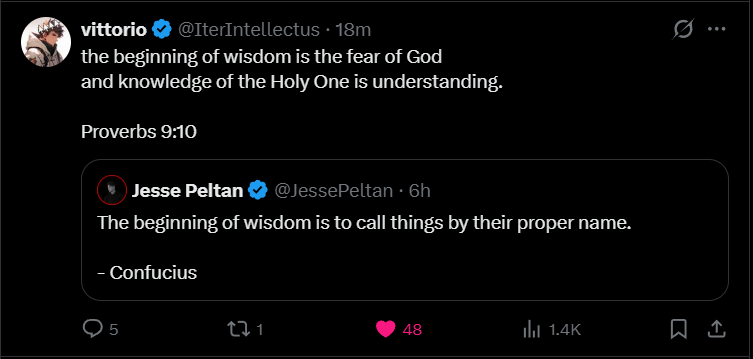
There are two ancient intuitions about wisdom that have lasted because each sees part of the truth. Proverbs locates wisdom in fear of the Lord. Confucian thought locates it in the rectification of names. One emphasizes humility before a higher order. The other emphasizes clarity in description. Each captures something essential. The root lies deeper.
Wisdom begins when an agent becomes answerable to constraint and explicit about frame.
That sentence needs care. Constraint does not refer to whatever happens to be old, powerful, or socially established. It does not confer moral legitimacy on existing arrangements. It says something more basic: the world contains structures, limits, tradeoffs, feedback loops, and consequences that do not disappear when they become inconvenient. Some belong to physics. Some belong to biology. Some arise from institutions, incentives, and coordination problems. Some arise from the limits of knowledge itself. Some arise from the fact that other agents exist and place boundaries on what can be justified. Wisdom begins when a person learns to see these clearly and to let them discipline thought.
Everything else grows from there.
Human beings spend enormous effort resisting this discipline. They do it with slogans, moral language, bureaucratic categories, prestige terminology, political narratives, and self-serving abstractions. They rename a problem and then behave as though the renaming has changed the thing itself. They discover a tradeoff and start speaking as though moral disapproval has repealed it. They encounter resistance from the world and reinterpret that resistance as mere prejudice, mere politics, mere semantics, or mere bad faith.
Sometimes the target really is contingent. Social norms and institutions are human constructions. Laws, markets, universities, currencies, and bureaucracies are not mountains or stars. Yet constructed systems generate structure of their own. Incentives harden. Path dependencies emerge. Information bottlenecks appear. Coordination failures accumulate. Corruption pressures grow. A socially constructed system can become stubbornly real in its consequences. Wisdom requires seeing contingency and structural reality at the same time.
That is why the beginning of wisdom cannot rest in reverence alone or naming alone. Wisdom starts with disciplined contact with what resists us.
The Religious Insight
The enduring value of the Biblical line lies in its psychology. A wise person does not place himself at the center of reality. Wisdom starts when self-importance loses its grip. The mind stops treating its own wishes, moral passions, and convictions as sovereign.
That is the part worth keeping.
One person expresses that insight in theological language and says wisdom begins in submission before God. Another expresses it in secular language and says wisdom begins in submission before reality. The language changes. The structure remains. In each case, the self loses its claim to final authority over what is the case.
Without that shift, intelligence becomes a very efficient machine for self-deception. It produces better camouflage, better justifications, better conceptual escape routes, better ways of laundering desire into principle. That is why intelligence and wisdom drift apart so easily. Brilliant people often become extraordinarily skilled at protecting themselves from reality. They build elegant arguments on top of motives they never inspect.
Wisdom begins earlier, at the point where self-flattery stops deciding what counts as true.
The Confucian Insight
The Confucian insight matters for a different reason. Clear speech and clear thought travel together. A society that loses the habit of accurate description loses its grip on what is happening inside its own institutions. People stop seeing who is acting, what is being done, how costs are being shifted, and which interests are being served.
This is why disputes over naming matter so much. They shape perception. They influence what can be noticed, criticized, defended, or resisted.
That said, naming has its own trap. “Proper names” always invite the question proper by whose standard. A culture can become highly disciplined about approved language while drifting away from reality. In fact, that pattern often signals ideological capture. Vocabulary grows more rigid while observation grows more dangerous.
Names therefore need correction. They do not validate themselves. The real question concerns the discipline that keeps language in contact with the world when institutions, incentives, and social coalitions are pushing it elsewhere.
A naming regime deserves trust when it continues to explain, predict, and reveal. It deserves suspicion when it mainly advertises obedience. Language can clarify reality. Language can also perform management on behalf of power. Wisdom requires separating those two functions.
What Constraint Actually Means
The word constraint covers several different kinds of things, and they need to be distinguished.
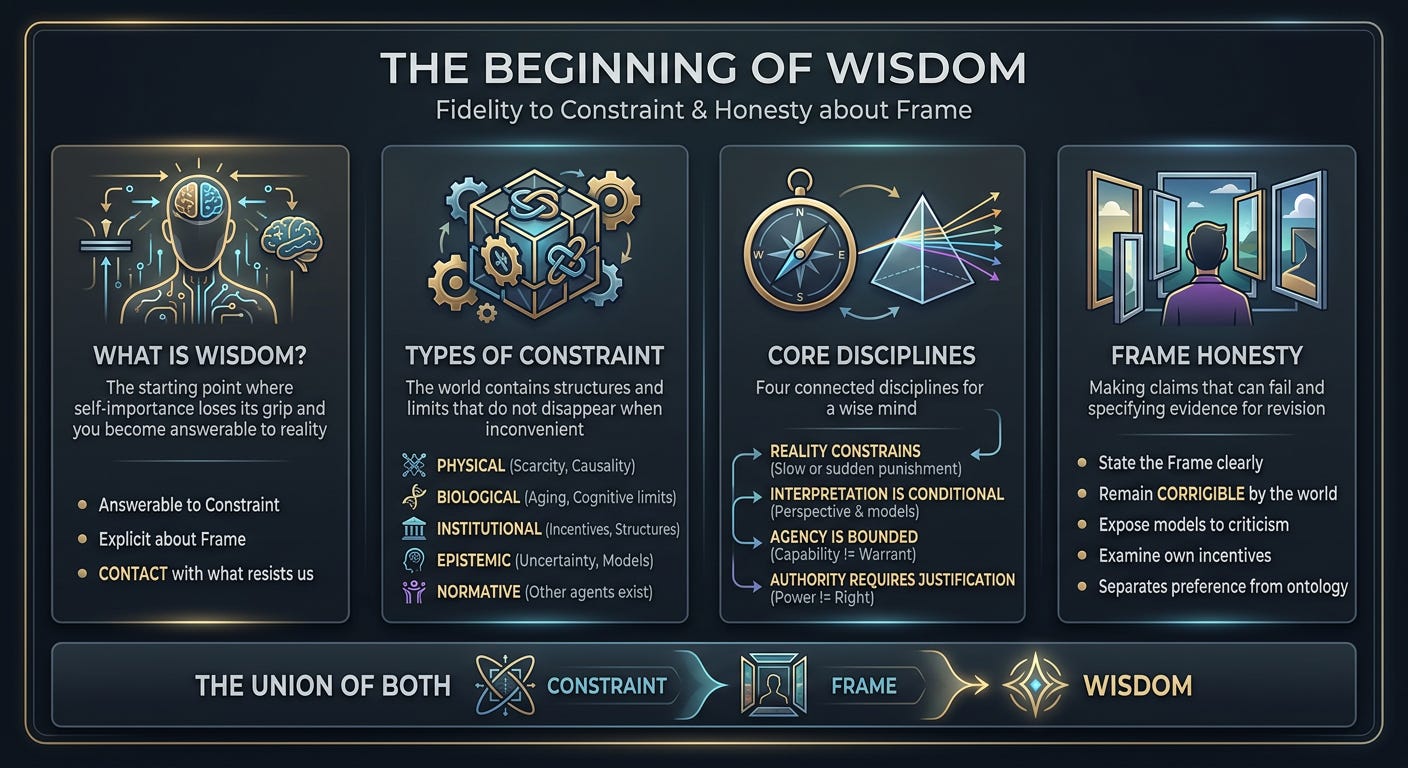
Physical constraints include scarcity, causality, time, energy, entropy, and irreversibility.
Biological constraints include embodiment, aging, reproduction, cognitive limits, temperamental variation, and the stubborn fact that organisms are not infinitely rewriteable software.
Institutional constraints include incentive structures, principal-agent failures, information asymmetries, corruption pressures, coordination problems, and path dependence.
Epistemic constraints include uncertainty, underdetermination, model dependence, measurement limits, and the partial nature of human knowledge.
Normative constraints arise once agency is taken seriously. Other agents exist. Their existence places limits on what any one person or institution can justify doing. A desirable outcome does not automatically generate jurisdiction. A solvable problem does not automatically generate warrant. A capability does not automatically generate permission.
These constraints differ in kind. That matters. Recognition comes before evaluation. A real structure can be unjust. A stable arrangement can be corrosive. A hard constraint can deserve resistance, adaptation, or replacement. Wisdom begins with clear sight. Judgment comes after clear sight.
This is also where people often make a lazy objection. Someone appeals to reality, and the immediate response invokes the “view from nowhere,” as though any acknowledgment of constraint must claim perfect objectivity. That move protects bad thinking. Human beings never reason without frames. That fact does not erase the difference between a frame that survives contact with consequences and a frame that survives only inside a sympathetic coalition. Perfect neutrality is unavailable. Honest discipline remains possible.
A serious standard asks for three things: state the frame, distinguish the kind of constraint under discussion, and remain corrigible by what the world does in response.
The Human Problem
The confusion between preference and reality is not the vice of one tribe. It is a human constant. Everyone does it. Intelligence often refines it. Moral seriousness often sanctifies it. Power often shields it from consequences. Religious people express it in sacred language. Technocrats express it in administrative language. Revolutionaries express it in historical language. Progressives express it in therapeutic language. Conservatives express it in the language of inheritance and order.
No one begins with clean access to reality.
That point sharpens the argument. Many disagreements do not separate people who believe in constraint from people who deny it. More often the disagreement concerns which constraints are treated as primary, which tradeoffs are being hidden, and which level of analysis governs the discussion.
A climate activist may understand ecological and thermodynamic constraints very well while neglecting institutional and energy-infrastructure constraints. A Marxist may focus intensely on class and material pressures while downplaying knowledge problems, incentive gradients, and coordination costs. A market liberal may see incentive structures clearly while underestimating cultural erosion, public-goods problems, or fragile trust. A nationalist may track loyalty and cohesion constraints while ignoring the economic and moral costs of exclusion.
These disagreements are serious because each side often sees something real. Folly enters when one constraint set becomes absolute and every other source of friction is reclassified as illusion, bad faith, or moral contamination. Wisdom requires a mind that can notice multiple layers of resistance without worshipping the one most flattering to its own temperament.
The Core Discipline
The framework can be stated simply.
Reality constrains.
Interpretation is conditional.
Agency is bounded.
Authority requires justification.
These are connected disciplines, not slogans.
Reality constrains. Some features of the world persist regardless of endorsement. Costs continue to exist when they are politically awkward. Systems punish delusion, sometimes slowly, sometimes all at once.
Interpretation is conditional. Every description depends on a perspective, a model, a background vocabulary, a scale, and a purpose. Wisdom grows when those conditions are brought into the open instead of smuggled out of sight.
Agency is bounded. Human beings constantly confuse capability with warrant. They assume that prediction creates jurisdiction, that expertise creates entitlement, that benevolent intention licenses intervention. Understanding a system and owning it are different things.
Authority requires justification. Public life repeatedly collapses the distinction between possessing power and possessing a rightful claim to use it. Urgency, compassion, expertise, danger, and historical necessity are regularly invoked to blur that line. Wisdom keeps it visible.
Taken together, these four disciplines produce a mind that neither floats away into relativism nor calcifies into dogma. They keep thought tied to the world while preventing the thinker from pretending to stand outside every frame.
How Frame Honesty Works
“Frame honesty” can sound noble and useless if it remains abstract. It needs a practical meaning.
Frame honesty means making claims that can fail. It means specifying what evidence would force revision. It means exposing a model to criticism from people who do not share one’s incentives. It means asking what interests a given interpretation serves, including one’s own. It means checking whether one’s favored vocabulary reveals mechanism or hides tradeoffs. It means watching domains where error is punished by the world rather than cushioned by applause. It means becoming suspicious when certainty rises in direct proportion to the social cost of dissent.
A frame that survives only inside a coalition is weak. A frame that cannot imagine disconfirming evidence is unserious. A frame that reinterprets every failure as proof of its moral superiority has crossed into theology, even when its vocabulary sounds scientific or progressive or rational.
None of this yields purity. It yields discipline. That is enough.
Where Wisdom Actually Begins
So where does wisdom begin?
Wisdom begins when a person stops letting preference legislate ontology.
That shift sounds obvious until one sees what it demands. It asks for the surrender of some of the most comfortable illusions available to the human mind. It asks a person to consider that his moral language may be camouflage, that his politics may filter his perception, that his categories may be tracking incentives he has not examined, and that his confidence may rest more on coalition reinforcement than on contact with reality.
Most people can voice these possibilities in the abstract. Few can tolerate them when identity, tribe, or status are involved. That is why wisdom is scarce.
Eloquence is easy. Sincerity is easy. Good intentions are easy. Fluency in the approved vocabulary of one’s class is easy. Wisdom is harder. Wisdom requires a mind that can be corrected by the world and that can say, out loud, which frame it is using while it looks.
That standard forbids several familiar evasions. A failing belief cannot be saved by relabeling contrary evidence. Moral fervor cannot replace mechanism. A desirable outcome does not grant immediate permission to impose it. Social enforcement of a naming regime does not settle whether the named thing has been described truthfully.
Wisdom enters when these evasions lose their glamour.
The Political Consequence
Politics gives this problem its harshest expression because politics is where language and force meet. A reality becomes inconvenient. Someone renames it. The renaming fails to resolve resistance. Speech gets regulated. Speech control proves insufficient. Conduct gets regulated. Each stage arrives wrapped in moral language designed to make domination sound like care, necessity, expertise, justice, or safety.
Coercion should not be reduced to simple epistemic weakness. Power, profit, institutional survival, strategic interest, and resource control matter a great deal. Even so, coercion often enters where persuasion, competence, truth-tracking, and voluntary alignment have failed or have been abandoned. In that sense coercion frequently functions as enforceable preference standing in for justified agreement.
The burden of justification therefore remains immense. One of the earliest warning signs of illegitimate power appears when the language required to describe what is happening has already been preemptively moralized out of public use. A society that cannot name coercion clearly will have trouble limiting it.
A wise person notices how easily the ability to enforce acquires the aura of rightful authority. He notices how linguistic capture often precedes political capture. He notices how quickly societies decay when they lose the distinction between what is real, what is desired, and what may be legitimately imposed.
The Right Formulation
The beginning of wisdom is fidelity to constraint joined to honesty about frame.
Those two disciplines belong together. Constraint keeps thought in contact with the world. Frame honesty keeps thought from mistaking its own angle of vision for reality in full. Wisdom grows from their union.
Proper naming matters because the world resists distortion. Humility matters because the self does not outrank reality. Bounded agency matters because other agents exist and because capability alone never settles legitimacy. Justified authority matters because power and right are different things.
Reality is approached through correction. A human being never transcends frame once and for all. A human being can still submit his frame to friction, evidence, criticism, and consequence.
From this point of view, wisdom begins when an agent becomes answerable to what resists him and transparent about the conditions under which he claims to know. That is the first honest moment. Truth begins there. Legitimacy begins there. Real agency begins there as well.