

We use economic words loosely because most of the time the looseness costs nothing. A rich person “has money.” A firm “raises capital.” A house “has value.” A government “prints currency.” Everyone follows the conversation.
The harm starts when these words begin carrying arguments. Then the slack in the terms becomes slack in the thinking. Confuse money with wealth and you get the fantasy that printing claims produces prosperity. Confuse capital with cash and the machinery under economic growth disappears from view. Confuse value with price and you erase everything markets price badly while also forgetting how much information a price can carry. Confuse currency with money and the particular token starts to look like the essence of the thing.
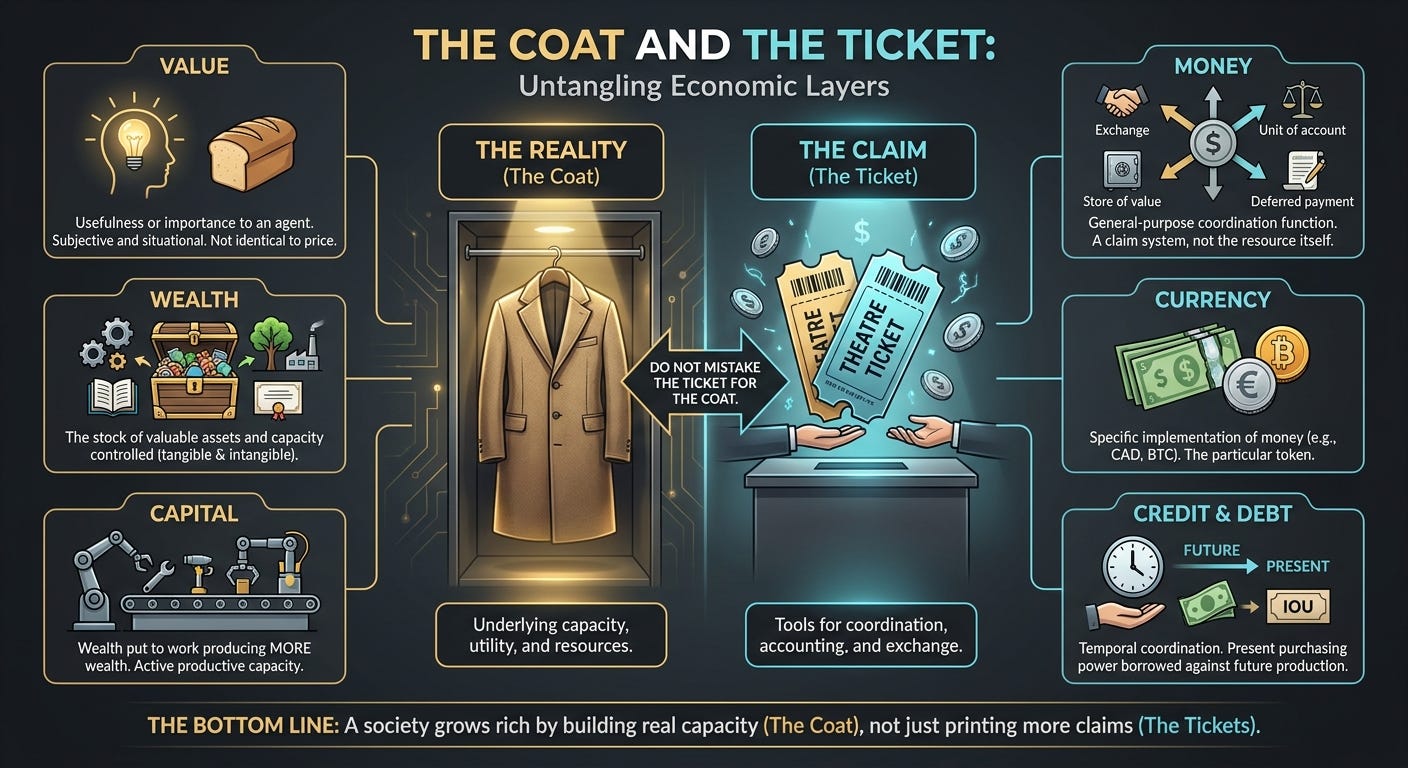
The terms name different layers. Value is the reason anyone wants the thing at all. Wealth is control over valuable things. Capital is the slice of that wealth put to work making more. Money is the layer that lets value be exchanged and counted. Currency is the particular monetary system in your pocket. Credit stretches all of it across time, and debt is the claim left behind.
Hold onto one image while we go through them, because it does most of the work. Picture a coat-check at the door of a theatre. You hand over your coat and receive a numbered ticket. The ticket is not the coat. It is a claim on a coat sitting in the back room. Nearly every confusion below is some version of mistaking the ticket for the coat.
Value
Value is the usefulness, desirability, or importance of something to some agent.
That last phrase carries the weight. Value is not a substance sealed inside an object, waiting to be measured. A vial of insulin is worth enormous amounts to a diabetic and almost nothing, directly, to someone who is not. A litre of water is nearly free beside a clean lake and nearly priceless to a lost hiker in the desert. The same object holds different value depending on the person, the moment, the alternatives at hand, and how far ahead you look.
None of which makes value imaginary. People need food, shelter, safety, tools, knowledge, status, beauty, affection. Some things satisfy those needs better than others, and the difference is real: a working generator beats a broken one during a blackout, a correct map beats a wrong one when you are lost. What value cannot be reduced to is physical substance, labour time, production cost, or market price. Each of those can influence value. None of them exhausts it. A painting is valuable because it is beautiful, or scarce, or signals taste; a reputation because it lowers the cost of dealing with you; a scientific theory because it lets you predict and bend the world; a social norm because it makes cooperation cheap.
Price is something narrower: an exchange ratio struck under particular conditions. A family photograph can have great value and no price. A fashionable token can have a high price and little lasting value. A road can generate enormous value while charging nothing at the point of use. A monopoly drug can carry a price far above its cost because the buyer’s alternative is death. Prices are real signals, and they summarize a staggering amount of distributed information about scarcity, demand, and substitution, but they are generated inside institutions. Change the property rules, the law, the available substitutes, the liquidity of the market, and the price moves while the object sits there unchanged.
Wealth
Wealth is the stock of valuable assets an agent controls, and the agent can be a person, a firm, a city, a foundation, or a nation.
Money is part of wealth. Wealth is far larger than money. Someone with $100,000 in cash and nothing else may be poorer than someone with little cash but a paid-off house, sharp skills, loyal customers, and a share of a profitable business. A country can hold weak currency reserves and still be immensely wealthy in educated people, working ports, farmland, energy systems, and legal predictability.
Most wealth never appears on a bank statement, because most of it is embodied, institutional, or relational. A surgeon’s skill is wealth held as human capital. A merchant’s good name is wealth held as reputation. A city with safe streets and reliable courts holds wealth in institutional form. A maintained codebase, a functioning supply chain, a culture of honesty — all wealth, none of it a tidy line item.
Societies destroy wealth without noticing when they watch money flows and ignore the capacities underneath. A regulation can lift measured revenue while cutting real productive capacity. Inflation can raise nominal asset prices while purchasing power rots. Crime generates brisk spending on locks, guards, and insurance, and every dollar of it is the cost of lost trust, not a sign of prosperity. Wealth, properly understood, is accumulated capacity to satisfy human purposes, and you can lose a great deal of it while the figures look fine.
Capital
Capital is wealth put to work producing more wealth, and whether something is capital depends entirely on what it is doing.
A laptop used to watch films is a consumer good; the same laptop writing software for clients is capital. A house you live in is consumption wealth; rented to tenants it is capital. Cash under the mattress is wealth and money but not capital, because it produces nothing. The same cash used to buy equipment, hire labour, or finance inventory becomes capital the moment it enters production.
This error wrecks a lot of economic argument: treating capital and money as the same thing. Money converts into capital only when there are real productive opportunities and competent people to seize them. Hand a fool a million dollars and you have created purchasing power, nothing more. Whether it becomes productive depends on judgment, institutions, incentives, and execution.
Capital comes in forms that a cash figure cannot capture. Physical capital is tools, machines, factories, data centres, power plants. Financial capital is equity, bonds, credit lines, working cash — claims that can be mobilized for production. Human capital is skill, knowledge, health, judgment. Social capital is trust, reputation, networks, credible commitments. Intellectual capital is patents, designs, algorithms, datasets, operational know-how. Institutional capital is law, standards, accounting, property records, working courts.
A modern economy runs on these in combination. A semiconductor fab is not a building full of machines. It is physical capital sitting inside human, intellectual, financial, supply-chain, and institutional capital all at once, and pull any one of them out and the machines become expensive sculpture. Capital accumulation is not really about saving money. It is the construction of productive order — the patient assembly of reliable ways to turn time, energy, matter, and coordination into things people want.
Money
Money is a general-purpose instrument that serves four jobs at once: medium of exchange, unit of account, store of value, standard of deferred payment.
As a medium of exchange, it kills the need for barter. The baker no longer has to find a shoemaker who happens to want bread at the exact moment the baker wants shoes. As a unit of account, it gives everything a common denominator, so rent, wages, steel, haircuts, and software subscriptions can be compared on one scale. As a store of value, it carries purchasing power forward in time — imperfectly, especially under inflation, but well enough to function. As a standard of deferred payment, it lets debts, salaries, and contracts be written down in advance. Pull these together and money is a coordination technology: it cuts transaction costs, makes accounting possible, enables specialization, and lets strangers cooperate without any chain of personal obligation between them.
Now the coat-check. Suppose every dollar in a country doubled overnight. The country would not wake up with twice the houses, doctors, farms, machines, or kilowatt-hours. It would have twice the tickets and exactly the same number of coats. Prices would climb, relative prices would lurch, some people would gain and others lose as the new tickets worked through the system, and real wealth would not have moved at all. Printing claims cannot conjure coats out of the back room.
There is one genuine exception, and it matters. If coats are sitting unclaimed because the cloakroom has seized up — because demand has collapsed, credit has frozen, or panic has people hoarding tickets — then issuing more spendable claims can bring idle labour, unused machines, and stalled supply chains back into use. The new money did not create the workers or the materials. It changed the conditions under which existing resources get mobilized. So the diagnostic question is always: what is actually binding? If the constraint is demand or a jammed credit system, monetary expansion helps. If the constraint is real capacity — energy, labour, physical plant — the new claims merely bid against the same fixed stock of goods, and you get distortion dressed up as growth.
Money can mobilize real resources. It is not the resource base. It is a claim system laid over goods, labour, energy, knowledge, and institutions, and its power comes from coordination, not magic. Good money improves that coordination. Bad money corrupts it: when money loses value unpredictably, long contracts get harder, saving gets riskier, accounting gets noisier, and people burn effort escaping monetary distortion instead of producing anything. Money touches everything because exchange touches everything, but it touches them as a claim, never as the thing claimed.
Currency
Currency is a particular implementation of money.
The Canadian dollar, the euro, the yen, the Swiss franc, bitcoin — each is a monetary system with its own units, issuance rules, settlement mechanics, and expectations about who will accept it. The relationship is the one between language and English. Language is the general phenomenon; English is one instance of it. Money is the general role; the Canadian dollar is one currency filling it. Banknotes and coins are currency in the narrow sense. Bank deposits are money denominated in a currency without being physical currency. Central-bank reserves are another layer again, and stablecoins or payment balances behave like money under some conditions while leaning on collateral, redemption promises, or network acceptance underneath.
Currency is concrete; money is functional. And a currency can do money’s four jobs well or badly. It can be liquid or illiquid, stable or volatile, widely accepted or parochial, inflationary or deflationary, cheap or expensive to settle. It succeeds or fails on monetary properties: acceptability, liquidity, stability, divisibility, portability, durability, settlement assurance, governance credibility. State currencies start with heavy advantages — legal privilege, tax backing, banking integration, deep network effects. Non-state currencies have to earn adoption the hard way, through portability, scarcity, neutrality, settlement finality, or resistance to seizure.
Credit and debt
Separate money from currency and the next complication arrives: time.
People picture money as tokens already sitting somewhere — coins, balances, reserves. That picture misses where most spendable money actually comes from. In a modern economy, most of it is created when a bank extends credit. The loan brings a deposit into existence for the borrower and a debt owed back to the bank. The borrower gets present purchasing power; the bank gets a claim on future payment. In coat-check terms, credit issues a ticket for a coat that has not arrived yet but is expected later this evening.
This is neither a trick nor a fraud. Used well, credit lets people build capital before they have saved its full price. A mortgage buys a house over time. A business loan buys machines, or carries inventory across the gap between production and payment. A bond finances long-lived infrastructure out of future revenue. Credit becomes dangerous at a specific point: when claims on the future grow faster than the future’s capacity to honour them. Then debt stops funding capital and starts funding consumption, speculation, or political evasion, and the books still balance — assets here, liabilities there — while the real question goes unasked. Does the debt correspond to productive capacity that can service it?
A loan that builds a profitable factory creates debt and capital together. A loan that bids up the price of existing land creates debt and a higher number with no new productive capacity behind it. A loan covering operating losses buys time, and time is worth something only if the underlying problem can be fixed. Debt is a claim on future money; future money is a claim on future goods and services; the chain terminates, always, in real production. One party’s financial asset is another’s liability, which is why debt can never be counted as net wealth without looking at the whole balance sheet. Credit is temporal coordination — the present borrowing against a plausible future. The danger is treating a politically convenient future as a plausible one.
The bakery
Make it concrete. You own a bakery.
The ovens, recipes, delivery van, brand, customer list, skilled staff, supplier relationships, and bread all have value. Your ownership of them is wealth. The ovens, van, staff skill, and working cash used to produce and sell bread are capital. The dollars in the till are money, and they happen to be denominated in a particular currency, the Canadian dollar.
Borrow from a bank for a second oven and the loan creates a debt while handing you present purchasing power. If the oven lets you bake more bread profitably, the debt financed capital formation. If it merely covers inflated rent on the same storefront, you have taken on debt without adding any productive capacity. As for the bread: it has value because people want to eat it; held for sale it is inventory, and in the business it is circulating capital, part of the produce-and-sell cycle. Carry a loaf home and eat it and it stops being capital and becomes consumption. The same object slides between categories as its role changes. This is the lesson the physical objects can never tell you on their own. A van, a building, a computer, a pile of cash — none is inherently capital. They become capital only when organized into production.
Mistaking the ticket for the coat
The most dangerous confusion of all is money for wealth — the ticket for the coat.
Money is a claim-like coordination instrument. Wealth is the underlying stock of valuable capacity. A society can grow its money faster than its wealth, its credit faster than its productive assets, its financial claims faster than its real usefulness. It can even grow GDP through defensive spending while quality of life degrades. Nominal prosperity can drift a long way from the real thing.
Housing shows it cleanly. If home prices rise because houses are better, more abundant, or better located, that can be genuine wealth creation. If they rise because zoning chokes supply while credit expands, owners feel richer while the society is not — younger buyers face higher walls, mobility falls, household formation slips, labour markets stiffen. The price signal announces “wealth,” but a chunk of what happened is artificial scarcity capitalized into an asset value. The same pattern recurs across healthcare, education, and finance: more money flowing through, more claims generated, more intermediaries paid, and the question that actually matters is whether real value rose or whether the cost of reaching value simply went up. Wealth creation enlarges the stock of valuable capacity. Value extraction captures purchasing power by controlling access, manipulating scarcity, or sitting on a choke point. Both throw off income. Both can post high valuations. Only one leaves society richer.
Capital and time
Capital is wealth pointed at the future. To build it is to defer consumption now for productive power later, and that far more often means building tools, learning skills, writing code, or earning trust than it means setting money aside.
A child learning mathematics is accumulating human capital. A team documenting its systems is accumulating organizational capital. A city maintaining its water mains is preserving capital that will not show up as this year’s revenue. Short-term accounting misses capital formation in both directions. A firm can lift quarterly profit by under-maintaining equipment, burning out staff, cutting research, and postponing security work — the income statement improves while the firm quietly eats its seed corn. The reverse hides too: a firm can look less profitable precisely because it is training people, refactoring software, and building customer trust, booking as cost what is really investment. The test is simple: does it increase future productive capacity?
Price, value, and judgment
Price is one of the most powerful information systems our species has ever produced, and it still cannot substitute for judgment.
Prices compress local knowledge that no one person holds. They tell producers where demand is rising, where inputs are scarce, where substitution is possible, where expectations are turning. This is the real reason central planning fails to replace them: the planner would have to reconstruct by hand an immense distributed computation that markets run continuously through bids, offers, profits, and losses. But prices are generated inside rules — property rights, taxes, subsidies, prohibitions, monetary conditions, bargaining power — so a price can be informative and distorted in the very same number. Price worship and price contempt make the identical mistake from opposite ends. The useful question is what a given price measures, which rules produced it, and what it leaves out.
A wage carries the same ambiguity. It is the price of labour under specific bargaining conditions, credentialing rules, immigration rules, and available alternatives. A low wage may reveal low productivity, or a weak bargaining position, or regulatory exclusion from better options, and telling these apart takes context the number alone won’t give you. Refusing to price something does not preserve its value; it usually drives tradeoffs underground, where allocation still happens through queues, favouritism, rationing, decay, or force. Abolish prices and valuation does not disappear. It moves into less explicit and less accountable forms.
Measuring wealth
Define wealth as control over valuable capacity and a measurement problem lands immediately. A hospital, a forest, a codebase, a port, a patent, and a skilled workforce cannot be added together directly; accounting needs a common unit, and money is the only serious one we have for large-scale calculation. Using prices to measure wealth, though, does not make wealth identical to price.
Every valuation smuggles in assumptions — property rights, discount rates, legal stability, expected demand, replacement cost, regulatory risk. Shift those and the measured wealth shifts while the object sits there physically unchanged. This is not a flaw to be engineered away by finding the perfect number. It is what measuring purposive usefulness under uncertainty actually is. A dataset makes the point: the same file can be useless noise, a training corpus, a scientific instrument, a privacy liability, or the foundation of a new product, depending on its accuracy, legality, exclusivity, and the competence of whoever holds it. Inert until it is dropped into the right model or workflow — at which point it becomes capital. So prices are indispensable and incomplete at once. Serious analysis treats a monetary valuation as a useful compression of value and then asks what the compression threw away. We measure wealth in money because we need a common unit. The unit is the ruler, not the length.
Money, trust, and institutions
Money runs on trust, but not always the same kind. Commodity money trusts the commodity’s properties — durability, scarcity, recognizability. Fiat money trusts the issuing state, the central bank, the tax system, the legal order. Bank deposits trust banks, deposit insurance, and convertibility. Bitcoin trusts cryptography, software, network consensus, and the incentives securing it. No monetary system is trustless in any absolute sense; the real questions are where the trust sits, how far it can be minimized, how it fails, and who is positioned to abuse it.
A currency is therefore half technology and half institution. It has technical properties, but it also lives inside expectations, laws, payment rails, tax rules, and habits, which is why monetary transitions are so hard. A better asset does not automatically become better money. It has to overcome network effects, liquidity constraints, unit-of-account inertia, and the sheer convenience of the incumbent. Money is coordination, and coordination is sticky.
Postscript
These distinctions earn their keep because arguments smuggle conclusions through the blurry words.
“The rich have all the money” usually means wealthy people own a large share of assets — equity, real estate, businesses, claims on future income — which is a very different statement from saying they sit on the cash, and it implies different things for how taxing or redistributing or inflating those assets would actually play out. “We need more capital” often means firms need financing, but if the true bottleneck is skilled labour, energy, permits, or trust, more financing just bids up the scarce input; money can fund capital formation, but it cannot stand in for every missing form of capital. “This creates value” demands the follow-up: for whom, over what horizon, against what alternative? A casino creates value for some customers and income for its staff and may destroy value for addicts and their families, and pointing at the revenue settles none of it. “Currency debasement creates wealth effects” needs dissection: asset holders gain in nominal terms, debtors benefit, savers lose, investment signals distort, and whether the society gained any real productive capacity is a separate question entirely. A wealth effect is not wealth creation.
Good analysis keeps the layers apart. An apparent gain may be a gain in real value, a transfer of existing wealth, a conversion of wealth into capital, an increase in monetary claims, an expansion of credit, or a change in currency denomination. Those are different events with different consequences.
Collapse them all into “money” and the same errors recur: claims get mistaken for resources, prices for value, spending for investment, liquidity for capital, nominal gains for real wealth. The ticket gets mistaken for the coat.
A civilization grows rich by producing and preserving valuable capacity: knowledge, tools, energy, infrastructure, health, beauty, trust, competence, and institutions that let strangers cooperate. Money, currency, credit, capital, and wealth matter because each participates in that process at a different level.