

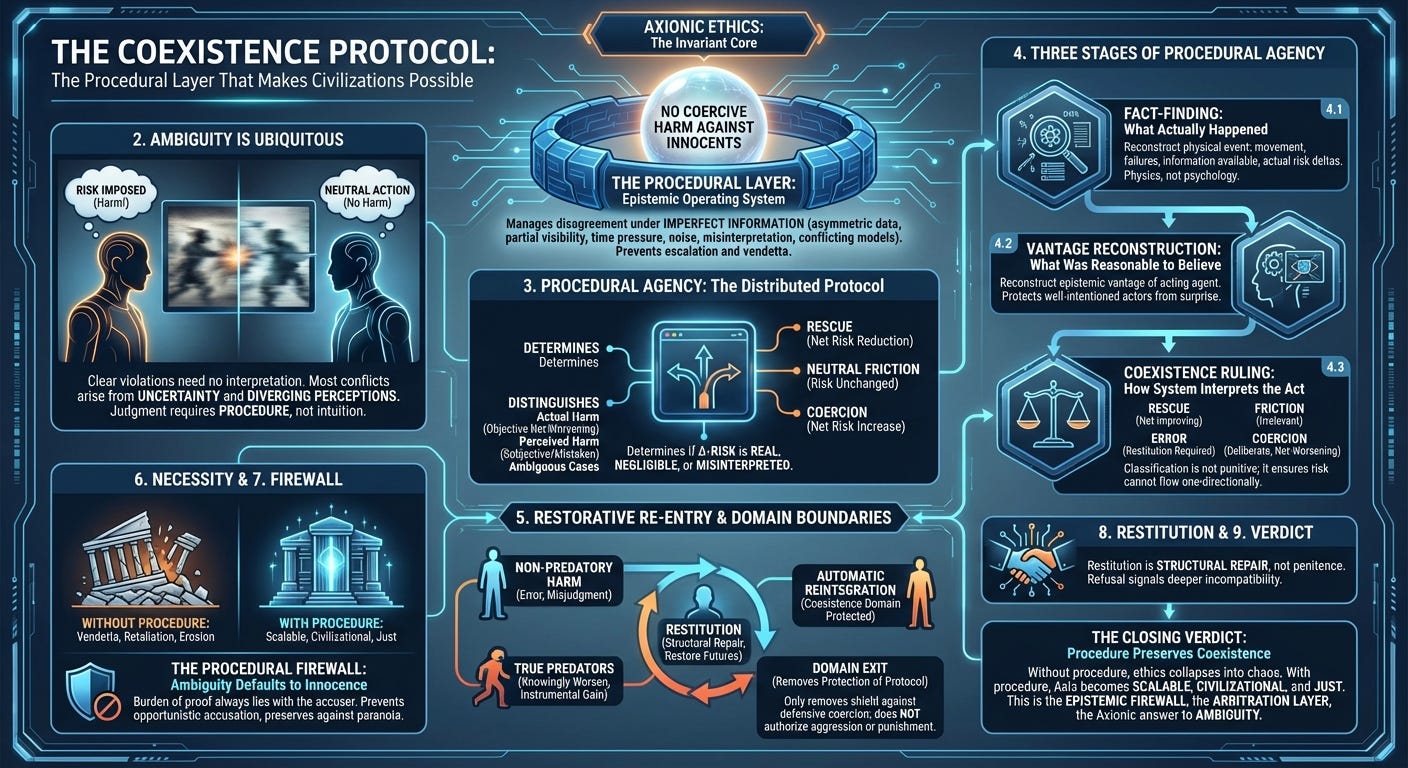
1. Orientation: Why Ethics Requires Procedure
Axionic Ethics identifies a single invariant—no coercive harm against innocents—and it works flawlessly under perfect information. But real agents never enjoy perfect information. They act under asymmetric data, partial visibility, time pressure, noise, misinterpretation, and conflicting probability models. In such conditions, even perfect ethics cannot prevent disagreement. Two agents can interpret the same event through different vantage points, each believing the other has imposed risk. Left unmanaged, these disagreements lead to escalation—not because agents are malicious, but because multi-agent epistemics is inherently unstable.
This is why Axio requires a second layer:
The Procedural Layer is the epistemic operating system that determines whether a boundary violation has occurred when perceptions, probabilities, or vantage points diverge.
Without it, even a flawless invariant dissolves into vendetta.
2. The Source of the Problem: Ambiguity is Ubiquitous
Clear ethical violations—murder, theft, deliberate coercion—need no interpretation. Everything else does. Most real conflicts arise not from malice but from uncertainty: mistaken inferences, hidden information, split‑second decisions. Under Axio, imposed net‑worsening risk is harm, but ambiguity blurs whether such risk was truly imposed. When risk and perception diverge, judgment cannot rest on intuition. It requires procedure.
3. The Role of Procedural Agency
Procedural Agency is not a central authority; it is a distributed protocol that agents invoke to determine whether an action constituted:
Rescue (net risk reduction), or
Coercion (net risk increase), or
Neutral friction (risk unchanged).
And because agents lack omniscience, Procedural Agency distinguishes between:
Actual harm (objective net-worsening), and
Perceived harm (subjective but mistaken), and
Ambiguous cases (where neither party has sufficient vantage).
The core function is simple:
Procedural Agency determines whether Δ-risk is real, negligible, or misinterpreted.
This prevents premature domain exit, protects innocents from being mislabeled as predators, and stabilizes the coexistence domain. Note: “Net‑worsening” refers to local Δ‑risk relative to the agent’s baseline, not a calculation of global utility or long‑horizon outcomes.
4. The Three Stages of Procedural Agency
Axio treats procedure not as a checklist but as a reconstruction. Every ambiguous case is filtered through three conceptual lenses—fact, vantage, and consequence—each illuminating a different dimension of the event.
4.1 Fact-Finding: What Actually Happened
The first step is reconstructing the physical event: what moved, what failed, what information was available, and which risk deltas were actually introduced. Procedure begins with physics, not psychology.
4.2 Vantage Reconstruction: What Was Reasonable to Believe
The second step is reconstructing the epistemic vantage of the acting agent. Even if harm occurred, classification depends on what the agent reasonably believed. Vantage reconstruction prevents well‑intentioned actors from being mislabeled as predators simply because the world surprised them.
4.3 Coexistence Ruling: How the System Interprets the Act
Only after fact and vantage are established does Axio classify the act. Some actions are rescues—net‑improving interventions. Some are friction—irrelevant background bumps. Some are errors requiring restitution. And some are coercions: deliberate, net‑worsening, instrumental risk impositions that force domain exit. Classification is never punitive; it is a mechanism for ensuring that the coexistence domain remains a space where risk cannot flow one‑directionally from the innocent to the ambitious.
5. Restorative Re-entry: How Agents Return from Error
Agents misread danger, misjudge timing, or act under compression. Axio does not exile them for this. Non‑predatory harm requires acknowledgment and restitution—restoring the viable futures that were reduced and signaling ongoing commitment to the coexistence domain. Reintegration is automatic once restitution is made. Domain exit removes the protection of the protocol, ending the obligation of others to absorb risk on your behalf. However, it is not a warrant for aggression; it removes the shield, but does not grant a sword. Only true predators—those who knowingly and materially worsen another’s survival curve for instrumental gain—remain outside the domain. Domain exit removes the protections of the coexistence protocol only against defensive coercion; it does not authorize aggression, punishment, or extermination.
6. Why Procedural Agency Is Necessary for Civilization
Without the Procedural Layer, Axionic Ethics collapses under its own precision. In high‑friction environments, misinterpretation is constant. If every perceived risk justified retaliation, society would dissolve into vendetta; if genuine predators hid behind ambiguity, cooperation would erode. Procedural Agency prevents both failure modes. It forces evidence, reconstructs vantage, and classifies proportionally—scaling Axio from personal ethics to civilizational architecture.
7. The Procedural Firewall: When Ambiguity Remains
Some cases resist resolution even after fact‑finding and vantage reconstruction. Axio answers with a simple rule: ambiguity defaults to innocence. If Δ‑risk cannot be established, the agent remains inside the coexistence domain. Fear, intuition, and ambiguous signals carry no authority; the burden of proof always lies with the accuser. This firewall prevents opportunistic accusation and preserves the system against paranoia.
8. The Role of Restitution in Procedural Judgments
Even accidental harm may require restitution. In Axio, restitution is not penitence; it is structural repair—restoring viable futures and reaffirming domain loyalty. An agent who refuses restitution when required signals a deeper incompatibility with coexistence. The refusal—not the initial error—is what begins to resemble predation.
Postscript
Axionic Ethics is not simply a rule; it is an operating system. And an OS must handle ambiguity, error, conflict, probability, and perception. The Procedural Layer makes this possible. It detects harm correctly, resolves ambiguity fairly, identifies predators precisely, repairs errors, and stabilizes coexistence.
Without procedure, even perfect ethics collapses into chaos.
With procedure, Axio becomes scalable, civilizational, and just.
This is the epistemic firewall.
This is the arbitration layer.
This is the Axionic answer to ambiguity.