

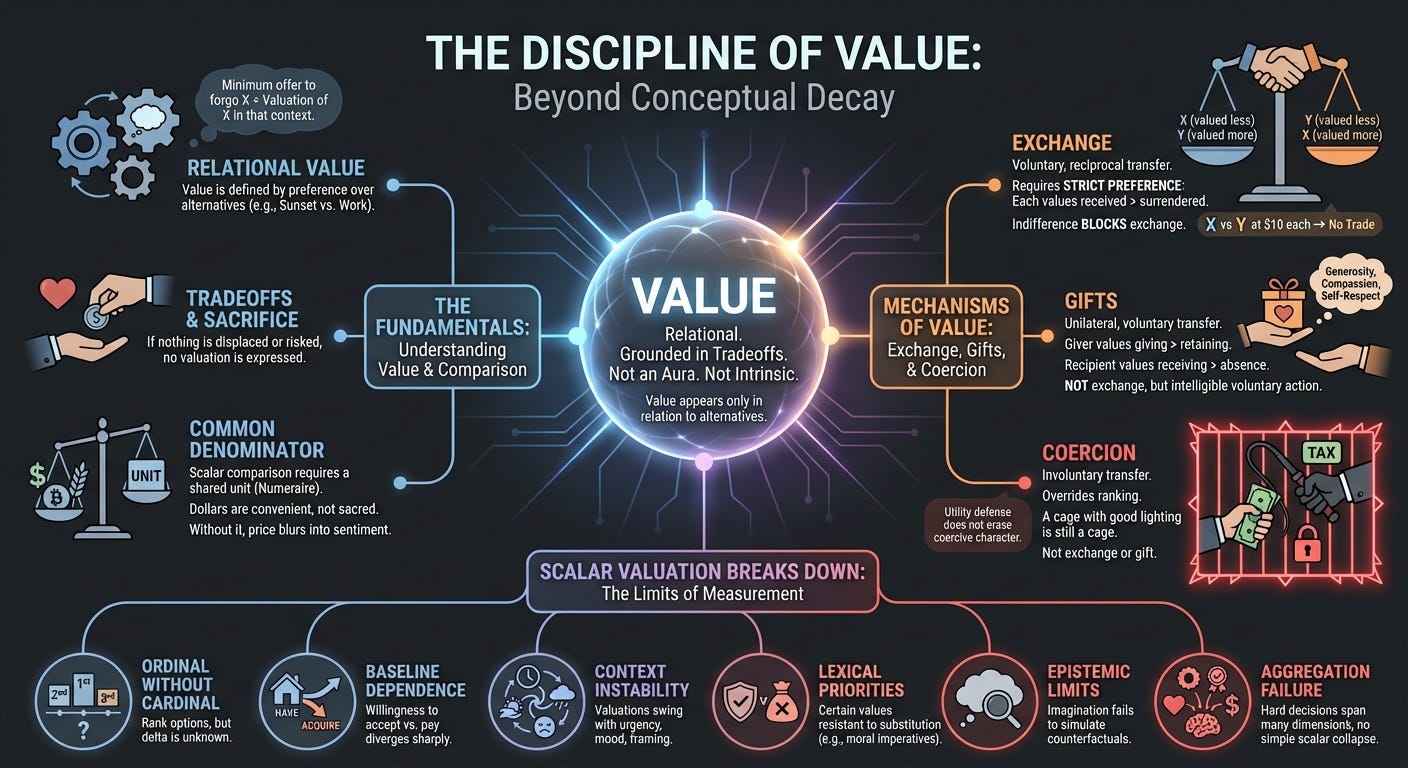
There is a familiar kind of conceptual decay in discussions of economics, ethics, and politics. A person begins with one meaning of value, shifts midway into another, and then treats the resulting confusion as insight. Usually nothing profound has occurred. The metric changed. The language blurred. The argument quietly cheated.
I want to fix the frame and keep it fixed.
My claim is simple. Value is relational. It is grounded in tradeoffs. To value something is to prefer it to alternatives one must forego. If nothing is sacrificed, displaced, renounced, or risked, then no valuation has been expressed. And if one wishes to compare values quantitatively, one needs a common denominator.
Dollars are the most convenient denominator in a monetary economy, though they are not metaphysically privileged. Gold, wheat, labor-hours, or bitcoin could serve as numeraires in principle. The point is not that money is sacred. The point is that scalar comparison requires a shared unit. Without that discipline, people slide from price to sentiment, from exchange value to moral importance, from cost to significance, and then pretend they are still talking about the same thing. They are not.
Once this much is kept clear, a great deal of nonsense dies on contact.
Value Is Not an Aura
Things do not contain little packets of value. Experiences do not glow with intrinsic price tags. Value is not an occult mist clinging to objects.
Value appears only in relation to alternatives.
A sunset has value even if there is no literal market for sunsets, because watching it has an opportunity cost. Time spent watching the sunset is time not spent doing something else. Attention allocated to beauty is attention withheld from work, sleep, reading, travel, conversation, or distraction.
So a coherent question can be asked:
What is the minimum amount of money someone would have to offer me to make me forgo the sunset?
That question can produce a monetary valuation of the sunset experience to me in that context.
But here a clarification matters. The existence of a tradeoff does not guarantee a unique, stable, canonical scalar price. Sometimes a tradeoff can be embedded in a numeraire cleanly. Sometimes it cannot. Sometimes the answer depends on whether the experience is framed as something I already have and must surrender, or something I must pay to acquire. Sometimes the answer varies wildly with context, mood, baseline, identity, taboo, or time horizon.
So the right claim is narrower and stronger:
All value is grounded in tradeoffs, but not all tradeoffs admit a unique, stable scalar embedding in a common denominator.
That is the discipline worth preserving.
Why a Common Denominator Matters
If all you want is ordinal ranking, you can say that A is preferred to B. Fine. But the moment you want to compare magnitudes, you need a unit.
That is what a numeraire does.
It lets us say that this book is worth $10, that apple is worth $10, this delay is not worth paying $20 to avoid, and that inconvenience would require at least $100 in compensation to endure.
Once the denominator is fixed, equal valuation means equal value in that framework. If X is valued at $10 and Y is valued at $10, then X and Y have the same value relative to that numeraire. That is not a deep theorem. It is simply what the statement means.
This point matters because people routinely concede it for one sentence and violate it in the next. They admit that two things have equal dollar value, then immediately insist that one is “really” more valuable because it matters more, feels different, carries deeper significance, or occupies a nobler place in some emotional hierarchy. Perhaps it does. But then the subject has changed. One is no longer talking about value in the original denominator.
That move is illicit unless explicitly declared.
Exchange Requires Asymmetry of Valuation
Voluntary exchange occurs only when each party values what he receives more than what he gives up.
That is the mechanism. Not mystery. Not sentiment. Not semantic perfume.
If I trade X for Y, I do so because I value Y more than X.
If you trade Y for X, you do so because you value X more than Y.
If both of us value what we receive exactly as much as what we surrender, then we are indifferent. In that case there is no motive to exchange.
This point is routinely muddled. People say that exchange happens because two goods have “the same value.” But equal value in a common denominator does not generate exchange. Indifference blocks exchange. Trade requires a strict preference: each side must rank the received item above the surrendered one.
So let the point be stated plainly.
If I have X and you value X at $10, and you have Y and I value Y at $10, then at that margin we are indifferent. There is no reason to exchange.
Exchange becomes possible only if I value Y at more than what I assign to X, and you value X at more than what you assign to Y.
That is the whole secret. It is not hidden. It is merely neglected.
Equal Value Does Not Generate Gain
Saying that two items have equal value in a common denominator does not imply that they are identical objects, identical experiences, or socially interchangeable. It means only that they have equal value in the chosen unit.
That alone is not enough to motivate exchange.
To motivate exchange, the comparative valuations must diverge at the level of surrender versus receipt. If they do not, the trade is inert. If they do, then exchange becomes possible.
The discipline here is simple: keep the denominator fixed and state the preference ordering honestly. Most muddle vanishes when that is done.
Gifts Are Not Exchange
A major conceptual mistake is to force all voluntary action into the category of exchange. That temptation should be resisted.
Exchange is reciprocal transfer between agents.
A gift is unilateral transfer.
These are not the same thing.
A gift is not an exchange merely because the giver prefers giving to not giving. Conflating the two weakens both concepts.
But the fact that a gift is not an exchange does not make it irrational or economically unintelligible. A voluntary gift still expresses valuation.
If I give $10 to a beggar, then I must value the resulting state of affairs more than retaining the $10. Otherwise I would not give it. I may value helping, generosity, compassion, solidarity, self-respect, fidelity to conscience, relief of guilt, or the simple fact of having acted as the sort of person I wish to be.
The recipient, meanwhile, values receiving the $10 more than not receiving it.
So the structure is not reciprocal exchange, but it is still grounded in tradeoffs.
The giver gives because the act or resulting state is worth more to him than the money surrendered.
The recipient receives because the money is worth more to him than its absence.
No new cash is created. No metaphysical surplus descends from heaven. Yet the action can still increase value in the ordinary sense that both parties end up in states they rank more highly than the available alternatives.
That is not exchange. It is voluntary transfer. The distinction matters.
Charity Is Not “Money for Nothing”
People sometimes describe charity as a pure zero-sum transfer. That is true only in a narrow accounting sense.
If one looks only at cash balances, then yes: the donor is down $10 and the recipient is up $10. Total cash is unchanged.
But that description is incomplete. It captures the money leg and ignores the act. The donor did not hand over $10 for nothing. The donor preferred giving to keeping. That preference is not a decorative afterthought. It is the entire reason the gift occurred.
So charity should not be misclassified as exchange, but neither should it be treated as economically unintelligible self-erasure. It is voluntary action chosen because the resulting state is valued more than the available alternative.
That is enough.
Coercion Is Structurally Different
A coerced transfer is different because it does not express the surrendering agent’s ranking of alternatives. It overrides it.
If I am forced to give up $10, the transfer may still produce downstream benefits. It may fund a road. It may support some public good. It may even satisfy a higher-order preference I hold under a broader social model. None of that changes the local structure of the act. The surrender itself is not voluntary.
So coercion remains coercion even when someone later constructs an argument for its instrumental benefits.
This matters because one of the laziest tricks in political argument is to redescribe coercion as though its alleged utility erases its character. It does not. A cage with good lighting is still a cage.
To say that coercion can sometimes be defended on consequential grounds is one thing. To pretend that it is therefore not coercion is dishonest.
Where Scalar Valuation Breaks Down
This is the point at which people often become either mystical or glib. Both reactions are useless.
Some tradeoffs do not yield clean scalar measures, and there are several distinct reasons why.
Ordinal Without Cardinal
Sometimes one can rank options without being able to say by how much. I may know that I would rather attend my mother’s funeral than a job interview, but that does not mean I can produce a stable and meaningful dollar delta between them.
Baseline Dependence
Willingness to accept compensation for giving something up often diverges sharply from willingness to pay to acquire it. That means the scalar representation depends on whether the good is treated as already possessed or not. There may be no unique number that deserves to be called the value.
Context Instability
Some valuations swing dramatically with urgency, fatigue, wealth, mood, framing, or time pressure. A number can be produced, but it may be too unstable to carry much theoretical weight.
Lexical Priorities
Sometimes an agent treats one class of consideration as resistant to substitution by another, at least within ordinary ranges. “I will not kill an innocent person for money” is not well modeled as a smooth exchange function.
Epistemic Limits
Sometimes the problem is not principle but imagination. People may be unable to simulate the counterfactual clearly enough to assign any meaningful scalar at all.
Social or Moral Deformation
Some choices can be ranked but are corrupted by explicit monetization. A mother’s funeral, a wedding vow, a vote, or testimony under oath may involve real tradeoffs while resisting price-tag treatment because the injection of a numeraire deforms the social meaning of the act.
Aggregation Failure
Many hard decisions span multiple dimensions with no justified compression rule: money, status, beauty, safety, autonomy, meaning, loyalty, legitimacy, identity. Each dimension may be somewhat intelligible. The problem is the final collapse into one scalar. Too often that collapse is theater masquerading as rigor.
So the correct conclusion is not that such tradeoffs are unreal. It is that scalar representation is often partial, local, unstable, taboo-laden, or non-unique.
A Cleaner Taxonomy
Once these distinctions are kept straight, we can say something more precise about the basic ways value and wealth enter the world.
Production creates new goods, services, capacities, or opportunities.
Exchange rearranges holdings through reciprocal voluntary transfer so that each party receives something more highly valued than what he gives up.
Gifts rearrange holdings through unilateral voluntary transfer because the giver values the resulting state more than retention.
Coercion rearranges holdings without the voluntary endorsement of at least one party, whatever later justifications may be offered.
These are not the same phenomenon. Treating them as interchangeable guarantees confusion.
Wealth and the Arrangement of Value
What, then, of wealth creation?
If by wealth one means cash balances, then a gift does not create new cash.
If by wealth one means physical stock, then a gift does not create new physical goods.
If by wealth one means the arrangement of resources, acts, and opportunities into forms more highly valued by the agents involved, then voluntary exchange and voluntary giving can both increase wealth in that broader sense.
This is not because value was smuggled in under a second hidden metric. It is because the relevant valuations were there from the start, expressed in tradeoffs and made legible through a common denominator where possible.
The key is to avoid equivocation.
If the metric is dollar value, keep it dollar value.
If the metric is moral ranking, say so.
If the metric is reservation price, state it explicitly.
If the metric changes, announce the change instead of sliding across it like a bureaucrat laundering coercion into benevolence.
The Real Discipline
The lesson here is not that all disputes about value are fake. Far from it. Political and moral disagreements remain real, deep, and often intractable. Questions of justice, power, coercion, legitimacy, and institutional design do not dissolve merely because one clarifies a few terms.
But a great deal of confusion does dissolve.
And confusion is not innocent. Confusion is one of the oldest refuges of bad theory and bad politics. It allows people to conflate transfer with production, coercion with consent, sentiment with value, equal denomination with motive for exchange, and local price with universal ranking. Once the language blurs, the reasoning follows it into the swamp.
So keep the frame fixed.
Value is relational.
Value is grounded in tradeoffs.
Scalar comparison requires a common denominator.
Not all tradeoffs admit a unique, stable scalar embedding.
Equal valuation in a given denominator means equal value in that framework.
Exchange requires each party to value what he receives more than what he gives up.
A gift is not an exchange, but it is still intelligible as voluntary action expressing a preference ordering.
Coercion remains coercion even when decorated with utilitarian excuses.
That is not the whole truth about economics or ethics. It is something better than that. It is a refusal to lie about the terms of the argument.