

AI has revived an old argument against capitalism. Firms compete for advantage, competition drives them to develop new productive technologies, and those technologies destroy jobs, institutions, cultural forms, and settled ways of life. AI is the latest instance and possibly the most severe.
The argument has gained force because the people making it now include market advocates. When longtime defenders of competitive order begin to worry that AI could destabilize society or end it, the critics can reasonably ask whether they understood something the defenders missed.
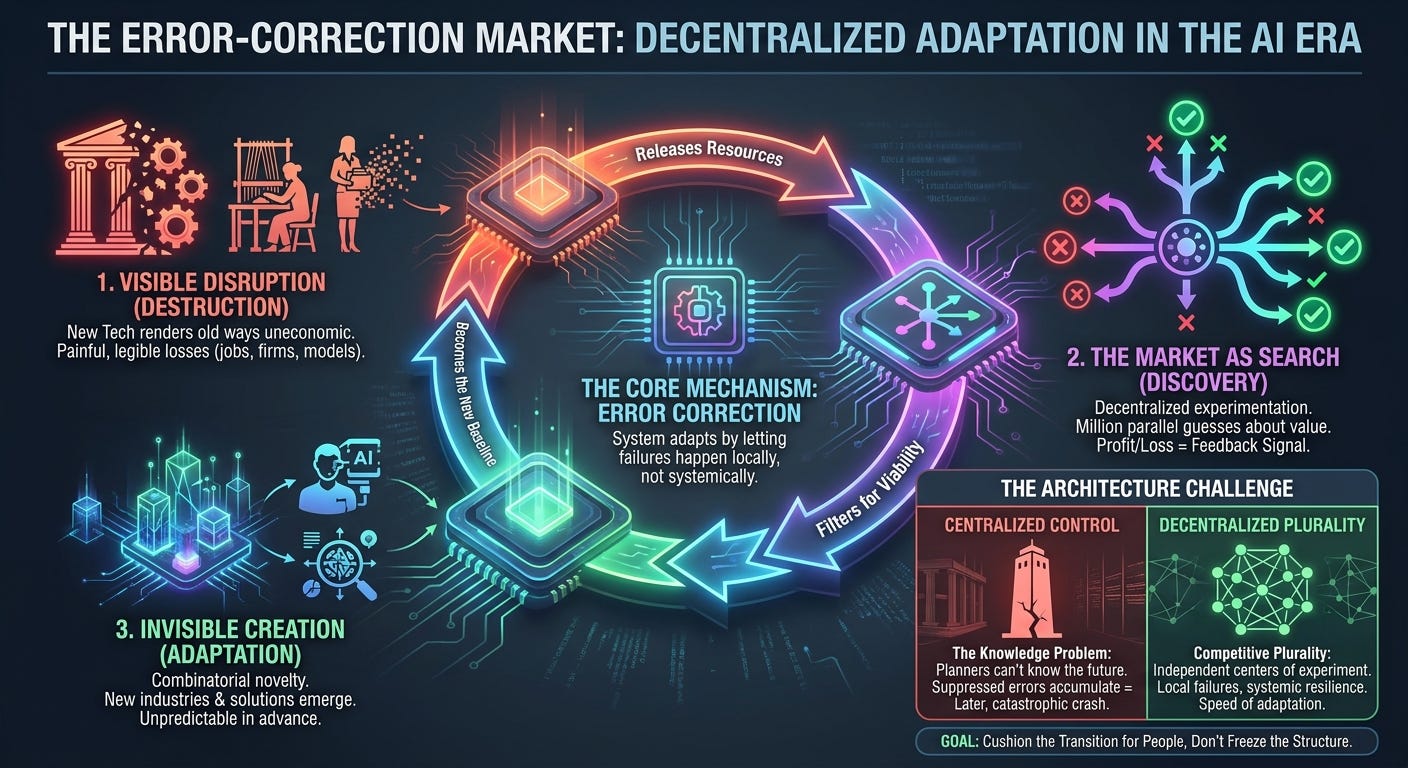
They understood half of it. Capitalism is destabilizing. Competitive markets replace technologies, firms, occupations, and business models continuously, and Marx saw this more clearly than most of his contemporaries. What the argument omits is that the same decentralized process is one of the main ways societies adapt to what it does. The omission is easy to make, because destruction arrives first and can be counted while adaptation arrives later and cannot.
When a technology eliminates an occupation, the loss has an address. A plant closes on a particular date, a profession contracts, a business model stops clearing its costs. The adaptations have no address yet, because they have not happened.
Mechanized agriculture displaced farm labor before anyone could list the industries that cheap food and released labor would make possible. Computers destroyed clerical work before anyone knew what software engineering or e-commerce would be. Nobody put out of work by the power loom could have named the occupations that electrification would eventually create, because the technology did not exist and neither did the demand for what it would do. AI may do the same to cognitive work. The jobs it threatens are visible now; most of the uses that cheap inference will support are not.
This produces a recurring accounting error. We compare a visible present against an unknowable future, then treat our uncertainty about future creation as evidence that creation will not occur.
Marx saw the destruction
Marx was right about a real property of capitalism. Competitive production does not merely raise output; it reorganizes society on a rolling basis. New techniques make old ones uneconomic. Capital moves, workers move, prices move, firms fail, and the social arrangements built around the previous technology lose their basis.
Later economists named this creative destruction. Destruction is often the mechanism itself: it is how resources become available for better uses. If a machine produces the same output with a tenth of the labor, holding the old labor requirement in place buys nothing in the way of output. It may preserve other things worth having, community continuity and tacit skill among them. The productive case for the arrangement is gone, and those other goods have to be defended on their own terms.
None of which makes displacement painless. A worker who loses a career does not experience an abstract gain in social productivity, and the costs can be large, concentrated, and lasting for the people who bear them.
But those costs do not tell us whether the change should have happened. They tell us that adaptation is necessary, which raises the question that critiques of technological capitalism tend to leave underdeveloped: which kind of system is best at finding the adaptations?
Markets as search
Critiques of technological capitalism often write as though the market’s role ends when the disruption begins. Competition produces the technology, the technology destabilizes society, and some external institution is then required to repair the damage. That picture leaves out most of what markets do.
A market is a decentralized system for discovering responses to changed conditions. An entrepreneur guesses that a new product solves a problem. An investor backs a technology on the belief it will pay. Somewhere a consumer decides the price is too high, and a competitor, watching, tries something else. Each of these is a conjecture about how resources can be combined to produce value, and profit, loss, entry, and bankruptcy are the tests those conjectures face.
No participant needs to know the final structure of the economy. Nobody has to predict which occupations should exist or which combinations of resources will turn out to be valuable. Many incompatible experiments run at once, most fail, and the economy reorganizes around the ones that survive. A market is an error-correcting architecture as much as an allocative one. It runs on distributed ignorance and does not require the ignorance to be resolved first.
Technological disruption belongs inside that process. A new technology is a discovery that some existing arrangement is no longer the best known use of the resources tied up in it, and the disruption that follows returns those resources to the search. The return is partial and often slow. Skills depreciate, capital is frequently specific to the use it was built for, and displaced workers can sit outside employment for years, so resources strand as well as move. Markets promise nothing about whether the search will be quick, painless, or evenly distributed. They allow it to proceed without anyone knowing the answer in advance.
Creation is harder to see than destruction
Technological pessimism has a structural advantage. Destruction is legible and creation is combinatorial. An AI system that replaces five thousand workers on a particular task produces a number you can print.
Suppose the same system cuts the cost of a certain kind of analysis by ninety-nine percent. Existing firms expand. Services once affordable only to large organizations reach individuals and small businesses. Workers combine the tool with specialized knowledge to make things that were previously too expensive to make at all. Somewhere a category of business becomes viable that has no name yet.
Most of that cannot be named in advance. The number of downstream combinations is too large, and many of them wait on adaptations that have not occurred. The accounting is biased at the source: known losses on one side, unknown gains on the other.
Incumbency confers an epistemic advantage that has nothing to do with merit. A job can point to itself. A displaced industry has employees, buildings, balance sheets, and a political constituency; an industry that will exist in ten years has none of these, and nobody to speak for it.
Counting only the visible half understates what decentralized discovery can find. Whether it understates it enough to reverse the verdict in any particular case is a separate question, and the answer will not be the same every time.
Adaptation has a timescale
Speed is the problem. Historical transitions unfolded over decades. Workers had time to move, retrain, retire, or age out. Capital could be redeployed gradually, schools could adjust their curricula, and political systems could absorb the shock in installments. AI may compress all of that.
If cognitive labor is displaced faster than new uses for human capability are found, the short-run consequences can be severe even where the long-run productivity gains are enormous. Labor markets do not clear on demand. People do not acquire new skills overnight. Institutions can become unstable well before a new equilibrium is anywhere in sight.
That is a real problem, and it does not favor centralized control. Faster change increases the number of adaptations that have to be discovered while shortening the time available to discover them. Under those conditions decentralized experimentation is worth more, not less, because no institution can specify in advance what tens of millions of workers, firms, and communities should do next. The response to a compressed transition is to improve the mechanisms by which people adapt to it.
Protecting people is a separate thing from protecting arrangements. Individuals can be carried through displacement without requiring yesterday’s jobs and firms to survive it. The mechanisms might be private or public, contractual or charitable, national or local. Which of them to use is a different argument from the economic principle, and a society can cushion a transition without freezing the structure that produced it.
The cost of stability
The common response to disruption is to ask how the existing arrangement can be preserved. Sometimes it should be. Institutions embody knowledge that is not written down, abrupt transitions impose real costs, and novelty is not self-justifying. But preservation cannot be the default setting of an adaptive economy, because a system that reliably prevented firms and occupations from being displaced would equally prevent better ones from replacing them.
Guilds preserved occupations. Licensing preserves incumbent professionals. Subsidies can keep an industry alive long after consumers have said, with their money, that they prefer something else. Each of these produces stability, and stability of this kind is no evidence that anything is working. An economy can be stable because it has stopped correcting errors.
Suppressed correction behaves like suppressed fire. Small corrections are how a system sheds accumulated misallocation, and a policy that prevents them does not remove the misallocation; it stores it. The fuel load builds under the appearance of calm, and the correction, when it finally comes, comes all at once. Protection converts continuous adjustment into a delayed and larger one. Some industries decay slowly under it for decades; others persist and then collapse.
Error correction requires that unsuccessful arrangements be allowed to disappear. Any system capable of meaningful change will produce disruption; the question is whether it can find better arrangements afterward.
Concentration
A defense of markets should not assume that private ownership by itself delivers a decentralized competitive structure. Markets concentrate. Economies of scale, network effects, capital requirements, and control of infrastructure all give incumbents durable advantages, and regulation frequently deepens them.
AI has several of these properties at once. Frontier systems need compute, specialized hardware, energy, and scarce technical talent, which creates barriers that do not exist in ordinary software markets.
Concentration and the disappearance of competition are different things, though. What decides the question is whether enough independent centers of experimentation remain able to challenge one another. Several large firms competing hard can preserve more corrective capacity than a fragmented market in which everyone shares the same assumptions. A privately owned market can go epistemically brittle once a few entrenched institutions control the infrastructure and can make independent experimentation prohibitively expensive.
The property at stake is competitive plurality: different actors pursuing different architectures, business strategies, safety approaches, and predictions, and able to contradict one another in practice rather than in principle.
High entry barriers threaten plurality well before they produce monopoly, which is a genuine institutional risk. It does not follow that the answer is to replace several powerful private institutions with one more powerful public one. The thing worth defending is the existence of multiple independent centers of experimentation and the capacity of failing institutions to be replaced, whatever ownership structure happens to deliver it. Durable monopoly suppresses competing corrections whether it is owned by shareholders or by a state.
The political problem
Rapid displacement is a political event as much as an economic one. People who lose status, income, identity, and bargaining power do not experience the transition as an elegant reallocation. They organize.
That response can damage the institutions adaptation depends on. Severe displacement generates demands for protectionism, industrial policy, restrictions on automation, and in bad cases for authoritarian control. A transition can be productive over twenty years and destabilizing over three.
Ignoring the backlash would be a mistake. So would treating it as an argument for preserving what was displaced; it is an argument that political and social institutions have to adapt too. Absorbing the human cost of a transition may in fact be a condition of an adaptive order surviving one, and that load can be spread across markets, insurance, courts, charities, and governments without any single institution having to know what the economy will look like afterward.
Institutions that help people adapt and institutions that preserve obsolete arrangements are not the same kind of thing, even when they are defended in the same language.
The knowledge problem
Suppose AI transforms a large fraction of existing cognitive work. A central authority attempting to manage that transformation would need answers to questions that have none yet. Which capabilities should be permitted, and which jobs protected? Which industries will emerge, which skills will hold their value, and which technologies that do not yet exist will solve the problems created by the ones arriving now?
Some of these look like questions about political values, which a legitimate authority might simply decide. They are questions about an unknown future. A planner has to act before the knowledge exists, and the decisions taken suppress the experiments that would have generated it.
Markets handle the problem by letting many actors make different predictions and pay for being wrong. That guarantees nothing about outcomes. It means only that error correction stops depending on one institution predicting the future correctly.
The case for decentralization is epistemic before it is ideological. Market actors are not unusually wise; they are fallible, often spectacularly. The architecture works because their errors compete, fail independently, and get corrected by others pursuing different conjectures. We should expect every institution to be wrong, including firms, regulators, governments, safety organizations, and markets themselves, and then ask which arrangement exposes the errors fastest.
AI makes the argument harder
Ordinary market error correction assumes mistakes are survivable. A company ships a bad product and loses money. An investor makes a bad bet and loses capital. Others watch, update, and the process continues.
Existential risk breaks the assumption. If an AI failure could permanently destroy civilization, there is no subsequent round of correction. Nothing learns from extinction. Everything above assumed a system that gets another round; the fire-suppression argument depends on there being a forest afterward. Irreversible catastrophic externalities are a genuine limit case for trial and error as such, and AI risk of that kind cannot be answered by a general appeal to market adaptation.
That changes the comparison rather than settling it. The alternative to decentralized experimentation is another fallible system with a different failure profile. A central AI authority can be captured. It can suppress competing safety approaches, concentrate dangerous capabilities under one roof, institutionalize a single mistaken model of the risk, and become the point at which technical and political failure coincide. Power accumulated to prevent misuse is still power available for misuse.
Centralization trades one failure mode for another: less competitive racing, more correlated failure. Which trade is better depends on which system detects danger earlier, contains failures once they occur, permits incompatible safety approaches to be tried, and remains correctable when its assumptions turn out to be wrong. Those are harder questions than whether markets can fail, and they are the ones on which the two architectures actually differ.
Containment
Decentralization is usually defended on economic grounds, but its safety value is a matter of fault containment. Independent firms, research groups, auditors, insurers, and users can disagree, test one another, expose failures, pursue incompatible strategies, and decline to participate in systems they judge dangerous. Diversity produces redundancy and adversarial checking. It keeps one mistaken judgment from becoming everyone’s mistake automatically, and it lets a system fail locally in ways that stay observable instead of going universal at once.
The argument carries a condition, and the condition deserves to be stated rather than assumed. Containment works only insofar as the failures are independent. If every laboratory trains on similar data, converges on similar architectures, and shares the same assumptions about what alignment requires, then the appearance of plurality is not plurality, and a flaw in the common approach fails everywhere simultaneously. Decentralization protects against correlated failure only when the decentralization reaches down to the level at which the failure would occur. Whether it currently does is an empirical question about the state of the field, and the institutional argument does not settle it.
Nothing here establishes that every AI capability should be developed or that decentralized outcomes will be safe. The claim is about the assumption that concentrating control reduces systemic risk: a sufficiently powerful central institution eliminates some dangerous experiments and, in the same motion, eliminates the competing corrections to its own errors.
Postscript
The anti-capitalist argument observes that markets generate technologies that destabilize existing arrangements. That observation is correct. The inference drawn from it, that the instability counts against markets, does not follow.
A decentralized discovery system will destabilize existing arrangements because those arrangements are provisional. Where nobody finds a better way, the arrangement persists. Where somebody does, it goes, and the resources move. Instability of that kind is what adaptation looks like from the inside.
The stronger version of the critique would have to show that some alternative arrangement preserves the benefits of technological discovery while handling the consequences better. That is a much harder claim than pointing at disruption. It requires specifying how the alternative acquires information it does not have, corrects its own errors, resists capture, preserves the experiments that would falsify it, and changes course when its model of the future proves wrong. It has to say what happens when technological change outruns political decision-making, when economic power concentrates, when displaced workers refuse the transition, and when some errors cannot be reversed.
Those are real problems. They are problems of institutional design.
Marx established that markets generate disruption. He did not establish that centralized or collectivized institutions handle disruption better, and the second claim is the one his successors have to carry.
AI will destroy some existing arrangements and may destroy a great many. It may do so faster than earlier technological revolutions, under unusual concentrations of capital, and against political pressures that are themselves destabilizing. None of that determines which architecture should govern the transition.
A civilization that lets value be discovered rather than prescribed will never be stable in the way incumbents would prefer. The instability is the price of the search, and the search is what produces answers nobody could have specified in advance.