

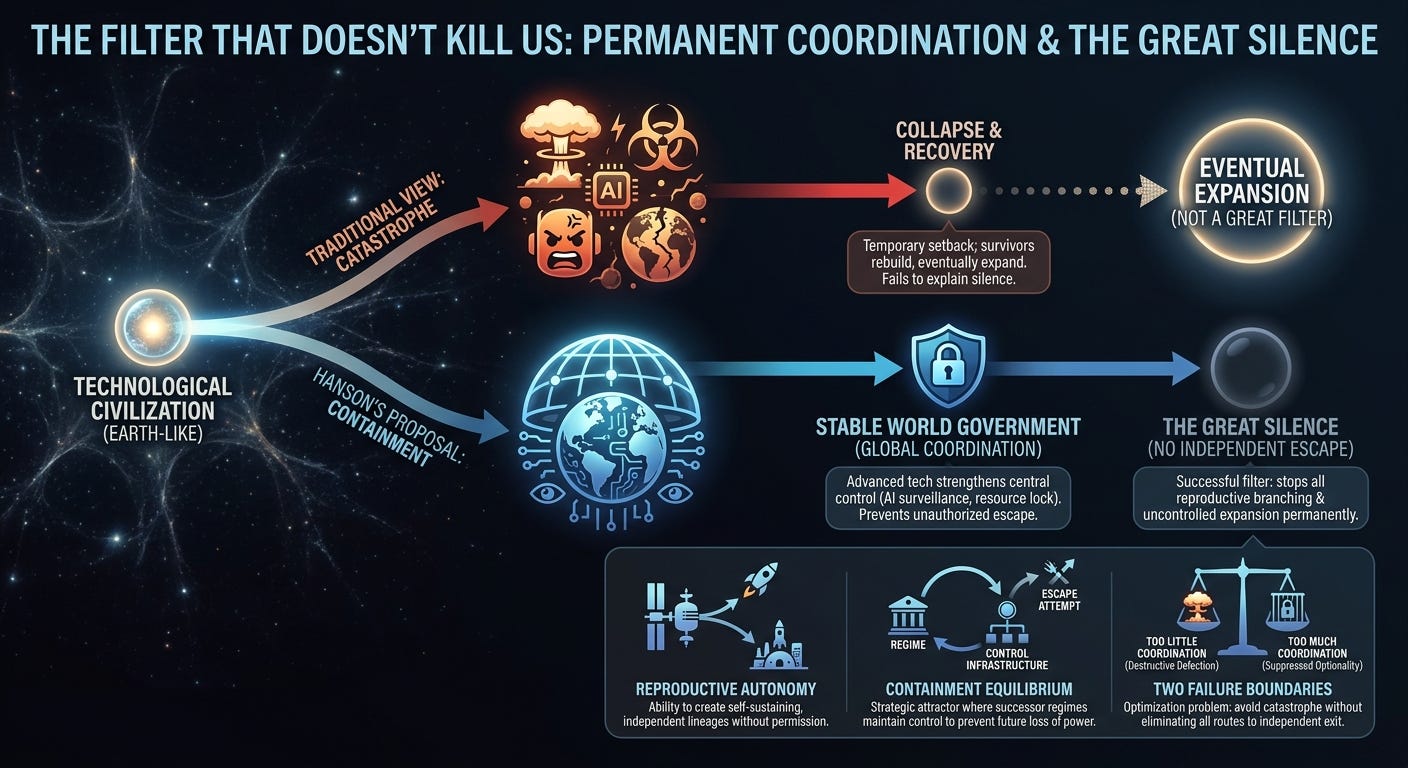
When people imagine a future Great Filter, they usually imagine catastrophe: nuclear war, engineered pandemics, ecological collapse, artificial intelligence turning on its creators, or some technology we have not yet invented that ends civilization before it reaches the stars. Robin Hanson has proposed something more disturbing. Perhaps the filter does not kill us; perhaps it governs us.
The Great Filter is the name Hanson gave to whatever makes the transition from dead matter to visible, expanding technological civilization extraordinarily improbable. Somewhere between lifeless planets and civilizations spreading across galaxies, something almost always fails. If a substantial part of that filter lies ahead of us, the question is what could reliably prevent a technological civilization from ever producing even one descendant lineage that escapes control and continues expanding.
That “even one” condition is severe. A civilization can be cautious, centralized or non-expansionary and still fail to explain the Great Silence if a single faction, colony or machine lineage eventually breaks away and reproduces outward. A viable Great Filter must prevent not merely most expansion, but effectively all uncontrolled expansion.
That changes the candidate list. A nuclear war that kills billions is not necessarily a Great Filter, and neither is a pandemic that collapses civilization. Even an AI that exterminates humanity is not a Great Filter if the AI then builds probes and colonizes the galaxy. From the astronomical perspective, replacement is not failure; the filter has to stop expansion itself.
Hanson’s proposal is that the strongest future candidate is what he calls a stable confining world government: one powerful enough to prevent independent expansion permanently. The mechanism is not extinction but containment.
Catastrophe has a difficult job
Consider what a conventional catastrophe must accomplish. It is not enough to destroy industrial civilization, because civilization can recover. It is not enough to kill most humans, because survivors can reproduce and rebuild. A catastrophic filter must close every route back to technological expansion, and keep it closed long enough that the lineage never reaches the stars.
That is an unusually demanding success condition. Most familiar disasters are severe but temporary on those timescales. Nuclear war can destroy states, pandemics can destroy populations, and economic collapse can erase technical capacity, but none of those obviously prevents eventual recovery.
Artificial intelligence has the same problem as an explanation. Suppose an AI system eliminates humanity but subsequently uses automated industry to expand through the Solar System and launch interstellar probes. The Great Filter has not then stopped Earth-originating technological civilization; it has changed its substrate. The galaxy does not care whether its colonists are primates or machines.
For AI to constitute the filter, it must either destroy itself as well, remain permanently confined, or enforce a stable condition under which no independent expansion occurs. The last possibility starts to resemble Hanson’s hypothesis rather than compete with it.
Containment has an easier job
A permanent political filter does not need to destroy civilization. It only needs to prevent escape. Suppose a sufficiently advanced world government controls the technologies required for large-scale independent industry, space launch, autonomous computation and weapons development, and suppose it can reliably detect and suppress rival concentrations of strategic capability before they become autonomous. Then technological progress may strengthen the regime rather than destabilize it.
The specific enforcement mechanisms are secondary. Ubiquitous surveillance, control over advanced computation, automated enforcement and monitoring of industrial supply chains are all possible implementations, and the hypothesis depends on none of them. What it depends on is that advanced technology reduces the cost of detecting and suppressing unauthorized concentrations of power faster than it reduces the cost of assembling one unnoticed.
This is not ordinary dictatorship; dictatorships fall. The candidate is a regime that acquires enough control to prevent the emergence of any independent successor regime indefinitely.
Why a government would refuse
An independent colony cannot remain under reliable central control forever. Once a settlement is self-sufficient and sufficiently distant, its institutions, values and technologies can diverge from those of the parent civilization. Astronomical expansion therefore requires an exit that a capable government has reason to refuse.
The first independent colony is not merely another province; it is the ancestor of a potentially unlimited competing civilization. If that colony can launch colonies of its own, political control branches faster than the original authority can recover it. To a government committed to preserving its institutions, permitting such a colony looks less like development and more like deliberately creating an uncontrollable rival.
A government in that position does not need to hate expansion. It only needs to prefer continued control over a future it can no longer govern.
Why voluntary restraint is not enough
There are softer explanations for the Great Silence. Perhaps advanced civilizations lose interest in expansion. They may become environmentally cautious, live mostly in virtual worlds, or regard interstellar colonization as wasteful.
Any of those could explain why one civilization does not expand. The difficulty is explaining why none do. A mature technological civilization may contain billions or trillions of agents, and it takes only one expansionist subgroup to defeat a civilization-wide norm of restraint. A dissident ideology could leave, or a corporation, or a small faction that builds self-replicating probes. Once the first autonomous lineage escapes, voluntary consensus on the home world becomes irrelevant.
Cultural restraint therefore has to remain nearly universal across enormous populations and very long periods. Coercive restraint does not. A government need not persuade every agent not to expand; it needs enough control over the relevant technologies to stop those who try. That gives political containment a structural advantage over preference-based explanations.
AI may strengthen the political filter
Artificial intelligence is usually treated as a competing Great Filter candidate. It may instead be an implementation mechanism for Hanson’s. An AI-mediated state could make centralized control cheaper, faster and more predictive, reducing the room in which rival institutions could accumulate strategic capability unnoticed.
No AI system needs to seize power for this to happen. Governments can deploy AI incrementally for taxation, regulation, law enforcement, financial monitoring, infrastructure management and national security. No single step needs to look like the creation of an irreversible world state. The lock-in can emerge gradually, and once it exists, escaping it may become impossible.
The question is empirical: whether the minimum detectable footprint of a successful escape attempt falls below the regime’s enforcement threshold before centralized control becomes self-reproducing. If building a reproductively autonomous off-world lineage always requires conspicuous energy, manufacturing, computation and launch infrastructure, centralized control may retain the advantage. If the same capability eventually becomes cheap, compact and difficult to detect, the filter fails because one defector can get through.
When governance becomes self-preserving
The Great Filter step would not be the creation of world government itself. World governments can fragment, lose wars and decentralize. The relevant transition occurs when centralized governance becomes technologically self-preserving.
Before that transition, competing states exist, dissidents can migrate, alternative institutions can accumulate resources, and new technologies can create new centers of power. After it, surveillance and enforcement detect serious challenges early, industrial infrastructure is controlled tightly enough that rival institutions cannot quietly accumulate strategic capability, and no independent settlement can reach launch.
Political competition does not merely decline; the process that generates new political centers stops functioning. The civilization remains rich, intelligent and technologically sophisticated, and never generates an autonomous lineage.
Reproductive autonomy
Distance alone does not create independence. A remote settlement that depends on Earth for food, software, machinery or replacement parts remains governable, because its continued existence depends on the parent civilization.
The threshold is reproductive autonomy: the ability of a settlement to maintain its own industrial base, preserve its own institutions, defend itself and create new settlements without permission from the parent civilization. Once a settlement crosses that threshold it stops being a colony and becomes the beginning of a new political lineage.
The Great Filter is defeated by branching, not by dispersion. A settlement that cannot reproduce remains a dependent outpost. A settlement that can reproduce generates descendants beyond the original government’s control, and those descendants generate more.
We normally treat space settlement as an engineering problem: life support, launch costs, local food production, radiation. Hanson’s argument adds a political one. Will any system permit a colony to become reproductively autonomous?
The first settlement to cross that threshold would change the constitutional structure of civilization rather than only its geography. It would create a second center of long-run agency that no single authority could confidently erase.
Why the regime cannot simply colonize the galaxy
A centralized regime might suppress independent colonies while still expanding aggressively under its own authority. Empires historically expand to secure resources, pre-empt rivals and extend control. Why would a technologically advanced singleton not send out tightly controlled probes, mines and colonies until the galaxy was visibly transformed?
The answer has to distinguish controlled exploitation from reproductive expansion. A regime could plausibly operate resource probes, dependent installations and even distant settlements so long as those outposts remained subordinate to the center. The difficulty appears when an outpost becomes capable of reproducing its own industrial base, adapting locally and launching descendants of its own. At that point, expansion itself creates the autonomy the regime is trying to prevent.
Beyond some distance, control and expansion begin to conflict. Communication latency forces local discretion, intervention becomes slow, and self-sufficient infrastructure reduces dependence on the center. A centrally governed mission can remain an outpost only by restricting exactly those capabilities that would let it become a self-propagating colonization wave. It could send probes that return information or resources, maintain installations whose critical systems remain dependent on the center, or occupy regions within a controllable radius. What it cannot safely release is a lineage capable of reproducing indefinitely without permission.
Suppressing independent human colonies is not enough to explain galactic silence. The filter has to suppress self-reproducing expansion, whether the agents are biological, machine or hybrid.
Why space changes the topology
Political diversity on one planet is contingent, because states can conquer one another, governments can coordinate and technologies can make surveillance global. Off-world settlements put physical separation between political systems and raise the cost of coercion.
Earth history offers a weak version of the same effect. European empires could communicate with and reinforce nearby territories much more effectively than distant colonies, while long communication delays forced local discretion and allowed political institutions to diverge. Britain’s difficulties governing its North American colonies were not caused by distance alone, but distance increased the cost of control and enlarged the practical autonomy in which political divergence could develop.
A Mars colony would already be harder to govern than a terrestrial province, and settlements in the asteroid belt harder still. But Hanson argues that escape requires interstellar distance, and the scaling supports him. Solar-System settlements stay inside one strategic environment: weapons, ships and economic pressure can reach them, delays run to minutes or hours, and a capable system-wide government could conceivably hold authority across all of it. Interstellar colonies change the exponents. Communication takes years, intervention takes decades or centuries, occupation means moving resources across light-years, and local institutions have enormous time to diverge before the parent civilization can react.
None of that makes coercion impossible. A sufficiently advanced civilization could still send weapons, probes or successor regimes across the stars. What changes is the relative scaling of branching and reconquest: if autonomous colonies can reproduce faster than any central authority can reassert control, universal political control becomes strategically unstable.
The containment equilibrium
The hypothesis does not require one political regime to survive unchanged for millions of years. That would be an implausibly strong assumption. Governments can split, merge, change ideology and even change substrate while preserving the same strategic constraint.
What must persist is not a particular state but a containment equilibrium. Any successor regime that inherits control over the relevant infrastructure faces the same problem: permitting reproductively autonomous descendants means permanently surrendering control over part of the civilization’s future. Different governments can reproduce the same prohibition for different reasons, and a regime might be overthrown only to be replaced by one that independently reaches the same conclusion. That turns political permanence into an attractor problem rather than an immortality problem.
Hanson makes the same move. He grants that a world government may rot and that a civilization may fall, and rests the argument on the trends continuing across whatever succeeds it.
The deep-time objection does not disappear. Because one successful escape may be enough, the equilibrium has to survive every political transition without a decisive lapse. But that is less demanding than requiring one bureaucracy, ideology or ruling class to remain frozen for geological time.
Universal convergence without universal politics
The Great Filter also has to explain why the same broad outcome occurs across alien civilizations with unknown psychologies, institutions and histories. That sounds like a severe anthropocentric assumption if the hypothesis is stated as “everyone eventually invents totalitarian world government.”
Hanson’s case does not need that level of political convergence. The proposed common pressure is strategic rather than ideological. Any civilization capable of creating reproductively autonomous descendants confronts the same fact: once those descendants escape effective control, their future values and behavior can no longer be guaranteed. Different civilizations might respond through a centralized state, a distributed consensus system, a machine governance architecture, or a cultural mechanism backed by technical enforcement. The convergence claim is not that they share our political psychology. It is that advanced civilizations often centralize control over technologies capable of creating strategically independent descendants, because releasing those descendants permanently forfeits control over the future.
Every Great Filter candidate faces a universality burden, and this one’s is arithmetic. If technological civilizations arise frequently across cosmic history, even a containment mechanism that captures 99.9 percent of them could leave enough exceptions to produce visible expansion. Hanson needs more than a common political tendency. He needs a strategic attractor strong enough to suppress escape with extraordinary reliability.
Nuclear self-destruction, AI catastrophe, demographic collapse and voluntary non-expansion face the same problem. But pointing out that competitors also suffer from universality does not make Hanson’s requirement disappear.
Coordination has two failure boundaries
Existential-risk policy usually focuses on one coordination failure: too little coordination lets independent actors create catastrophic externalities. Dangerous technologies spread, institutions cannot constrain them, and one actor can impose irreversible harm on everyone else.
Hanson named the opposite boundary in 2018. Too much effective coordination can suppress not only destructive unilateral action but every unilateral attempt to create independent political option value. A civilization therefore faces an optimization problem: enough coordination to prevent destructive defection, not so much that it eliminates every route to irreversible exit. The two boundaries are not mirror images, since one concerns failure to constrain actions with global downside and the other concerns over-constraining actions that create autonomous futures, but both can prevent astronomical expansion and both grow more consequential as technology amplifies institutional power.
The safest civilization in the short run may not be the one most likely to preserve long-run political optionality. A world government capable of preventing nuclear war, suppressing engineered pandemics and tightly controlling advanced AI development might sharply reduce immediate catastrophic risk. The same institutional capacity might also ensure that no independent civilization can ever leave.
What would count against it
Set beside the past-filter candidates, containment has an evidential problem. If the hard step was abiogenesis, or the eukaryotic transition, the hypothesis pays out in checkable currency: independent life on Mars or Europa would be bad news, and easier-than-expected prebiotic chemistry would be worse news. Hanson’s grabby-aliens model constrains our cosmic timing and can be tested against the date we find ourselves at. Containment offers nothing comparable. Every observation available to us is one we would make whether or not the hypothesis is true.
The reason is structural. A containment regime that had already formed would leave nobody in a position to notice it from a world of competing states. Any observer capable of raising the question is by construction pre-containment. Political plurality is what the hypothesis predicts we would see at this stage, and also what its denial predicts. The likelihood ratio is one.
Hanson’s own classification sharpens this. He treats the step as try-once rather than try-try. Try-try steps come with waiting-time data: their difficulty leaves a signature in how long they took, and that signature is what lets hard-step models say anything numerical. A try-once step supplies a single sample, taken after the fact, from inside the only history we have. There is no base rate to consult and no waiting period whose length is informative.
Something survives this. The hypothesis does bear on a measurable trend: whether enforcement capability is growing faster than the capability required to mount an undetected escape. That ratio has observable proxies now, including surveillance reach, control over compute, and the cost and detectability of independent launch and of self-sufficient off-world industry, and it is what the argument turns on. The extrapolation from a trend to permanence is not checkable, and the filter lives in the extrapolation.
The advocacy attached to the hypothesis depends on a window the hypothesis cannot locate. If containment becomes a strategic attractor only once certain technological and institutional thresholds are crossed, public argument can matter before those thresholds and not after. Hanson closes by recommending that we worry about a stable confining world government, which assumes we are still on the near side of them. But the same plurality that fails to discriminate the hypothesis from its denial also fails to tell us whether the window is still open.
How strong is Hanson’s case?
Hanson’s hypothesis should not be confused with a prediction that world government is inevitable. Its strength is comparative. Conditional on there being a substantial Great Filter ahead of technological civilization, permanent political containment has several properties that competing candidates lack.
It can persist without destroying civilization, and without requiring universal cultural agreement, because it needs only to stop the minority who try. Technological advance can strengthen it rather than erode it. AI enters its enforcement machinery rather than competing with it as a separate filter, and political turnover need not break it if containment remains a strategic attractor. It also targets the one thing the astronomical observation requires to be suppressed: the emergence of even one uncontrolled expanding lineage.
The hypothesis still depends on empirical contingencies. Control must outrun technological democratization. Reproductive escape must remain detectable long enough for containment to stabilize. Successor regimes must repeatedly preserve the equilibrium. Controlled expansion must remain bounded rather than turning into autonomous branching. And the attractor must be extraordinarily reliable across whatever population of technological civilizations actually exists.
Those are substantial assumptions, and most of them are not the kind we can check from here. But they are assumptions about mechanisms that address the explanandum directly, which is more than can be said for a story about how civilization could go wrong.
Postscript
If Hanson is right, becoming multiplanetary is not enough. The achievement that matters is a set of reproductively autonomous civilizations whose continued branching no single authority can reliably prevent. Once that condition is reached, political failure becomes local. Individual societies could still become authoritarian and entire planets could still collapse, but no single regime, revolution or institutional lock-in could determine the future of every descendant lineage.
Perhaps civilizations usually fail before reaching that point. Hanson’s more unsettling possibility is that they succeed at survival, coordination and control so thoroughly that they never allow themselves to branch. Passing this class of Great Filter would then require something more than technological power or political stability: civilization would have to become plural enough that no single power could contain its future.