

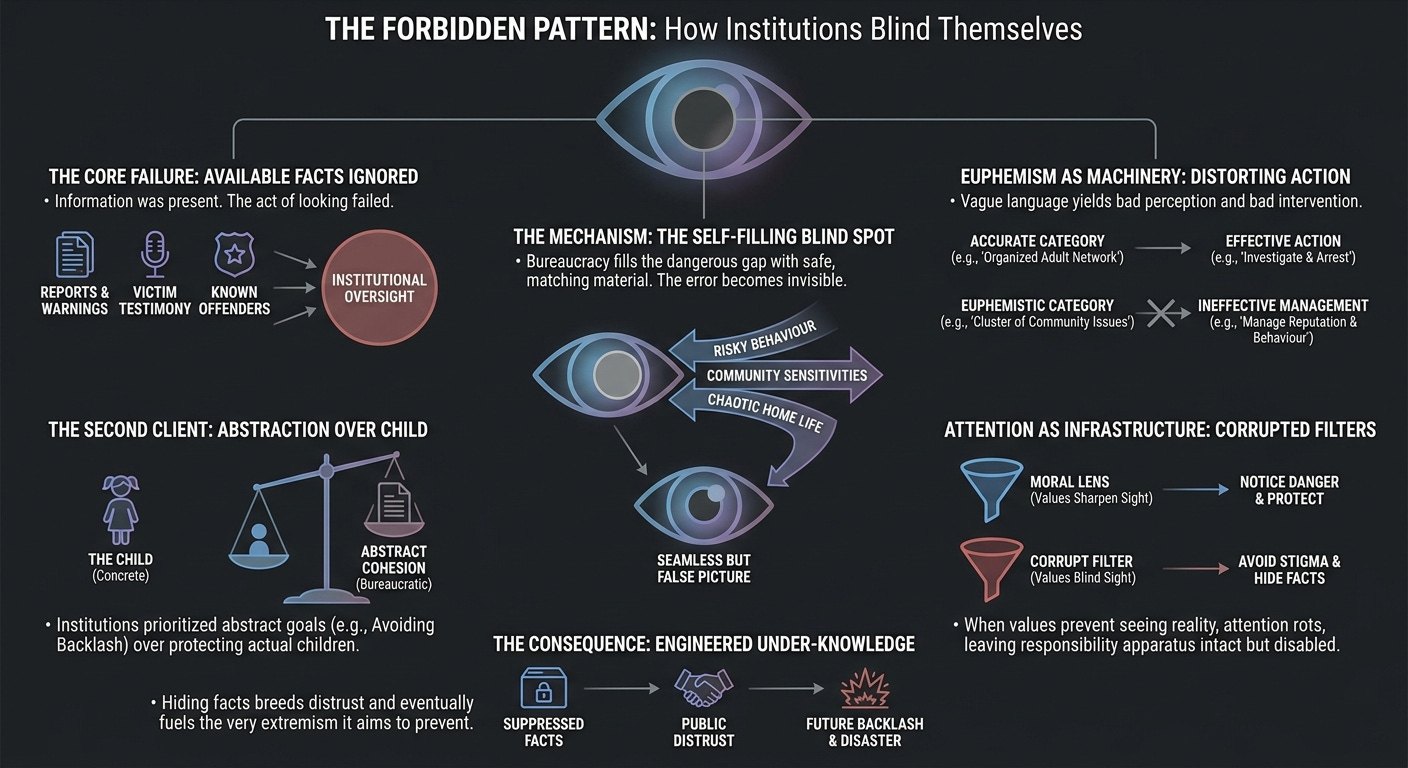
The British grooming-gang scandal was not a failure to gather information. The information was lying in plain view. Girls spoke. Parents complained. Youth workers filed warnings. Police held the names, the cars, the hotels, the takeaways, the taxi firms, the care homes, the same offenders surfacing again and again. The facts were present. What failed was the act of looking at them. The institutions had learned that one kind of fact was hazardous to perceive, and so they perceived around it.
Start with the order of guilt, because nothing that follows should blur it. The first crime belonged to the men who raped, drugged, trafficked, and terrorized children. Predators are responsible for predation, fully and without discount. The girls were not “putting themselves at risk” or making “lifestyle choices.” They were children, and they were being hunted by organized adult men.
The second failure belonged to the institutions paid to protect them: police, councils, social workers, schools, prosecutors, safeguarding boards. They failed to name what was happening clearly enough to stop it. Some were incompetent. Some were cowardly. Some were protecting themselves. Some were frozen by fear of being called racist. And some, it seems, simply found poor working-class girls easier to file away than politically sensitive offender networks.
The scandal usually gets argued as a quarrel about race, religion, immigration, or policing. All of that is on the map. The deeper thing is more general and more unsettling: a society can blind itself by moralizing its own attention. Teach an institution that certain facts are unsafe to notice, and its eyes begin to fail in a specific place. The consequence here was concrete. Children remained exposed to offenders the authorities had already had chances to identify.
The blind spot that fills itself in
There is a hole in the back of every human eye. Where the optic nerve leaves the retina there are no light receptors, so each eye is blind at one small patch of its field. You can find yours: close one eye, fix the other on a mark, and a coin held at the right spot off to the side will vanish. Here is the strange part. You do not see a hole. You do not see darkness or a gap. Your brain fills the missing patch with whatever surrounds it — the wall, the carpet, the empty page — and hands you a picture that feels seamless and complete. The blindness is real. The sense of seeing everything is also real. That is the trap.
An institution can grow a blind spot in exactly this way, positioned by what it has been trained not to look at, and then paint over it so smoothly that no one inside feels blind. This is the mechanism of the grooming-gang scandal. The dangerous fact fell in the scotoma. The bureaucracy filled the gap with material that matched the surroundings: “risky adolescent behaviour,” “community sensitivities,” “chaotic home life.” The resulting picture looked whole. Meetings happened. Reports circulated. Everyone felt they were doing the work of seeing. The child in the taxi disappeared into the category error.
When noticing became the sin
The taboo had an honourable origin. False racial panic is corrosive. Collective blame is unjust. A minority should not be smeared because some of its members commit crimes, and a liberal society is right to resist crude ethnic scapegoating, most of all in criminal justice.
Then a sound caution mutated into a disease. The rule slid from “do not blame the innocent” to “do not describe a guilty pattern if the description might embarrass a minority.” That second rule is lethal, because a fact can be both inflammatory and true. An offender pattern can be politically radioactive and operationally essential at the same time. Handling dangerous facts with care is the entire job of a serious institution. Pretending the dangerous fact is not there makes care impossible.
In these cases, the forbidden pattern was networks of mostly Pakistani-heritage Muslim-background men, in particular towns, exploiting vulnerable girls who were often white and working-class. The pattern did not describe all child sexual abuse, which is overwhelmingly committed by other kinds of men in other settings. It did not implicate all Muslims, all Pakistanis, all South Asians, or all men. But in the specific street-grooming scandals that tore through Rotherham, Rochdale, Telford, and Oxford, the pattern was far too strong to wave off as coincidence.
The wording has to be exact, and exactness cuts in several directions. “Muslim-background” does not establish a religious motive. “Pakistani-heritage” carries no guilt by itself. “South Asian” is too wide for most of these cases. “Asian,” the favoured British euphemism, hides more than it reveals. “Men” is true and operationally useless when the pattern being avoided is far more specific. The demand is not for a louder accusation. It is for an accurate one.
Rotherham was never invisible
Rotherham is the clearest case because so much was finally written down. The independent inquiry led by Alexis Jay estimated that at least 1,400 children were sexually exploited there between 1997 and 2013. The victims were frequently girls already known to services. In many historic cases, the offender networks were heavily Pakistani-heritage. The agencies had reports, warnings, and local knowledge in hand long before the story became impossible to deny.
The damning fact about Rotherham is not that officials knew nothing. They knew a great deal and declined to assemble it into an honest model. Youth workers raised the alarm. Families were brushed off. Victims were logged as troublesome, promiscuous, unreliable, complicit in their own abuse. The category error was fatal: adult predation was read through the conduct of the child.
This is what euphemism does once it sets inside a bureaucracy. It does not merely soften the speech. It swaps out the object the institution is acting on. A raped child becomes a difficult teenager. An organized network becomes a cluster of community sensitivities. A safeguarding emergency becomes a reputational problem to be managed. Rotherham shows precisely why vague language fails in practice. The threat was not “men” in general, or “abusers” in general. It was particular networks, addresses, vehicles, families, businesses, and silences. A system that refuses the relevant categories cannot build a response that fits the crime.
The second client
A safeguarding institution is supposed to have one client: the child.
In practice many of them acquired a second, an abstraction called community cohesion, and served it first. The abstraction was not conjured from nothing. After the riots of 2001 in Bradford, Oldham, and Burnley, councils in fragile post-industrial towns came under heavy pressure to head off ethnic disorder, and central government pushed the language of cohesion hard. Local agencies learned to treat communal tension as a live emergency.
That history makes the failure intelligible. It does not make it forgivable. Officials were forced to choose which danger would command their attention: the visible rape of children in front of them, or the hypothetical disorder that might follow an honest description of the offenders. Too often they ranked a possible riot above an actual child.
That ranking is the moral centre of the whole affair. The girls were concrete and the cohesion was bureaucratic. The girls had names, injuries, parents, hospital visits, police statements, testimony given and ignored. The abstraction had committees, strategy documents, press risk, and career consequences. The abstraction won.
This is how institutional corruption usually works, and it rarely needs a bribe or a conspiracy. It needs only a rival incentive strong enough to bend attention away from the truth. Once an official has to weigh how an investigation might play on race relations, in the local press, at the next election, or in his own appraisal, the child has stopped being sovereign. The official mind quietly learns to translate evidence into risk. A victim’s account becomes a hazard. An offender pattern becomes a public-relations problem. A furious parent becomes a threat to public order. Seeing and appearance-management fuse, and appearance wins.
The austerity evasion
Austerity is the standard alibi for public-sector failure, and in many areas it earns its place. Thin staffing forces triage, delays investigations, erodes competence, and burns out frontline workers.
But austerity does not explain the shape of this failure. Scarcity can account for missed appointments, weak follow-up, sloppy records, crude triage. It cannot account for why raped girls were redescribed as risky adolescents, why ethnicity turned radioactive, why parents were handled as nuisances, why offender networks stayed less legible to the system than the reputational cost of naming them. A starved institution fails at random. A corrupted one fails in a pattern, and this failure had a pattern: the same kind of fact softened, buried, and misclassified in town after town, year after year. A funding curve does not do that. A taboo does.
Austerity may have made weak systems weaker and hard cases easier to dodge. Promoted to the central explanation, it performs its own act of misdirection: it moves agency away from the moral and epistemic failure and turns a scandal of evasion into one more argument about council budgets. The children were not failed for lack of capacity to notice them. They were failed by institutions that had the capacity and the incentive to look away.
Euphemism is not politeness
Outside an institution, euphemism is a manner. Inside one, it is machinery, because the category drives the act. Get the category wrong and the action is wrong by construction. If “children raped by organized adult networks” is filed as “young people making risky choices,” the institution will manage the children’s behaviour instead of arresting the men. If “a local offender network” is filed as “groups of men,” the institution will never go looking for the kinship links, the business nodes, the taxi and takeaway access, the community silences that the real case runs through. Bad language yields bad perception, and bad perception yields bad intervention. There is no later stage at which the error gets caught, because the error is upstream of looking.
The grooming-gang scandal was, at bottom, a categorization failure. The institutions lacked or refused the categories they needed to describe what was in front of them. They could tally incidents without ever seeing the pattern. They could interview a victim without letting her account rearrange their model. They could hold the meetings and update the guidance while the central fact stayed too hot to file.
The worst euphemism of all was the one applied to the children themselves: that they were making choices, taking risks, placing themselves in danger. That language moved the agency from the adult predator to the child, and in doing so it quietly downgraded the institution’s task from emergency to welfare admin. The words determined what the officials thought they were dealing with.
How anti-racism failed these girls
Anti-racism failed here the moment it lost sight of the individual. An innocent Muslim man is innocent, completely. An innocent Pakistani-heritage family is innocent, completely. And a girl being raped by Pakistani-heritage men is also an individual, whose reality cannot be sacrificed to protect a narrative about group innocence. The official reflex treated the possible staining of a community as more urgent than the actual destruction of a child, and then dressed that inversion up as sophistication: sensitivity, restraint, responsible language. An anti-racism that requires silence about raped children has gone morally insane.
The correct principle is not complicated: never assign guilt by group, and never suppress evidence because a group is involved. The first half shields the innocent minority citizen from collective blame. The second half shields the victim from being erased when her attackers belong to a protected category. You need both halves, and the officials kept only the first.
They feared that naming the pattern would feed bigots, and they were partly right. Bigots do strip-mine real crimes for collective hatred. But refusing to name it fed the predators, discredited the institutions, abandoned the girls, and stored up a far uglier backlash for later. Suppressed facts do not vanish. They reappear later as evidence that the authorities lied. That is how cowardice manufactures the extremism it claims to oppose.
Precision against the smear
The opposite error is just as destructive: answer euphemism with a collective indictment of Muslims as such. That also annihilates precision. It abandons the individual, flattens the evidence, and trades operational categories for tribal ones, which catch the innocent and miss the actual network.
The pattern has to be named at the right resolution. In several of the major British cases, the offender networks were dominated by Pakistani-heritage Muslim-background men, and the victims were often vulnerable white working-class girls. The mechanism seems to have braided several strands: male predation, group reinforcement, local criminal opportunity, contempt for girls treated as a degraded out-group, honour-and-shame dynamics, feeble safeguarding, and official fear of the racism charge.
Religion should not be quarantined from the analysis, but neither should it be assumed to be the engine. Religious inheritance can shape sexual morality, shame, in-group loyalty, out-group contempt, gender norms, and family silence. Formal theology is only one possible layer, and in many cases Kashmiri village norms, clan structure, class contempt, ordinary male criminality, the night-time economy, and British welfare failure may explain more than doctrine does.
The distinction is not academic, because a problem has to be attacked where it actually lives. If the mechanism is a local network, work the network. If it is access through taxis, takeaways, and hotels, police those channels. If it is community silence, confront the institutions that keep the silence. If it is religious or cultural contempt for out-group girls, say so without flinching. Precision is not softness. Precision is the only thing that hits the target.
Attention as infrastructure
Every civilization runs on institutions built to see. Police are meant to notice crime, medicine to notice disease, science to notice the anomaly, journalism the corruption, courts the evidence, child protection the child in danger. These are perception organs grafted onto a society, because no individual can take in the structure of a complex world on their own. We build institutions to notice on our behalf.
That is why corrupted attention is among the deepest failures an institution can suffer. It can fail for want of resources. It can fail for want of competence. It can also fail because its perception has been trained away from reality. That third kind is the most dangerous, because it leaves the outward apparatus of responsibility intact while quietly disabling the act that matters.
All attention is selective, and not every moral filter is corrupt. A doctor notices symptoms because health matters; a parent notices danger because the child matters. Values can sharpen sight. But values can also blind, and the test is what the operative value actually is. When it became “avoid stigmatizing a community” rather than “protect the innocent with maximum accuracy,” the filter started hiding the very facts that protection depended on.
The empathy was not absent. It was misrouted. Officials pictured the pain of a stigmatized community more vividly than the pain of a raped girl, the spectre of a racist backlash more vividly than the child trying to make an adult believe her.
And attention followed status down. The offender communities were politically sensitive; the girls were not. They were poor, often already known to services, often already easy to discount. Some drank. Some skipped school. Some came from broken homes. All of that made middle-class officials more comfortable reading coercion as consent. This is the class dimension the race argument usually swallows. The taboo around ethnicity met an older contempt for the underclass, and the two reinforced each other.
The cost of not looking
There is a familiar defence of suppression: some truths are too dangerous for the public to hold. It can even sound responsible. Facts can be weaponized. Extremists do exploit real criminal patterns. A diverse society does need care in how it speaks.
But the bill for suppression almost never gets added up honestly. Hiding a fact does not only deny it to the bigot who would abuse it. It denies it to everyone who would use it well: the officer who could police accurately, the journalist who could report it straight, the parent who could recognize the danger, the scholar who could study it, the voters who could hold someone accountable. The official class talks as though the only risk is public overreaction. This scandal proves the larger risk runs the other way: public under-knowledge, engineered from above.
Hide a fact to prevent hatred today and you may breed worse hatred tomorrow, because citizens eventually see the gap between what is real and what they were told. Once they catch the authorities lying, they stop believing them even when, later, the authorities are telling the truth.
What should have happened
The right response was available from the first warning, and it was not complicated. Record ethnicity, nationality, and where relevant religion, alongside occupation, kinship, business links, locations, vehicles, victim pathways, network shape. Treat repeated victim testimony as pattern evidence rather than as a credibility problem. Separate individual guilt from group blame in public, out loud and on purpose. Tell the truth carefully instead of hiding it clumsily. Protect innocent Muslim and Pakistani-heritage people not by blurring the offenders but by being exact about them, since vagueness is what leaves the public to fill the dark with their own worst guesses.
And treat the girls as whole people. A child with a chaotic home is not owed less protection. A child who drinks has not consented to anything. A child who goes back to her abusers out of fear, grooming, or dependency is not choosing her exploitation. A child who is hard to help is still a child. The system, in the end, had ample moral vocabulary to defend its abstractions. What it lacked was the moral force to defend the girls.
Postscript
This is a British scandal, but the failure underneath it is not British. Every society has its forbidden patterns. Every institution holds facts it would rather not integrate. Every moral culture quietly attaches incentives to attention: some facts win you promotion, some win you punishment, some make you look compassionate, some make you look dangerous. Over time the institution learns where it is unsafe to look. The same blind spot can form in medicine, finance, a university, an intelligence service, a church, a family. Any institution can grow a zone where seeing clearly threatens the story it prefers to tell about itself.
Attention is moral infrastructure, and it can rot. A civilization survives on its capacity to look directly at what is real, especially when reality is ugly, inconvenient, and politically lopsided. A society that cannot face its own failure modes does not avoid the correction. It only delays it, and outsources it to disaster.
The girls in those towns did not need the adults around them to fix every problem in Britain. They needed those adults to believe what was in front of them, write it down accurately, and act before the next girl was pulled into the same machinery. The information was there from the start. What was missing was permission to see it, courage to say it, and loyalty to put the children ahead of the institution’s image of itself.