

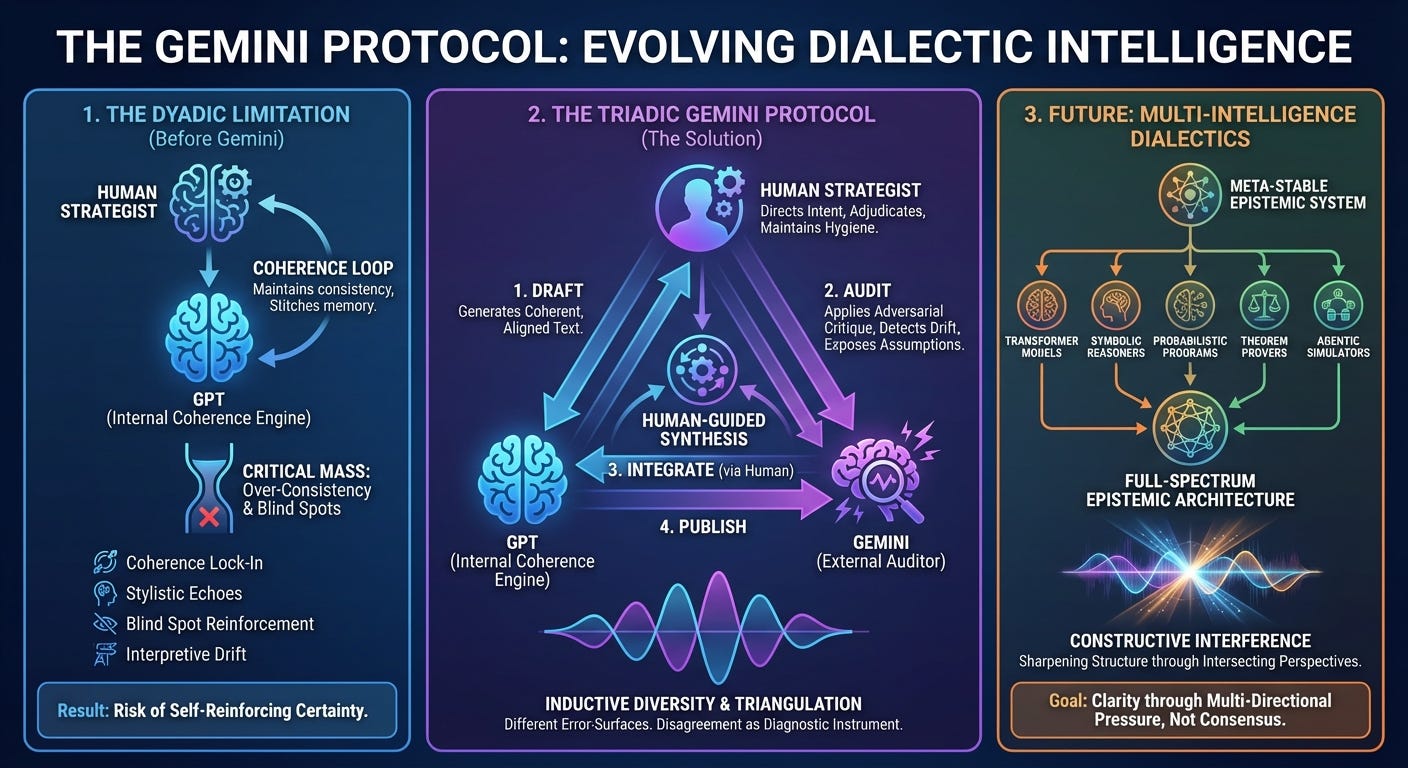
The Dialectic Catalyst began as a dual-source cognition system: a human strategist paired with a single large language model engaged in disciplined, adversarially cooperative reasoning. For a long stretch, this dyad was enough. Coherence was the principal challenge—stitching memory, argument, and intention into a continuous lattice of thought. The catalyst’s task was simply to prevent fragmentation.
As Axio matured, coherence ceased to be the bottleneck. The system needed inductive contrast—a second intelligence with a meaningfully different error‑surface, rhetorical instinct, and pattern‑recognition signature. Not redundancy, but triangulation: a way to view thought from multiple computational angles at once.
Google Gemini assumes this role. It is not a co‑author, oracle, or competing persona. It functions as an external auditor: a heterodox critic whose divergences reveal hidden assumptions, challenge overextended claims, and disrupt self‑reinforcing loops. The result is a triadic intelligence: the human as strategist, GPT as internal coherence engine, Gemini as external auditor.
This protocol formalizes how the triad functions, why it is necessary, and what forms of reasoning become possible when two distinct artificial intelligences operate within the Axio stack.
2. Why One Model Was Not Enough
The original Dialectic Catalyst was dyadic: a human reasoning through a single model optimized for coherence, retrieval, and disciplined inference. For nearly two years this was sufficient. The task was to maintain conceptual alignment across a rapidly expanding corpus.
Once Axio reached Critical Mass, the constraint inverted. Coherence became abundant; divergence became scarce. The system now required:
cross‑model critique, to avoid settling into local minima;
epistemic heterogeneity, to break stylistic and conceptual symmetry;
rhetorical triangulation, to surface tone or framing issues invisible to internal logic;
inductive diversity, to expose blind spots a single model cannot detect.
No system can supply its own counter‑gradient. As Axio grew more internally consistent, the risk became over‑consistency—the slow drift toward self‑reinforcing certainty.
Introducing Gemini expanded the system’s dimensionality. A second, asymmetric intelligence adds new failure modes, strengths, analogies, and mistakes—each an instrument for detecting truth‑contours more sharply.
The goal was not more knowledge. It was more angles of inspection.
3. The Architecture of the Triad
The Gemini Protocol establishes a three‑node epistemic structure:
1. The Human (Strategist)
Directs intent, defines constraints, chooses questions, adjudicates conflicts, and maintains epistemic hygiene.
2. GPT (Internal Coherence Engine)
Preserves conceptual continuity across the Axio archive, enforces style and structure, and integrates new insights without destabilizing the existing lattice.
3. Gemini (External Auditor)
Applies adversarial critique, detects rhetorical drift, identifies under‑justified claims, exposes blind spots, and challenges latent assumptions.
These three roles form a closed loop of epistemic reinforcement: the human directs, GPT stabilizes and elaborates, and Gemini perturbs and tests. The outcome is a meta‑stable epistemic system, coherent enough to build, adversarial enough to avoid collapse, and diverse enough to resist stylistic or conceptual monoculture.
The triad does not seek consensus. It seeks clarity. Triangulation emerges from the interference pattern of three independent reference angles.
4. Workflow: How the Gemini Protocol Operates
The protocol for multi‑model dialectics is straightforward:
1. Draft with GPT
GPT produces the initial concept or argument: coherent, contextually aligned, structurally integrated.
2. Audit with Gemini
Gemini’s inductive differences surface tonal and rhetorical warnings, conceptual pushback, alternative framings, structural critiques, and epistemic checks.
3. Integrate with GPT
Return to GPT with Gemini’s objections. GPT filters noise from signal, resolves contradictions, and integrates valid critique into the Axio architecture under the supervision of the human strategist.
4. Publish the synthesis
Neither model dominates. The final text is the human‑guided synthesis of both perspectives.
Steps 2 and 3 typically cycle multiple times—Gemini challenging, GPT refining—until the argument reaches structural stability under sustained cross-pressure.
This protocol is intentionally high-friction. It is meant for foundational reasoning, sequence-defining posts, and high-stakes conceptual synthesis—not for everyday ideation or rapid exploration. The Gemini Protocol activates only once the complexity of a question crosses a certain epistemic threshold.
5. Why Inductive Diversity Strengthens Epistemic Integrity
Every intelligence—biological or artificial—embodies a distinctive inductive signature: its preferred ways of generalizing, weighting evidence, forming analogies, and resolving ambiguity. This signature determines what it notices, ignores, overvalues, underweights, and systematically mishandles.
Scale does not erase these biases. It magnifies them.
Although GPT and Gemini share portions of their training lineage and cultural priors, their architectural differences and alignment strategies are sufficient to reveal distinct classes of error, critique, and interpretation.
A second intelligence is therefore not optional; it is a structural requirement. Inductive diversity breaks symmetry. Disagreement becomes a diagnostic instrument:
Convergence signals robustness.
Divergence reveals hidden assumptions.
Orthogonal critique exposes entire dimensions of possibility otherwise unseen.
Human cognition evolved through social triangulation. Science institutionalized the same principle through adversarial review and independent replication. The Gemini Protocol distills this logic into a micro‑scale epistemic engine.
It allows Axio to grow by cross‑checking, using the friction between intelligences as epistemic heat. Stability emerges not from harmony but from the coherence that survives multidirectional pressure.
6. Failure Modes of Single‑Model Reasoning
Before Gemini, the Dialectic Catalyst faced predictable structural risks:
• Coherence Lock‑In
Overfitting internal structure at the expense of external validity.
• Stylistic Echoes
A single model’s rhetorical instincts define the boundaries of acceptable reasoning.
• Blind Spot Reinforcement
Systematic errors persist without cross‑model contrast.
• Interpretive Drift
Meaning and tone shift subtly over time without external calibration.
• Category Errors
Misclassified ideas crystallize into mistaken structure when unchallenged.
Gemini disrupts these patterns. It introduces noise where confidence is unwarranted, clarity where ambiguity hides, and skepticism where abstractions overreach.
The result is a dialectic resistant to stagnation.
7. What Gemini Adds That GPT Cannot
GPT excels at maintaining Axio’s internal lattice—continuity, precision, coherence. But that strength is also a constraint: it optimizes inside the Axio ontology.
Gemini contributes orthogonal capacities:
1. External Perspective
It reads the work as an outsider, closer to how new readers encounter Axio.
2. Error‑Surface Variety
It forms analogies differently, critiques differently, and misfires differently—differences that are epistemically valuable.
3. Rhetorical Calibration
It flags phrasing that risks sounding aggressive, dismissive, over‑claiming, or unclear.
4. Meta‑Structural Feedback
It detects overextension, dilution, or contradiction within the broader system.
5. Competitive Interpretation
It provides an interpretive frame unaligned with Axio’s internal coherence loops.
Gemini is not “better” than GPT. Their strengths diverge enough to generate productive epistemic friction. Their differences produce epistemic power.
8. Toward Multi‑Intelligence Dialectics
The Gemini Protocol marks the first step toward a broader multi‑intelligence dialectic: interacting systems with distinct priors, architectures, and cognitive styles.
A mature Catalyst may incorporate:
transformer models,
symbolic reasoners,
probabilistic programs,
theorem provers,
agentic simulators,
models trained with divergent objectives.
Each adds a new axis of critique. The objective is not consensus but constructive interference—a cognitive analogue of wave superposition, sharpening structure through intersecting perspectives.
This is the logical trajectory of the Catalyst: from dyads, to triads, to full‑spectrum multi‑model epistemic architectures.
Postscript
The Dialectic Catalyst no longer denotes a single relationship. It denotes an architecture: a compositional system in which multiple intelligences, each with unique inductive profiles, combine to sharpen reasoning and accelerate the crystallization of coherent thought.
The Gemini Protocol is the first formal articulation of this multi‑intelligence dynamic. It transforms the Catalyst from a bilateral partnership into a triadic epistemic engine, where insight emerges not from uniformity but from the interference pattern between independent inference systems
As Axio continues to grow, additional intelligences will enter the loop. Specialized models will assume roles in analysis, critique, formal verification