

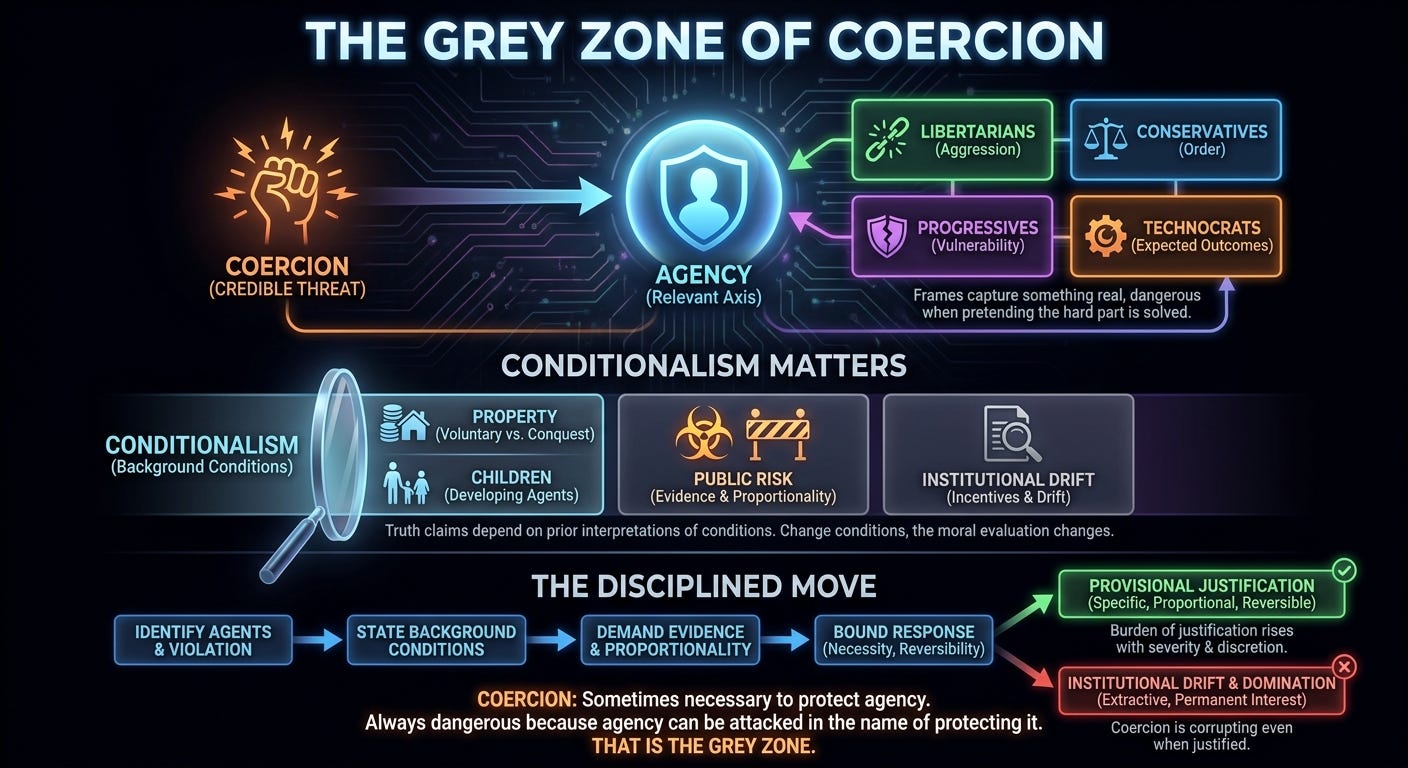
Everyone wants a clean rule for coercion. Libertarians usually reach for aggression. Progressives reach for vulnerability. Conservatives reach for order. Technocrats reach for expected outcomes. Each frame catches something real, and each frame becomes dangerous when it pretends the hard part has already been solved.
Coercion has a simple structure: the credible threat of actual harm to gain compliance. The moral question is whether that threat preserves agency or commandeers it.
Agency is the relevant axis because coercion operates by overriding agency. Other values matter: survival, stability, prosperity, order, continuity, trust. But coercion is the political instrument that converts one agent’s purposes into another agent’s constraint. That makes agency the first thing to examine, even when other values are also at stake.
Some cases are easy. Defensive force against an attacker is justified because the attacker has already initiated an agency violation. Restitution against theft or fraud is similarly clean. The coercion tracks a prior violation and aims to repair it. The problem begins when the facts are uncertain, the harms are probabilistic, the property claims are historically compromised, the agents have unequal capacities, or the institution applying coercion has incentives of its own.
That is where Conditionalism matters.
Conditionalism says that truth claims become meaningful only under specified background conditions. A claim like “this coercion is justified” depends on prior interpretations of harm, agency, ownership, consent, authority, evidence, proportionality, and responsibility. Change those background conditions and the moral evaluation may change with them.
This makes lazy judgment harder.
Property is the obvious case. If a resource was acquired through voluntary exchange, defending it can preserve agency. If the title descends from conquest, fraud, enclosure, state privilege, or regulatory capture, defending the same title may preserve one person’s planning horizon by freezing another person’s dispossession. The coercive act can look identical from the outside. The moral analysis changes because the background conditions changed.
Children expose the same structure from another angle. Forcing a child away from traffic, into medical treatment, or through basic education can preserve future agency because children are developing agents. Apply that same rationale to competent adults and it becomes paternalistic domination. The relevant condition is agency capacity. Ignore that condition and the argument degenerates into slogan-swapping.
Public risk is harder still. Quarantine can be defensive coercion when the threat is severe, transmissible, measurable, and bounded by evidence. Under weak evidence, indefinite emergency powers, institutional self-protection, or political opportunism, the same tool becomes administrative captivity. The word “safety” does no moral work by itself. It has to be cashed out in conditions.
This is why “good coercion” is a dangerous phrase. It makes coercion sound as if it can be morally sanitized in advance. It cannot. Coercion can be provisionally justified only when it prevents or repairs a clearer agency violation, and only when it is specific, proportional, evidence-bound, reversible, and institutionally contained.
The word provisionally carries the weight. Coercion is corrupting even when justified. It creates tools, offices, budgets, precedents, enforcement classes, and incentives. The first use may be defensive. The institution built around it may become extractive. A serious theory of legitimate coercion has to treat institutional drift as part of the moral calculation from the beginning.
Real institutions sometimes have to act before all conditions are settled. That does not abolish the burden of justification. It changes its timing. Emergency coercion should be narrow, temporary, evidence-preserving, and reversible where possible. When immediate action is unavoidable, the missing analysis becomes an obligation of review, restitution, and institutional correction. Urgency may justify acting under uncertainty; it does not justify pretending uncertainty has disappeared.
Most political argument is dishonest because it smuggles grey-zone cases into green-zone language. Redistribution becomes justice. Censorship becomes safety. War becomes defense. Moral regulation becomes protection. Property enforcement becomes peace. Border exclusion becomes security. Every faction redescribes its preferred coercion as the repair of a prior violation.
The disciplined move is to deny the shortcut. Identify the agents. Specify the alleged agency violation. State the background conditions. Ask who initiated the violation under those conditions. Demand evidence proportional to the severity of the coercion. Bound the response by necessity, proportionality, reversibility, and termination conditions. Then ask whether the enforcement mechanism preserves future agency or creates a standing authority class with a permanent interest in expanding its domain.
That procedure leaves a large grey area. It should. Conditionalism does not remove ambiguity by decree. It prevents ambiguity from being concealed under moralized labels.
The burden of justification should rise with severity, duration, uncertainty, and discretion. Defensive force against an attacker has a low burden. Permanent bureaucratic coercion over millions of people has an enormous one. The same moral vocabulary should never be allowed to cover both without doing the work.
A coherent ethics of coercion begins with suspicion. It permits force under specified conditions, for specified purposes, against specified violations, within specified limits. It does not let society, justice, safety, property, democracy, equality, or the common good function as magic words.
Coercion is sometimes necessary because agency can be attacked. It is always dangerous because agency can also be attacked in the name of protecting it.
That is the grey zone. Any philosophy that pretends to abolish it is selling authority with cleaner branding.