

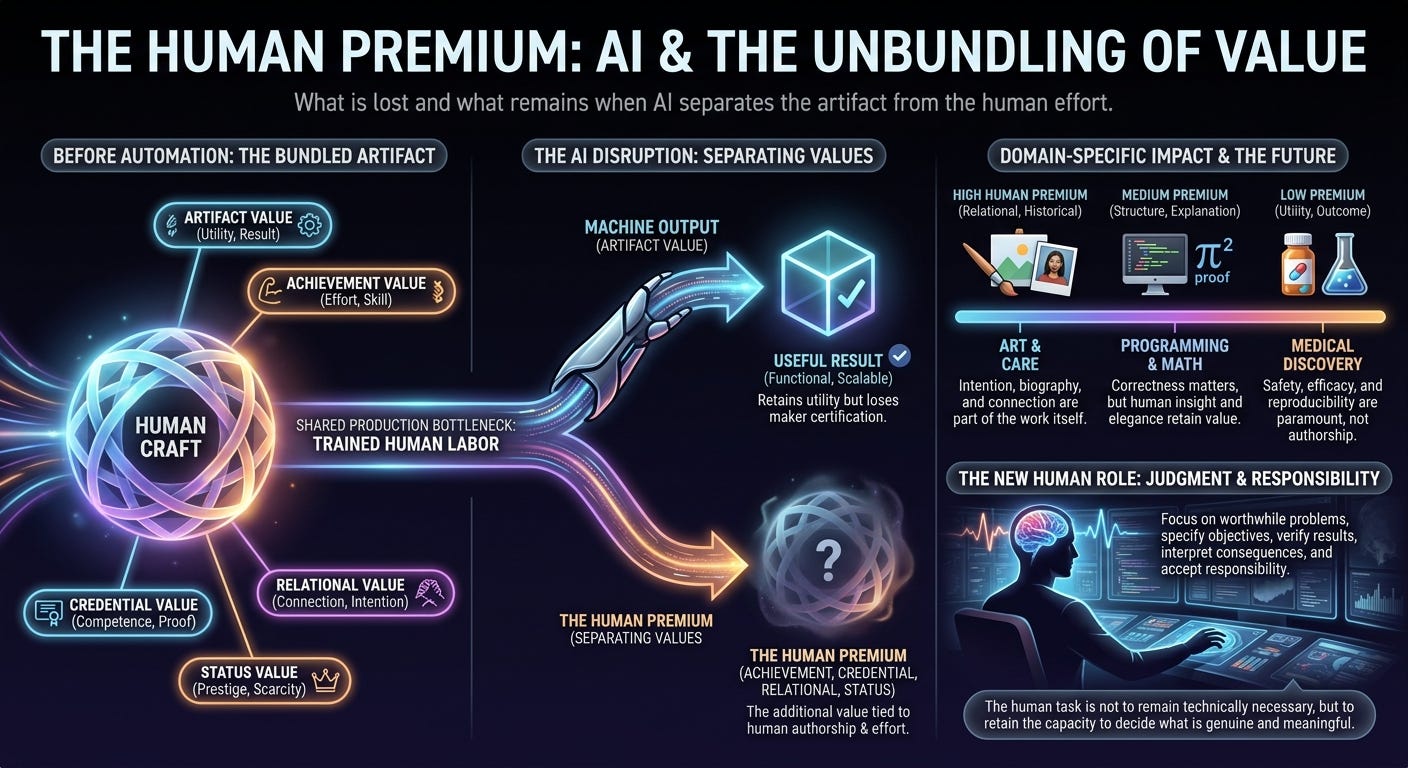
Before automation, every industry looked like a human craft.
Farming meant accumulated knowledge of soil, weather, animals, tools, and seasons. Printing meant compositors, engravers, pressmen, and binders. Engineering drawings were made by draftsmen whose hands embodied years of geometric discipline. Software was written line by line by people who learned to think within the constraints of machines. Because the human process was inseparable from the result, people learned to treat the process as part of the result.
Then the machines arrived.
Today the same argument appears across very different fields. Artists say an image without human intention is not art. Programmers say generated code is not real engineering. Mathematicians say proofs require soul. Scientists worry that automated discovery is replacing the human insight that gives research meaning. These claims are not all false. They are usually confused.
Automation does not simply replace labour. It separates values that scarcity had bundled together.
The bundled artifact
A difficult human-made artifact once performed several functions at once.
It had artifact value: the program worked, the proof established a theorem, the painting produced an experience, the treatment improved survival. It had achievement value: producing it demonstrated effort, discipline, originality, or skill. It had credential value: possession of the artifact provided evidence about the producer’s competence. It had relational value: the artifact could be experienced as contact with another human mind. And it had status value: the producer acquired prestige because few people could do the work.
These values were correlated because they shared a production bottleneck. Only a trained human could produce the artifact, so the useful result also certified the person who made it.
AI breaks that correlation. A generated program may work without demonstrating that its operator can program. A generated proof may be valid without recording the path of human discovery. A generated image may be beautiful without expressing the biography of a painter. A generated hypothesis may lead to a treatment without being the product of a scientist’s intuition. The artifact may retain much of its value while losing its power to certify the maker. What happens to institutions when that certifying function collapses, and what they might use in its place, is the subject of an earlier essay.
That is the human premium: the additional value attached to an artifact because of the human authorship, intention, effort, or relationship embodied in its production. Some human premiums reflect genuine relational or historical value. Others are residual payments for scarcity, status, or exclusion.
When the premium disappears
People rarely describe the loss in those terms. They say the automated result is hollow, inauthentic, derivative, soulless, or not real, and these words move silently between different claims.
Sometimes the objection is epistemic: the output may be unreliable, opaque, or impossible to verify. That is a serious problem. Sometimes it is practical. Generated code may be unmaintainable, a generated hypothesis may not survive replication, a machine-produced proof may be formally correct while offering no explanatory insight. Sometimes it is aesthetic. A reader may value a poem partly because it expresses another person’s experience; remove the person and the object changes.
But sometimes the complaint is simpler: the artifact no longer demonstrates the sort of human achievement that once made it admirable. That loss is real. The inference drawn from it is invalid.
A result does not cease to work because its production became easier. A theorem does not become false because no mathematician experienced the decisive insight. A treatment does not become less effective because a model found it. Difficulty may contribute to achievement value, but it does not create artifact value.
The craft fallacy is to treat the scarcity of production as the source of the product’s worth.
Different fields, different premiums
The human premium varies by domain.
In art, the premium can be substantial. Provenance and intention may be part of the work itself. A portrait painted by a grieving parent is not culturally interchangeable with an indistinguishable image generated from a prompt: the visible surface is the same while the human object is different. This does not make generated images aesthetically powerless. It means some forms of artistic value are relational and historical rather than purely visual.
In mathematics, the premium is smaller. A valid counterexample remains valid regardless of its origin. Human explanation still matters, and a proof that reveals structure is more valuable than an opaque certificate, but truth is not conferred by biography.
In programming, the premium is smaller still. Software exists to satisfy requirements under constraints. Correctness, security, maintainability, performance, and accountability matter; the author’s personal struggle does not. Programmers may value elegance and craft, but those values remain subordinate to engineering outcomes.
In medical discovery, the human premium approaches zero. A cancer therapy should be judged by safety, efficacy, reproducibility, and cost, not by whether a scientist or a model found it.
Clinical care is different. Trust, consent, communication, accountability, and the interpretation of suffering retain substantial relational value. The human premium is low in the provenance of the molecule and high in the relationship through which medicine is practised.
The same appeal to humanity can therefore range from defensible to grotesque depending on what the field is for.
The loss beneath the argument
The resistance is not difficult to understand. A profession is rarely only a method of producing outputs; it is also a structure of identity. People spend decades acquiring abilities that are scarce, difficult, and socially legible. The work gives them income, rank, community, and a reason to regard their effort as significant. When a machine produces comparable results cheaply, the threat is not merely economic.
The machine appears to say that the sacrifice was unnecessary.
That conclusion is too strong. The sacrifice may have been necessary under the previous production regime, and it may also have created forms of judgment and understanding that remain valuable. But it no longer guarantees continued necessity.
This is the point at which status loss is often translated into moral language. Human labour becomes dignity. Scarcity becomes authenticity. Professional exclusion becomes standards. The preservation of a guild becomes the preservation of humanity. Some of these claims identify real risks; others protect incumbents from competition. The distinction cannot be settled by invoking soul.
Who captures the gain
Cheaper production does not determine who receives the benefit. Automation may lower prices, expand access, increase profits, suppress wages, or concentrate control in firms that own models, compute, data, and distribution. The disappearance of a human premium can benefit society while impoverishing the humans whose labour previously commanded it.
A programmer who fears wage suppression is not necessarily defending mystique. An artist who objects to a platform training on their work may be making a claim about appropriation and bargaining power rather than metaphysics. A researcher may reasonably fear that productivity gains will accrue to institutions while professional autonomy disappears. Those are distributional conflicts, and they do not show that the automated artifact lacks value.
Automation separates the artifact from the achievement. It can also separate productivity from compensation.
Where judgment comes from
Human judgment is not created in a vacuum. In many cognitive fields, the ability to verify a result is acquired by learning to produce one. A mathematician recognizes a suspicious proof because they have struggled with proofs. A programmer detects a brittle abstraction because they have built systems that failed. A scientist notices weak causal inference because they have designed experiments and watched them break.
This creates a problem for the usual post-automation settlement. Humans are told to stop producing and move upward into supervision, verification, and judgment, but those higher functions depend on expertise developed through the lower ones. The result is institutional deskilling: systems continue to generate outputs while fewer people remain capable of evaluating them independently.
The problem will not correct itself. Markets optimize current production costs, not the long-term reproduction of independent competence, so preserving formative practice requires deliberate inefficiency: protected exercises, simulated failure, redundant manual practice, or public subsidy. This is not artificial scarcity imposed to preserve wages. It is institutional redundancy maintained to prevent dependence from becoming incapacity, and it applies only to those forms of practice that reproduce understanding rather than to every obsolete task.
What automation actually removes
Automation exposes which parts of a craft created value for users, which parts created meaning for practitioners, and which parts generated rents for institutions that controlled production.
It removes some drudgery and some skill premiums. It weakens credentials based on polished output. It reduces the prestige attached to performing tasks that machines now perform cheaply. It may also remove apprenticeship paths, erode tacit knowledge, transfer income from labour to capital, and leave institutions dependent on systems they cannot independently audit. Those are genuine systemic dangers.
The response is to preserve the capabilities that remain necessary: choosing worthwhile problems, specifying objectives and constraints, distinguishing success from plausible failure, verifying results, interpreting consequences, assigning responsibility, and maintaining enough practical competence to perform those functions independently.
These functions are less visible than production, and harder to certify. A finished artifact once bundled them together; AI forces institutions to evaluate them directly. Most schools, firms, and credentialing systems are poorly equipped for that. They know how to evaluate finished work, credentials, and procedural compliance. They are much worse at measuring judgment, problem selection, specification quality, or the ability to recognize plausible failure.
Nor is there any guarantee that displaced workers will move upward into these roles. There may be fewer such roles, and the market may reward them less than the production work they replace. That is a serious problem of institutional design and political economy, but it is not a reason to preserve the old production bottleneck as a source of artificial scarcity.
Postscript
The decline of the human premium does not imply the decline of human value. It implies the end of a convenient equation:
difficult human labour = valuable output = deserving person
Those terms were never identical. Scarcity made them appear so.
A machine-generated artifact may be useful without being admirable as an achievement. A handmade artifact may be admirable even when it is no better at its practical function. Human authorship may add meaning in one domain and nothing in another. The mistake is demanding that every artifact continue to carry the social meaning it acquired under conditions of human scarcity.
Automation does not desecrate a craft by separating the result from the struggle required to produce it. It reveals that their union was contingent.
But automation can also destroy the training systems that produce judgment and transfer the gains from workers to owners. Dismissing every objection as nostalgia is therefore as crude as declaring every automated result unreal.
The human task is not to remain technically necessary at every stage of production. It is to retain the capacity to decide which results are worth producing, determine whether they are genuine, preserve the competence required to judge them, and accept responsibility for what follows.