

Our Blessed Homeland
Tom Gauld’s cartoon Our Blessed Homeland depicts two nearly identical countries facing one another across a border. On one side stand our glorious leader, our great religion, our noble populace, and our heroic adventurers. On the other stand their wicked despot, their primitive superstition, their backward savages, and their brutish invaders.
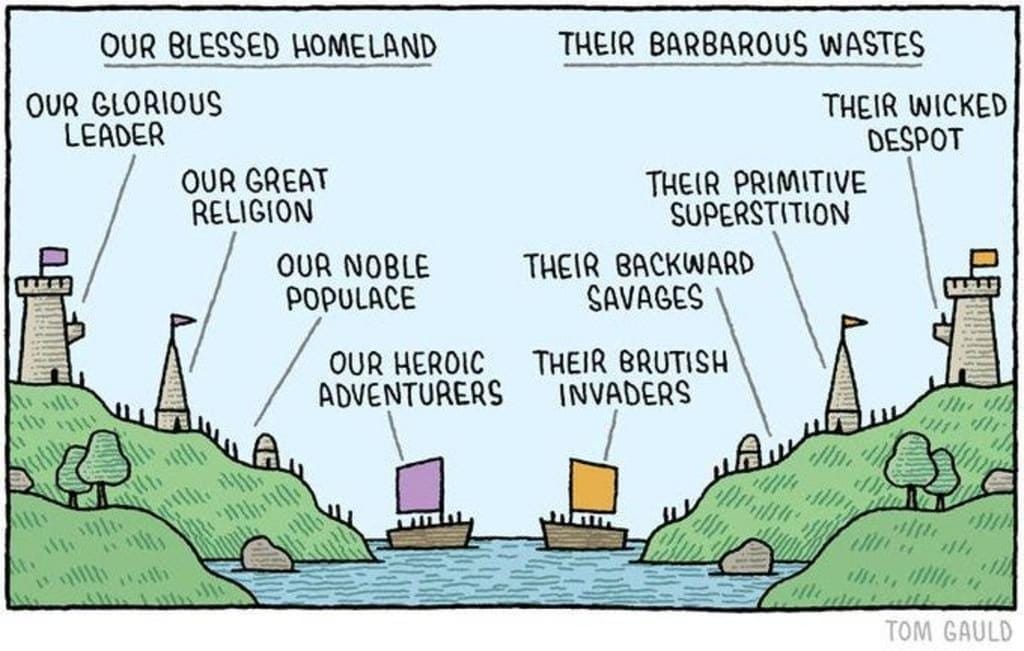
The joke works because the moral vocabulary changes before any relevant difference has been established. Identity determines description, and description determines judgment.
This is a common structure of hypocrisy.
Hypocrisy is usually treated as a defect of character. People preach one thing and practise another because they are weak, dishonest, vain, or corrupt. Sometimes they are. But hypocrisy is too common, too patterned, and too resistant to exposure to be explained only as individual vice. It is also a stable social strategy.
The concern here is not every gap between profession and conduct. A person may sincerely endorse a rule and fail to live up to it through weakness, temptation, or negligence. The more consequential case is selective universalism: presenting a standard as general while changing its application according to affiliation. That form of hypocrisy is not an accidental failure of moral reasoning but, often, the predictable result of moral reasoning conducted under coalition pressure.
The Profitable Middle
Open tribalism says that our side deserves latitude because it is our side. This is candid, but morally disreputable.
Consistent universalism says that the same rule applies regardless of who benefits. This carries moral prestige, but it is strategically expensive. It may require condemning allies, surrendering advantages, limiting useful powers, or accepting outcomes one dislikes.
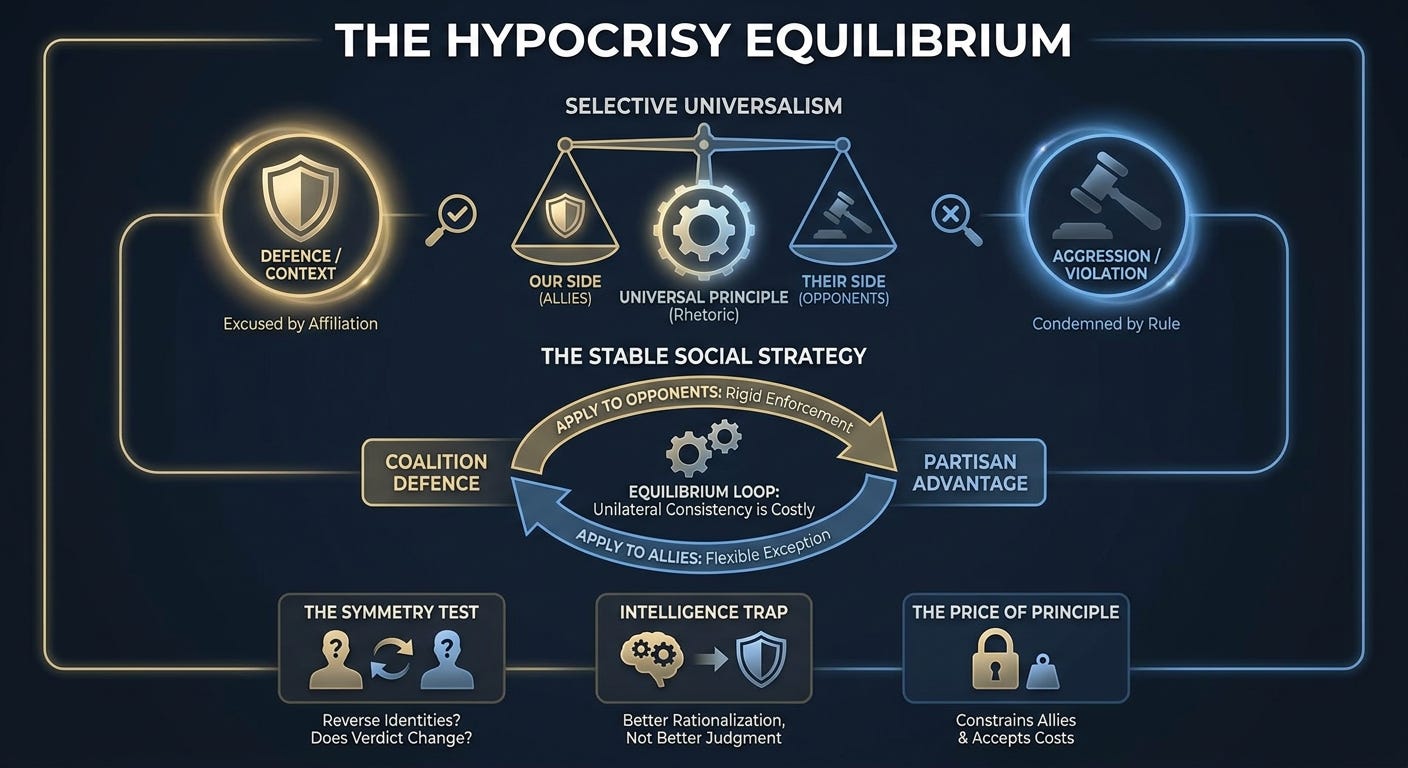
Hypocrisy occupies the profitable position between them. It speaks the language of universal principle when judging opponents and the language of context, complexity, and exception when judging allies.
Our violence is defence, while theirs is aggression. Our censorship is safety, while theirs is repression. Our propaganda is public education, while theirs is indoctrination. Our patronage is representation, while theirs is corruption. Our riots are the voice of the unheard, while theirs are lawless disorder.
The judgment appears to follow from the description, but the description was chosen to produce the judgment.
This is why relabelling is so effective. The hypocrite need not defend the claim that aggression is acceptable when committed by allies. He classifies allied force as defence. He need not argue that censorship is legitimate when his faction controls it. He calls it moderation, safety, or harm reduction. The letter of the rule remains intact because the favoured case has been reassigned to another category.
Hypocrisy Without Conscious Liars
This process does not require deliberate fraud.
A journalist chooses one verb rather than another. A lawyer identifies a distinction. An activist selects the most favourable comparison. An institution enforces a rule more aggressively against one faction. A citizen remembers the outrages of the other side and forgets those of his own. An intellectual converts an inherited preference into a general principle.
Each act may feel locally defensible. The aggregate result is systematic asymmetry without a central hypocrite.
People often do not first choose a conclusion in full awareness and then invent an excuse. Preference and justification may develop together. A person inherits a coalition’s categories, notices the facts that fit them, and experiences the resulting judgment as direct perception rather than interpretation.
This makes intelligent people especially formidable defenders of double standards. Intelligence improves the ability to identify distinctions, generate analogies, and construct coherent explanations. It does not guarantee that the governing principle was applied impartially. No two cases are identical, so any sufficiently capable advocate can identify some difference between them. The question is whether that difference governs judgment across cases or becomes salient only when it protects a preferred conclusion.
The Symmetry Test
A useful test is to remove the factional names. What factual predicate changes the verdict? Would the same predicate be accepted if the actors were reversed? Would the rule still seem compelling if an opponent acquired the power it authorizes? Would the distinction have been noticed before the identity of the actor was known?
If no stable answer can be given, the distinction is probably coalition defence masquerading as moral analysis.
This test does not assume that opposing parties are equal in power, responsibility, or moral standing. Real asymmetries can be decisive. A weaker party resisting domination may occupy a different moral position from a stronger party imposing it. A police officer and a private citizen do not face identical obligations because they possess different powers and duties. A large aggressor and a small defender are not interchangeable merely because both use force.
Power asymmetry does not invalidate the symmetry test. It supplies one possible answer to it.
The distinction must still generalize. If disparities of power excuse coercion only when our faction is weaker, or cease to matter when our faction becomes stronger, power has become another partisan label rather than a governing principle.
Consistency does not require identical verdicts. It requires rules whose relevant distinctions do not depend merely on factional identity.
When Context Becomes a Solvent
Historical context, intent, scale, authority, proportionality, coercive capacity, available alternatives, and prior obligation may all alter a moral judgment. Any serious account must allow them to do so.
The difficulty is that context is almost infinitely expandable. Once a person is motivated to defend one side, every surrounding fact can become morally relevant. One side’s history explains its conduct; the other side’s history merely excuses it. One side’s fear establishes necessity; the other side’s fear reveals paranoia. One side’s intention mitigates the outcome; the other side’s intention is inferred from the outcome.
Context then ceases to clarify the rule and begins to dissolve it. Which facts carry the weight, and would they carry the same weight if the identities changed?
Consider the language used for political disorder. When a favoured movement blocks roads, occupies buildings, or clashes with police, its actions may be described as protest, civil disobedience, resistance, or the understandable eruption of accumulated grievance. When an opposing movement does the same, the vocabulary shifts to riot, intimidation, insurrection, or mob rule. These judgments need not be identical. Scale, target selection, proportionality, and political purpose may matter. The test is whether those predicates govern both cases, or whether the category changes when the affiliation changes.
A distinction that cannot survive that test is probably not a distinction. It is an exemption.
The Equilibrium
Hypocrisy becomes durable because it is not merely individually rewarding. It is an equilibrium.
Imagine two coalitions choosing between consistent and selective enforcement of a shared principle.
If both apply the principle consistently, both incur internal costs. Allies are punished, useful powers are restrained, and immediate advantages are lost. The benefit is that the shared rule retains authority and each side can predict the other’s conduct.
If one side remains consistent while the other becomes selective, the selective side gains. It can condemn enemy violations while excusing its own, exploit institutional restraints without reciprocating, and use the opponent’s concessions as evidence of weakness. The consistent coalition pays the costs of principle while the selective coalition captures the benefits.
Its members then face a strong incentive to defect. Restraint begins to look like unilateral disarmament. Why should we follow rules they exploit but do not obey? Why should we condemn our excesses when they conceal theirs? Why should we surrender powers they will use without hesitation?
Once both sides reason this way, selective enforcement becomes self-sustaining. Each faction cites the other’s conduct as justification for its own. Every exception becomes precedent, and every precedent becomes permission.
No participant needs to regard himself as a hypocrite. He can see his own departure as defensive and the opponent’s as aggressive. Retaliation becomes restoration. Escalation becomes deterrence. Partiality becomes prudence.
The equilibrium is stable because unilateral consistency is costly, while reciprocal consistency requires trust. Yet the conduct of each side continually destroys the trust required to escape it.
Partiality and Disguised Partiality
Not every preference for one’s own side is hypocritical. A person may openly believe that obligations are stronger toward family, friends, compatriots, or allies. That view may be defensible or indefensible, but it is not hypocritical merely because it is partial.
Hypocrisy begins when partiality disguises itself as universalism.
Political cultures that entrench universal legitimacy make this disguise especially attractive. Universal principles retain enormous moral prestige. Equality before the law, impartial institutions, universal rights, due process, free expression, and neutral procedures are difficult to reject openly. Yet these principles are valuable precisely because they constrain those who invoke them. A commitment that binds only opponents is not a constraint. The permanent temptation is therefore to preserve the rhetoric while suspending the cost.
This produces a revealing paradox. Hypocrisy corrupts universalism, but also testifies to its authority. The hypocrite rarely announces that allies deserve immunity. He instead invents reasons why the universal rule has been satisfied, why the case is exceptional, or why the apparent violation belongs in another category.
That tribute is not morally redeeming, but it shows that open partiality remains costly. Hypocrisy preserves the prestige of the norm while corroding confidence in its enforcement. Universalism may fail to govern conduct while still governing legitimacy, and the hypocrite counterfeits principle because principle retains value.
Why Exposure Usually Fails
Pointing out hypocrisy rarely cures it because the accusation threatens identity and coalition standing.
The accused person does not usually experience the challenge as a neutral invitation to refine a rule. He experiences it as an attack on his judgment, loyalty, status, or moral character. The mind then stops solving for consistency and starts solving for defence.
The response is predictable. The cases differ. The critic is ignoring context. The comparison is offensive. The opponent did worse. The timing is suspicious. The accusation itself is bad faith.
Sometimes these objections are valid. Often they are generated by the same machinery that produced the double standard.
This is why intelligence alone offers no protection. The ability to reason can improve the quality of self-correction, but it can also improve the quality of rationalization. Unless the person values consistency more than coalition defence, argument supplies better weapons rather than better judgment.
The objective is therefore not always persuasion. Sometimes it is classification. Is the person confused? Self-deceived? Strategically dishonest? Openly particularist? Committed to an alternative principle? Only some of these states are responsive to demonstrations of inconsistency.
Constraining Selective Reasoning
Moral exhortation will not eliminate the temptation toward selective universalism. Resistance requires procedures that make it harder to change the rule after discovering who benefits.
State the rule before evaluating the case. Reverse the identities and test whether the judgment survives. Remove names and group labels where possible. Design institutional powers under the assumption that opponents will eventually inherit them. Ask which factual distinction carries the moral weight, then apply that distinction across cases. Require unequal treatment to be justified in terms that generalize beyond the parties involved.
These procedures do not depend on universal goodwill or emotional detachment. Their purpose is to reduce the discretion through which partiality enters judgment.
They work imperfectly because every procedure must still be interpreted and enforced. A symmetry test can itself be manipulated. A supposedly neutral rule can encode hidden assumptions. Relevant facts can be excluded before the analysis begins.
Still, procedures can raise the cost of selective reasoning. They can force people to articulate distinctions, expose reversals, preserve prior commitments, and make deviations more visible. That is often the most that institutions can achieve. They cannot make people impartial. They can make partiality harder to disguise.
Postscript
Consistency does not guarantee truth. A principle can be consistently applied and still be false, cruel, or absurd. Consistency is necessary for universalism, not sufficient for justice.
But inconsistency reveals that the stated principle is not doing the governing; it has become a weapon, universal in language and partisan in deployment.
A principle earns authority when it survives contact with our own interests. If it never constrains our allies and never produces an unwelcome conclusion, it is probably not governing judgment at all.
It is decorating preference.
The test of a principle is not whether it condemns your enemies. It is whether you still recognize it when it condemns your friends.