

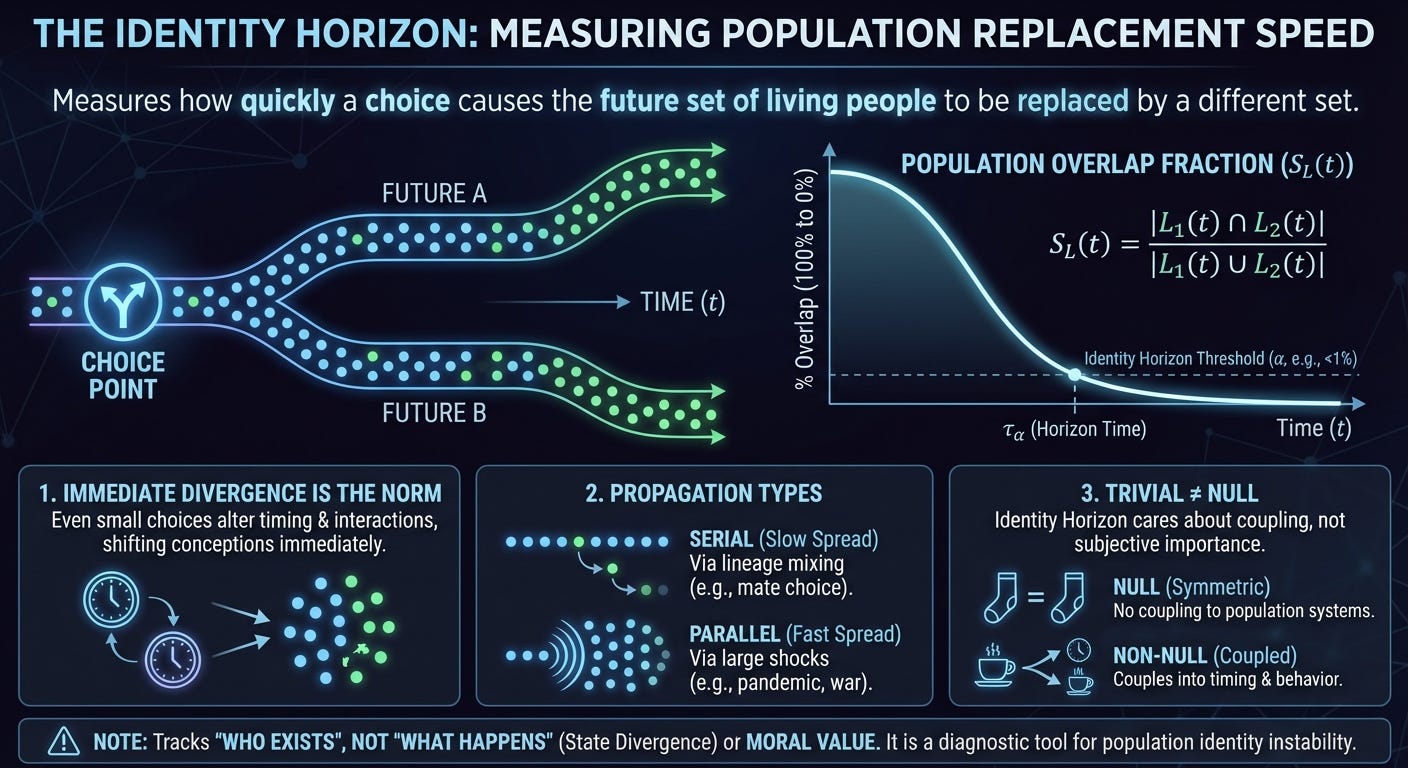
We routinely describe choices as “impactful” or “world-changing,” but those descriptions usually slide between incompatible meanings. Sometimes we mean that a choice mattered. Sometimes we mean it caused harm. Sometimes we mean history would have unfolded differently. These are not the same claims, and treating them as interchangeable generates confusion rather than insight.
This post introduces a narrow, structural concept: the Identity Horizon of a choice.
The Identity Horizon does not measure moral importance, responsibility, harm, benefit, or value. It measures one thing only: how quickly a choice causes the future set of living people to be replaced by a different set of living people.
1. Branching Is Cheap
In a branching universe, every resolved choice partitions the future. Once a decision is made, there are successor futures in which one outcome occurs and others in which it does not.
That fact alone is trivial.
If all choices create different futures, then “creates different futures” cannot distinguish between a minor personal decision and a civilization-altering event. Branching by itself says nothing about scale, propagation, or impact.
The Identity Horizon begins where that observation ends. It is not concerned with whether a choice produces distinct futures in some abstract or microphysical sense. At sufficiently fine resolution, almost everything does. What matters instead is how divergence spreads through the population over time.
Branching is cheap. Population replacement is not.
The Identity Horizon measures that difference.
2. Population Overlap as the Object of Measurement
To speak coherently about “impact on the future,” we need a population-level quantity.
Take two futures that diverge at a choice point. At any later time, consider the set of people alive in Future A and the set of people alive in Future B. Ask what fraction of the living population is composed of the same individuals in both futures. That fraction is the living-population overlap.
The Identity Horizon is the behavior of this overlap over time: how quickly it decays toward zero. In practice, we do not need literal zero. We choose a small threshold—one percent is a useful default—and define the Identity Horizon as the time at which the overlap falls below that threshold. In plain terms: when do “almost all” living people differ between the two futures?
3. Immediate Divergence Is the Norm
Once the focus is fixed on living population identity, an important fact becomes unavoidable: all non-null choices cause immediate population divergence.
This does not require drama or scale. Conception, survival, interaction, and migration are timing-sensitive and socially entangled. Even small perturbations alter schedules and meetings, shift conception timing, and change who is alive within months. Two successor futures therefore tend to differ in living population identity almost immediately. Not just one person differs. Often dozens or hundreds do—locally at first, then spreading outward.
The Identity Horizon is not about whether divergence begins. It is about how fast divergence spreads from local to global scale.
4. Trivial Is Not Null
Many readers will assume that if two choices feel equally trivial, they are structurally equivalent. This is false.
The Identity Horizon does not care whether a choice feels important, worth deliberating about, or subjectively meaningful. It cares whether a choice introduces an asymmetric perturbation that couples into population-relevant systems.
Consider two choices most people rank as equally inconsequential: choosing tea instead of coffee, and putting on the left sock before the right. Subjectively, these feel identical. Structurally, they are not.
A choice can fail to matter under the Identity Horizon only if its alternatives are indistinguishable under the population-identity patterns being tracked. In practice, this requires symmetry and decoupling. Symmetry means the alternatives are effectively isomorphic at the resolution we care about. Decoupling means the choice does not feed into systems that affect interaction, reproduction, survival, or migration.
The sock-order choice often satisfies both conditions. It produces no meaningful timing difference, no physiological difference, and no downstream coupling. At the population-identity grain, the two futures are indistinguishable. The choice is null, not because it is trivial, but because it is symmetric.
Tea versus coffee breaks symmetry immediately. Caffeine absorption differs. Hydration differs. Alertness timing differs. Micro-behavior diverges. Those differences couple into schedules, attention, responsiveness, and timing-sensitive interactions. That coupling feeds, however weakly, into reproduction, survival, and migration networks. The choice remains trivial in every ordinary sense, but it is not null.
A crucial clarification follows. Null does not mean no physics happened. At the microphysical level, essentially all actions differ. Nullity here is pattern-relative, not metaphysical. In practice, many “null” choices may simply have extremely long Identity Horizons rather than infinite ones. That does not weaken the concept. It clarifies what it is.
The rule is simple: a choice is null under the Identity Horizon only if its alternatives are symmetric and uncoupled from population-affecting systems at the pattern level being tracked.
5. Replacement vs Experience
The Identity Horizon tracks who exists. It does not track what happens to those people.
Two futures can diverge massively in experiences, institutions, and outcomes while still sharing many of the same living individuals at a given time. The Identity Horizon is deliberately blind to this kind of state divergence. That blindness is what makes it structurally clean.
How fast population overlap decays depends on how divergence is injected into the population. Some choices propagate serially. The perturbation enters through a small number of lineages and spreads outward through intergenerational mixing. Population overlap declines immediately but slowly. Mate choice is the archetype.
Other events propagate in parallel. The perturbation enters many lineages simultaneously, altering survival, migration, or reproduction at scale. Population overlap drops rapidly. Wars, pandemics, mass migrations, and large systemic shocks are the archetypes.
This distinction explains why some events rapidly replace the future population while others do not.
6. A Stress Test: Hitler’s Parents
Consider the mating choice that produced Adolf Hitler. That choice created two futures: one in which Hitler exists, and one in which he does not.
From the moment the choice resolves, the two futures diverge immediately. Local timing differs. Interactions differ. Conceptions and births diverge. Living population identity begins to separate almost at once.
However, early divergence is local rather than global. The fraction of the world population that differs is initially small. Large drops in overlap occur later, when mass death, displacement, and reproduction shocks propagate broadly. Wars, migrations, and mortality events are where population replacement accelerates.
This exposes a crucial distinction. The Identity Horizon measures replacement speed, not latent causal leverage. The existence of a high-leverage individual can radically alter future states long before population replacement occurs. That is a different axis, and the Identity Horizon intentionally does not track it.
7. Scope and Use
The Identity Horizon is not a replacement for ethics, policy analysis, or decision theory. It is a diagnostic instrument.
Its primary use is to rule out invalid arguments, especially those that rely on preserving “future people” as a stable object of concern. Under a strict identity criterion—the same biological individual traced to a shared ancestral history—future populations are fragile, rapidly replaced, and rarely invariant under choice.
If identity is defined strictly in this way, the Identity Horizon will indeed be short for most choices. That is not a flaw. It is a formal expression of the Non-Identity Problem.
The Identity Horizon does not answer whether a choice was good or bad, whether outcomes should be optimized, whether individuals are blameworthy, or whether history could or should have been steered. Those are different questions, at different layers.
This post fixes the population-identity layer only. Once that layer is fixed, many debates about impact, importance, and responsibility stop talking past one another—and that alone makes the concept worth having.