

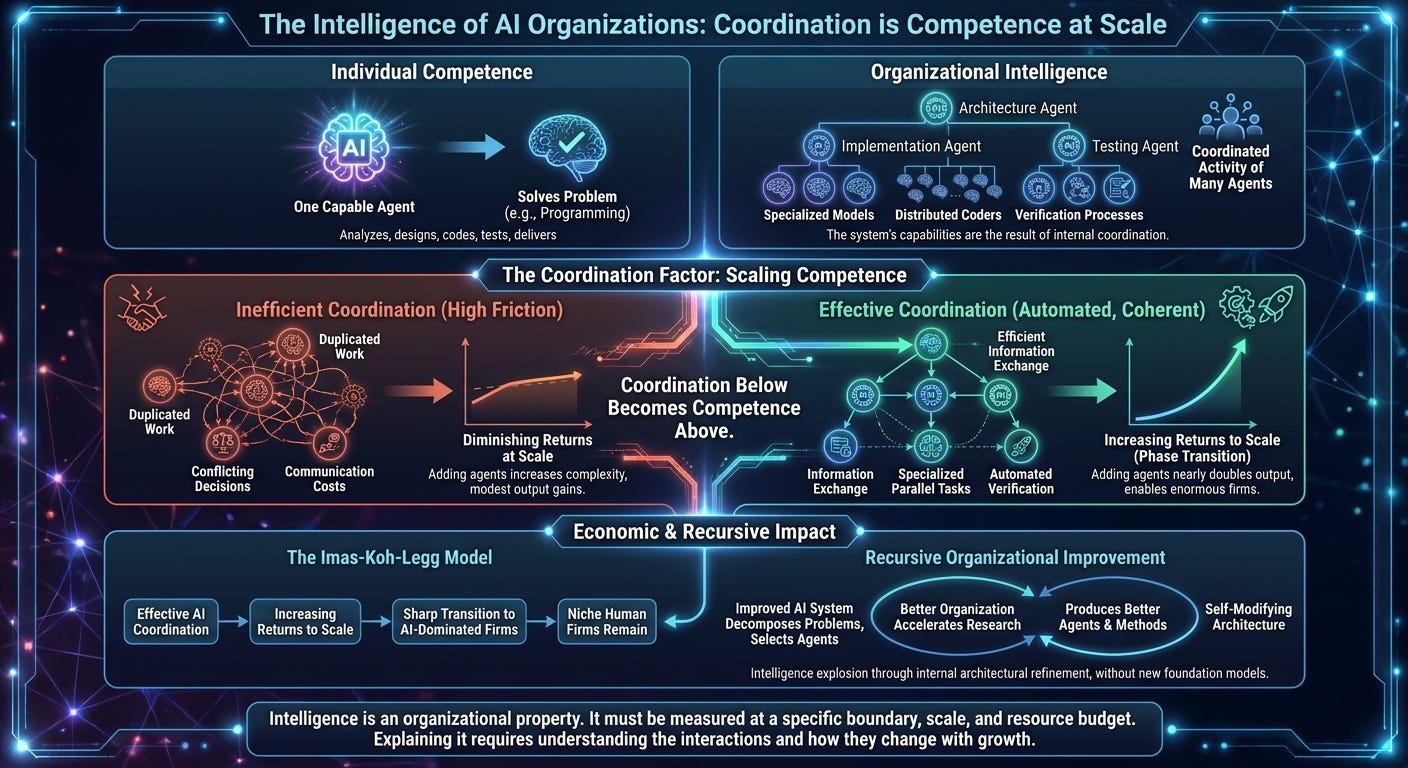
An artificial intelligence solves a difficult programming problem. It analyzes the requirements, designs an architecture, writes the code, tests the implementation, and delivers a working system. We evaluate its performance and conclude that it is a competent programmer.
Now suppose we look inside.
The AI delegated architecture to one agent, implementation to another, and testing to a third. Each of those agents employed additional subagents. The architecture agent consulted specialized models, the implementation agent distributed coding tasks, and the testing agent deployed hundreds of independent processes to search for defects.
What initially appeared to be the competence of one agent turns out to be the coordinated activity of many.
The system’s observable capabilities are unchanged. We have learned something about how they are implemented, but the competence we attributed to the system remains.
Now suppose we improve the coordination among its subagents. They exchange information more efficiently, avoid duplicated work, detect errors earlier, and integrate their results more reliably. The underlying models remain unchanged, yet the composite system becomes a better programmer.
From inside the organization, this is an improvement in coordination. From outside, it is an improvement in competence.
The distinction depends on where we draw the system boundary. If coordination contributes to competence, why distinguish them at all?
The Organization of Intelligence
In Organizing Intelligence, Alex Imas, Andrew Koh, and Shane Legg develop an economic model of how artificial intelligence changes the organization of production.
Their model distinguishes competence from coordination. Each agent, human or AI, brings task skills and a coordination capability. Competence determines productivity at a given organizational scale. Coordination, averaged across a firm’s members, determines how productivity changes as the organization grows.
The distinction explains why increasingly capable AI might first produce modest economic changes, then much larger disruptions once its ability to coordinate crosses a threshold.
Human expertise is scarce and heterogeneous, while copies of an AI model share the same profile of strengths and weaknesses. A programmer, writer, and manager possess complementary capabilities that can combine into what the authors call mosaic intelligence. An organization of specialists may outperform an AI that exceeds the average individual human on conventional benchmarks.
AI differs from human labor in two further respects. Its capabilities can be reproduced at the cost of computation, whereas the supply of particular human capabilities is fixed. And it may escape the coordination limits that restrict human organizations.
Human firms encounter diminishing returns as they grow. Additional workers create opportunities for specialization, but also increase communication costs, conflicting incentives, and demands on managerial attention. Copies of a model, by contrast, can share representations and exchange computational state, and specialized agents can work in parallel under automated coordination.
Whether AI actually escapes human limits is an open empirical question. The authors cite studies reporting severe coordination friction in current multi-agent language-model systems: failure rates of 41–87% on particular benchmark workflows, attributed to misalignment between agents, context lost in handoffs, and broken verification, and planning performance that degrades as agents are added.
The authors show that sufficiently effective AI coordination could produce increasing returns to organizational scale. In their model, where demand is large enough to absorb the output, this creates the possibility of a sharp transition toward enormous AI-dominated firms, while niche markets can still sustain human firms. An AI that performs brilliantly in isolation may scale poorly, while a less capable AI that coordinates effectively may anchor a far more productive organization.
The model represents coordination in reduced form, through its effect on how productivity scales, without specifying the internal structure of a firm. Recursive agent composition is one account of what that structure can look like when the members are AI.
Agents All the Way Down
An AI agent can contain subagents, which can contain further subagents, in arbitrarily elaborate hierarchies. An AI tasked with discovering a mathematical theorem might reason sequentially, invoke specialized tools, or launch thousands of independent searches. A hierarchy of its agents could propose conjectures, test lemmas, challenge assumptions, and integrate proofs.
If the system produces a correct theorem, we can evaluate the competence of the composite or investigate how its constituents contributed to the result.
Neither description requires us to identify a privileged component in which the intelligence resides.
A corporation develops products, negotiates contracts, pursues strategies, and responds to competition. Those accomplishments arise through the interactions of employees, departments, software systems, and institutions. We can evaluate the corporation’s performance without assuming that any individual employee possesses all the capabilities of the organization.
The analogy extends to brains, although the mechanisms are very different. Human cognition depends on interactions among specialized neural systems. We attribute intelligence to the person without requiring every constituent process to possess the intelligence of the whole.
An organization of AI agents can therefore be treated as a composite intelligent system. Its ability to accomplish tasks depends on the capabilities of its components and the organization of their interactions.
The Boundary of an Agent
As argued in The Intentional Gradient, agency is attributed through explanatory models. We model a system as an agent when describing its behavior in terms of goals helps us explain or predict what it does. A corporation, a department, and an individual employee can each support useful agent descriptions, even when their attributed goals differ.
This does not make their accomplishments subjective. A corporation that produces a successful engineering design has produced something real. Whether we attribute that achievement to the corporation, its engineering department, a particular employee, or an AI system used by that employee depends on the explanation we are constructing.
An observer may treat an entire AI organization as one agent, while another examines the decisions and interactions of its constituent agents.
But explanatory boundaries must be distinguished from economic boundaries.
A firm’s ownership, contractual relationships, and mechanisms of control have observable consequences. The Imas–Koh–Legg model explains how agents sort into firms and how those firms compete. Their boundaries emerge from economic conditions, including the costs and benefits of different organizational arrangements.
Our freedom to model a firm as a composite agent does not make its economic boundaries arbitrary. The same collection of agents may be modeled as one composite intelligent system while its division into competing firms remains essential to explaining its economic behavior.
Competence at Scale
Suppose two AI organizations each contain one hundred agents and produce the same quantity and quality of useful work. At this scale, their observed competence is equivalent.
Now double the number of agents.
The first organization produces only slightly more output. Additional agents duplicate work, introduce conflicting decisions, and increase the burden of verification.
The second organization nearly doubles its output. It distributes tasks effectively, maintains coherent information, and integrates results with little additional overhead.
A competence measurement at a single scale cannot reveal this difference.
The organization’s current performance is one property. Its response to increasing scale is another.
The second property is central to the paper’s economic results. If additional agents eventually impose greater costs than benefits, organizations encounter limits to productive scale. If coordination mechanisms permit output per agent to continue increasing with organizational size, larger organizations may acquire substantial competitive advantages wherever demand can absorb their output.
The paper’s own terms show how this survives recursive composition. Folded into one composite agent, an organization’s internal coordination becomes part of the composite’s task competence at its current size. If that composite then joins a larger organization, a new coordination problem arises: how well it combines with other composites, which may depend on which composites it joins. Its internal coordination does not settle the answer. Recursive composition repeats the step at every level. Coordination below becomes competence above, and coordination has to be measured again at the new boundary.
Which Intelligence Are We Measuring?
Consider three AI systems.
The first is a language model answering questions without external assistance.
The second is the same model equipped with tools, persistent memory, and the ability to execute programs.
The third is an autonomous organization built around the model, with specialized subagents, delegated tasks, independent verification, and substantial computational resources.
Which is more intelligent?
The question requires specifying both the system being evaluated and the resources available to it.
If we want to compare underlying model capabilities, we might restrict external tools and computational resources. If we want to measure the ability of deployed systems to achieve goals, their organizational mechanisms are relevant to the evaluation.
Two systems with identical underlying models can exhibit very different capabilities because their architectures differ. Two systems with identical architectures can perform differently because one has access to more computation, memory, or time.
All these factors contribute to effective competence. Holding some fixed while varying the others is how we locate its causes.
The Imas–Koh–Legg model adds a further requirement. Two systems that perform equally well at a given scale may differ in economic potential because their productivity scales differently.
A benchmark evaluating one AI instance cannot establish the capabilities of an organization containing thousands of instances. Nor can the performance of that organization at one size establish how effectively it will use additional resources.
Recursive Organizational Improvement
In Recursive Self-Improvement Is Already Here, we argued that recursive improvement can occur through distributed processes in which advances in research, engineering, and organizational capabilities accelerate one another. Recursive agent composition extends that argument.
Suppose an AI system improves its ability to decompose problems, select specialized agents, distribute computational resources, verify results, and integrate discoveries. Its effective competence increases even if its model weights remain unchanged.
The improved system may then become more capable of discovering further organizational improvements. Better organization accelerates research, which produces better agents and better organizational methods.
From the perspective of the subordinate agents, their coordinating environment has improved. From the perspective of the composite agent, it has modified its own architecture.
The same physical process can be described as organizational improvement or self-improvement.
An AI system might therefore become substantially more capable without another training run or a new foundation model. Oversight focused exclusively on training runs and model releases would miss such developments, and forecasts that track only underlying models would understate the growth of deployed capability.
Some organizational improvements raise competence at every scale. A verification procedure that halves errors regardless of size shifts productivity up and leaves the shape of the scaling curve alone. Only improvements that change how productivity responds to additional agents move AI toward the threshold at which the Imas–Koh–Legg model predicts a phase transition.
The scaling test described earlier gives oversight something to measure, provided it holds the task fixed and accounts for output quality, compute cost, and completion time. A hundred agents that finish a task five times faster than ten may produce less per agent while delivering something economically valuable; the authors note that their own scaling estimates omit such speedups.
Organizational architecture becomes another dimension of the intelligence explosion.
Postscript
A claim about the intelligence of an AI system has to specify a boundary, a resource budget, and a scale. Within that specification, competence can be measured. The claim then has to say how competence changes as agents are added, and that answer has to be obtained again at each level of composition, because how well a composite coordinates internally settles nothing about how it coordinates with others.
The intelligence of an organization belongs to the system we are evaluating. Explaining that intelligence requires understanding how the system is organized, how its constituents interact, and how those relationships change as it grows.